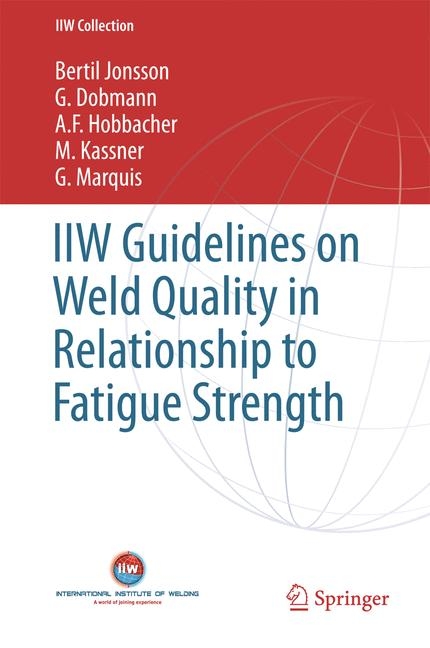
IIW Guidelines on Weld Quality in Relationship to Fatigue Strength (eBook)
XIII, 115 Seiten
Springer International Publishing (Verlag)
978-3-319-19198-0 (ISBN)
The authors are well-known professional Researchers in Welding technology and material sciences.
The authors are well-known professional Researchers in Welding technology and material sciences.
Contents 6
Nomenclature 9
Throat Thicknesses 11
1 Introduction 14
1.1 Existing IIW Recommendations and Guidelines 14
1.2 Scope 15
References 16
2 Design for Purpose 17
2.1 Limit State Design 17
2.2 Fatigue Versus Static Loading 18
2.3 Weld Quality and Design 19
2.4 Practical Design for Purpose 21
3 IIW Fatigue Assessment Procedures 23
3.1 Available Assessment Procedures 23
3.1.1 Fatigue Testing 23
3.1.2 Nominal Stress Method 24
3.1.3 Structural Hot Spot Stress Method 26
3.1.4 Effective Notch Stress Method 28
3.1.5 Fracture Mechanics Method 29
References 30
4 Classification of Weld Imperfections and Features 31
4.1 Overview About Classifications of Weld Imperfections in ISO Standards 31
4.2 Classification of Geometric Imperfections for Fusion Welds in Metallic Materials, ISO 6520-1 32
4.3 Quality Criteria of Welded Joints in ISO 5817 35
4.4 The Relationship Between ISO 5817 and Fatigue Strength for Arc-Welded Steel Structures 39
References 50
5 Weld Quality Levels for Fatigue Loaded Structures 51
5.1 Assessment of Defects 51
5.2 Requirements for a Production Standard Weld Quality 52
5.2.1 Effect of Toe Geometry 52
5.2.1.1 Toe Radius in Butt Welds 53
5.2.1.2 Toe Radius in Fillet Welds 54
5.2.2 Effect of Misalignment 55
5.2.2.1 Misalignment in Butt Welds 56
5.2.2.2 Misalignment in Fillet Welds 57
5.2.3 Effect of Undercut 57
5.2.3.1 Undercut in Butt Welds 60
5.2.3.2 Undercut in Fillet Welds 61
5.2.4 Effect of Cold Laps 61
5.2.4.1 Cold Laps in Butt Welds 63
5.2.4.2 Cold Laps in Fillet Welds 63
5.2.5 Effect of Inclusions and Porosity 63
5.2.5.1 Inclusions and Porosity in Butt Welds 65
5.2.5.2 Inclusions and Porosity in Fillet Welds 65
5.2.6 Effect of Cracks and Crack-Like Imperfections 65
5.2.6.1 Crack-Like Imperfections in Butt Welds 68
5.2.6.2 Crack-Like Imperfections in Fillet Welds 69
5.3 Design of Experiments (DOE) Using Simulation 69
5.3.1 Parameters Using the Effective Notch Method on Butt Welds 69
5.3.2 Parameters Using the Effective Notch Method on Fillet Welds 70
5.4 Fatigue Design of High-Quality Welds 71
5.4.1 Effect of Improvement Methods 71
5.4.2 Improvement of Shape of Weld Toe 72
5.4.3 Improvement by Compressive Residual Stress 73
References 73
References for Toe Geometry 73
References for Misalignment 73
References for Undercut 74
References for Cold Laps 74
References Porosity 74
Reference Improvement 74
References, Others 74
6 Root Side Requirements 76
6.1 General 76
6.2 Joints with Weld Root as Weakest Point 76
6.3 Designation for Penetration 76
6.4 Design of Experiments on an Example of Load-Carrying Weld 77
6.5 Throat Size Versus Penetration 80
References 82
7 Inspection, Quality Control, and Documentation 83
7.1 Probability of Detection (POD) and Probability of Sizing (POS) 85
7.2 Imperfection-Specific and NDT Technique-Specific POD 89
7.3 Human Factor Influences 89
7.4 Real-Time Inspection 90
7.5 Notes on Limits 91
References 98
8 Fitness for Service 100
8.1 General 100
8.2 Stress Intensity Factors 101
8.2.1 General Solution 101
8.2.2 Stress Intensity Factor for Welds 101
8.2.3 Weight Function Approach 102
8.2.4 Finite Element Programs 104
8.2.5 Aspect Ratio 104
8.2.6 Assessment of Welded Joints Without Detected Imperfections 105
8.3 Fatigue Assessment by Crack Propagation 105
8.4 Material Parameters for Crack Propagation 107
8.5 Dimensions of Cracks 108
8.6 Formulae for Stress Intensity Factors 109
8.6.1 Standard Solutions 109
8.6.2 Solutions for Magnification Function Mk 110
8.6.3 Examples of a Fracture Mechanics Assessment 112
8.6.3.1 Crack at the Toe of a Fillet Weld of a Cruciform Joint 112
8.6.3.2 Weld with Partial Penetration (Root Gap) in a Cruciform Joint 115
8.7 Computation of Results Using Design of Experiments Theory 117
8.7.1 Butt Welded from 1 Side Only, Flexible Boundary Conditions 118
8.7.2 Butt Welded from 2 Sides, Symmetric Weld 118
8.7.3 Load-Carrying Cruciform Joint 119
8.7.4 Non-load-Carrying Cruciform Joint 121
References 122
| Erscheint lt. Verlag | 13.4.2016 |
|---|---|
| Reihe/Serie | IIW Collection | IIW Collection |
| Zusatzinfo | XIII, 115 p. 58 illus., 32 illus. in color. |
| Verlagsort | Cham |
| Sprache | englisch |
| Themenwelt | Technik ► Bauwesen |
| Technik ► Maschinenbau | |
| Schlagworte | Cold Lap • Design Throat Thickness • Effective Notch Stress • FAT Classes • fracture mechanics • Hot Spot Stress • ISO 5817 • Macro-geometric Discontinuity • Nominal Stress • Penetration • Structural Stress |
| ISBN-10 | 3-319-19198-5 / 3319191985 |
| ISBN-13 | 978-3-319-19198-0 / 9783319191980 |
| Informationen gemäß Produktsicherheitsverordnung (GPSR) | |
| Haben Sie eine Frage zum Produkt? |
 PDF (Wasserzeichen)
DRM: Digitales Wasserzeichen
Dieses eBook enthält ein digitales Wasserzeichen und ist damit für Sie personalisiert. Bei einer missbräuchlichen Weitergabe des eBooks an Dritte ist eine Rückverfolgung an die Quelle möglich.
Dateiformat: PDF (Portable Document Format)
Mit einem festen Seitenlayout eignet sich die PDF besonders für Fachbücher mit Spalten, Tabellen und Abbildungen. Eine PDF kann auf fast allen Geräten angezeigt werden, ist aber für kleine Displays (Smartphone, eReader) nur eingeschränkt geeignet.
Systemvoraussetzungen:
PC/Mac: Mit einem PC oder Mac können Sie dieses eBook lesen. Sie benötigen dafür einen PDF-Viewer - z.B. den Adobe Reader oder Adobe Digital Editions.
eReader: Dieses eBook kann mit (fast) allen eBook-Readern gelesen werden. Mit dem amazon-Kindle ist es aber nicht kompatibel.
Smartphone/Tablet: Egal ob Apple oder Android, dieses eBook können Sie lesen. Sie benötigen dafür einen PDF-Viewer - z.B. die kostenlose Adobe Digital Editions-App.
Buying eBooks from abroad
For tax law reasons we can sell eBooks just within Germany and Switzerland. Regrettably we cannot fulfill eBook-orders from other countries.
aus dem Bereich