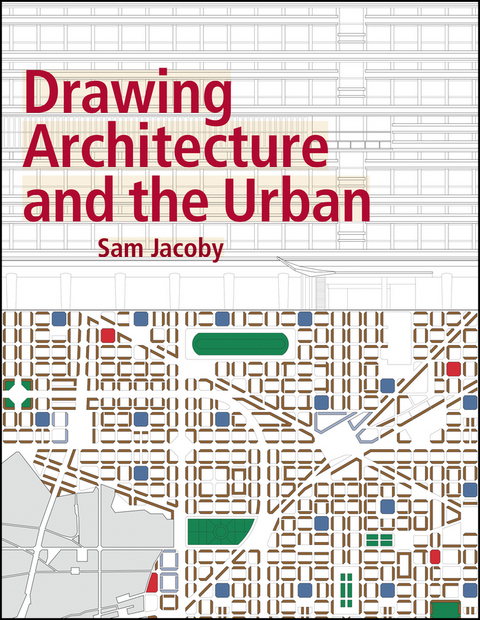
Drawing Architecture and the Urban (eBook)
John Wiley & Sons (Verlag)
978-1-118-87949-8 (ISBN)
Sam Jacoby (AA Dip, Dr.-Ing, ARB, RIBA) is a chartered architect and educator with eleven years of experience teaching design studios at undergraduate and graduate level. He is Director of the MPhil in Architecture and Urban Design (Projective Cities) programme at the Architectural Association School of Architecture and Teaching Fellow on the MArch Urban Design, Bartlett School of Architecture, University College London (UCL). He has previously taught at the University of Nottingham and worked for various architectural and planning offices in the UK, USA and Malaysia.
Drawing is an important means to analyse information and develop rigorous arguments both conceptually and visually. Going beyond the how-to drawing manual, this book provides an instrumental approach to drawing, especially computer-generated drawings; it outlines how drawings should be used to convey clear and analytical information in the process of design, as well as the communication and discussion of a project. In depth examples are provided how to communicate effectively. The final section demonstrates how to transform case-studies, directly connecting an analytical approach with the design process.
Sam Jacoby (AA Dip, Dr.-Ing, ARB, RIBA) is a chartered architect and educator with eleven years of experience teaching design studios at undergraduate and graduate level. He is Director of the MPhil in Architecture and Urban Design (Projective Cities) programme at the Architectural Association School of Architecture and Teaching Fellow on the MArch Urban Design, Bartlett School of Architecture, University College London (UCL). He has previously taught at the University of Nottingham and worked for various architectural and planning offices in the UK, USA and Malaysia.
INTRODUCTION
Description, Analysis and Transformation: Drawing as Diagram
CHAPTER 1: CONVENTIONS
1 Point, Line, Plane and Volume
2 Plan Conventions
2.1 Orthographic Projections (Elevation)
2.2 Cut-away Views (Plan and Section)
2.3 Paraline Drawings
2.4 Perspective Drawings
3 Graphic Conventions
3.1 Line Weight, Style and Type
3.2 Hatching, Texture, Material and Shading
3.3 Colour
3.4 Drawing Scale and Paper Size
3.5 Annotation and Dimensioning
CHAPTER 2: ARCHITECTURE
1 Description
1.1 Context: Location Plan and Site Section
1.2 Building: Plan, Elevation and Section
1.3 Building: Axonometric and Perspective
2 Analysis
2.1 Context: Figure-Ground Plan
2.2 Context: Orientation
2.3 Building: Massing
2.4 Building: Structural Organisation
2.5 Building: Programme
2.6 Building: Circulation-to-Use
2.7 Building: Part-to-Whole
2.8 Building: Repetitive-to-Unique
2.9 Building: Geometrical Order
2.10 Building: Parti
3 Comparison
3.1 Free Plan vs Raumplan
3.2 Deconstruction of Whole to Parts
3.3 Vertical vs Horizontal
3.4 Sectional Organisation
3.5 Landscape and Landform
3.6 Modularity
4 Comparative Matrices
4.1 Massing
4.2 Conceptual Organisation
4.3 Disposition
4.4 Distribution
4.5 Circulation
4.6 Difference
4.7 Growth
CHAPTER 3: THE URBAN
1 Description
1.1 Urban Plan
1.2 Land Use
1.3 Density
1.4 Circulation (Transport)
1.5 Open Spaces
1.6 Infrastructures
2 Analysis
2.1 Figure-Ground Plan
2.2 Hierarchies and Organisation
2.3 Part-to-Whole and Repetitive-to-Unique
2.4 Built Environment
2.5 Phasing
3 Comparison
3.1 Block
3.2 Enclave
3.3 Ground
3.4 Infrastructure
4 Comparative Matrices
4.1 Size
4.2 Distribution
4.3 Hierarchy and Layering
4.4 Difference
4.5 Growth
4.6 Architectural Types and Urban Morphology
CHAPTER 4: TRANSFORMATION
1 Typological Transformation
1.1 Timeline
1.2 Comparative Matrix
1.3 Comparative Diagrams
1.4 Typological Transformation Diagrams
1.5 Transformative Matrix
2 Design Examples
2.1 Tokyo Podium by Sakiko Goto
2.2 The City Campus by Marcin Ganczarski
2.3 The Chinese Unit by Yuwei Wang
2.4 Cité Housing by Alvaro Arancibia Tagle
Drawing Acknowledgements and References
| Erscheint lt. Verlag | 25.4.2016 |
|---|---|
| Sprache | englisch |
| Themenwelt | Technik ► Architektur |
| Schlagworte | Architecture • architecture description • Architektur • chapter conventions • ConText • conventions • cutaway views • Deconstruction • Design, Drawing & Presentation • diagram • Drawings • Entwurf • Entwurf, Zeichnung u. Präsentation • Entwurf, Zeichnung u. Präsentation • graphic conventions • growth • Introduction • Perspective • Plan • Point • Programme • scale • Stadtentwicklung • urban description • Urban Development • Volume • whole |
| ISBN-10 | 1-118-87949-X / 111887949X |
| ISBN-13 | 978-1-118-87949-8 / 9781118879498 |
| Informationen gemäß Produktsicherheitsverordnung (GPSR) | |
| Haben Sie eine Frage zum Produkt? |
 PDF (Adobe DRM)
Kopierschutz: Adobe-DRM
Adobe-DRM ist ein Kopierschutz, der das eBook vor Mißbrauch schützen soll. Dabei wird das eBook bereits beim Download auf Ihre persönliche Adobe-ID autorisiert. Lesen können Sie das eBook dann nur auf den Geräten, welche ebenfalls auf Ihre Adobe-ID registriert sind.
Details zum Adobe-DRM
Dateiformat: PDF (Portable Document Format)
Mit einem festen Seitenlayout eignet sich die PDF besonders für Fachbücher mit Spalten, Tabellen und Abbildungen. Eine PDF kann auf fast allen Geräten angezeigt werden, ist aber für kleine Displays (Smartphone, eReader) nur eingeschränkt geeignet.
Systemvoraussetzungen:
PC/Mac: Mit einem PC oder Mac können Sie dieses eBook lesen. Sie benötigen eine
eReader: Dieses eBook kann mit (fast) allen eBook-Readern gelesen werden. Mit dem amazon-Kindle ist es aber nicht kompatibel.
Smartphone/Tablet: Egal ob Apple oder Android, dieses eBook können Sie lesen. Sie benötigen eine
Geräteliste und zusätzliche Hinweise
Buying eBooks from abroad
For tax law reasons we can sell eBooks just within Germany and Switzerland. Regrettably we cannot fulfill eBook-orders from other countries.
aus dem Bereich