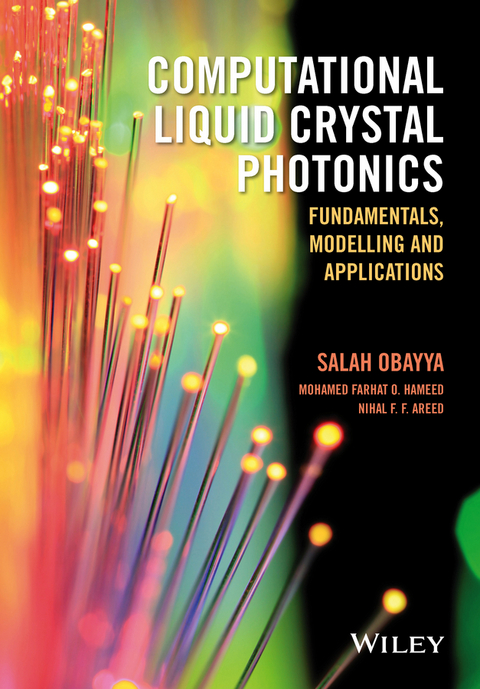
Computational Liquid Crystal Photonics (eBook)
John Wiley & Sons (Verlag)
978-1-119-04198-6 (ISBN)
Optical computers and photonic integrated circuits in high capacity optical networks are hot topics, attracting the attention of expert researchers and commercial technology companies. Optical packet switching and routing technologies promise to provide a more efficient source of power, and footprint scaling with increased router capacity; integrating more optical processing elements into the same chip to increase on-chip processing capability and system intelligence has become a priority.
This book is an in-depth look at modelling techniques and the simulation of a wide range of liquid crystal based modern photonic devices with enhanced high levels of flexible integration and enhanced power processing. It covers the physics of liquid crystal materials; techniques required for modelling liquid crystal based devices; the state-of-the art liquid crystal photonic based applications for telecommunications such as couplers, polarization rotators, polarization splitters and multiplexer-demultiplexers; liquid core photonic crystal fiber (LC-PCF) sensors including biomedical and temperature sensors; and liquid crystal photonic crystal based encryption systems for security applications.
Key features
- Offers a unique source of in-depth learning on the fundamental principles of computational liquid crystal photonics.
- Explains complex concepts such as photonic crystals, liquid crystals, waveguides and modes, and frequency- and time-domain techniques used in the design of liquid crystal photonic crystal photonic devices in terms that are easy to understand.
- Demonstrates the useful properties of liquid crystals in a diverse and ever-growing list of technological applications.
- Requires only a foundational knowledge of mathematics and physics.
Optical computers and photonic integrated circuits in high capacity optical networks are hot topics, attracting the attention of expert researchers and commercial technology companies. Optical packet switching and routing technologies promise to provide a more efficient source of power, and footprint scaling with increased router capacity; integrating more optical processing elements into the same chip to increase on-chip processing capability and system intelligence has become a priority. This book is an in-depth look at modelling techniques and the simulation of a wide range of liquid crystal based modern photonic devices with enhanced high levels of flexible integration and enhanced power processing. It covers the physics of liquid crystal materials; techniques required for modelling liquid crystal based devices; the state-of-the art liquid crystal photonic based applications for telecommunications such as couplers, polarization rotators, polarization splitters and multiplexer-demultiplexers; liquid core photonic crystal fiber (LC-PCF) sensors including biomedical and temperature sensors; and liquid crystal photonic crystal based encryption systems for security applications. Key features Offers a unique source of in-depth learning on the fundamental principles of computational liquid crystal photonics. Explains complex concepts such as photonic crystals, liquid crystals, waveguides and modes, and frequency- and time-domain techniques used in the design of liquid crystal photonic crystal photonic devices in terms that are easy to understand. Demonstrates the useful properties of liquid crystals in a diverse and ever-growing list of technological applications. Requires only a foundational knowledge of mathematics and physics.
Salah S. A. Obayya, Zewail City of Science and Technology, Giza, Egypt Professor Salah Obayya developed for his PhD a novel finite element-based full-vectorial-beam-propagation algorithm for the analysis of various photonic devices. He worked as a Senior Research Fellow at the School of Engineering, City University London. From June 2003 until Sept. 2006, he joined the School of Engineering and Design, Brunel University, West London, U.K., to work as a Senior Lecturer, followed by a Readership at The School of Electronic and Electrical Engineering, University of Leeds. Professor Obayya is now Full Professorial Chair of Photonics and led the establishment of the "Nano-Photonics Research Centre" at The University of Glamorgan, UK, while he is now Full Professor of Photonics and Director of Centre for Photonics and Smart Materials at Zewail City of Science and Technology. Mohamed Farahat O. Hameed, Zerwail City of Science and Technology, Giza, Egypt Dr Mohamed Farahat O. Hameed was a member of Prof. Obayya photonics group at Leeds University, South Wales University, UK, and now Zewail City, contributing in the design and analysis of a wide range of liquid crystal based photonic devices such as polarization splitter, polarization rotators, couplers, multiplexer-demultiplexers, and sensors. Nihal F. F. Areed, Zerwail City of Science and Technology, Giza, Egypt Associate Professor Nihal Areed is a lecturer at Electronics and Communications Dept., Faculty of Engineering, Mansoura University, Mansoura, Egypt. She obtained her PhD degrees in Electronics and Communications Engineering from Mansoura University, Egypt. Her main research interests are focused on the fields of electromagnetics and photonics, in particular in the area of modelling, design and numerical simulation of nanophotonic devices.
"...anyone concerned with liquid-crystal photonics will profit from reading it." (The Optical Society/OPN 09/05/2017)
1
Principles of Waveguides
1.1 Introduction
A waveguide can be defined as a structure that guides waves, such as electromagnetic or sound waves [1]. In this chapter, the basic principles of the optical waveguide will be introduced. Optical waveguides can confine and transmit light over different distances, ranging from tens or hundreds of micrometers in integrated photonics, to hundreds or thousands of kilometers in long-distance fiber-optic transmission. Additionally, optical waveguides can be used as passive and active devices such as waveguide couplers, polarization rotators, optical routers, and modulators. There are different types of optical waveguides such as slab waveguides, channel waveguides, optical fibers, and photonic crystal waveguides. The slab waveguides can confine energy to travel only in one dimension, while the light can be confined in two dimensions using optical fiber or channel waveguides. Therefore, the propagation losses will be small compared to wave propagation in open space. Optical waveguides usually consist of high index dielectric material surrounded by lower index material, hence, the optical waves are guided through the high index material by a total internal reflection mechanism. Additionally, photonic crystal waveguides can guide the light through low index defects by a photonic bandgap guiding technique. Generally, the width of a waveguide should have the same order of magnitude as the wavelength of the guided wave.
In this chapter, the basic optical waveguides are discussed including waveguides operation, Maxwell’s equations, the wave equation and its solutions, boundary conditions, phase and group velocity, and the properties of modes.
1.2 Basic Optical Waveguides
Optical waveguides can be classified according to their geometry, mode structure, refractive index distribution, materials, and the number of dimensions in which light is confined [2]. According to their geometry, they can be categorized by three basic structures: planar, rectangular channel, and cylindrical channel as shown in Figure 1.1. Common optical waveguides can also be classified based on mode structure as single mode and multiple modes. Figure 1.1a shows that the planar waveguide consists of a core that must have a refractive index higher than the refractive indices of the upper medium called the cover, and the lower medium called the substrate. The trapping of light within the core is achieved by total internal reflection. Figure 1.1b shows the channel waveguide which represents the best choice for fabricating integrated photonic devices. This waveguide consists of a rectangular channel that is sandwiched between an underlying planar substrate and the upper medium, which is usually air. To trap the light within a rectangular channel, it is necessary for the channel to have a refractive index greater than that of the substrate. Figure 1.1c shows the geometry of the cylindrical channel waveguide which consists of a central region, referred to as the core, and surrounding material called cladding. Of course, to confine the light within the core, the core must have a higher refractive index than that of the cladding.
Figure 1.1 Common waveguide geometries: (a) planar, (b) rectangular, and (c) cylindrical
Figure 1.2 shows the three most common types of channel waveguide structures which are called strip, rip, and buried waveguides. It is evident from the figure that the main difference between the three types is in the shape and the size of the film deposited onto the substrate. In the strip waveguide shown in Figure 1.2a, a high index film is directly deposited on the substrate with finite width. On the other hand, the rip waveguide is formed by depositing a high index film onto the substrate and performing an incomplete etching around a finite width as shown in Figure 1.2b. Alternatively, in the case of the buried waveguide shown in Figure 1.2c, diffusion methods [2] are employed in order to increase the refractive index of a certain zone of the substrate.
Figure 1.2 Common channel waveguides: (a) strip, (b) rip, and (c) buried
Figure 1.3 shows the classification of optical waveguides based on the number of dimensions in which the light rays are confined. In planar waveguides, the confinement of light takes place in a single direction and so the propagating light will diffract in the plane of the core. In contrast, in the case of channel waveguides, shown in Figure 1.3b, the confinement of light takes place in two directions and thus diffraction is avoided, forcing the light propagation to occur only along the main axis of the structure. There also exist structures that are often called photonic crystals that confine light in three dimensions as revealed from Figure 1.3c. Of course, the light confinement in this case is based on Bragg reflection. Photonic crystals have very interesting properties, and their use has been proposed in several devices, such as waveguide bends, drop filters, couplers, and resonators [3].
Figure 1.3 Common waveguide geometries based on light confinement: (a) planar waveguide, (b) rectangular channel waveguide, and (c) photonic crystals
Classification of optical waveguides according to the materials and refractive index distributions results in various optical waveguide structures, such as step index fiber, graded index fiber, glass waveguide, and semiconductor waveguides. Figure 1.4a shows the simplest form of step index waveguide that is formed by a homogenous cylindrical core with constant refractive index surround by cylindrical cladding of a different, lower index. Figure 1.4b shows the graded index planar waveguide where the refractive index of the core varies as a function of the radial distance [4].
Figure 1.4 Classification of optical waveguide based on the refractive index distributions: (a) step-index optical fiber and (b) graded-index optical fiber
1.3 Maxwell’s Equations
Maxwell’s equations are used to describe the electric and magnetic fields produced from varying distributions of electric charges and currents. In addition, they can explain the variation of the electric and magnetic fields with time. There are four Maxwell’s equations for the electric and magnetic field formulations. Two describe the variation of the fields in space due to sources as introduced by Gauss’s law and Gauss’s law for magnetism, and the other two explain the circulation of the fields around their respective sources. In this regard, the magnetic field moves around electric currents and time varying electric fields as described by Ampère’s law as well as Maxwell’s addition. On the other hand, the electric field circulates around time varying magnetic fields as described by Faraday’s law. Maxwell’s equations can be represented in differential or integral form as shown in Table 1.1. The integral forms of the curl equations can be derived from the differential forms by application of Stokes’ theorem.
Table 1.1 The differential and integral forms of Maxwell’s equations
| Differential form | Integral form |
| (1.1) |
| (1.2) |
| (1.3) |
| (1.4) |
where E is the electric field amplitude (V/m), H is the magnetic field amplitude (A/m), D is the electric flux density (C/m2), B is the magnetic flux density (T), J is the current density (A/m2), ρ is the charge density (C/m3), and Q is the charge (C). It is worth noting that the flux densities, D and B, are related to the field amplitudes E and H for linear and isotropic media by the following relations:
Here, ε = εoεr is the electric permittivity (F/m) of the medium, μ = μoμr is the magnetic permeability of the medium (H/m), σ is the electric conductivity, εr is the relative dielectric constant, εo = 8.854 × 10⁻¹² F/m is the permittivity of free space, and μo = 4π × 10−7 H/m is the permeability of free space.
1.4 The Wave Equation and Its Solutions
The electromagnetic wave equation can be derived from Maxwell’s equations [2]. Assuming that we have a source free (ρ = 0, J = 0), linear (ε and μ are independent of E and H), and isotropic medium. This can be obtained at high frequencies (f > 1013 Hz) where the electromagnetic energy does not originate from free charge and current. However, the optical energy is produced from electric or magnetic dipoles formed by atoms and molecules undergoing transitions. These sources are included in Maxwell’s equations by the bulk permeability and permittivity constants. Therefore, Maxwell’s equations can be rewritten in the following forms:
The...
| Erscheint lt. Verlag | 20.4.2016 |
|---|---|
| Sprache | englisch |
| Themenwelt | Technik ► Elektrotechnik / Energietechnik |
| Schlagworte | Electrical & Electronics Engineering • Elektrotechnik u. Elektronik • finite difference methods • liquid crystals • Materials Science • Materialwissenschaften • Multiplexer and Demultiplexer • Optical and Non-Linear Optical Materials • Optical Image Encryption • Optical Logic Gates • Optical Router • Optics & Photonics • Optik u. Photonik • Optische u. Nichtlineare Optische Materialien • Photonic Crystal Coupler • Photonic Crystals • Photonic Crystal Sensor • Photonics & Lasers • Photonik u. Laser • Physics • Physik • Polarization Splitter and Rotator |
| ISBN-10 | 1-119-04198-8 / 1119041988 |
| ISBN-13 | 978-1-119-04198-6 / 9781119041986 |
| Informationen gemäß Produktsicherheitsverordnung (GPSR) | |
| Haben Sie eine Frage zum Produkt? |
 EPUB (Adobe DRM)
Kopierschutz: Adobe-DRM
Adobe-DRM ist ein Kopierschutz, der das eBook vor Mißbrauch schützen soll. Dabei wird das eBook bereits beim Download auf Ihre persönliche Adobe-ID autorisiert. Lesen können Sie das eBook dann nur auf den Geräten, welche ebenfalls auf Ihre Adobe-ID registriert sind.
Details zum Adobe-DRM
Dateiformat: EPUB (Electronic Publication)
EPUB ist ein offener Standard für eBooks und eignet sich besonders zur Darstellung von Belletristik und Sachbüchern. Der Fließtext wird dynamisch an die Display- und Schriftgröße angepasst. Auch für mobile Lesegeräte ist EPUB daher gut geeignet.
Systemvoraussetzungen:
PC/Mac: Mit einem PC oder Mac können Sie dieses eBook lesen. Sie benötigen eine
eReader: Dieses eBook kann mit (fast) allen eBook-Readern gelesen werden. Mit dem amazon-Kindle ist es aber nicht kompatibel.
Smartphone/Tablet: Egal ob Apple oder Android, dieses eBook können Sie lesen. Sie benötigen eine
Geräteliste und zusätzliche Hinweise
Buying eBooks from abroad
For tax law reasons we can sell eBooks just within Germany and Switzerland. Regrettably we cannot fulfill eBook-orders from other countries.
aus dem Bereich