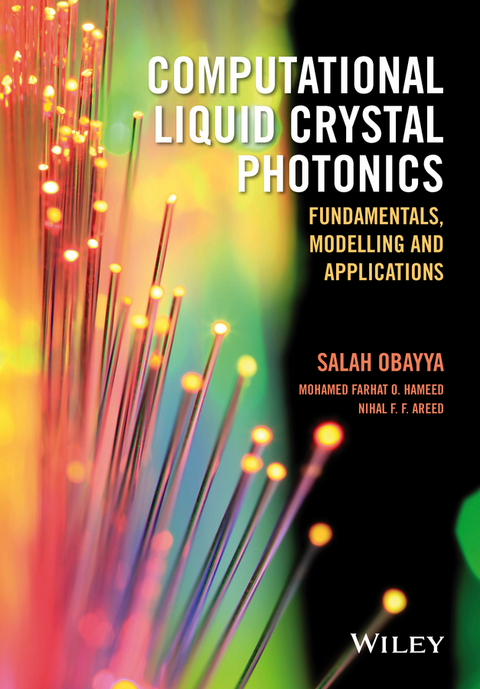
Computational Liquid Crystal Photonics (eBook)
John Wiley & Sons (Verlag)
978-1-119-04200-6 (ISBN)
Optical computers and photonic integrated circuits in high capacity optical networks are hot topics, attracting the attention of expert researchers and commercial technology companies. Optical packet switching and routing technologies promise to provide a more efficient source of power, and footprint scaling with increased router capacity; integrating more optical processing elements into the same chip to increase on-chip processing capability and system intelligence has become a priority.
This book is an in-depth look at modelling techniques and the simulation of a wide range of liquid crystal based modern photonic devices with enhanced high levels of flexible integration and enhanced power processing. It covers the physics of liquid crystal materials; techniques required for modelling liquid crystal based devices; the state-of-the art liquid crystal photonic based applications for telecommunications such as couplers, polarization rotators, polarization splitters and multiplexer-demultiplexers; liquid core photonic crystal fiber (LC-PCF) sensors including biomedical and temperature sensors; and liquid crystal photonic crystal based encryption systems for security applications.
Key features
- Offers a unique source of in-depth learning on the fundamental principles of computational liquid crystal photonics.
- Explains complex concepts such as photonic crystals, liquid crystals, waveguides and modes, and frequency- and time-domain techniques used in the design of liquid crystal photonic crystal photonic devices in terms that are easy to understand.
- Demonstrates the useful properties of liquid crystals in a diverse and ever-growing list of technological applications.
- Requires only a foundational knowledge of mathematics and physics.
Salah S. A. Obayya, Zewail City of Science and Technology, Giza, Egypt
Professor Salah Obayya developed for his PhD a novel finite element-based full-vectorial-beam-propagation algorithm for the analysis of various photonic devices. He worked as a Senior Research Fellow at the School of Engineering, City University London. From June 2003 until Sept. 2006, he joined the School of Engineering and Design, Brunel University, West London, U.K., to work as a Senior Lecturer, followed by a Readership at The School of Electronic and Electrical Engineering, University of Leeds. Professor Obayya is now Full Professorial Chair of Photonics and led the establishment of the 'Nano-Photonics Research Centre' at The University of Glamorgan, UK, while he is now Full Professor of Photonics and Director of Centre for Photonics and Smart Materials at Zewail City of Science and Technology.
Mohamed Farahat O. Hameed, Zerwail City of Science and Technology, Giza, Egypt
Dr Mohamed Farahat O. Hameed was a member of Prof. Obayya photonics group at Leeds University, South Wales University, UK, and now Zewail City, contributing in the design and analysis of a wide range of liquid crystal based photonic devices such as polarization splitter, polarization rotators, couplers, multiplexer-demultiplexers, and sensors.
Nihal F. F. Areed, Zerwail City of Science and Technology, Giza, Egypt
Associate Professor Nihal Areed is a lecturer at Electronics and Communications Dept., Faculty of Engineering, Mansoura University, Mansoura, Egypt. She obtained her PhD degrees in Electronics and Communications Engineering from Mansoura University, Egypt. Her main research interests are focused on the fields of electromagnetics and photonics, in particular in the area of modelling, design and numerical simulation of nanophotonic devices.
Optical computers and photonic integrated circuits in high capacity optical networks are hot topics, attracting the attention of expert researchers and commercial technology companies. Optical packet switching and routing technologies promise to provide a more efficient source of power, and footprint scaling with increased router capacity; integrating more optical processing elements into the same chip to increase on-chip processing capability and system intelligence has become a priority. This book is an in-depth look at modelling techniques and the simulation of a wide range of liquid crystal based modern photonic devices with enhanced high levels of flexible integration and enhanced power processing. It covers the physics of liquid crystal materials; techniques required for modelling liquid crystal based devices; the state-of-the art liquid crystal photonic based applications for telecommunications such as couplers, polarization rotators, polarization splitters and multiplexer-demultiplexers; liquid core photonic crystal fiber (LC-PCF) sensors including biomedical and temperature sensors; and liquid crystal photonic crystal based encryption systems for security applications. Key features Offers a unique source of in-depth learning on the fundamental principles of computational liquid crystal photonics. Explains complex concepts such as photonic crystals, liquid crystals, waveguides and modes, and frequency- and time-domain techniques used in the design of liquid crystal photonic crystal photonic devices in terms that are easy to understand. Demonstrates the useful properties of liquid crystals in a diverse and ever-growing list of technological applications. Requires only a foundational knowledge of mathematics and physics.
Salah S. A. Obayya, Zewail City of Science and Technology, Giza, Egypt Professor Salah Obayya developed for his PhD a novel finite element-based full-vectorial-beam-propagation algorithm for the analysis of various photonic devices. He worked as a Senior Research Fellow at the School of Engineering, City University London. From June 2003 until Sept. 2006, he joined the School of Engineering and Design, Brunel University, West London, U.K., to work as a Senior Lecturer, followed by a Readership at The School of Electronic and Electrical Engineering, University of Leeds. Professor Obayya is now Full Professorial Chair of Photonics and led the establishment of the "Nano-Photonics Research Centre" at The University of Glamorgan, UK, while he is now Full Professor of Photonics and Director of Centre for Photonics and Smart Materials at Zewail City of Science and Technology. Mohamed Farahat O. Hameed, Zerwail City of Science and Technology, Giza, Egypt Dr Mohamed Farahat O. Hameed was a member of Prof. Obayya photonics group at Leeds University, South Wales University, UK, and now Zewail City, contributing in the design and analysis of a wide range of liquid crystal based photonic devices such as polarization splitter, polarization rotators, couplers, multiplexer-demultiplexers, and sensors. Nihal F. F. Areed, Zerwail City of Science and Technology, Giza, Egypt Associate Professor Nihal Areed is a lecturer at Electronics and Communications Dept., Faculty of Engineering, Mansoura University, Mansoura, Egypt. She obtained her PhD degrees in Electronics and Communications Engineering from Mansoura University, Egypt. Her main research interests are focused on the fields of electromagnetics and photonics, in particular in the area of modelling, design and numerical simulation of nanophotonic devices.
"...anyone concerned with liquid-crystal photonics will profit from reading it." (The Optical Society/OPN 09/05/2017)
| Erscheint lt. Verlag | 4.4.2016 |
|---|---|
| Sprache | englisch |
| Themenwelt | Technik ► Elektrotechnik / Energietechnik |
| Schlagworte | Electrical & Electronics Engineering • Elektrotechnik u. Elektronik • finite difference methods • liquid crystals • Materials Science • Materialwissenschaften • Multiplexer and Demultiplexer • Optical and Non-Linear Optical Materials • Optical Image Encryption • Optical Logic Gates • Optical Router • Optics & Photonics • Optik u. Photonik • Optische u. Nichtlineare Optische Materialien • Photonic Crystal Coupler • Photonic Crystals • Photonic Crystal Sensor • Photonics & Lasers • Photonik u. Laser • Physics • Physik • Polarization Splitter and Rotator |
| ISBN-10 | 1-119-04200-3 / 1119042003 |
| ISBN-13 | 978-1-119-04200-6 / 9781119042006 |
| Informationen gemäß Produktsicherheitsverordnung (GPSR) | |
| Haben Sie eine Frage zum Produkt? |
 PDF (Adobe DRM)
Kopierschutz: Adobe-DRM
Adobe-DRM ist ein Kopierschutz, der das eBook vor Mißbrauch schützen soll. Dabei wird das eBook bereits beim Download auf Ihre persönliche Adobe-ID autorisiert. Lesen können Sie das eBook dann nur auf den Geräten, welche ebenfalls auf Ihre Adobe-ID registriert sind.
Details zum Adobe-DRM
Dateiformat: PDF (Portable Document Format)
Mit einem festen Seitenlayout eignet sich die PDF besonders für Fachbücher mit Spalten, Tabellen und Abbildungen. Eine PDF kann auf fast allen Geräten angezeigt werden, ist aber für kleine Displays (Smartphone, eReader) nur eingeschränkt geeignet.
Systemvoraussetzungen:
PC/Mac: Mit einem PC oder Mac können Sie dieses eBook lesen. Sie benötigen eine
eReader: Dieses eBook kann mit (fast) allen eBook-Readern gelesen werden. Mit dem amazon-Kindle ist es aber nicht kompatibel.
Smartphone/Tablet: Egal ob Apple oder Android, dieses eBook können Sie lesen. Sie benötigen eine
Geräteliste und zusätzliche Hinweise
Buying eBooks from abroad
For tax law reasons we can sell eBooks just within Germany and Switzerland. Regrettably we cannot fulfill eBook-orders from other countries.
aus dem Bereich