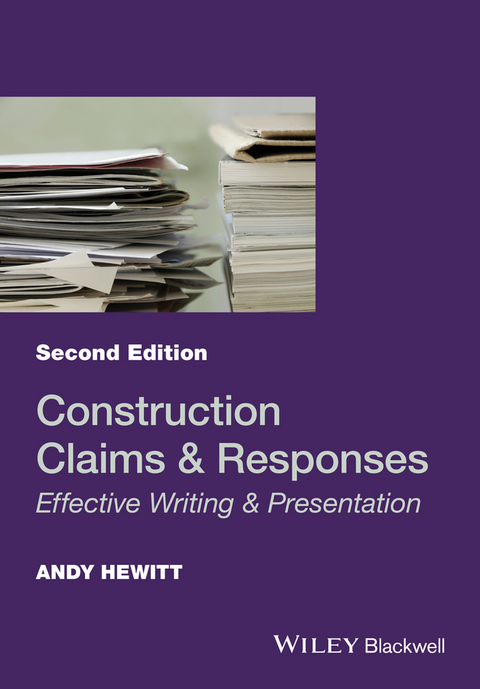
Construction Claims and Responses (eBook)
John Wiley & Sons (Verlag)
978-1-119-15188-3 (ISBN)
A practical, step-by-step guide on how to prepare and respond to construction claims. Everyone involved in the preparation or review of construction claims should have this book to hand. The book examines the different types of claim common to construction contracts and presents a step-by-step guide to demonstrate the process of building up a fully detailed claim submission. It includes advice on:
- Contract administration for claims and claims avoidance.
- Identifying the various types of claim.
- The key points for an effective claim or response document.
- The essential elements to be included in a claim or response.
- Extension of time claims.
- Claims for additional payment.
- Principles of delay analysis.
- Quantum calculations.
- Responses and determinations to achieve agreement and avoid disputes.
- A note on dispute boards.
The advice given in the book is supported by worked examples of typical claims and responses with sample wording.
The book includes a foreword by Roger Knowles, who says:
'The book is without a doubt fully comprehensive and goes though the preparation of a claim from A to Z. I have no hesitation in recommending it to students, beginners, those involved on a day-to-day basis with time and cost on projects, as well as the seasoned claims consultants'.
This book is suitable for contracts managers, commercial managers, project managers, quantity surveyors, engineers and architects.
Andy Hewitt, FICCP, FCIOB, FCInstCES, FQSi has over 40 years' experience in the construction industry, gained in the UK, Africa and the Middle East. His earlier career included senior positions with contractors, subcontractors and consultants in project, commercial and contract management roles, during which time he worked on many prestigious projects. For the past 15 years or so, Andy has specialised in contractual matters, claims and disputes, culminating in him becoming a partner in Hewitt Decipher Partnership, offering consultancy services relating to contractual and commercial matters, claims and disputes. Andy is also a partner in Claims Class, a specialist organisation that offers training and education on claims, the FIDIC contracts and related subjects. Hundreds of companies and individuals have benefitted from Andy's experience, delivered via Claims Class' internationally acclaimed workshops and e-courses.
A practical, step-by-step guide on how to prepare and respond to construction claims. Everyone involved in the preparation or review of construction claims should have this book to hand. The book examines the different types of claim common to construction contracts and presents a step-by-step guide to demonstrate the process of building up a fully detailed claim submission. It includes advice on: Contract administration for claims and claims avoidance. Identifying the various types of claim. The key points for an effective claim or response document. The essential elements to be included in a claim or response. Extension of time claims. Claims for additional payment. Principles of delay analysis. Quantum calculations. Responses and determinations to achieve agreement and avoid disputes. A note on dispute boards. The advice given in the book is supported by worked examples of typical claims and responses with sample wording. The book includes a foreword by Roger Knowles, who says:"e;The book is without a doubt fully comprehensive and goes though the preparation of a claim from A to Z. I have no hesitation in recommending it to students, beginners, those involved on a day-to-day basis with time and cost on projects, as well as the seasoned claims consultants"e;. This book is suitable for contracts managers, commercial managers, project managers, quantity surveyors, engineers and architects.
Andy Hewitt, FICCP, FCIOB, FCInstCES, FQSi has over 40 years' experience in the construction industry, gained in the UK, Africa and the Middle East. His earlier career included senior positions with contractors, subcontractors and consultants in project, commercial and contract management roles, during which time he worked on many prestigious projects. For the past 15 years or so, Andy has specialised in contractual matters, claims and disputes, culminating in him becoming a partner in Hewitt Decipher Partnership, offering consultancy services relating to contractual and commercial matters, claims and disputes. Andy is also a partner in Claims Class, a specialist organisation that offers training and education on claims, the FIDIC contracts and related subjects. Hundreds of companies and individuals have benefitted from Andy's experience, delivered via Claims Class' internationally acclaimed workshops and e-courses.
About the Author ix
Foreword by Roger Knowles xi
Acknowledgements xviii
Chapter 1: Introduction 1
Why is it Necessary to Produce a Fully Detailed and Professionally Presented Claim or Response? 1
The Purpose of the Book 3
Things to be Considered Before Writing the Claim 5
The form of Contract used in the Examples 8
Definitions 9
The example projects 10
Chapter 2: Contract Administration for Claims and Claims Avoidance 11
Introduction 11
The contract documents 11
Programmes and Planning 14
Records, Records, Records 17
Chronology and database 19
Notices 22
Dispute Adjudication Boards and the Like 24
Procedures 25
Chapter 3: Types of Claim 27
Claims for Variations 27
Claims for Extensions of Time 32
Claims for Additional Payment Due to Prolongation 35
Acceleration and Disruption Claims 37
Claims for Damages Under Law 40
Interim and Final Claims 41
Chapter 4: Presentation 43
Presentation of the Submission or Review Document 43
Writing Style 44
Key points for claim presentation 48
Making the Document User-Friendly 48
Making the submission or review a stand-alone document 49
Superfluous and irrelevant information 50
Do not Assume that the Reviewer has Prior Knowledge of the Project or Circumstances 50
The importance of leading the reviewer to a logical conclusion 51
Explanations, summaries and conclusions 52
Use of the Narrative to Explain other Documents 52
Substantiation by the use of Exhibits and Additional Documents 53
Compilation of the document 54
Summary of the Principles Covered in this Chapter 56
Chapter 5: Essential Elements of a Successful Claim 57
Introduction 57
Summary of the principles covered in this chapter 81
Chapter 6: The preliminaries to the claim 83
Introduction 83
Chapter 7: The Extension of Time Claim 107
The Method of Delay Analysis 108
The Extension of Time Claim 112
Chapter 8: The Claim for Additional Payment 129
Calculations 142
Chapter 9: The appendices and editing 147
Arrangement of the appendices 147
Editing and review 152
Chapter 10: Claim Responses and Determinations 155
Chapter 11: A note on dispute boards 183
Information Sources 191
FIDIC Clause References 193
Index 195
Chapter 1
Introduction
Why is it Necessary to Produce a Fully Detailed and Professionally Presented Claim or Response?
Imagine that you have been invited to an interview for a new job. This job is a real step up the career ladder and could enable you to move to a better house in a new area where your children would be able to attend a really good school. The job would be stimulating and interesting, and this is the chance that you have been waiting for to prove yourself professionally. When the time comes for the interview, you would undoubtedly take care of your appearance – wear a good suit and ensure that your shoes were polished. You would also probably have spent time thinking of how best to convince the interviewers that you are the ideal person for the job and would have rehearsed answers to the questions that you expect to be asked. If you thought that there may be some negative aspects to your qualifications or experience, lack of specialised experience for part of the job for example, you would probably have thought about how you could put a positive perspective to the interviewers, maybe by stressing some other aspect of your experience which could be easily drawn upon to overcome the perceived disadvantage. In short, given the rewards for success arising from the results of the interview, any person in this position would do their very best to sell themselves to the people making the decision.
Why then, do many of those people or companies responsible for presenting or reviewing claims, which often equate to considerable sums of money, not take similar pains to ensure that their submissions are presented in a professional and thorough manner; that they contain all the relevant and necessary information; and that they answer questions that will probably be asked by the reviewer of the claim? During the past several years, I have spent a considerable proportion of my time reviewing claims, and I can honestly say that during this time I have received very few submissions for which I have not had to raise queries or request additional particulars to be submitted. In some cases I have simply rejected the claims as presented because they do not fulfil the basic requirements to prove that, on the balance of probabilities, the claim has any merit. Many of the submissions have consisted of a two-page or three-page letter enclosing a haphazard, dog-eared collection of documents which leave the reviewer to try to follow the logic of the claim and make his own conclusions. Well, I am sorry, but my job in such circumstances is to produce a determination, and however impartial I try to be, it is human nature that if my life is made difficult or if I am expected to do the claimant’s work for them, I am hardly likely to be predisposed to giving the benefit of the doubt to the person who has brought about this state of mind. I probably would not offer a job to someone who turned up for an interview in a pair of scruffy old jeans with no real idea of how they could make a success of the position either.
Taking the point of view from the other side of the fence (and I am blowing my own trumpet a little here), I have also put together sound claim documents with reasoned and substantiated arguments to demonstrate clear entitlement and quantum, only to have them rejected out of hand by way of a few sentences with no real reasons being given for the rejection. Such responses are, if anything, even less professional than producing a bad claim document, because they are likely to lead to a costly dispute.
The aim of a claim is to persuade the respondent that, on the balance of probabilities, the claimant has entitlement under the contract and/or at law, and to succeed in this, the facts of the events on which the claim is based need to be presented in a logical manner and they need to be substantiated. The contract and, if necessary, the law should be examined to demonstrate that the events give cause to entitlement. If the claimant has been at fault in any way or if there are weaknesses in the claimant’s case, then these should be considered and arguments made as to why such things should not affect the case. The same considerations should be taken into account when reviewing a claim. Has the claimant reasonably proved each element of his case and is he entitled to an award of all, or possibly part, of the claim and if not, why not? Such determinations should be clearly written in the response and the reasons for the conclusions should be adequately demonstrated and substantiated. The respondent needs to be equally persuasive that his arguments are well founded if he is to convince not only the claimant, but also the project owner of his findings, which he will need to do if the situation is to be settled and a dispute avoided.
Salespeople are taught that the first rule in selling is to get the customer to like them – the phrase used is ‘selling yourself’ and the principle here is that people do not want to buy from people that they don’t like. We have all been in a situation whereby we grudgingly buy something from an obnoxious salesperson because we have no other choice and also in situations where we walk away as satisfied customers when we have been treated well by a friendly, helpful and likeable salesperson who is knowledgeable about their product. Presenting a claim or a response to a claim is exactly the same because the goal is to ‘sell’ it to the other party. The major difference, however, is that we have to initially promote our arguments by means of the printed word, so anything we can do to help ‘sell’ the claim by obtaining sympathy from the reviewer and by making it easier to agree has direct benefits on the likely outcome.
The Purpose of the Book
This book presents a guide to preparing claims in order to ensure that a claim submission contains all the relevant and necessary information to prove the case and that the document is set out in an easily understood manner, which leads the reviewer to a logical conclusion to demonstrate the claimant’s entitlement. It also deals with the preparation and presentation of responses and determinations in a similar manner in order to resolve matters rather than prolong them. In addition to ensuring that the claim or response document contains all the necessary information, the following chapters also contain guidelines for making such documents user-friendly so as not to alienate the reviewer and thus make him less predisposed to disagree with your point of view.
In my experience, many problems surrounding claim and response writing arise from the fact that, in many cases, the people tasked with writing the claim or the response have little or no specific experience in the subject and tend to have to make things up as they go along. On a typical project the number of claims presented may be small and infrequent, so the persons responsible for producing the claim or response do not get the opportunity to practise the art on a regular basis. Adding the considerable requirements in terms of time and effort necessary to prepare a successful claim or a professional response to the pressure of their day-to-day tasks, there is little wonder why the result is often less than perfect.
A mechanical engineer is able to calculate the cooling requirements of an air-conditioning system through a proven and established set of rules to take into account the local climatic conditions, the thermal characteristics of the structure and the building’s usage. Quantity surveyors use established and prescribed ways of calculating quantities so that any other person with the required level of experience can understand the methodology and verify the calculations. These tasks are possible because established procedures are taught either at learning institutions or on the job and are often recorded in industry publications. I believe that the writing of claims can be approached in the same way and this book attempts to set out a framework – a workshop manual, if you like – to assist claim writers and claims’ reviewers in these tasks.
We usually think of claims in terms of a submission by a main contractor to the party responsible for administering the contract or by a subcontractor to a main contractor. While this is inevitably the first step, it is possible, however, that the situation may develop into a long and drawn-out affair involving many people and parties with varying degrees of skill and experience in such matters. While this book is primarily aimed at the project personnel responsible for writing or responding to claims, it is also hoped that the principles discussed and the examples worked through will be of use to those who deal with such matters on a more regular basis – dispute-review board members, mediators, adjudicators, arbitrators and the like.
In subsequent chapters, we will discuss the various types of claim and how they should be presented. We will consider what information should be included in claim documents and why. We will examine how to set out and present a claim in various sections so as to bring clarity to the presentation. Finally, we will discuss how to present the actual document in terms of a list of contents, page layout, appendices, exhibits and the like within the submission.
Chapter 2 contains some advice on contract administration for claims and claim avoidance. Chapters 3–5 are included to discuss claims in general terms and the key elements that are required to produce a successful claim submission together with examples of how various claims could be presented. We...
| Erscheint lt. Verlag | 22.3.2016 |
|---|---|
| Sprache | englisch |
| Themenwelt | Recht / Steuern ► EU / Internationales Recht |
| Recht / Steuern ► Öffentliches Recht | |
| Recht / Steuern ► Privatrecht / Bürgerliches Recht ► Baurecht (privat) | |
| Technik ► Bauwesen | |
| Schlagworte | Abortive work • acceleration • Acceleration of the works • Act of prevention • Adjudication Board’s Appointment • Adverse climatic conditions • Allocation of risk • ambiguities • Ambiguity in documents • arbitration • Balance of probabilities • Balance of probability • Baubetrieb • Bauingenieur- u. Bauwesen • Baurecht • calculations • cause and effect • Changes in government legislation • Chronology and database for claims • Civil Engineering & Construction • claimant • Claim narrative • Claim presentation • Claims for extensions of time • Claim strategy • Conditions of contract • Conditions of contract for construction for building and engineering works designed by the employer • Conditions precedent • Conflict between documents • construction law • Construction Management • Contemporary records • Contract Administration • Contract Clauses • Contract documents • Contractor's claims • Delay caused by the Employer • Delay damages • Delay penalties • Dispute adjudication • Dispute Resolution Board Foundation • Disruption • effect • Emden formula • entitlement • Example variation claim • explanations • Extension of Time • FIDIC • Force majeure • form of contract • Identification of claims • Instructions of the Engineer • Instruction to carry out additional work • Late issue of instructions • Late or restricted access • liquidated damages • Liquidated Damages or Penalties • Loss of production • Massenermittlung u. Bauökonomie • Massenermittlung u. Bauökonomie • Mitigation • narrative • Notices of claims • Order of precedence • page layout • Project records • Prolongation costs • Quantity Surveying & Construction Economics • Quantum of the claim • response • Revised drawings • Revised programme • rework • Site establishment • Society of Construction Law • Stand-alone document • substantiation • Suspension of the works • The Contract • Time-related costs • Updated programme • Variation instructions • Variation procedure |
| ISBN-10 | 1-119-15188-0 / 1119151880 |
| ISBN-13 | 978-1-119-15188-3 / 9781119151883 |
| Informationen gemäß Produktsicherheitsverordnung (GPSR) | |
| Haben Sie eine Frage zum Produkt? |
 EPUB (Adobe DRM)
Kopierschutz: Adobe-DRM
Adobe-DRM ist ein Kopierschutz, der das eBook vor Mißbrauch schützen soll. Dabei wird das eBook bereits beim Download auf Ihre persönliche Adobe-ID autorisiert. Lesen können Sie das eBook dann nur auf den Geräten, welche ebenfalls auf Ihre Adobe-ID registriert sind.
Details zum Adobe-DRM
Dateiformat: EPUB (Electronic Publication)
EPUB ist ein offener Standard für eBooks und eignet sich besonders zur Darstellung von Belletristik und Sachbüchern. Der Fließtext wird dynamisch an die Display- und Schriftgröße angepasst. Auch für mobile Lesegeräte ist EPUB daher gut geeignet.
Systemvoraussetzungen:
PC/Mac: Mit einem PC oder Mac können Sie dieses eBook lesen. Sie benötigen eine
eReader: Dieses eBook kann mit (fast) allen eBook-Readern gelesen werden. Mit dem amazon-Kindle ist es aber nicht kompatibel.
Smartphone/Tablet: Egal ob Apple oder Android, dieses eBook können Sie lesen. Sie benötigen eine
Geräteliste und zusätzliche Hinweise
Buying eBooks from abroad
For tax law reasons we can sell eBooks just within Germany and Switzerland. Regrettably we cannot fulfill eBook-orders from other countries.
aus dem Bereich