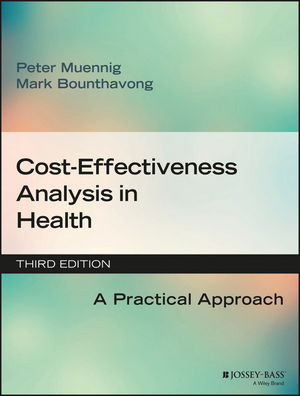
Cost-Effectiveness Analysis in Health (eBook)
John Wiley & Sons (Verlag)
978-1-119-01128-6 (ISBN)
Cost-Effectiveness Analysis in Health is a practical introduction to the tools, methods, and procedures used worldwide to perform cost-effective research, Covering every aspect of a complete cost-effectiveness analysis, this book shows you how to find which data you need, where to find it, how to analyze it, and how to prepare a high-quality report for publication, Designed for the classroom or the individual learner, the material is presented in simple and accessible language for those who lack a biostatistics or epidemiology background, and each chapter includes real-world examples and 'tips and tricks' that highlight key information, Exercises throughout allow you to test your understanding with practical application, and the companion website features downloadable data sets for students, as well as lecture slides and a test bank for instructors, This new third edition contains new discussion on meta-analysis and advanced modeling techniques, a long worked example using visual modeling software TreeAge Pro, and updated recommendations from the U,S, Public Health Service's Panel on Cost-Effectiveness in Health and Medicine, This is the second printing of the 3rd Edition, which has been corrected and revised for 2018 to reflect the latest standards and methods,
Cost-effectiveness analysis is used to evaluate medical interventions worldwide, in both developed and developing countries, This book provides process-specific instruction in a concise, structured format to give you a robust working knowledge of common methods and techniques,
- Develop a thoroughly fleshed-out research project
- Work accurately with costs, probabilities, and models
- Calculate life expectancy and quality-adjusted life years
- Prepare your study and your data for publication
Comprehensive analysis skills are essential for students seeking careers in public health, medicine, biomedical research, health economics, health policy, and more, Cost-Effectiveness Analysis in Health walks you through the process from a real-world perspective to help you build a skillset that's immediately applicable in the field,
PETER MUENNIG, MD, MPH, is a professor in the Department of Health Policy and Management at Columbia University,
MARK BOUNTHAVONG, PharmD, MPH is a pharmacoeconomist at the Veterans Affairs San Diego Health Care System and an adjunct faculty member of the Skaggs School of Pharmacy and Pharmaceutical Sciences at the University of California, San Diego,
PETER MUENNIG, MD, MPH, is a professor in the Department of Health Policy and Management at Columbia University. MARK BOUNTHAVONG, PharmD, MPH is a pharmacoeconomist at the Veterans Affairs San Diego Health Care System and an adjunct faculty member of the Skaggs School of Pharmacy and Pharmaceutical Sciences at the University of California, San Diego.
LIST OF TABLES, FIGURES, AND EXHIBITS
Tables
- 1.1 Hypothetical League Table for a Village in Malawi with a $58,000 Health Budget
- 2.1 Costs Included in a Cost-Effectiveness Analysis of Free Contraception, Conducted from Three Perspectives
- 2.2 Hypothetical Differences in Health-Related Quality of Life over 10 Years for Diabetic Women and Women in Perfect Health
- 2.3 Decision Matrix for Various Cost-Effectiveness Scenarios
- 4.1 Comparison of Pharmaceutical Benchmark Prices
- 4.2 Partial List of Costs for Treatment of Influenza Infection
- 4.3 Common Codes Used to Group Diseases
- 4.4 MEDPAR Cost Data by DRG for 2011
- 4.5 Medical Component of the Consumer Price Index 2004–2014, Annual Percentage Change over Previous Year
- 4.6 Hypothetical and Discounted Costs of a Cohort of 1,000 Elderly Persons over 10 Years
- 5.1 Probabilities and Costs for Vaccinated and Not Vaccinated (Supportive Care) Strategies
- 5.2 Calculation of Expected Cost for Each Event Pathway for Vaccination and Supportive Care Strategies
- 6.1 Number of Deaths due to Influenza Virus Infection, by Age Group
- 6.2 Deaths, Mean Age of Death due to Influenza Virus Infection, and Life Expectancy for Persons Aged 15 to 65
- 6.3 Calculating Total Years of Life Lost due to Influenza Virus Infection in the United States
- 6.4 Total Deaths, Deaths due to Influenza Virus Infection, and Total Survivors in a Cohort of 1 Million 15-Year-Olds
- 6.5 Total Person-Years Lived by the Cohort of 1 Million 15-Year-Olds
- 6.6 Person-Years Lived Among the Cohort of 15-Year-Olds, Including and Excluding Deaths due to Influenza Virus Infection
- 6.7 Age-Specific Mortality Rates, Survivors, and Number of Deaths in the Cohort of 1 Million 15-Year-Old Subjects
- 6.8 Progression of a Cohort of 10 Women with Breast Cancer over a Six-Year Period
- 7.1 Example of How an HRQL Score for Influenza Illness May Be Derived Using the EQ-5D
- 7.2 EQ-5D Preference Score Variation Among Age Categories
- 8.1 Total Person-Years Lived by the Cohort of 1 Million 15-Year-Olds
- 8.2 Sum of Person-Years Across Age Groups for the Cohort of 1 Million 15-Year-Olds
- 8.3 Calculating Life Expectancy at a Given Age
- 8.4 Abridged Life Table for 2011
- 8.5 A Quality-Adjusted Life Table
- 10.1 Simple Summary of Costs Used in a Cost-Effectiveness Model
- 10.2 Cost-Effectiveness Table
- 10.3 Example of a Cost-Effectiveness Table
- 11.1 Calculating the Incidence Rate of Developing Cancer due to Exposure to Radiation in a Two-Year Observation Period, 2011–2012
- 11.2 Calculating the Age-Adjusted Mortality Rate Using a Hypothetical U.S. Population
- 11.3 Frequency Distribution of Hypothetical Cholesterol Values Obtained from 100 Subjects
- 12.1 Datasets Useful for Finding Frequently Needed Cost-Effectiveness Parameters
- 13.1 Results of the Base-Case Analysis
- 13.2 Age-Indexed Table for Use in the New Tree
- 13.3 Base-Case Results for the Markov Model
- 13.4 Base-Case Results After Applying a 3 Percent Discount Rate
- 13.5 Results After Terminating Calculations at Age 65 or Older
- A.1 Comparison Between Vaccinated and Not Vaccinated Strategies
- A.2 Markov Model Using a Vaccine Effectiveness of 75 Percent
- B.1 Abridged Life Table for the Total Population, United States, 2011
- B.2 Abridged Quality-Adjusted Life Table for the Total Population, United States, 2011
Figures
- 1.1 Example of the Effect of a Health Intervention on the Health States of Patients Admitted to the Emergency Room for an Acute Asthma Attack
- 1.2 Components of a Cost-Effectiveness Analysis
- 2.1 Graphical Representation of an HRQL Score
- 2.2 Difference in Total QALYs Between Women Treated and Not Treated for Diabetes over 10 Years
- 2.3 Graphical Representation of the Impact of High and Low Numerators and Denominators in Calculating Incremental Cost-Effectiveness Ratios
- 3.1 Flowchart Indicating the Clinical Course of Influenza Illness
- 3.2 Flowchart Indicating the Course of Influenza Infection Among Subjects Who Receive a Vaccination
- 3.3 Probability of Seeing a Doctor Among Subjects Who Receive Vaccination Versus Those Who Receive Supportive Care
- 3.4 Vaccination Strategy Represented with All Probabilities Filled In
- 3.5 Vaccination Decision Node
- 4.1 Partial Flowchart of the Course of the Flu
- 4.2 Costs Associated with the “Does Not See Doctor” Box
- 5.1 Decision Tree for Whether to Pursue Public Health School or Write a Novel
- 5.2 Decision Tree with the Potential for Not Finding a Job After Public Health School
- 5.3 Example of Two Mutually Exclusive Events
- 5.4 Probabilities of Outcomes for Patients Receiving the Vaccine Intervention
- 5.5 Course of Events During an Influenza Season Among Those Receiving Supportive Care Alone
- 5.6 Course of Events During an Influenza Season Among Those Receiving a Vaccination
- 5.7 Supportive Care Versus Vaccination Decision (Figure 5.5 and 5.6) Represented as a Decision Analysis Tree
- 5.8 Event Pathway for Vaccination Versus Supportive Care Represented as a Decision Analysis Tree
- 5.9 The Expected Probability for Each Terminal Node in the Vaccination and Supportive Care Decision Tree
- 5.10 The Total Cost for Each Terminal Node in the Vaccination and Supportive Care Decision Tree
- 5.11 Expected Costs for Each Terminal Node in the Vaccination and Supportive Care Decision Tree
- 5.12 Total Cost and Probability for All Terminal Nodes in the Vaccination and Supportive Care Decision Tree
- 5.13 Expected Cost and Outcomes for Each Chance Node in the Vaccinated and Supportive Care Decision Tree
- 5.14 Calculation for the Expected Cost and Probability for a Patient Who Receives Supportive Care, Becomes Ill, and Sees Doctor
- 5.15 Expected Costs and Outcomes for Different Chance Nodes in the Vaccinated and Supportive Care Decision Tree
- 6.1 Markov Model for Influenza Mortality in 15-Year-Olds
- 6.2 Basic Concept of a Markov Model
- 6.3 Complete Decision Analysis Tree for Calculating Life Expectancy Using TreeAge Pro
- 6.4 A Rolled-Back Model Using the Probability of Death for the General U.S. Population
- 7.1 Trade-off Between the Status Quo Health State and a Gamble
- 7.2 EQ-5D-5L Form Filled Out by a Patient
- 7.3 Diabetes Markov Model Depicting Three Health States: Mild, Moderate, and Severe Diabetes
- 8.1 Year-to-Year Progress of Treated and Untreated Subjects with Leishmaniasis
- 8.2 Basic Markov Model Used to Calculate Life Expectancy
- 8.3 Markov Models Designed to Calculate the Life Expectancy of Subjects Receiving the Filmore and Reinkenshein Procedures
- 8.4 Difference in HRQL Among Subjects Who Received the Filmore or the Reinkenshein Procedure
- 8.5 Filmore Versus Reinkenshein Model Rolled Back to Reveal Gains in Quality-Adjusted Life Expectancy Associated with Each Strategy
- 8.6 Filmore Versus Reinkenshein Model with Costs Added
- 8.7 Filmore Versus Reinkenshein Model with Discounting Added to the HRQL Values
- 8.8 Filmore Versus Reinkenshein Model Rolled Back
- 9.1 Sensitivity Analysis Focusing on Structure for the Vaccine Event Pathway
- 9.2 Sensitivity Analysis Focusing on the Parameter Change (Remains Well) for the Vaccine Event Pathway
- 9.3 Terminal Branch of the Filmore Arm Represented in Figure 8.3
- 9.4 Incremental Effectiveness of the Reinkenshein Procedure Relative to the Filmore Procedure over a Range of Risk Ratios
- 9.5 One-Way Sensitivity Analysis Examining How the Cost of Providing the Influenza Vaccine Influences Intervention
- 9.6 Two-Way Sensitivity Analysis Comparing Changes in the Efficacy of the Influenza Vaccine and the Incidence of Influenza-Like Illness
- 9.7 Tornado Diagram Example
- 9.8 Microsimulation of Individual Patients Through a Decision Path
- 9.9 Chance of Incurring Any Given Value of a Normally Distributed Variable
- 9.10 Diabetes Model in Which Values of Each Variable Are Normally Distributed
- 9.11 The Triangular Distribution
- 9.12 Other Distributions Used in Monte Carlo Simulations
- 9.13 Cost-Effectiveness Plane with a Single Simulation
- 9.14 Hypothetical Results of 100 Simulations on the Cost-Effectiveness Plane
- 9.15 Cost-Effectiveness Acceptability Curve
- 9.16 Cost-Effectiveness Acceptability Curve for Exercises 2 and 3
- 11.1 Nonrandom Error
- 11.2 Random Error
- 11.3 Graphical Representation of the 100 Cholesterol Values
- 11.4 Probability Distribution of the 100 Cholesterol...
| Erscheint lt. Verlag | 3.2.2016 |
|---|---|
| Sprache | englisch |
| Themenwelt | Medizin / Pharmazie ► Allgemeines / Lexika |
| Medizin / Pharmazie ► Gesundheitswesen | |
| Studium ► Querschnittsbereiche ► Prävention / Gesundheitsförderung | |
| Technik | |
| Wirtschaft ► Betriebswirtschaft / Management ► Finanzierung | |
| Schlagworte | Ãffentlicher Gesundheitsdienst u. Gesundheitspolitik • analyzing cost effectiveness • Biostatistics • cost-effectiveness analysis guide • Cost-Effectiveness Analysis in Health: A Practical Approach, 3rd Edition • cost-effectiveness analysis methods • cost-effectiveness analysis techniques • cost-effectiveness analysis textbook • epidemiology • Gesundheits- u. Sozialwesen • Health & Social Care • health care analysis • health data analysis • life sciences cost-effectiveness analysis • Mark Bounthavong • medical intervention cost effectiveness • medical intervention evaluation • Medizin • Öffentlicher Gesundheitsdienst u. Gesundheitspolitik • Peter Muennig • public health cost-effectiveness • Public Health Guide • public health modeling • public health program cost-effectiveness analysis • Public Health Services & Policy • statistics for health |
| ISBN-10 | 1-119-01128-0 / 1119011280 |
| ISBN-13 | 978-1-119-01128-6 / 9781119011286 |
| Informationen gemäß Produktsicherheitsverordnung (GPSR) | |
| Haben Sie eine Frage zum Produkt? |
 EPUB (Adobe DRM)
Kopierschutz: Adobe-DRM
Adobe-DRM ist ein Kopierschutz, der das eBook vor Mißbrauch schützen soll. Dabei wird das eBook bereits beim Download auf Ihre persönliche Adobe-ID autorisiert. Lesen können Sie das eBook dann nur auf den Geräten, welche ebenfalls auf Ihre Adobe-ID registriert sind.
Details zum Adobe-DRM
Dateiformat: EPUB (Electronic Publication)
EPUB ist ein offener Standard für eBooks und eignet sich besonders zur Darstellung von Belletristik und Sachbüchern. Der Fließtext wird dynamisch an die Display- und Schriftgröße angepasst. Auch für mobile Lesegeräte ist EPUB daher gut geeignet.
Systemvoraussetzungen:
PC/Mac: Mit einem PC oder Mac können Sie dieses eBook lesen. Sie benötigen eine
eReader: Dieses eBook kann mit (fast) allen eBook-Readern gelesen werden. Mit dem amazon-Kindle ist es aber nicht kompatibel.
Smartphone/Tablet: Egal ob Apple oder Android, dieses eBook können Sie lesen. Sie benötigen eine
Geräteliste und zusätzliche Hinweise
Buying eBooks from abroad
For tax law reasons we can sell eBooks just within Germany and Switzerland. Regrettably we cannot fulfill eBook-orders from other countries.
aus dem Bereich