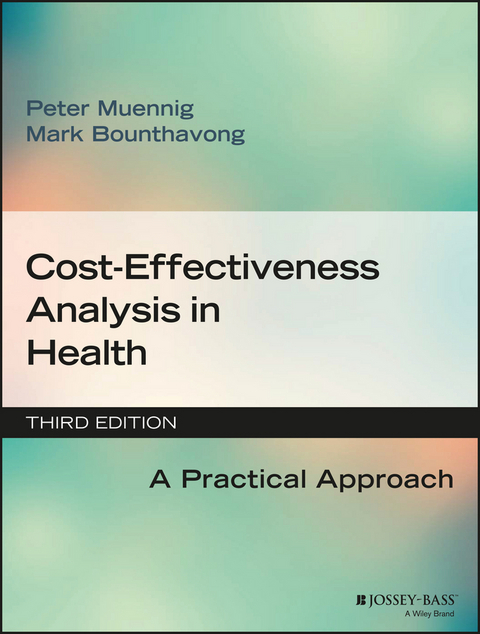
Cost-Effectiveness Analysis in Health (eBook)
John Wiley & Sons (Verlag)
978-1-119-01127-9 (ISBN)
Cost-Effectiveness Analysis in Health is a practical introduction to the tools, methods, and procedures used worldwide to perform cost-effective research. Covering every aspect of a complete cost-effectiveness analysis, this book shows you how to find which data you need, where to find it, how to analyze it, and how to prepare a high-quality report for publication. Designed for the classroom or the individual learner, the material is presented in simple and accessible language for those who lack a biostatistics or epidemiology background, and each chapter includes real-world examples and 'tips and tricks' that highlight key information. Exercises throughout allow you to test your understanding with practical application, and the companion website features downloadable data sets for students, as well as lecture slides and a test bank for instructors. This new third edition contains new discussion on meta-analysis and advanced modeling techniques, a long worked example using visual modeling software TreeAge Pro, and updated recommendations from the U.S. Public Health Service's Panel on Cost-Effectiveness in Health and Medicine. This is the second printing of the 3rd Edition, which has been corrected and revised for 2018 to reflect the latest standards and methods.
Cost-effectiveness analysis is used to evaluate medical interventions worldwide, in both developed and developing countries. This book provides process-specific instruction in a concise, structured format to give you a robust working knowledge of common methods and techniques.
- Develop a thoroughly fleshed-out research project
- Work accurately with costs, probabilities, and models
- Calculate life expectancy and quality-adjusted life years
- Prepare your study and your data for publication
Comprehensive analysis skills are essential for students seeking careers in public health, medicine, biomedical research, health economics, health policy, and more. Cost-Effectiveness Analysis in Health walks you through the process from a real-world perspective to help you build a skillset that's immediately applicable in the field.
PETER MUENNIG, MD, MPH, is a professor in the Department of Health Policy and Management at Columbia University.
MARK BOUNTHAVONG, PharmD, MPH is a pharmacoeconomist at the Veterans Affairs San Diego Health Care System and an adjunct faculty member of the Skaggs School of Pharmacy and Pharmaceutical Sciences at the University of California, San Diego.
The field's bestselling reference, updated with the latest tools, data, techniques, and the latest recommendations from the Second Panel on Cost-Effectiveness in Health and Medicine Cost-Effectiveness Analysis in Health is a practical introduction to the tools, methods, and procedures used worldwide to perform cost-effective research. Covering every aspect of a complete cost-effectiveness analysis, this book shows you how to find which data you need, where to find it, how to analyze it, and how to prepare a high-quality report for publication. Designed for the classroom or the individual learner, the material is presented in simple and accessible language for those who lack a biostatistics or epidemiology background, and each chapter includes real-world examples and "e;tips and tricks"e; that highlight key information. Exercises throughout allow you to test your understanding with practical application, and the companion website features downloadable data sets for students, as well as lecture slides and a test bank for instructors. This new third edition contains new discussion on meta-analysis and advanced modeling techniques, a long worked example using visual modeling software TreeAge Pro, and updated recommendations from the U.S. Public Health Service's Panel on Cost-Effectiveness in Health and Medicine. This is the second printing of the 3rd Edition, which has been corrected and revised for 2018 to reflect the latest standards and methods. Cost-effectiveness analysis is used to evaluate medical interventions worldwide, in both developed and developing countries. This book provides process-specific instruction in a concise, structured format to give you a robust working knowledge of common methods and techniques. Develop a thoroughly fleshed-out research project Work accurately with costs, probabilities, and models Calculate life expectancy and quality-adjusted life years Prepare your study and your data for publication Comprehensive analysis skills are essential for students seeking careers in public health, medicine, biomedical research, health economics, health policy, and more. Cost-Effectiveness Analysis in Health walks you through the process from a real-world perspective to help you build a skillset that's immediately applicable in the field.
PETER MUENNIG, MD, MPH, is a professor in the Department of Health Policy and Management at Columbia University. MARK BOUNTHAVONG, PharmD, MPH is a pharmacoeconomist at the Veterans Affairs San Diego Health Care System and an adjunct faculty member of the Skaggs School of Pharmacy and Pharmaceutical Sciences at the University of California, San Diego.
Cover 1
Title Page 3
Copyright 4
Contents 5
List of Tables, Figures, and Exhibits 11
Preface 21
Acknowledgments 25
About the Author 27
Chapter 1 Introduction to Cost?Effectiveness 29
Overview 29
Why Cost?Effectiveness Is Useful 30
Elements of Cost?Effectiveness Analysis 32
Health Interventions 32
The Competing Alternative 33
Health States 33
Health Status 34
The Quality?Adjusted Life?Year 35
Costs 36
The Average and Incremental Cost?Effectiveness Ratio 37
Why Conduct Cost?Effectiveness Analysis? 39
Costs Matter 39
Effectiveness Versus Efficacy 41
The Reference Case Analysis 43
Cost?Effectiveness Analysis and Policy 45
Prioritizing Health Interventions 45
Do Cost?Effectiveness Analyses Actually Change the Way Things Are Done? 48
What Does the Future Hold? 50
Summary 52
Further Readings 52
References 53
Chapter 2 Principles of Cost?Effectiveness Analysis 57
Overview 57
The Perspective of a Cost?Effectiveness Analysis 57
Capturing Costs 61
Capturing Quality 63
Interpreting the Cost?Effectiveness Ratio 68
Defining the Comparator 69
Interpreting Incremental Changes in Cost and Effectiveness 71
Types of Economic Analysis 72
Cost?Effectiveness and Cost?Utility Analysis 72
When to Use Nonreference Case Cost?Effectiveness Analyses 72
Other Measures 73
Cost?Benefit Analysis 74
Cost?Minimization Analysis 76
Burden?of?Disease Analysis 76
Summary 77
Further Readings 78
References 78
Chapter 3 Developing a Research Project 81
Overview 81
Eight Steps to a Perfect Research Project 81
Developing a Research Question 83
Anatomy of a Research Question 83
Defining the Population 83
Defining the Interventions Under Study 84
Defining the Disease You Are Studying 85
Research Checklist 86
Have I Included All of the Important Alternatives? 86
Where Will the Intervention Take Place? 87
Are Different Levels of Treatment or Different Screening Intervals Relevant? 88
What Type of Study Is Appropriate? 88
For Whom Will I Conduct the Study? 89
How Far into the Future Do I Need to Capture Outcomes? 90
What Do I Include, and What Do I Ignore? 90
Are There Enough Data to Answer My Question? 91
Review 91
Designing Your Analysis 92
Summary 98
Further Readings 98
References 98
Chapter 4 Working with Costs 101
Overview 101
Opportunity Costs 102
Identifying Costs 105
Micro?Costing and Gross Costing 108
Getting Cost Data 110
Using Diagnosis Codes 112
Adjusting Costs 114
Hospital Charges 115
Converting Other Charges 117
Adjusting for Inflation 118
Discounting Future Costs 119
When to Use Discounting 121
How to Use Discounting 121
Costs Associated with Pain and Suffering 123
Assessing the "Relevancy" of Cost Data 126
Other Cost Considerations 126
Measuring Changes in Costs 127
When to Use Micro?Costing 127
Friction Costs and Transfer Payments 129
Savings Associated with Premature Death 129
Summary 130
Further Readings 131
References 131
Chapter 5 Probabilities and Decision Analysis Models 133
Overview 133
The Idea Behind Decision Analysis 133
Probabilities 137
Some Basic Rules of Probability 138
Applying the Rules 140
Decision Analysis Models 142
Calculating the Probability of Each Strategy 148
Calculating the Cost of Each Strategy 150
Putting It All Together 151
Rollback Method (Thinking Inside the Tree) 153
Types of Decision Analysis Models 158
Summary 159
Further Reading 160
References 160
Chapter 6 Calculating Life Expectancy 163
Overview 163
Hand?Calculating Years Gained 163
Calculating Life?Years Lost Using Markov Models 168
Principles of Markov Modeling 171
Markov Models in Practice 175
Summary 178
Further Readings 179
References 179
Chapter 7 Working with Health?Related Quality?of?Life Measures 181
Overview 181
Framework 182
Preference Scores 183
Who Should Valuate HRQL? 185
Deriving HRQL Scores 186
Using Preference?Weighted Generic Instruments 188
Generating HRQL for Acute Conditions 193
HRQL Scores Generated from Other Health Surveys 195
Other Considerations and Reminders 196
Effect of Age on HRQL 196
Effect of Disease Stage on HRQL 197
Effect of an Intervention on HRQL 197
Use of HRQL Scores in Diverse Populations 198
Disease?Specific HRQL Instruments 198
Fees Associated with HRQL Instruments 199
Using Disability?Adjusted Life?Years 199
Summary 200
Further Readings 201
References 201
Chapter 8 Calculating QALYs 205
Overview 205
Using the Summation Method 206
Using the Life Table Method 208
Quality?Adjusted Life Expectancy 212
Using Markov Models to Calculate QALE 214
More On Discounting 217
Issues with QALYs 219
Calculating Incremental Cost?Effectiveness 220
Disability?Adjusted Life?Year (DALY) 223
Summary 224
Further Readings 224
References 225
Chapter 9 Conducting a Sensitivity Analysis 227
Overview 227
Performing a Sensitivity Analysis 227
Sensitivity Analysis 229
One?Way Sensitivity Analysis 231
Using One?Way Sensitivity Analyses to Validate a Model 233
Answering Secondary Questions Using One?Way Sensitivity Analyses 234
Two?Way Sensitivity Analysis 235
Tornado Diagram 236
Multiway Sensitivity Analysis 238
First?Order Monte Carlo Simulation 239
Second?Order Monte Carlo Simulation 240
Picking Distributions 242
Determining the Plausible Range of Each Variable 245
Presenting the Results of the Probabilistic Sensitivity Analysis 246
Summary 250
Further Readings 250
References 251
Chapter 10 Preparing Your Study for Publication 253
Overview 253
Content and Structure of Cost?Effectiveness Articles 253
Title and Abstract 258
Introduction 259
Methods 261
Results 263
Discussion 266
Other 266
Technical Appendix 268
Figures and Illustrations 269
Summary 270
Further Reading 270
References 270
Chapter 11 Basic Concepts in Epidemiology and Application to Cost?Effectiveness Analysis 273
Overview 273
Review of Incidence 274
Crude, Category?Specific, and Adjusted Rates 276
Prevalence Versus Incidence 280
Relationship Between Risks and Rates 280
Understanding Error 282
Managing Error in Cost?Effectiveness Analysis 285
Frequency Distributions and Random Error 285
Basics of Statistical Inference 289
Calculating Weighted Means 291
Evaluating Study Limitations 293
Review of Medical Study Designs 293
Cross?Sectional Studies 294
Retrospective Studies 294
Prospective Studies 296
Randomized Controlled Trials 298
Meta?Analysis 299
Primary Cost?Effectiveness Studies 301
Generalizability 302
Other Ways of Identifying Error in the Medical Literature 304
Summary 304
Further Readings 305
References 306
Chapter 12 Finding the Data You Need 309
Overview 309
Finding Data in the Medical Literature 309
Grading Published Data 311
Using Electronic Datasets 312
Finding the Right Electronic Data 317
Which Source of Data Do You Turn to? 318
Data Extraction Tools 320
Using Printed Tabulations of Electronic Data 321
Using Datasets Themselves 322
Understanding Error in Electronic Data 323
Using Unpublished Data 323
Using Data from Piggybacked Studies 324
Using Expert Opinion 324
Organizing Your Data 325
Summary 325
Further Readings 326
References 326
Chapter 13 A Worked Example 329
Overview 329
Helping Students Learn 329
Laboratory Exercise One: Building a Markov Tree 330
Laboratory Exercise Two: Comparing Interventions 350
Laboratory Exercise Three: The Cost?Effectiveness of Health Insurance 363
Laboratory Exercise Four: Sensitivity Analysis 374
Summary 388
Appendix A Answer Key to Exercises 389
Appendix B Life Expectancy and Quality?Adjusted Life Expectancy Tables 407
Appendix C EQ?5D?5L Health Questionnaire (English version for the United States) 411
Appendix D Diagnosis, Charges, Medicare Reimbursement, Average Length of Stay, and Cost?to?Charge Ratio by Diagnosis?Related Groups, 2011 415
Glossary 451
Index 463
EULA 483
| Erscheint lt. Verlag | 1.2.2016 |
|---|---|
| Sprache | englisch |
| Themenwelt | Medizin / Pharmazie ► Allgemeines / Lexika |
| Medizin / Pharmazie ► Gesundheitswesen | |
| Studium ► Querschnittsbereiche ► Prävention / Gesundheitsförderung | |
| Technik | |
| Wirtschaft ► Betriebswirtschaft / Management ► Finanzierung | |
| Schlagworte | Ãffentlicher Gesundheitsdienst u. Gesundheitspolitik • analyzing cost effectiveness • Biostatistics • cost-effectiveness analysis guide • Cost-Effectiveness Analysis in Health: A Practical Approach, 3rd Edition • cost-effectiveness analysis methods • cost-effectiveness analysis techniques • cost-effectiveness analysis textbook • epidemiology • Gesundheits- u. Sozialwesen • Health & Social Care • health care analysis • health data analysis • life sciences cost-effectiveness analysis • Mark Bounthavong • medical intervention cost effectiveness • medical intervention evaluation • Medizin • Öffentlicher Gesundheitsdienst u. Gesundheitspolitik • Peter Muennig • public health cost-effectiveness • Public Health Guide • public health modeling • public health program cost-effectiveness analysis • Public Health Services & Policy • statistics for health |
| ISBN-10 | 1-119-01127-2 / 1119011272 |
| ISBN-13 | 978-1-119-01127-9 / 9781119011279 |
| Informationen gemäß Produktsicherheitsverordnung (GPSR) | |
| Haben Sie eine Frage zum Produkt? |
 PDF (Adobe DRM)
Kopierschutz: Adobe-DRM
Adobe-DRM ist ein Kopierschutz, der das eBook vor Mißbrauch schützen soll. Dabei wird das eBook bereits beim Download auf Ihre persönliche Adobe-ID autorisiert. Lesen können Sie das eBook dann nur auf den Geräten, welche ebenfalls auf Ihre Adobe-ID registriert sind.
Details zum Adobe-DRM
Dateiformat: PDF (Portable Document Format)
Mit einem festen Seitenlayout eignet sich die PDF besonders für Fachbücher mit Spalten, Tabellen und Abbildungen. Eine PDF kann auf fast allen Geräten angezeigt werden, ist aber für kleine Displays (Smartphone, eReader) nur eingeschränkt geeignet.
Systemvoraussetzungen:
PC/Mac: Mit einem PC oder Mac können Sie dieses eBook lesen. Sie benötigen eine
eReader: Dieses eBook kann mit (fast) allen eBook-Readern gelesen werden. Mit dem amazon-Kindle ist es aber nicht kompatibel.
Smartphone/Tablet: Egal ob Apple oder Android, dieses eBook können Sie lesen. Sie benötigen eine
Geräteliste und zusätzliche Hinweise
Buying eBooks from abroad
For tax law reasons we can sell eBooks just within Germany and Switzerland. Regrettably we cannot fulfill eBook-orders from other countries.
aus dem Bereich