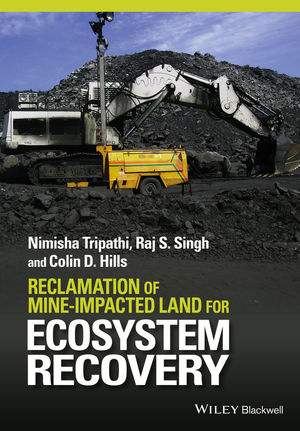
Reclamation of Mine-impacted Land for Ecosystem Recovery (eBook)
John Wiley & Sons (Verlag)
978-1-119-05793-2 (ISBN)
Mining activities significantly impact the environment; they generate huge quantities of spoil, promote deforestation and the loss of agricultural production, as well as releasing contaminants that result in the loss of valuable soil resources. These negative impacts are now being recognized and this book shows how corrective action can be taken.
The introduction of sustainable mining requires mitigation strategies that start during the mine planning stage and extend to after mineral extraction has ceased, and post-closure activities are being executed.
Reclamation of Mine-impacted Land for Ecosystem Recovery covers: methods of rejuvenation of mine wasteland including different practices of physical, chemical and ecological engineering methods; benefits of rejuvenation: stabilization of land surfaces; pollution control; aesthetic improvement; general amenity; plant productivity; and carbon sequestration as well as restoring biodiversity and ecosystem function; best management practices and feasible solutions to the impacts of mining which will reduce the pollution load by reducing the discharge rate and the pollutant concentration; reduce erosion and sedimentation problems, and result in improved abandoned mine lands; and ecosystem development.
The authors explain how mining impacts on soil properties and how soil carbon reserves/soil fertility can be restored when mining has ceased. Restoration involves a coordinated approach that recognizes the importance of key soil properties to enable re-vegetation to take place rapidly and ecosystems to be established in a low cost and sustainable way.
This book's unique combination of the methods for reclamation technologies with policies and best practice worldwide will provide the background and the guidance needed by scientists, researchers and engineers engaged in land reclamation, as well as by industry managers.
Nimisha Tripathi is anAustralian Endeavour Fellow, working as a visiting academic at the University of Greenwich, UK. Her broad area of research includes restoration, microbial ecology of damaged terrestrial ecosystems and waste utilisation. She has worked as a Project Leader on the rejuvenation of contaminated mine wastelands and has carried out pioneering work in Australia on modified chitosan for soil remediation and carbon sequestration. Having good publishing records, she has won a number of national and international awards.
Raj S. Singh is Principal Scientist and Associate Professor at CSIR-Central Institute of Mining and Fuel Research, Dhanbad, India. He specializes in restoration ecology and has extensive research experience on restoration of alternate land uses and damaged ecosystems, remediation of contaminated wastelands, environmental impact assessment and management plans. His publication record is extensive and has given him international and national recognition, and awards - including the Commonwealth Fellowship, UK.
Colin D. Hills is Professor of Environment and Materials Engineering and the Director, Centre for Contaminated Land Remediation at the University of Greenwich, UK. He has an extensive research and publishing record on the treatment and valorisation of hazardous wastes and contaminated soils and has authored national guidance on stabilisation/solidification technology for the Environment Agency. His work has attracted international recognition, has won a number of national and regional awards and led to innovative treatments for the management of difficult wastes.
Mining activities significantly impact the environment; they generate huge quantities of spoil, promote deforestation and the loss of agricultural production, as well as releasing contaminants that result in the loss of valuable soil resources. These negative impacts are now being recognized and this book shows how corrective action can be taken. The introduction of sustainable mining requires mitigation strategies that start during the mine planning stage and extend to after mineral extraction has ceased, and post-closure activities are being executed. Reclamation of Mine-impacted Land for Ecosystem Recovery covers: methods of rejuvenation of mine wasteland including different practices of physical, chemical and ecological engineering methods; benefits of rejuvenation: stabilization of land surfaces; pollution control; aesthetic improvement; general amenity; plant productivity; and carbon sequestration as well as restoring biodiversity and ecosystem function; best management practices and feasible solutions to the impacts of mining which will reduce the pollution load by reducing the discharge rate and the pollutant concentration; reduce erosion and sedimentation problems, and result in improved abandoned mine lands; and ecosystem development. The authors explain how mining impacts on soil properties and how soil carbon reserves/soil fertility can be restored when mining has ceased. Restoration involves a coordinated approach that recognizes the importance of key soil properties to enable re-vegetation to take place rapidly and ecosystems to be established in a low cost and sustainable way. This book s unique combination of the methods for reclamation technologies with policies and best practice worldwide will provide the background and the guidance needed by scientists, researchers and engineers engaged in land reclamation, as well as by industry managers.
Nimisha Tripathi is anAustralian Endeavour Fellow, working as a visiting academic at the University of Greenwich, UK. Her broad area of research includes restoration, microbial ecology of damaged terrestrial ecosystems and waste utilisation. She has worked as a Project Leader on the rejuvenation of contaminated mine wastelands and has carried out pioneering work in Australia on modified chitosan for soil remediation and carbon sequestration. Having good publishing records, she has won a number of national and international awards. Raj S. Singh is Principal Scientist and Associate Professor at CSIR-Central Institute of Mining and Fuel Research, Dhanbad, India. He specializes in restoration ecology and has extensive research experience on restoration of alternate land uses and damaged ecosystems, remediation of contaminated wastelands, environmental impact assessment and management plans. His publication record is extensive and has given him international and national recognition, and awards - including the Commonwealth Fellowship, UK. Colin D. Hills is Professor of Environment and Materials Engineering and the Director, Centre for Contaminated Land Remediation at the University of Greenwich, UK. He has an extensive research and publishing record on the treatment and valorisation of hazardous wastes and contaminated soils and has authored national guidance on stabilisation/solidification technology for the Environment Agency. His work has attracted international recognition, has won a number of national and regional awards and led to innovative treatments for the management of difficult wastes.
1
Introduction
1.1 Background and purpose
Since Palaeolithic times (ca. 450 000 years ago), mining has been an integral part of the human existence (Hartman, 1987). Mining is fundamental to technological development and there is evidence of subsurface mining dating back to 15 000 BC (Kennedy, 1990).
Throughout the world, the most common form of mineral extraction is surface or open-pit mining. Minerals with a low stripping ratio generate large amounts of overburden or spoil, which are discarded on adjacent land surface.
The discarded overburden is disposed of in surface dumps, which significantly impact upon both flora and fauna. Spoil dumps occupy large areas of productive land and contaminate surface and subsurface water resources, upon impacting ecological pools and biological processes (Tripathi et al., 2012). The loss of key components of an ecosystem directly results in land degradation.
Surface mining disrupts the environment by disturbing the landscape, despoiling agricultural land and through deforestation. The consequence of mining is a loss of plant biomass and land productivity. The environmental impacts caused by mining, based on Richards (2002), are:
- Ecosystem disturbance and degradation
- Habitat destruction
- Adverse chemical impacts (from improperly treated wastes); and
- Loss of soil-bound carbon (to the atmosphere)
The management of mine spoil/degraded land is a major issue throughout the world. The ecological and environmental impacts of mining warrant a corrective action supported by appropriate post-closure management strategies. By managing environmental impacts, the long-term viability of mining operations can be secured.
The practice of ecological restoration of disturbed and degraded land is a primary action in ecosystem recovery. This is achieved by ensuring a nutrient cycling is re-established, which in turn fosters increasing biodiversity.
The introduction of a progressive post-mining plan, which considers the ecological condition of the land (to be mined) and the suitability of native plants for reclamation activities is an important step as this:
- Minimizes the overall impact of mining at a site
- Ensures an appropriate post-mining closure design is implemented
- Reduces overall cost
- Enhances environmental protection and restoration of soil-based carbon
- Reduces the time frame for completing the reclamation strategy
Post-closure reclamation actions can be implemented immediately after the cessation of mining and should utilize the best available technology options available.
Thus, by using appropriate management strategies, such as mulches and organic matter-based additions, re-vegetation can be effectively carried out post mine closure. Reclamation will re-establish the soil carbon reserve lost during mining that is essential for the correct functioning of vegetation. The reintroduction of soil organic matter is achieved via the removal of CO2 from the atmosphere into root mass and leaf litter. The growth of biomass reduces the amount of CO2 in the atmosphere, and therefore mitigates the effects of climate change.
This work provides a comprehensive description of impacts arising from land degradation caused by mining activities. It provides insight into the technical aspects of the restoration and reclamation of mining-impacted land and the reintroduction of soil-based carbon reserves that are so important to the re-establishment of self-sustaining ecosystems. Key ecological concepts are explored, and the major ecological pools and biological processes functioning in disturbed or degraded ecosystems are presented.
The successful repair of degraded land and reintroduction of a sustainable ecosystem requires a multidisciplinary approach, and this is reflected in the content of this book. All the stages of land reclamation from the initial policy decisions to management and outcomes are presented. As such, this work will provide key insights to undergraduate and postgraduate students, researchers, mine managers, policymakers and professionals dealing with contaminated mine land reclamation and management issues.
1.2 Key concepts and definitions
A number of key concepts and definitions are presented which underpin the understanding of ecological restoration. A number of these are as follows:
| Biogeochemical cycles | The pathway by which a chemical substance moves through both biotic (biosphere) and abiotic (lithosphere, atmosphere and hydrosphere) components of Earth. |
| Carbon sequestration | This is the process of naturally or artificially storing carbon dioxide for a longer-term out of the atmosphere, where it contributes to the greenhouse effect. |
| Carbon sink | A natural or artificial reservoir that accumulates and stores carbon-containing chemical compounds (e.g. CO2) for an indefinite period. |
| Decomposition | Conversion or decay of chemically unstable material to simpler forms by the natural action of air, water, light and microorganisms. |
| Disturbance | The major cause of long-term changes in the structure and functioning of ecosystems. Disturbance may be natural, involving fire, wind, disease, insect outbreaks and landslides, or anthropogenic from human impacts (e.g. clear cutting, deforestation, habitat destruction, introduction of invasive species). |
| Ecology | A branch of biology dealing with the interactions among organisms and their abiotic environment: the study of ‘the structure and function of nature, which includes the living world’ (Odum, 1959). In terms of disturbance, ecology encompasses the study of interrelationships between biotic and abiotic components of the existing disturbed ecosystems. |
| Ecosystem | A biological community of interacting organisms and their physical environment. Ecosystems are characterized as complex systems with abiotic and biotic processes interacting between the various components. In simple terms, Odum’s ecosystem is the fundamental unit of ecology. |
| Ecological processes | The key processes regulating the ecological system (ecosystem) – nutrient processing, productivity, decomposition, nutrient turnover, hydrological flux. |
| Ecological restoration | The practice of renewing and returning a degraded, damaged or destroyed ecosystems to its original (prior to disturbance) condition. |
| Ecosystem development | The development of pools and processes of an ecosystem culminating in a stabilized ecosystem. Ecosystem development is the part of ecological succession. The concepts of ecosystem development are often based on assumptions and extrapolations with respect to structural–functional interactions in the initial stage of ecosystem development. |
| Ecosystem productivity | In ecology, productivity refers to the rate of generation of biomass in an ecosystem. |
| Endemic (or native) plants | The plant species indigenous and unique to a specific geographic region over a given period of time. |
| Exotic plants | The plant species living outside its native distributional range, which has arrived there either by deliberate or accidental human activity. |
| Functional components | The components of ecosystem having specific roles in regulating the functioning (e.g. biogeochemical processes, disturbance regimes) of an ecosystem but governed by the structural components. Four functional components of an ecosystem include:
|
| Greenhouse effect | The phenomenon by which the sun’s thermal radiation is trapped by the gases (e.g. carbon dioxide, methane, water vapour) of a planetary surface and is re-radiated back from the planet causing atmospheric heating. |
| Greenhouse emission | The emission of gases, for example, chlorofluorocarbon, carbon dioxide, perfluorocarbon, sulphur hexafluoride, that contributes to the greenhouse effect by absorbing infrared radiation. |
| Habitat alteration | The process making changes to the environment that adversely affects ecosystem function. However, the effects are not permanent (Dodd and Smith, 2003). |
| Habitat destruction | The process in which natural habitat is rendered functionally unable to support the existing species. In this process, the regional ecosystem is completely eliminated resulting into the total removal of its former biological function and loss of biodiversity (Dodd and Smith, 2003). Habitat destruction is the primary cause of species extinction worldwide. |
| Habitat fragmentation | A secondary affect of habitat destruction, which occurs when the remaining species populations after habitat destruction are isolated due to destroyed linkages between habitat patches after disturbance. |
| Land disturbance | Changes of land use and land forms, soil moisture... |
| Erscheint lt. Verlag | 4.2.2016 |
|---|---|
| Sprache | englisch |
| Themenwelt | Technik ► Bauwesen |
| Technik ► Umwelttechnik / Biotechnologie | |
| Schlagworte | accelerated • Accretion • Amendements • Bauingenieur- u. Bauwesen • Benefits • Best • Budget • carbon • Carbon dioxide • Carbon Sequestration • Chemie • Chemistry • Civil Engineering & Construction • damaged • Development Processes • Displacement • disturbance • Ecological restoration • ecosystem • Enhanced • Environmental Chemistry • Environmental management plan • Environmental Science • Environmental Studies • Erd- u. Grundbau • impacts • international • land degradation • laws and policies • Management • Mine reclamation • Mine spoil • Mining • national • nutrient • Offset • Opencast • Plant • Practices • Reclamation • Recovery • remediation • Renaturierung • Restoration Ecology • Revegetation • Roots • selection • Sequestration • Societal Ecology • Soil • Soil (Civil Engineering) • Solid Waste • succession • Umweltchemie • Umweltforschung • Umweltwissenschaften • Water • woodland |
| ISBN-10 | 1-119-05793-0 / 1119057930 |
| ISBN-13 | 978-1-119-05793-2 / 9781119057932 |
| Informationen gemäß Produktsicherheitsverordnung (GPSR) | |
| Haben Sie eine Frage zum Produkt? |
 EPUB (Adobe DRM)
Kopierschutz: Adobe-DRM
Adobe-DRM ist ein Kopierschutz, der das eBook vor Mißbrauch schützen soll. Dabei wird das eBook bereits beim Download auf Ihre persönliche Adobe-ID autorisiert. Lesen können Sie das eBook dann nur auf den Geräten, welche ebenfalls auf Ihre Adobe-ID registriert sind.
Details zum Adobe-DRM
Dateiformat: EPUB (Electronic Publication)
EPUB ist ein offener Standard für eBooks und eignet sich besonders zur Darstellung von Belletristik und Sachbüchern. Der Fließtext wird dynamisch an die Display- und Schriftgröße angepasst. Auch für mobile Lesegeräte ist EPUB daher gut geeignet.
Systemvoraussetzungen:
PC/Mac: Mit einem PC oder Mac können Sie dieses eBook lesen. Sie benötigen eine
eReader: Dieses eBook kann mit (fast) allen eBook-Readern gelesen werden. Mit dem amazon-Kindle ist es aber nicht kompatibel.
Smartphone/Tablet: Egal ob Apple oder Android, dieses eBook können Sie lesen. Sie benötigen eine
Geräteliste und zusätzliche Hinweise
Buying eBooks from abroad
For tax law reasons we can sell eBooks just within Germany and Switzerland. Regrettably we cannot fulfill eBook-orders from other countries.
aus dem Bereich