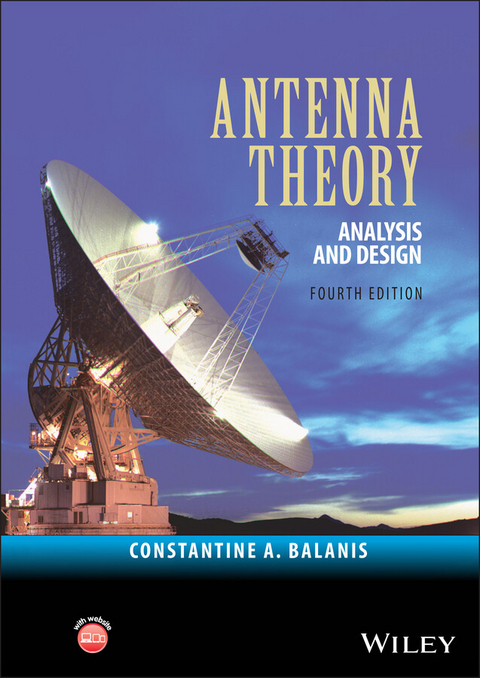
Antenna Theory (eBook)
John Wiley & Sons (Verlag)
978-1-119-17899-6 (ISBN)
Updated with color and gray scale illustrations, a companion website housing supplementary material, and new sections covering recent developments in antenna analysis and design
This book introduces the fundamental principles of antenna theory and explains how to apply them to the analysis, design, and measurements of antennas. Due to the variety of methods of analysis and design, and the different antenna structures available, the applications covered in this book are made to some of the most basic and practical antenna configurations. Among these antenna configurations are linear dipoles; loops; arrays; broadband antennas; aperture antennas; horns; microstrip antennas; and reflector antennas. The text contains sufficient mathematical detail to enable undergraduate and beginning graduate students in electrical engineering and physics to follow the flow of analysis and design. Readers should have a basic knowledge of undergraduate electromagnetic theory, including Maxwell's equations and the wave equation, introductory physics, and differential and integral calculus.
- Presents new sections on flexible and conformal bowtie, Vivaldi antenna, antenna miniaturization, antennas for mobile communications, dielectric resonator antennas, and scale modeling
- Provides color and gray scale figures and illustrations to better depict antenna radiation characteristics
- Includes access to a companion website housing MATLAB programs, Java-based applets and animations, Power Point notes, Java-based interactive questionnaires and a solutions manual for instructors
- Introduces over 100 additional end-of-chapter problems
Antenna Theory: Analysis and Design, Fourth Edition is designed to meet the needs of senior undergraduate and beginning graduate level students in electrical engineering and physics, as well as practicing engineers and antenna designers.
Constantine A. Balanis received his BSEE degree from the Virginia Tech in 1964, his MEE degree from the University of Virginia in 1966, his PhD in Electrical Engineering from The Ohio State University in 1969, and an Honorary Doctorate from the Aristotle University of Thessaloniki in 2004. From 1964 to 1970, he was with the NASA Langley Research Center in Hampton, VA, and from 1970 to 1983, he was with the Department of Electrical Engineering of West Virginia University. In 1983 he joined Arizona State University and is now Regents' Professor of Electrical Engineering. Dr. Balanis is also a life fellow of the IEEE.
Constantine A. Balanis received his BSEE degree from the Virginia Tech in 1964, his MEE degree from the University of Virginia in 1966, his PhD in Electrical Engineering from The Ohio State University in 1969, and an Honorary Doctorate from the Aristotle University of Thessaloniki in 2004. From 1964 to 1970, he was with the NASA Langley Research Center in Hampton, VA, and from 1970 to 1983, he was with the Department of Electrical Engineering of West Virginia University. In 1983 he joined Arizona State University and is now Regents' Professor of Electrical Engineering. Dr. Balanis is also a life fellow of the IEEE.
Updated with color and gray scale illustrations, a companion website housing supplementary material, and new sections covering recent developments in antenna analysis and designThis book introduces the fundamental principles of antenna theory and explains how to apply them to the analysis, design, and measurements of antennas. Due to the variety of methods of analysis and design, and the different antenna structures available, the applications covered in this book are made to some of the most basic and practical antenna configurations. Among these antenna configurations are linear dipoles; loops; arrays; broadband antennas; aperture antennas; horns; microstrip antennas; and reflector antennas. The text contains sufficient mathematical detail to enable undergraduate and beginning graduate students in electrical engineering and physics to follow the flow of analysis and design. Readers should have a basic knowledge of undergraduate electromagnetic theory, including Maxwell s equations and the wave equation, introductory physics, and differential and integral calculus. Presents new sections on flexible and conformal bowtie, Vivaldi antenna, antenna miniaturization, antennas for mobile communications, dielectric resonator antennas, and scale modeling Provides color and gray scale figures and illustrations to better depict antenna radiation characteristics Includes access to a companion website housing MATLAB programs, Java-based applets and animations, Power Point notes, Java-based interactive questionnaires and a solutions manual for instructors Introduces over 100 additional end-of-chapter problems Antenna Theory: Analysis and Design, Fourth Edition is designed to meet the needs of senior undergraduate and beginning graduate level students in electrical engineering and physics, as well as practicing engineers and antenna designers.Constantine A. Balanis received his BSEE degree from the Virginia Tech in 1964, his MEE degree from the University of Virginia in 1966, his PhD in Electrical Engineering from The Ohio State University in 1969, and an Honorary Doctorate from the Aristotle University of Thessaloniki in 2004. From 1964 to 1970, he was with the NASA Langley Research Center in Hampton, VA, and from 1970 to 1983, he was with the Department of Electrical Engineering of West Virginia University. In 1983 he joined Arizona State University and is now Regents' Professor of Electrical Engineering. Dr. Balanis is also a life fellow of the IEEE.
Constantine A. Balanis received his BSEE degree from the Virginia Tech in 1964, his MEE degree from the University of Virginia in 1966, his PhD in Electrical Engineering from The Ohio State University in 1969, and an Honorary Doctorate from the Aristotle University of Thessaloniki in 2004. From 1964 to 1970, he was with the NASA Langley Research Center in Hampton, VA, and from 1970 to 1983, he was with the Department of Electrical Engineering of West Virginia University. In 1983 he joined Arizona State University and is now Regents' Professor of Electrical Engineering. Dr. Balanis is also a life fellow of the IEEE.
Preface
The fourth edition of Antenna Theory is designed to meet the needs of electrical engineering and physics students at the senior undergraduate and beginning graduate levels, and those of practicing engineers. The text presumes that the students have knowledge of basic undergraduate electromagnetic theory, including Maxwell's equations and the wave equation, introductory physics, and differential and integral calculus. Mathematical techniques required for understanding some advanced topics in the later chapters are incorporated in the individual chapters or are included as appendices.
The book, since its first edition in 1982 and subsequent two editions in 1997 and 2005, has been a pacesetter and trail blazer in updating the contents to keep abreast with advancements in antenna technology. This has been accomplished by:
- Introducing new topics
- Originating innovative features and multimedia to animate, visualize, illustrate and display radiation characteristics
- Providing design equations, procedures and associate software
This edition is no exception, as many new topics and features have been added. In particular:
- New sections have been introduced on:
- Flexible and conformal bowtie
- Vivaldi antenna
- Antenna miniaturization
- Antennas for mobile communications
- Dielectric resonator antennas
- Scale modeling
- Additional MATLAB and JAVA programs have been developed.
- Color and gray scale figures and illustrations have been developed to clearly display and visualize antenna radiation characteristics.
- A companion website has been structured by the publisher which houses the MATLAB programs, JAVA-based applets and animations, Power Point notes, and JAVA-based interactive questionnaires. A solutions manual is available only for the instructors that adopt the book as a classroom text.
- Over 100 additional end-of-chapter problems have been included.
While incorporating the above new topics and features in the current edition, the book maintained all of the attractive features of the first three additions, especially the:
- Three-dimensional graphs to display the radiation characteristics of antennas. This feature was hailed, at the time of its introduction, as innovative and first of its kind addition in a textbook on antennas.
- Advanced topics, such as a chapter on Smart Antennas and a section on Fractal Antennas.
- Multimedia:
- Power Point notes
- MATLAB programs
- FORTRAN programs
- JAVA-based animations
- JAVA-based applets
- JAVA-based end-of-the-chapter questionnaires
The book's main objective is to introduce, in a unified manner, the fundamental principles of antenna theory and to apply them to the analysis, design, and measurements of antennas. Because there are so many methods of analysis and design and a plethora of antenna structures, applications are made to some of the most basic and practical configurations, such as linear dipoles; loops; arrays; broadband, and frequency-independent antennas; aperture antennas; horn antennas; microstrip antennas; and reflector antennas.
A tutorial chapter on Smart Antennas is included to introduce the student in a technology that will advance antenna theory and design, and revolutionize wireless communications. It is based on antenna theory, digital signal processing, networks and communications. MATLAB simulation software has also been included, as well as a plethora of references for additional reading.
Introductory material on analytical methods, such as the Moment Method and Fourier transform (spectral) technique, is also included. These techniques, together with the fundamental principles of antenna theory, can be used to analyze and design almost any antenna configuration. A chapter on antenna measurements introduces state-of-the-art methods used in the measurements of the most basic antenna characteristics (pattern, gain, directivity, radiation efficiency, impedance, current, and polarization) and updates progress made in antenna instrumentation, antenna range design, and scale modeling. Techniques and systems used in near- to far-field measurements and transformations are also discussed.
A sufficient number of topics have been covered, some for the first time in an undergraduate text, so that the book will serve not only as a text but also as a reference for the practicing and design engineer and even the amateur radio buff. These include design procedures, and associated computer programs, forYagi.Uda and log-periodic arrays, horns, and microstrip patches; synthesis techniques using the Schelkunoff, Fourier transform, Woodward.Lawson, Tschebyscheff, and Taylor methods; radiation characteristics of corrugated, aperture-matched, and multimode horns; analysis and design of rectangular and circular microstrip patches; and matching techniques such as the binomial and Tschebyscheff. Also new sections have been introduced on flexible & conformal bowtie and Vivaldi antennas in Chapter 9, antenna miniaturization in Chapter 11 and expanded scale modeling in Chapter 17.
Chapter 14 has been expanded to include antennas for Mobile Communications. In particular, this new section includes basic concepts and design equations for the Planar Inverted-F Antenna (PIFA), Slot Antenna, Inverted-F Antenna (IFA), Multiband U-type Slot Antenna, and Dielectric Resonator Antennas (DRAs). These are popular internal antennas for mobile devices (smart phones, laptops, pads, tablets, etc.). A MATLAB computer program, referred to as DRA_Analysis_Design, has been developed to analyze the resonant frequencies of Rectangular, Cylindrical, Hemicylindrical, and Hemispherical DRAs using TE and TM modal cavity techniques by modeling the walls as PMCs. Hybrid modes are used to analyze and determine the resonant frequencies and quality factor (Q) of the Cylindrical DRA. The MATLAB program DRA_Analysis_Design has the capability, using a nonlinear solver, to design (i.e., find the Q, range of values for the dielectric constant, and finally the dimensions of the Cylindrical DRA) once the hybrid mode (TE01ϑ, TM01ϑ or HE11ϑ), fractional bandwidth (BW, in %), VSWR and resonant frequency (fr, in GHz) are specified. A detailed procedure to follow the design is outlined in Section 14.10.4.
The text contains sufficient mathematical detail to enable the average undergraduate electrical engineering and physics students to follow, without difficulty, the flow of analysis and design. A certain amount of analytical detail, rigor, and thoroughness allows many of the topics to be traced to their origin. My experiences as a student, engineer, and teacher have shown that a text for this course must not be a book of unrelated formulas, and it must not resemble a “cookbook.” This book begins with the most elementary material, develops underlying concepts needed for sequential topics, and progresses to more advanced methods and system configurations. Each chapter is subdivided into sections or subsections whose individual headings clearly identify the antenna characteristic(s) discussed, examined, or illustrated.
A distinguished feature of this book is its three-dimensional graphical illustrations from the first edition, which have been expanded and supplemented in the second, third and fourth editions. In the past, antenna texts have displayed the three-dimensional energy radiated by an antenna by a number of separate two-dimensional patterns. With the advent and revolutionary advances in digital computations and graphical displays, an additional dimension has been introduced for the first time in an undergraduate antenna text by displaying the radiated energy of a given radiator by a single three-dimensional graphical illustration. Such an image, formed by the graphical capabilities of the computer and available at most computational facilities, gives a clear view of the energy radiated in all space surrounding the antenna. In this fourth edition, almost all of the three-dimensional amplitude radiation patterns, along with many two-dimensional graphs, are depicted in color and gray-scale. This is a new and pacesetting feature adopted, on a large scale, in this edition. It is hoped that this will lead to a better understanding of the underlying principles of radiation and provide a clearer visualization of the pattern formation in all space.
In addition, there is an abundance of general graphical illustrations, design data, references, and an expanded list of end-of-the chapter problems. Many of the principles are illustrated with examples, graphical illustrations, and physical arguments. Although students are often convinced that they understand the principles, difficulties arise when they attempt to use them. An example, especially a graphical illustration, can often better illuminate those principles. As they say, “a picture is worth a thousand words.”
Numerical techniques and computer solutions are illustrated and encouraged. A number of MATLAB computer programs are included in the publisher's website for the book. Each program is interactive and prompts the user to enter the data in a sequential manner. Some of these programs are translations of the FORTRAN ones that were included in the first and second editions. However, many new ones have been developed. Every chapter, other than Chapters 3 and 17, has at least one MATLAB computer program; some have as many as four. The outputs of the MATLAB programs include graphical illustrations and tabulated results. For completeness, the...
| Erscheint lt. Verlag | 28.12.2015 |
|---|---|
| Sprache | englisch |
| Themenwelt | Technik ► Elektrotechnik / Energietechnik |
| Technik ► Nachrichtentechnik | |
| Schlagworte | Antenna Arrays • Antenna miniaturization • Antennas & Propagation • Antenne • Aperture Antennas • Bessel functions • Broadband antennas • Broadband Dipoles • Cylindrical Dipole • Drahtlose Kommunikation • Electrical & Electronics Engineering • Elektrotechnik u. Elektronik • fractal antennas • Fresnel integrals • Horn Antennas • Integral equations • Loop Antennas • microstrip antennas • Mobile & Wireless Communications • Mutual Coupling • Radiation Integrals • reflector antennas • Sende- u. Empfangseinrichtungen • Signal Processing • Signalverarbeitung • Smart Antennas • Vector analysis • Vivaldi Antenna • wireless communications |
| ISBN-10 | 1-119-17899-1 / 1119178991 |
| ISBN-13 | 978-1-119-17899-6 / 9781119178996 |
| Informationen gemäß Produktsicherheitsverordnung (GPSR) | |
| Haben Sie eine Frage zum Produkt? |
 EPUB (Adobe DRM)
Kopierschutz: Adobe-DRM
Adobe-DRM ist ein Kopierschutz, der das eBook vor Mißbrauch schützen soll. Dabei wird das eBook bereits beim Download auf Ihre persönliche Adobe-ID autorisiert. Lesen können Sie das eBook dann nur auf den Geräten, welche ebenfalls auf Ihre Adobe-ID registriert sind.
Details zum Adobe-DRM
Dateiformat: EPUB (Electronic Publication)
EPUB ist ein offener Standard für eBooks und eignet sich besonders zur Darstellung von Belletristik und Sachbüchern. Der Fließtext wird dynamisch an die Display- und Schriftgröße angepasst. Auch für mobile Lesegeräte ist EPUB daher gut geeignet.
Systemvoraussetzungen:
PC/Mac: Mit einem PC oder Mac können Sie dieses eBook lesen. Sie benötigen eine
eReader: Dieses eBook kann mit (fast) allen eBook-Readern gelesen werden. Mit dem amazon-Kindle ist es aber nicht kompatibel.
Smartphone/Tablet: Egal ob Apple oder Android, dieses eBook können Sie lesen. Sie benötigen eine
Geräteliste und zusätzliche Hinweise
Buying eBooks from abroad
For tax law reasons we can sell eBooks just within Germany and Switzerland. Regrettably we cannot fulfill eBook-orders from other countries.
aus dem Bereich