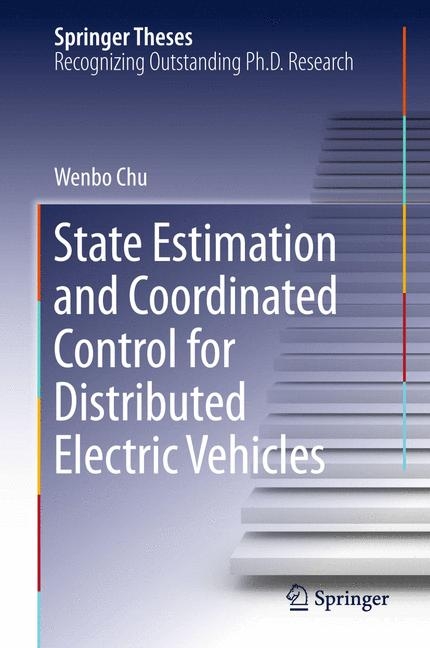
State Estimation and Coordinated Control for Distributed Electric Vehicles (eBook)
XVIII, 187 Seiten
Springer Berlin (Verlag)
978-3-662-48708-2 (ISBN)
This book tackles some of the most challenging problems in state estimation and traction coordinated control systems to improve the dynamic control performance of Distributed Electric Vehicles. The developed methods make it possible to gain more accurate information regarding the vehicle states, ensure more desirable vehicle motions and better robustness in unforeseeable driving environments. Given the impressive features of Distributed Electric Vehicles, including their simple and compact structure, short transmission chains, fast and accurate control response, modular drivetrain design etc., it is widely recognized that they represent an important future development direction and attract many of the brightest engineers and scientists. This book makes a significant contribution to the design of safer and more efficient vehicles.
Supervisors' Foreword 7
Acknowledgments 9
Contents 11
Acronyms 14
1 Introduction 18
1.1 Overview 18
1.2 Research on Status of Vehicle State Estimation 20
1.2.1 Estimation of Longitudinal Vehicle Velocity 21
1.2.2 Estimation of Side Slip Angle 24
1.2.3 Yaw Rate Estimation 28
1.2.4 Estimation of Tire Lateral Force 28
1.2.5 Estimation of Tire Vertical Force 30
1.2.6 Estimation of Mass and Gradient 32
1.3 Research Status of Coordinated Control 34
1.3.1 Lateral Control Target 34
1.3.2 Driving Force Control Allocation 40
1.3.3 Motor Discrepancy Compensation 44
1.4 Main Study Contents of This Dissertation 45
References 48
2 State Estimation and Coordinated Control System 54
2.1 Structural Design of the System 54
2.2 Technological Difficulties and Key Points 59
3 State Estimation of Distributed Electric Vehicles 62
3.1 Mass Estimation of Full Vehicle Extraction Based on High Frequency Information 62
3.1.1 Analysis on Decoupling of Mass and Gradient 63
3.1.2 Mass Estimation by Recursive Least Square Method 65
3.2 Gradient Estimation Based on Multi-method Fusion 67
3.2.1 Gradient Estimation Based on Dynamics 67
3.2.2 Gradient Estimation Based on Kinematics 69
3.2.3 Fusion of Kinematics and Dynamics 70
3.3 Vertical Force Estimation of Tire Based on Multi-information Infusion 70
3.3.1 Estimation of Roll Angle and Roll Rate of Vehicle Body 71
3.3.2 Analysis on Dynamic Axle Load Transfer 73
3.4 Estimation of Vehicle Motion State and Lateral Force Based on UPF 74
3.4.1 Design of Unscented Particle Filter 75
3.4.2 Analysis on Non-linear Vehicle Dynamic Model 82
3.4.3 Analysis on Magic Formula Tire Model 87
3.4.4 Analysis on Dynamic Tire Model 91
3.4.5 Calibration of Inertial Sensor 91
3.4.6 Self-adaptive Adjustment of Measurement Noise 96
3.5 Brief Summary 97
References 98
4 Coordinated Control of Distributed Electric Vehicles 101
4.1 Determination of Vehicle Dynamic Demand Target 102
4.1.1 Determination of Desired Longitudinal Driving Force 102
4.1.2 Lateral Control Target Based on Non-linear Model 103
4.1.3 Feedforward Control Based on Non-linear Vehicle Model 104
4.1.4 Design of Expected Vehicle Response Model 106
4.1.5 Optimum Feedback Control Based on LQR 106
4.1.6 Adjusting of Weight Coefficient of Lateral Control Target 108
4.2 Control Allocation 111
4.2.1 Design of Optimum Objective Function for Control Allocation 111
4.2.2 Establishment of Constraint Conditions of Control Model 115
4.2.3 Solution of Driving Force Allocation Based on QP 120
4.3 Motor Property Compensation Control 121
4.3.1 Analysis on Motor Response Properties 122
4.3.2 Self-Adaptive Motor Property Control 124
4.4 Brief Summary 127
References 128
5 Simulation Verification on State Estimation and Coordinated Control 131
5.1 Development of Simulation Platform 131
5.1.1 Development of CarSim and Simulink Joint Simulation Platform 131
5.1.2 Design of Overall Structure of Simulation Platform 133
5.2 Simulation of State Estimation 134
5.2.1 Simulation for Mass Estimation Based on High-Frequency Information Extraction 135
5.2.2 Algorithm Simulation for Gradient Estimation Based on Multi-method Fusion 139
5.2.3 Algorithm Simulation for Vertical Force Estimation Based on Multi-information Fusion 142
5.2.4 Simulation for Vehicle Motion State and Lateral Force Estimation Based on Unscented Particle Filter 146
5.3 Simulation of Coordinated Control Algorithm 157
5.3.1 Simulation of Motor Property Compensation Control Algorithm 158
5.3.2 Simulation of Driving Force Control Allocation Algorithm 161
5.3.3 Simulation of Determination Algorithm for Vehicle Dynamic Target 168
5.4 Brief Summary 172
References 173
6 Experimental Verification of State Estimation and Coordinated Control 174
6.1 Experiment Platform of Distributed Electric Vehicle 174
6.2 Experiment of State Estimation System 176
6.2.1 Experiment of Mass Estimation Based on High-Frequency Information Extraction 176
6.2.2 Experiment of Gradient Estimation Based on Multi-method Fusion 178
6.2.3 Experiment of Vehicle Motion State Estimation Based on Unscented Particle Filter 180
6.3 Experiment of Coordinated Control 185
6.3.1 Experiment of Motor Property Compensation Control 185
6.3.2 Experiment of Control Allocation 187
6.3.3 Experiment of Vehicle Dynamic Demand Target Determination 193
6.4 Brief Summary 197
References 198
7 Conclusions 199
| Erscheint lt. Verlag | 26.10.2015 |
|---|---|
| Reihe/Serie | Springer Theses | Springer Theses |
| Zusatzinfo | XVIII, 187 p. 74 illus., 11 illus. in color. |
| Verlagsort | Berlin |
| Sprache | englisch |
| Themenwelt | Technik ► Maschinenbau |
| Schlagworte | Control Allocation • Coordinated Control • Distributed Electric Driven Vehicle • Fault tolerant control • State Estimation |
| ISBN-10 | 3-662-48708-X / 366248708X |
| ISBN-13 | 978-3-662-48708-2 / 9783662487082 |
| Informationen gemäß Produktsicherheitsverordnung (GPSR) | |
| Haben Sie eine Frage zum Produkt? |
 PDF (Wasserzeichen)
DRM: Digitales Wasserzeichen
Dieses eBook enthält ein digitales Wasserzeichen und ist damit für Sie personalisiert. Bei einer missbräuchlichen Weitergabe des eBooks an Dritte ist eine Rückverfolgung an die Quelle möglich.
Dateiformat: PDF (Portable Document Format)
Mit einem festen Seitenlayout eignet sich die PDF besonders für Fachbücher mit Spalten, Tabellen und Abbildungen. Eine PDF kann auf fast allen Geräten angezeigt werden, ist aber für kleine Displays (Smartphone, eReader) nur eingeschränkt geeignet.
Systemvoraussetzungen:
PC/Mac: Mit einem PC oder Mac können Sie dieses eBook lesen. Sie benötigen dafür einen PDF-Viewer - z.B. den Adobe Reader oder Adobe Digital Editions.
eReader: Dieses eBook kann mit (fast) allen eBook-Readern gelesen werden. Mit dem amazon-Kindle ist es aber nicht kompatibel.
Smartphone/Tablet: Egal ob Apple oder Android, dieses eBook können Sie lesen. Sie benötigen dafür einen PDF-Viewer - z.B. die kostenlose Adobe Digital Editions-App.
Buying eBooks from abroad
For tax law reasons we can sell eBooks just within Germany and Switzerland. Regrettably we cannot fulfill eBook-orders from other countries.
aus dem Bereich