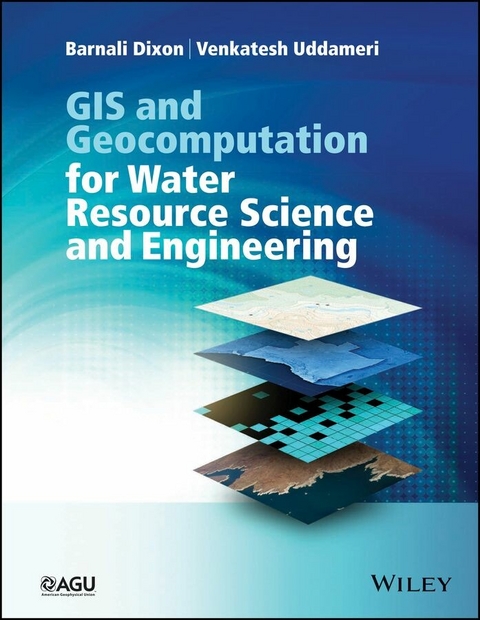
GIS and Geocomputation for Water Resource Science and Engineering (eBook)
John Wiley & Sons (Verlag)
978-1-118-82618-8 (ISBN)
GIS and Geocomputation for Water Resource Science and Engineering not only provides a comprehensive introduction to the fundamentals of geographic information systems but also demonstrates how GIS and mathematical models can be integrated to develop spatial decision support systems to support water resources planning, management and engineering, The book uses a hands-on active learning approach to introduce fundamental concepts and numerous case-studies are provided to reinforce learning and demonstrate practical aspects, The benefits and challenges of using GIS in environmental and water resources fields are clearly tackled in this book, demonstrating how these technologies can be used to harness increasingly available digital data to develop spatially-oriented sustainable solutions, In addition to providing a strong grounding on fundamentals, the book also demonstrates how GIS can be combined with traditional physics-based and statistical models as well as information-theoretic tools like neural networks and fuzzy set theory,
BARNALI DIXON is a Professor in the Department of Environmental Science, Policy and Geography, University of South Florida St, Petersburg (USFSP) and the Director of the Geospatial Analytics Lab of USFSP,
VENKATESH UDDAMERI is a Professor in the Department of Civil, Environmental and Construction Engineering at Texas Tech University and the Director of the TTU Water Resources Center,
GIS and Geocomputation for Water Resource Science and Engineering not only provides a comprehensive introduction to the fundamentals of geographic information systems but also demonstrates how GIS and mathematical models can be integrated to develop spatial decision support systems to support water resources planning, management and engineering. The book uses a hands-on active learning approach to introduce fundamental concepts and numerous case-studies are provided to reinforce learning and demonstrate practical aspects. The benefits and challenges of using GIS in environmental and water resources fields are clearly tackled in this book, demonstrating how these technologies can be used to harness increasingly available digital data to develop spatially-oriented sustainable solutions. In addition to providing a strong grounding on fundamentals, the book also demonstrates how GIS can be combined with traditional physics-based and statistical models as well as information-theoretic tools like neural networks and fuzzy set theory.
BARNALI DIXON is a Professor in the Department of Environmental Science, Policy and Geography, University of South Florida St. Petersburg (USFSP) and the Director of the Geospatial Analytics Lab of USFSP. VENKATESH UDDAMERI is a Professor in the Department of Civil, Environmental and Construction Engineering at Texas Tech University and the Director of the TTU Water Resources Center.
List of Acronyms
| Abbreviation | Details |
| AAE | Average absolute error |
| ACRIMSAT | Active Cavity Radiometer Irradiance Monitor Satellite |
| ACWPP | Arroyo Colorado Watershed Protection Program |
| ADEQ | Arkansas Department of Environmental Quality |
| AF | Attenuation factor |
| AFC | Attenuation factor calculator |
| AFY | Acre-feet per year |
| AHP | Analytical Hierarchy Process |
| AI | Artificial intelligence |
| AIC | Akaike's information criterion |
| ANFIS | Artificial Neuro-Fuzzy Information Systems |
| ANN | Artificial Neural Networks |
| AOI | Area of interest |
| AP | Apparent color |
| ASCII | American Standard Code for Information Interchange |
| ASMC | Antecedent soil moisture conditions |
| ASR | Aquifer storage and recovery |
| ASTER | Advanced Spaceborne Thermal Emission and Reflection Radiometer |
| ASV | Autonomous surface vehicles |
| AVHRR | Advanced Very High Resolution Radiometer |
| AVIRIS | Airborne Visible InfraRed Imaging Spectrometer |
| AWRC | Arkansas Water Resources Center |
| BASINS | Better Assessment Science Integrating Point and Nonpoint Sources |
| BCF | Billions of cubic feet |
| BD | Bulk density |
| BGIS | Basin Geomorphic Information System |
| BIL | Band interleaved by line |
| BMPs | Best Management Practices |
| BOD | Biochemical oxygen demand |
| CAD | Computer Aided Design |
| CART | Classification and regression trees |
| CC | Correlation coefficient |
| CCN | Certificate of convenience and necessity |
| CEC | Cation exchange capacity |
| CERL | Construction Engineering Research Laboratory |
| CERP | Comprehensive Everglades Restoration Plan |
| CHIPS | Colonia Health, Infrastructure, and Planning Status |
| CI | Convexity index |
| CN | Curve number |
| COAV | Class-object-attribute-value |
| CSA | Clay settling area |
| CWA | Clean Water Act |
| DBMS | Database management system |
| DCIA | Directly connected impervious area |
| DEDNM | Digital Elevation Drainage Network Model |
| DEM | Digital elevation model |
| DFA | Discriminant function analysis |
| DGN | Design file |
| DGPS | Differential GPS |
| DLG | Digital line graphs |
| DO | Dissolved oxygen |
| DOM | Dissolved organic matter |
| DOQQs | Digital Orthophoto Quarter Quads |
| DOQs | Digital Orthophoto Quadrangles |
| DRASTIC | Aquifer vulnerability index: Depth to water table, Recharge, Aquifer media, Soil type, Topography, Impact of vadose zone, Conductivity |
| DSM | Digital surface model |
| DSS | Decision support systems |
| DTM | Digital terrain model |
| E/ET or ET/EV | Evaporation/evapotranspiration |
| EDAP | Economically distressed area program |
| EF | Ecological Fallacy |
| ELM | Everglade Landscape Model |
| EMC | Event mean concentration |
| EMR | Electromagnetic radiation |
| ENVI | Environment for Visualizing Images |
| EPA | Environmental Protection Agency |
| EROS | Earth Resources Observation and Science |
| ESA | European Space Agency |
| ESRI | Environmental Systems Research Institute |
| ESSP | Earth System Science Pathfinder Program |
| ESTDM | Event-based spatiotemporal data model |
| ET | Evapotranspiration |
| ETJ | Extraterritorial jurisdiction |
| ETM | Enhanced Thematic Mapper (Landsat) |
| ETM+ | Enhanced Thematic Mapper Plus |
| FAC2 | Fraction of predictions within a factor of two of observations |
| FAVA | Florida Aquifer Vulnerability Assessment |
| FAWN | Florida Automated Weather Network |
| FB | Fractional bias |
| FD | Fractal dimension |
| FDEP | Florida Department of Environmental Protection |
| FDOH | Florida Department of Health |
| FEMA | Federal Emergency Management Agency |
| FFNN | Feedforward neural network |
| FGDC | Federal Geographic Data Commission |
| FLUCCS | Florida land use and cover classification system |
| FMG Info Atlas | Info Atlas for Bay of Fundy, Gulf of Maine |
| FORTRAN | Formula Translation |
| FWRI | Fish and Wildlife Research Institute (Florida) |
| GAM | Groundwater availability modeling |
| GCDs | Groundwater Conservation Districts |
| GCM | Global climate model |
| GCPs | Ground control points |
| GeoTIFF | Georeferenced Tagged Image File Format |
| GIRAS | Geographic Information Retrieval and Analysis System |
| GIS | Geographic Information Systems |
| GOCE | Gravity field and steady-state Ocean Circulation Explorer |
| GOES | Geostationary Operational Environmental Satellite |
| GPS | Global Positioning system |
| GRACE | Gravity Recovery and Climate Experiment |
| GRASS | Geographic Resources Analysis Support System |
| GRDC | Global Runoff Data Center |
| GRS | Geodetic Reference System |
| GUI | Graphical User Interface |
| GUS | Groundwater ubiquity score |
| GWVIP | Groundwater Vulnerability Index for Pesticides |
| HABs | Harmful Algal Blooms |
| HAL | Health advisory level |
| HEC | Hydrologic Engineering Center |
| HEC-RAS | Hydrologic Engineering Center River Analysis System |
| HMS | Hydrologic Modeling Systems |
| HRUs | Hydrologic Response Units |
| HSG | Hydrologic soil group |
| HUC | Hydrologic unit code |
| HUC# | Hydrologic Unit Catalog number |
| I&O | Index and overlay |
| ICA | International Cartographic Association |
| IDL | Interactive Data Language |
| IDW | Inverse distance weighted |
| IFOV | Instantaneous field of... |
| Erscheint lt. Verlag | 30.11.2015 |
|---|---|
| Reihe/Serie | Wiley Works |
| Wiley Works | Wiley Works |
| Sprache | englisch |
| Themenwelt | Naturwissenschaften ► Geowissenschaften ► Geografie / Kartografie |
| Naturwissenschaften ► Geowissenschaften ► Geologie | |
| Naturwissenschaften ► Geowissenschaften ► Hydrologie / Ozeanografie | |
| Technik ► Bauwesen | |
| Technik ► Umwelttechnik / Biotechnologie | |
| Schlagworte | Bauingenieur- u. Bauwesen • Civil Engineering & Construction • earth sciences • Environmental Engineering • Geoinformationssystem • Geowissenschaften • GIS & Remote Sensing • GIS, remote sensing, geocomputation, water resources, hydrology, hydrological science, hydroengineering, geological engineering, geophysics, geology, environmental science, resource management, environmental resources, environmental • GIS u. Fernerkundung • Management von Wasservorräten • Management von Wasservorräten • Umwelttechnik • Wasservorrat • Water resource management |
| ISBN-10 | 1-118-82618-3 / 1118826183 |
| ISBN-13 | 978-1-118-82618-8 / 9781118826188 |
| Informationen gemäß Produktsicherheitsverordnung (GPSR) | |
| Haben Sie eine Frage zum Produkt? |
 EPUB (Adobe DRM)
Kopierschutz: Adobe-DRM
Adobe-DRM ist ein Kopierschutz, der das eBook vor Mißbrauch schützen soll. Dabei wird das eBook bereits beim Download auf Ihre persönliche Adobe-ID autorisiert. Lesen können Sie das eBook dann nur auf den Geräten, welche ebenfalls auf Ihre Adobe-ID registriert sind.
Details zum Adobe-DRM
Dateiformat: EPUB (Electronic Publication)
EPUB ist ein offener Standard für eBooks und eignet sich besonders zur Darstellung von Belletristik und Sachbüchern. Der Fließtext wird dynamisch an die Display- und Schriftgröße angepasst. Auch für mobile Lesegeräte ist EPUB daher gut geeignet.
Systemvoraussetzungen:
PC/Mac: Mit einem PC oder Mac können Sie dieses eBook lesen. Sie benötigen eine
eReader: Dieses eBook kann mit (fast) allen eBook-Readern gelesen werden. Mit dem amazon-Kindle ist es aber nicht kompatibel.
Smartphone/Tablet: Egal ob Apple oder Android, dieses eBook können Sie lesen. Sie benötigen eine
Geräteliste und zusätzliche Hinweise
Buying eBooks from abroad
For tax law reasons we can sell eBooks just within Germany and Switzerland. Regrettably we cannot fulfill eBook-orders from other countries.
aus dem Bereich