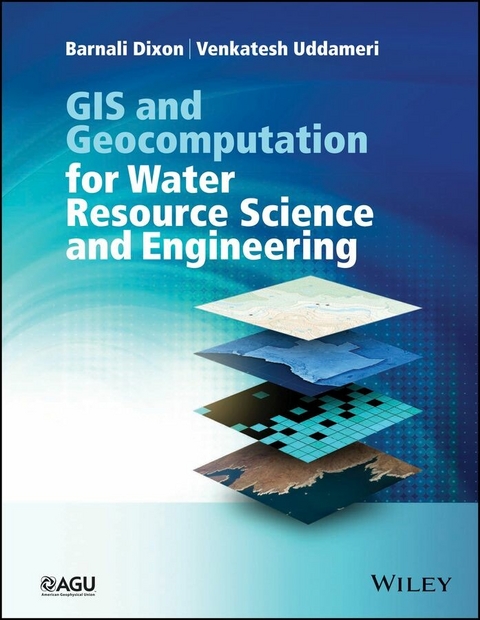
GIS and Geocomputation for Water Resource Science and Engineering (eBook)
John Wiley & Sons (Verlag)
978-1-118-82621-8 (ISBN)
GIS and Geocomputation for Water Resource Science and Engineering not only provides a comprehensive introduction to the fundamentals of geographic information systems but also demonstrates how GIS and mathematical models can be integrated to develop spatial decision support systems to support water resources planning, management and engineering. The book uses a hands-on active learning approach to introduce fundamental concepts and numerous case-studies are provided to reinforce learning and demonstrate practical aspects. The benefits and challenges of using GIS in environmental and water resources fields are clearly tackled in this book, demonstrating how these technologies can be used to harness increasingly available digital data to develop spatially-oriented sustainable solutions. In addition to providing a strong grounding on fundamentals, the book also demonstrates how GIS can be combined with traditional physics-based and statistical models as well as information-theoretic tools like neural networks and fuzzy set theory.
BARNALI DIXON is a Professor in the Department of Environmental Science, Policy and Geography, University of South Florida St. Petersburg (USFSP) and the Director of the Geospatial Analytics Lab of USFSP.
VENKATESH UDDAMERI is a Professor in the Department of Civil, Environmental and Construction Engineering at Texas Tech University and the Director of the TTU Water Resources Center.
GIS and Geocomputation for Water Resource Science and Engineering not only provides a comprehensive introduction to the fundamentals of geographic information systems but also demonstrates how GIS and mathematical models can be integrated to develop spatial decision support systems to support water resources planning, management and engineering. The book uses a hands-on active learning approach to introduce fundamental concepts and numerous case-studies are provided to reinforce learning and demonstrate practical aspects. The benefits and challenges of using GIS in environmental and water resources fields are clearly tackled in this book, demonstrating how these technologies can be used to harness increasingly available digital data to develop spatially-oriented sustainable solutions. In addition to providing a strong grounding on fundamentals, the book also demonstrates how GIS can be combined with traditional physics-based and statistical models as well as information-theoretic tools like neural networks and fuzzy set theory.
BARNALI DIXON is a Professor in the Department of Environmental Science, Policy and Geography, University of South Florida St. Petersburg (USFSP) and the Director of the Geospatial Analytics Lab of USFSP. VENKATESH UDDAMERI is a Professor in the Department of Civil, Environmental and Construction Engineering at Texas Tech University and the Director of the TTU Water Resources Center.
| Erscheint lt. Verlag | 25.11.2015 |
|---|---|
| Reihe/Serie | Wiley Works |
| Wiley Works | Wiley Works |
| Sprache | englisch |
| Themenwelt | Naturwissenschaften ► Geowissenschaften ► Geografie / Kartografie |
| Naturwissenschaften ► Geowissenschaften ► Geologie | |
| Naturwissenschaften ► Geowissenschaften ► Hydrologie / Ozeanografie | |
| Technik ► Bauwesen | |
| Technik ► Umwelttechnik / Biotechnologie | |
| Schlagworte | Bauingenieur- u. Bauwesen • Civil Engineering & Construction • earth sciences • Environmental Engineering • Geoinformationssystem • Geowissenschaften • GIS & Remote Sensing • GIS, remote sensing, geocomputation, water resources, hydrology, hydrological science, hydroengineering, geological engineering, geophysics, geology, environmental science, resource management, environmental resources, environmental • GIS u. Fernerkundung • Management von Wasservorräten • Management von Wasservorräten • Umwelttechnik • Wasservorrat • Water resource management |
| ISBN-10 | 1-118-82621-3 / 1118826213 |
| ISBN-13 | 978-1-118-82621-8 / 9781118826218 |
| Informationen gemäß Produktsicherheitsverordnung (GPSR) | |
| Haben Sie eine Frage zum Produkt? |
 PDF (Adobe DRM)
Kopierschutz: Adobe-DRM
Adobe-DRM ist ein Kopierschutz, der das eBook vor Mißbrauch schützen soll. Dabei wird das eBook bereits beim Download auf Ihre persönliche Adobe-ID autorisiert. Lesen können Sie das eBook dann nur auf den Geräten, welche ebenfalls auf Ihre Adobe-ID registriert sind.
Details zum Adobe-DRM
Dateiformat: PDF (Portable Document Format)
Mit einem festen Seitenlayout eignet sich die PDF besonders für Fachbücher mit Spalten, Tabellen und Abbildungen. Eine PDF kann auf fast allen Geräten angezeigt werden, ist aber für kleine Displays (Smartphone, eReader) nur eingeschränkt geeignet.
Systemvoraussetzungen:
PC/Mac: Mit einem PC oder Mac können Sie dieses eBook lesen. Sie benötigen eine
eReader: Dieses eBook kann mit (fast) allen eBook-Readern gelesen werden. Mit dem amazon-Kindle ist es aber nicht kompatibel.
Smartphone/Tablet: Egal ob Apple oder Android, dieses eBook können Sie lesen. Sie benötigen eine
Geräteliste und zusätzliche Hinweise
Buying eBooks from abroad
For tax law reasons we can sell eBooks just within Germany and Switzerland. Regrettably we cannot fulfill eBook-orders from other countries.
aus dem Bereich