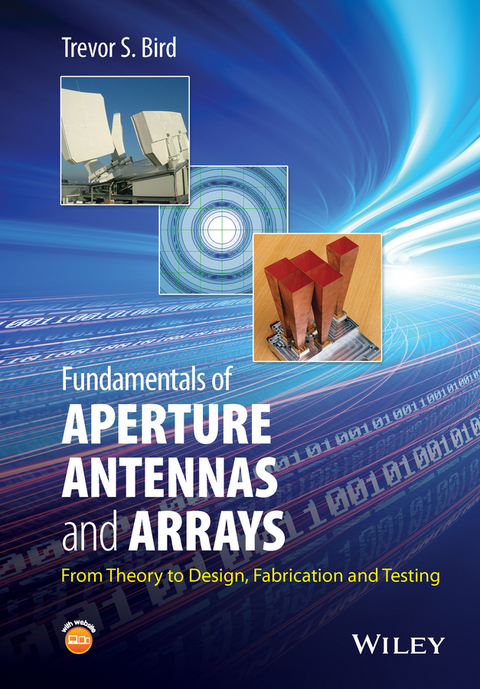
Fundamentals of Aperture Antennas and Arrays (eBook)
448 Seiten
Wiley (Verlag)
978-1-118-92354-2 (ISBN)

Trevor S. Bird PhD, FTSE, Principal Antengenuity, Adjunct Professor Macquarie University & Honorary CSIRO Fellow, Australia.
1
Introduction
The topic of this book covers a class of antenna in common use today as well as a way of describing many others. Examples include waveguides, horns, reflectors, lenses, slits, slots and printed antennas. Some examples are illustrated in Figure 1.1. In the following chapters, the background theory and application of some basic forms of these antennas are described as well as how they can be designed, fabricated and tested. Additionally, detail will be provided on some of the individual antennas pictured in Figure 1.1.
Figure 1.1 Examples of aperture antennas. (a) Open-ended waveguide antennas (right to left) coaxial, circular and rectangular. (b) Circular waveguide (diameter 32.7 mm) with three ring-slots designed for operation at 9 GHz. (c) Feed array of pyramidal horns for 12.25–12.75 GHz. (d) 11–14.5 GHz high-performance circular corrugated feed horn, diameter 273 mm, and flare angle 11.8°. (e) Small paraboloidal reflector and rear waveguide feed designed for a 15 GHz microwave link. (f) 64 m Parkes radio telescope is a front-fed paraboloid (f/D = 0.408). This versatile instrument has been used for frequencies from 30 MHz to >90 GHz.
Source: Reproduced with permission from CSIRO (a–f)
(g) Two multibeam earth station antennas at Danish Radio’s multimedia house in Ørestad in Copenhagen, Denmark, covering different segments of the geostationary satellite arc. (h) Multibeam feed system for the Parkes radio telescope.
Source: Reproduced with permission from CSIRO.
(i) On-board Ku-band satellite antennas under test on an outdoor test range prior to launch. (j) Dual-offset Cassegrain antenna with a waveguide array feed cluster under test in anechoic chamber (Bird & Boomars, 1980). (k) Series-fed microstrip patch array for a microwave landing system.
Source: Reproduced from INTERSCAN International Ltd.
(l) Conformal array of rectangular waveguides (22.86 × 10.16 mm) on a cylinder of radius 126.24 mm.
Source: Picture courtesy of Plessey Electronic Systems
Aperture antennas are normally associated with directional radiation beams and, indeed, this is their purpose in many applications. They can also create other types of beams such as shaped or contoured beams either separately or combined as arrays as will be shown. Aperture antennas can also occur on non-planar or conformal surfaces such as on aircraft or missile bodies where airflow and aerodynamic performance are paramount. Conformal antennas can consist of a single radiator or arrays in the surface where they can be used to provide directional and shaped beams.
Aperture antennas can be used to produce omnidirectional radiation patterns, which are important if the antenna platform is unstable or the user direction is unknown, for all-round electronic surveillance and monitoring or where the location of another user cannot be guaranteed such as in mobile radio systems. A 360-degree coverage can be achieved with a conformal antenna or with electronic switching between planar elements.
Directional beams are required in terrestrial and satellite microwave links to efficiently use the available power as well as to reduce interference and noise. Directional antennas are also required in radar systems to identify targets. A limitation of a directional planar antenna is that when it is scanned from broadside (typically boresight) the beam broadens and the pattern deteriorates. When the antenna is conformal to a convex surface, such as a cylinder or a cone, the beam can be scanned in discrete steps through an arc while maintaining a constant pattern. Recent developments in microwave and optical components have simplified the design of feed networks, thereby making conformal antennas and arrays attractive alternatives for directive applications as well as for scanned beam and in ultra-low sidelobe antennas. Of importance in the design of the latter, both planar and conformal antenna arrays are often employed, and in this application predicting the effect of mutual coupling between the array elements should be undertaken. Maximum performance is achieved from arrays when the effects of coupling are known and included in the design. Otherwise, the full potential of the array flexibility may not be realized.
Aperture antennas may be analysed in much the same way as the conceptually simpler wire antennas. First, the designer needs to find the currents on the conductors or in other materials from which the antenna is constructed. To do this exactly is usually impossible except in a few idealized cases, and numerical methods are required to obtain approximate solutions. After the currents are known, the radiated fields are obtained from Maxwell’s equations. Sometimes, however, adequate design information may be obtained from simplified approximations to the current, similar in some regards to adopting a sinusoidal current approximation on a linear wire antenna. This approach is especially valuable for analysing the far-field radiation characteristics, which are relatively insensitive to second-order variations in the current distribution. However, for more detailed information or quantities such as the input impedance, reflection coefficient at the input of horns or the effects of mutual coupling from nearby antennas, an accurate representation of the currents is usually required to properly take account of the current variations and near-field behaviour.
The representation of actual currents on the antenna structure may be difficult, or impossible, to achieve analytically because of the geometry and materials involved. It is convenient, and also physically allowable, to replace the actual sources by equivalent sources at the radiating surface, the antenna ‘aperture’, which need not lie on the actual antenna surface but on another often fictitious surface close by. For example, the aperture of a paraboloid reflector may be the projection of the rim onto a suitable plane. These equivalent sources are used in the same way as actual sources to find the radiated fields. Once these fields are known, an assessment of the antenna’s performance can be made.
For the engineer wishing to specialize in the area of communications systems, some knowledge is needed of the theory and design of aperture antennas. The intention of this book is to provide some of this basic information. Today, compared with prior to the 1980s and even earlier, a variety of full wave computer solvers are now available and are particularly valuable for final design and analysis. The fundamental material available in this book is important as a starting point and for understanding the physical nature of the antenna structure before more detailed design is undertaken. It is intended that readers should be able to move from the present material to more specialized topics and to the research literature. In addition, the details provided herein should help the non-specialist in antennas to critically assess aperture antenna specifications. Where possible, useful design information has also been included. An underlying assumption is that the reader is familiar with the basic concepts of electromagnetic fields, waves and radiation, as presented, in a variety of excellent textbooks (Harrington, 1961; Jones, 1964; Jordan & Balmain, 1968; Kraus & Carver, 1973; Johnk, 1975). Some topics of a more advanced nature have also been included here, beyond those of a typical introductory course. These are indicated by an asterisk (*) after the section heading. They have been included as possible extensions from standard material for more specialized courses, research or possibly part of a project.
The material included here is based on notes for several courses in antennas given to fourth year students in Electrical Engineering at James Cook University of North Queensland and also at the University of Queensland in the 1980s. At that time there was no suitable modern textbook available on antennas for undergraduate teaching. Since then, several excellent textbooks have appeared (Balanis, 1982). In addition, the notes were found useful over the years by members of my research group at CSIRO. Other relevant material had been developed on mutual coupling for presentation at several symposia held in the 1990s, and some of this information has been included here. As might be anticipated, practical topics of relevance that were encountered during my research career have been included as well.
The purpose of this book is to provide a stand-alone textbook for a course in antennas, possibly in the final undergraduate years or in a master’s degree by coursework. It should also be useful for Ph.D. candidates and practising engineers. For continuity, some background electromagnetics, fields and waves are included.
The antennas described in detail include horns, reflectors, lenses, patch radiators and arrays of some of these antennas. Because of its importance and to provide more than a superficial treatment of arrays, the topic of mutual coupling is covered in greater detail than most similar books in the area. Also included is an introduction to sources and arrays on non-planar surfaces, which is important for applications involving aerodynamic surfaces and for making aperture antennas unobtrusive. An introduction to the fabrication and...
| Erscheint lt. Verlag | 2.11.2015 |
|---|---|
| Sprache | englisch |
| Themenwelt | Technik ► Bauwesen |
| Technik ► Elektrotechnik / Energietechnik | |
| Technik ► Nachrichtentechnik | |
| Schlagworte | antennas • Antennas & Propagation • Antenne • apertures • Arrays • Drahtlose Kommunikation • Electrical & Electronics Engineering • Electromagnetic theory • Elektromagnetismus • Elektrotechnik u. Elektronik • Maxwell's equations • Mobile & Wireless Communications • reflectors • Sende- u. Empfangseinrichtungen • wireless communications |
| ISBN-10 | 1-118-92354-5 / 1118923545 |
| ISBN-13 | 978-1-118-92354-2 / 9781118923542 |
| Informationen gemäß Produktsicherheitsverordnung (GPSR) | |
| Haben Sie eine Frage zum Produkt? |
 EPUB (Adobe DRM)
Kopierschutz: Adobe-DRM
Adobe-DRM ist ein Kopierschutz, der das eBook vor Mißbrauch schützen soll. Dabei wird das eBook bereits beim Download auf Ihre persönliche Adobe-ID autorisiert. Lesen können Sie das eBook dann nur auf den Geräten, welche ebenfalls auf Ihre Adobe-ID registriert sind.
Details zum Adobe-DRM
Dateiformat: EPUB (Electronic Publication)
EPUB ist ein offener Standard für eBooks und eignet sich besonders zur Darstellung von Belletristik und Sachbüchern. Der Fließtext wird dynamisch an die Display- und Schriftgröße angepasst. Auch für mobile Lesegeräte ist EPUB daher gut geeignet.
Systemvoraussetzungen:
PC/Mac: Mit einem PC oder Mac können Sie dieses eBook lesen. Sie benötigen eine
eReader: Dieses eBook kann mit (fast) allen eBook-Readern gelesen werden. Mit dem amazon-Kindle ist es aber nicht kompatibel.
Smartphone/Tablet: Egal ob Apple oder Android, dieses eBook können Sie lesen. Sie benötigen eine
Geräteliste und zusätzliche Hinweise
Buying eBooks from abroad
For tax law reasons we can sell eBooks just within Germany and Switzerland. Regrettably we cannot fulfill eBook-orders from other countries.
aus dem Bereich