Zum Hauptinhalt springen
Nicht aus der Schweiz? Besuchen Sie lehmanns.de
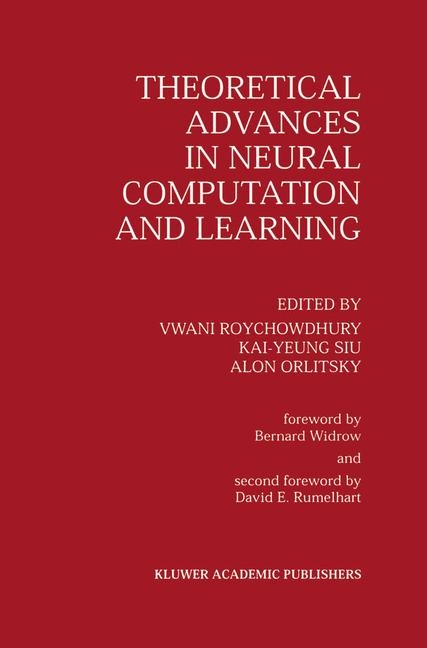
Theoretical Advances in Neural Computation and Learning -

Theoretical Advances in Neural Computation and Learning (eBook)

eBook Download: PDF
2012
Springer US (Verlag)
9781461526964 (ISBN)
Systemvoraussetzungen
170,76 inkl. MwSt
(CHF 166,80)
Der eBook-Verkauf erfolgt durch die Lehmanns Media GmbH (Berlin) zum Preis in Euro inkl. MwSt.
  • Download sofort lieferbar
  • Zahlungsarten anzeigen
For any research field to have a lasting impact, there must be a firm theoretical foundation. Neural networks research is no exception. Some of the founda- tional concepts, established several decades ago, led to the early promise of developing machines exhibiting intelligence. The motivation for studying such machines comes from the fact that the brain is far more efficient in visual processing and speech recognition than existing computers. Undoubtedly, neu- robiological systems employ very different computational principles. The study of artificial neural networks aims at understanding these computational prin- ciples and applying them in the solutions of engineering problems. Due to the recent advances in both device technology and computational science, we are currently witnessing an explosive growth in the studies of neural networks and their applications. It may take many years before we have a complete understanding about the mechanisms of neural systems. Before this ultimate goal can be achieved, an- swers are needed to important fundamental questions such as (a) what can neu- ral networks do that traditional computing techniques cannot, (b) how does the complexity of the network for an application relate to the complexity of that problem, and (c) how much training data are required for the resulting network to learn properly? Everyone working in the field has attempted to answer these questions, but general solutions remain elusive. However, encouraging progress in studying specific neural models has been made by researchers from various disciplines.
PDFPDF (Adobe DRM)

Kopierschutz: Adobe-DRM
Adobe-DRM ist ein Kopierschutz, der das eBook vor Mißbrauch schützen soll. Dabei wird das eBook bereits beim Download auf Ihre persönliche Adobe-ID autorisiert. Lesen können Sie das eBook dann nur auf den Geräten, welche ebenfalls auf Ihre Adobe-ID registriert sind.
Details zum Adobe-DRM

Dateiformat: PDF (Portable Document Format)
Mit einem festen Seiten­layout eignet sich die PDF besonders für Fach­bücher mit Spalten, Tabellen und Abbild­ungen. Eine PDF kann auf fast allen Geräten ange­zeigt werden, ist aber für kleine Displays (Smart­phone, eReader) nur einge­schränkt geeignet.

Systemvoraussetzungen:
PC/Mac: Mit einem PC oder Mac können Sie dieses eBook lesen. Sie benötigen eine Adobe-ID und die Software Adobe Digital Editions (kostenlos). Von der Benutzung der OverDrive Media Console raten wir Ihnen ab. Erfahrungsgemäß treten hier gehäuft Probleme mit dem Adobe DRM auf.
eReader: Dieses eBook kann mit (fast) allen eBook-Readern gelesen werden. Mit dem amazon-Kindle ist es aber nicht kompatibel.
Smartphone/Tablet: Egal ob Apple oder Android, dieses eBook können Sie lesen. Sie benötigen eine Adobe-ID sowie eine kostenlose App.
Geräteliste und zusätzliche Hinweise

Buying eBooks from abroad
For tax law reasons we can sell eBooks just within Germany and Switzerland. Regrettably we cannot fulfill eBook-orders from other countries.

Mehr entdecken
aus dem Bereich
Die Welt der generativen KI verstehen

von Daniel Scholz

eBook Download (2025)
Carl Hanser Verlag GmbH & Co. KG
CHF 34,15
A Comprehensive Guide for Beginners: Unlocking Computational Thinking

von Cuantum Technologies LLC

eBook Download (2024)
De Gruyter (Verlag)
CHF 25,35