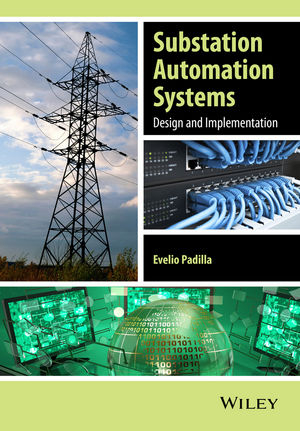
Substation Automation Systems (eBook)
John Wiley & Sons (Verlag)
978-1-118-98729-2 (ISBN)
Substation Automation Systems: Design and Implementation aims to close the gap created by fast changing technologies impacting on a series of legacy principles related to how substation secondary systems are conceived and implemented. It is intended to help those who have to define and implement SAS, whilst also conforming to the current industry best practice standards.
Key features:
- Project-oriented approach to all practical aspects of SAS design and project development.
- Uniquely focusses on the rapidly changing control aspect of substation design, using novel communication technologies and IEDs (Intelligent Electronic Devices).
- Covers the complete chain of SAS components and related equipment instead of purely concentrating on intelligent electronic devices and communication networks.
- Discusses control and monitoring facilities for auxiliary power systems.
- Contributes significantly to the understanding of the standard IEC 61850, which is viewed as a “black box” for a significant number of professionals around the world.
- Explains standard IEC 61850 – Communication networks and systems for power utility automation – to support all new systems networked to perform control, monitoring, automation, metering and protection functions.
Written for practical application, this book is a valuable resource for professionals operating within different SAS project stages including the: specification process; contracting process; design and engineering process; integration process; testing process and the operation and maintenance process.
Substation Automation Systems: Design and Implementation aims to close the gap created by fast changing technologies impacting on a series of legacy principles related to how substation secondary systems are conceived and implemented. It is intended to help those who have to define and implement SAS, whilst also conforming to the current industry best practice standards. Key features: Project-oriented approach to all practical aspects of SAS design and project development. Uniquely focusses on the rapidly changing control aspect of substation design, using novel communication technologies and IEDs (Intelligent Electronic Devices). Covers the complete chain of SAS components and related equipment instead of purely concentrating on intelligent electronic devices and communication networks. Discusses control and monitoring facilities for auxiliary power systems. Contributes significantly to the understanding of the standard IEC 61850, which is viewed as a black box for a significant number of professionals around the world. Explains standard IEC 61850 Communication networks and systems for power utility automation to support all new systems networked to perform control, monitoring, automation, metering and protection functions. Written for practical application, this book is a valuable resource for professionals operating within different SAS project stages including the: specification process; contracting process; design and engineering process; integration process; testing process and the operation and maintenance process.
Evelio Padilla, ELEUNION, Caracas, Venezuela With over a decade of experience in substation control systems, Evelio Padilla has project managed numerous substation designs and constructions and has written several relevant technical publications. He is currently a consultant at ELEUNION C.A., which is dedicated to supplying high and medium voltage apparatus and components to electrical utilities and general industries. Previously, as Substation Division Manager at EDELCA (now CORPOELEC), he was responsible for design and construction of substations including technical specification, bids analysis, contracting procedure, review of detailed design, follow-up on the milestones, follow-up on the site work progress regularly. He was also Head of Substation Engineering Department, responsible for basic design of high voltage substations including preparation of technical specification for purchase order of secondary items, bids analysis, review of detailed design.
1
Historical Evolution of Substation Automation Systems (SASs)
The key goal in the operation of electrical power systems is to maintain the energy balance between generation and demand in an economic manner. This often requires changes in system configuration to keep voltage and frequency parameters at acceptable pre-specified ranges; furthermore, configuration changes are needed for maintenance work at utility installations or for clearing faults due to short-circuit currents. Typical changes in system configurations include connection and disconnection of generators, power transformers, transmission lines, shunt reactors and static reactive power compensators. Therefore, such changes in system configuration are made through control facilities available in both generation stations and substations located along transmission and distribution systems (see a view of a substation in Figure 1.1).
Figure 1.1 View of a 765 kV electric substation.
Source: © Corpoelec. Reproduced with permission of Corpoelec
Until a few decades ago, the control of electric substations was based on systems consisting of discrete electronic or electromechanical elements, where several functions were carried out separately by specific subsystems. Although those arrangements were reliable because the failure of a subsystem does not affect the performance of the rest of control facilities, it was also quite expensive, as they require a large investment in wiring, cubicles and civil engineering work. Back then, stations were controlled through a large mimic control board located in the main control house, as shown in Figure 1.2.
Figure 1.2 Old mimic control board.
Source: © Corpoelec. Reproduced with permission of Corpoelec
Sometimes, primary arrangements of substations were placed outside control cubicles lodged in dedicated relay rooms (Figure 1.3).
Figure 1.3 Substation primary arrangement shown outside control cubicles.
Source: © Corpoelec. Reproduced with permission of Corpoelec
One of the most emblematic components of that age was the flag relay shown in Figure 1.4, which was the main way to display alarms for the attention of the substation operator.
Figure 1.4 Flag relay.
Source: © Corpoelec. Reproduced with permission of Corpoelec
In terms of civil engineering work, some substations were provided with large concrete channels where several kilometers of copper cables were run, as shown in Figure 1.5.
Figure 1.5 Old cabling channels.
Source: © Corpoelec. Reproduced with permission of Corpoelec
When microprocessor based substation control systems were originally developed, they were conceived as RTU-centric architecture, and later a distributed LAN architecture became the predominant technology. In more recent years, when control systems and other secondary systems began to incorporate new communication technologies and Intelligent Electronic Devices (IEDs), the complete set of secondary facilities and functionalities was referred to as “Substation Automation Systems” (SASs).
1.1 Emerging Communication Technologies
Development of communication technologies represents an important step allowing SASs to be more and more versatile and increase functionality. The most influential new technologies applied in substations are described in the following sections.
1.1.1 Serial Communication
Serial communication is the process of sending data one bit at a time, over a single communication line. In contrast, parallel communication requires at least as many lines as there are bits in a word being transmitted. This kind of communication was widely used at the beginning of the digital technology incursion in substations; in particular for relay to relay connections through a RS-232 interface. In recent years, instead of serial communication, Ethernet connectivity is gaining a place.
1.1.2 Local Area Network
As a group of computers/devices connected together locally to communicate with one another and share resources, this solution was early dedicated to office environments and later introduced to industrial applications, including substations. The use of LANs in a substation is increasing, in particular the Ethernet LAN specified in Standard IEEE 802.3.
1.2 Intelligent Electronic Devices (IEDs)
Generally, this refers to any device provided with one or several microprocessors able to receive/send data to or from another element. The most common IEDs used in substations are the following types:
1.2.1 Functional Relays
Digital relays (sometimes called computer relays, numerical relays or microprocessor-based relays) are devices that accept inputs and process them using logical algorithms to develop outputs addressed to make decisions resulting in trip commands or alarm signals. Early on, this kind of relay was designed to replace existing electromechanical or electronic protective relays and some years later they were also extended for use in control and monitoring functions.
1.2.2 Integrated Digital Units
Integrated digital units (also called multifunctional relays) have been developed for improving the efficiency of the substation secondary system decreasing the total cost of the asset by adding, in one element, several functions such as protection, control, monitoring and communication. This kind of device is widely used in particular for medium voltage substations where required availability is not a critical aspect.
1.3 Networking Media
The physical structure of LANs compresses cabling segments and connectivity devices allow computers and other IEDs connected to the LAN to share data and communicate. In the past, these elements were made up of copper wires and standardized communication ports and interfaces. Nowadays, these networking media are made with the following resources:
1.3.1 Fiber-Optic Cables
The use of optical technology eliminates the need for thousands of copper wires in a substation and replaces them with a few fiber-optic cables, making savings derived from installation and maintenance work while at the same time increasing worker safety and power system reliability. The main technical advantages in using fiber-optic cables in substations include high immunity to electrical interference and generous bandwidth. Today, the industry offers standardized fiber systems compatible with IEC 61850 devices oriented at reducing the chance of mistakes and minimizing costs in testing and commissioning activities.
1.3.2 Network Switches
These components are required to network multiple devices in a LAN. Their main function is to forward data from one device to another on the same network. They do it in an efficient manner since data can be directed from one device to another without affecting other devices on the same network. The most popular network switch used today in substations is the Ethernet switch, with different features or functions.
1.4 Communication Standards
Standards development is currently like “the motor” for SAS evolution. Initially, the Standard IEC 61850 had solved the important paradigm of vendor dependence that was blocking the advances in digital SAS installation for some years. Now, the Standard IEEE 803.2 allows an increase in networking facilities and functionalities. Both standards represent the state of art of SAS design and implementation as we know today, bringing clear rules for hardware design trends by manufacturers and more confidence in SAS users worldwide.
1.4.1 IEC Standard 61850 (Communication Networks and Systems for Power Utility Automation)
This Standard is a collection of publications intending to satisfy existing and emerging needs of the power transmission industry keeping interoperability as the main goal (allowing IEDs provided by different vendors to exchange data and work together in an acceptable manner). The Standard is based on continuous research and studies carried out by prestigious institutions such as UCA, CIGRE and IEEE, as well as the IEC itself. The scope of the standard currently is mainly addressed at the following:
- Technically define communication methods and specify their quality attributes.
- Provide guidelines for SAS project management and network engineering.
- Give recommendations for SAS testing and commissioning.
- Establish procedures for communication between substations.
- Define methods for communication between substations and remote control facilities.
- Provide guidelines for wide area control and monitoring.
The IEC still continues to develop several new areas. Utilities are waiting for them.
1.4.2 IEEE Standard 802.3 (Ethernet)
This standard defines the communication protocol called the “Carrier Sense Multiple Access Collision Detect” (CSMA/CD), which works under the broadcasting principle of carrying all delivered messages to all IEDs connected to a LAN. Currently, the standard maintains leadership on a LAN substation since such protocols were adopted by the IEC 61850 Standard as their communication...
| Erscheint lt. Verlag | 22.9.2015 |
|---|---|
| Sprache | englisch |
| Themenwelt | Naturwissenschaften ► Physik / Astronomie |
| Technik ► Elektrotechnik / Energietechnik | |
| Schlagworte | Communication Networks • data communication • Dielectrics & Electric Insulators • Dielektrika u. Isolatoren • Digital technology in substation • Electrical & Electronics Engineering • Elektrotechnik u. Elektronik • Energie • Energietechnik • Energy • Ethernet applications • High voltage substation • IEC 61850 • Power Technology & Power Engineering • Power transmission and distribution • Qualität • Qualität u. Zuverlässigkeit • Qualität • Qualität u. Zuverlässigkeit • Quality & Reliability • Substation Automation • Substation control and monitoring • Substation Design |
| ISBN-10 | 1-118-98729-2 / 1118987292 |
| ISBN-13 | 978-1-118-98729-2 / 9781118987292 |
| Informationen gemäß Produktsicherheitsverordnung (GPSR) | |
| Haben Sie eine Frage zum Produkt? |
 EPUB (Adobe DRM)
Kopierschutz: Adobe-DRM
Adobe-DRM ist ein Kopierschutz, der das eBook vor Mißbrauch schützen soll. Dabei wird das eBook bereits beim Download auf Ihre persönliche Adobe-ID autorisiert. Lesen können Sie das eBook dann nur auf den Geräten, welche ebenfalls auf Ihre Adobe-ID registriert sind.
Details zum Adobe-DRM
Dateiformat: EPUB (Electronic Publication)
EPUB ist ein offener Standard für eBooks und eignet sich besonders zur Darstellung von Belletristik und Sachbüchern. Der Fließtext wird dynamisch an die Display- und Schriftgröße angepasst. Auch für mobile Lesegeräte ist EPUB daher gut geeignet.
Systemvoraussetzungen:
PC/Mac: Mit einem PC oder Mac können Sie dieses eBook lesen. Sie benötigen eine
eReader: Dieses eBook kann mit (fast) allen eBook-Readern gelesen werden. Mit dem amazon-Kindle ist es aber nicht kompatibel.
Smartphone/Tablet: Egal ob Apple oder Android, dieses eBook können Sie lesen. Sie benötigen eine
Geräteliste und zusätzliche Hinweise
Buying eBooks from abroad
For tax law reasons we can sell eBooks just within Germany and Switzerland. Regrettably we cannot fulfill eBook-orders from other countries.
aus dem Bereich