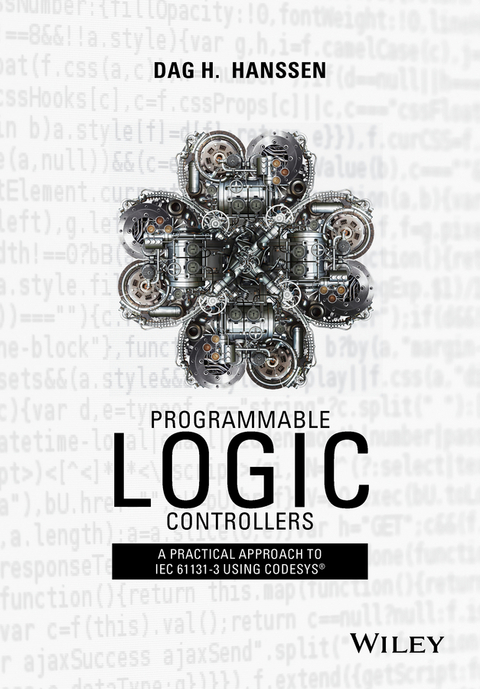
Programmable Logic Controllers (eBook)
John Wiley & Sons (Verlag)
978-1-118-94923-8 (ISBN)
Widely used across industrial and manufacturing automation, Programmable Logic Controllers (PLCs) perform a broad range of electromechanical tasks with multiple input and output arrangements, designed specifically to cope in severe environmental conditions such as automotive and chemical plants.
Programmable Logic Controllers: A Practical Approach using CoDeSys is a hands-on guide to rapidly gain proficiency in the development and operation of PLCs based on the IEC 61131-3 standard. Using the freely-available* software tool CoDeSys, which is widely used in industrial design automation projects, the author takes a highly practical approach to PLC design using real-world examples. The design tool, CoDeSys, also features a built in simulator/soft PLC enabling the reader to undertake exercises and test the examples.
Key features:
- Introduces to programming techniques using IEC 61131-3 guidelines in the five PLC-recognised programming languages.
- Focuses on a methodical approach to programming, based on Boolean algebra, flowcharts, sequence diagrams and state-diagrams.
- Contains a useful methodology to solve problems, develop a structured code and document the programming code.
- Covers I/O like typical sensors, signals, signal formats, noise and cabling.
- Features Power Point slides covering all topics, example programs and solutions to end-of-chapter exercises via companion website.
No prior knowledge of programming PLCs is assumed making this text ideally suited to electronics engineering students pursuing a career in electronic design automation. Experienced PLC users in all fields of manufacturing will discover new possibilities and gain useful tips for more efficient and structured programming.
* Register at www.codesys.com
www.wiley.com/go/hanssen/logiccontrollers
Dag H. Hanssen works as an Assistant Professor in automation at the Institute of Engineering and Safety at the University of Tromsø. During the course of his 18 year long career with the university he has taught many different courses, but he now focusses on control technique, process automation and Application Development.
Widely used across industrial and manufacturing automation, Programmable Logic Controllers (PLCs) perform a broad range of electromechanical tasks with multiple input and output arrangements, designed specifically to cope in severe environmental conditions such as automotive and chemical plants. Programmable Logic Controllers: A Practical Approach using CoDeSys is a hands-on guide to rapidly gain proficiency in the development and operation of PLCs based on the IEC 61131-3 standard. Using the freely-available* software tool CoDeSys, which is widely used in industrial design automation projects, the author takes a highly practical approach to PLC design using real-world examples. The design tool, CoDeSys, also features a built in simulator/soft PLC enabling the reader to undertake exercises and test the examples. Key features: Introduces to programming techniques using IEC 61131-3 guidelines in the five PLC-recognised programming languages. Focuses on a methodical approach to programming, based on Boolean algebra, flowcharts, sequence diagrams and state-diagrams. Contains a useful methodology to solve problems, develop a structured code and document the programming code. Covers I/O like typical sensors, signals, signal formats, noise and cabling. Features Power Point slides covering all topics, example programs and solutions to end-of-chapter exercises via companion website. No prior knowledge of programming PLCs is assumed making this text ideally suited to electronics engineering students pursuing a career in electronic design automation. Experienced PLC users in all fields of manufacturing will discover new possibilities and gain useful tips for more efficient and structured programming. * Register at www.codesys.com www.wiley.com/go/hanssen/logiccontrollers
Dag H. Hanssen works as an Assistant Professor in automation at the Institute of Engineering and Safety at the University of Tromsø. During the course of his 18 year long career with the university he has taught many different courses, but he now focusses on control technique, process automation and Application Development.
Title Page 5
Copyright Page 6
Contents 7
Programmable Logic Controllers 15
Preface 16
Part 1 Hardware 19
Chapter 1 About PLCs 21
1.1 History 22
1.1.1 More Recent Developments 24
1.2 Structure 25
1.2.1 Inputs and Outputs 28
1.3 PLC Operation 31
1.3.1 Process Knowledge 32
1.3.2 Standard Operations 34
1.3.3 Cyclic, Freewheeling, or Event-Controlled Execution 36
1.4 Test Problems 37
Chapter 2 Digital Signals and Digital Inputs and Outputs 38
2.1 Introduction 38
2.2 Terminology 39
2.2.1 Discrete, Digital, Logical, and Binary 39
2.2.2 Sensors, Transducers, and Transmitters 40
2.3 Switches 42
2.3.1 Limit Switches 42
2.3.2 Safety Devices 42
2.3.3 Magnetic Switches 43
2.4 Logical Sensors 44
2.4.1 Inductive Sensors 45
2.4.2 Capacitive Sensors 47
2.4.3 Photocells 48
2.4.4 Ultrasonic Sensors 51
2.4.5 Rotating Sensors (Encoders) 52
2.4.6 Other Detection Principles and Sensors 55
2.5 Connection of Logical Sensors 57
2.5.1 Sink/Source 59
2.5.2 Selecting a Sensor with the Proper Type of Output 61
2.6 Properties of Discrete Inputs 62
2.7 Discrete Actuators 63
2.7.1 Relays and Contactors 64
2.7.2 Solenoids and Magnetic Valves 65
2.7.3 Transistor Outputs versus Relay Outputs 67
2.8 Test Problems 68
Chapter 3 Analog Signals and Analog I/O 70
3.1 Introduction 70
3.2 Digitalization of Analog Signals 71
3.2.1 Filtering 71
3.2.2 A/D Conversion 73
3.3 Analog Instrumentation 76
3.3.1 About Sensors 76
3.3.2 Standard Signal Formats 77
3.3.3 On the 4–20mA Standard 77
3.3.4 Some Other Properties of Sensors 79
3.4 Temperature Sensors 79
3.4.1 Thermocouple 79
3.4.2 PT100/NI1000 80
3.4.3 Thermistors 82
3.5 Connection 82
3.5.1 About Noise, Loss, and Cabling 82
3.5.2 Connecting Sensors 85
3.5.3 Connection of a PT100 (RTD) 86
3.5.4 Connecting Thermocouples 90
3.6 Properties of Analog Input Modules 90
3.6.1 Measurement Ranges and Digitizing: Resolution 90
3.6.2 Important Properties and Parameters 92
3.7 Analog Output Modules and Standard Signal Formats 93
3.8 Test Problems 94
Part 2 Methodic 97
Chapter 4 Structured Design 99
4.1 Introduction 99
4.2 Number Systems 100
4.2.1 The Decimal Number Systems 100
4.2.2 The Binary Number System 100
4.2.3 The Hexadecimal Number System 101
4.2.4 Binary-Coded Decimal Numbers 103
4.2.5 Conversion between Number Systems 104
4.3 Digital Logic 105
4.4 Boolean Design 109
4.4.1 Logical Functional Expressions 109
4.4.2 Boolean Algebra 111
4.5 Sequential Design 115
4.5.1 Flowchart 115
4.5.2 Example: Flowchart for Mixing Process 117
4.5.3 Example: Flowchart for an Automated Packaging Line 119
4.5.4 Sequence Diagrams 125
4.5.5 Example: Sequence Diagram for the Mixing Process 128
4.5.6 Example: Batch Process 130
4.6 State-Based Design 131
4.6.1 Why Use State Diagrams? 132
4.6.2 State Diagrams 132
4.6.3 Example: Batch Process 135
4.6.4 Example: Level Process 136
4.6.5 Example: Packing Facility for Apples 139
4.7 Summary 142
4.8 Test Problems 143
Part 3 IEC 61131-3 149
Chapter 5 Introduction to Programming and IEC 61131-3 151
5.1 Introduction 151
5.1.1 Weaknesses in Traditional PLCs 152
5.1.2 Improvements with IEC 61131-3 154
5.1.3 On Implementation of the Standard 155
5.2 Brief Presentation of the Languages 156
5.2.1 ST 156
5.2.2 FBD 156
5.2.3 LD 157
5.2.4 IL 157
5.2.5 SFC 159
5.3 Program Structure in IEC 61131-3 159
5.3.1 Example of a Configuration 163
5.4 Program Processing 164
5.4.1 Development of Programming Languages 164
5.4.2 From Source Code to Machine Code 165
5.5 Test Problems 169
Chapter 6 IEC 61131-3: Common Language Elements 170
6.1 Introduction 170
6.2 Identifiers, Keywords, and Comments 171
6.2.1 Identifiers 171
6.2.2 Keywords 172
6.2.3 Comments 172
6.3 About Variables and Data Types 174
6.4 Pragmas and Literals 174
6.4.1 Literal 175
6.5 Data Types 176
6.5.1 Numerical and Binary Data Types 176
6.5.2 Data Types for Time and Duration 179
6.5.3 Text Strings 181
6.5.4 Generic Data Types 182
6.5.5 User-Defined Data Types 184
6.6 Variables 187
6.6.1 Conventional Addressing 188
6.6.2 Declaration of Variables with IEC 61131-3 189
6.6.3 Local Versus Global Variables 192
6.6.4 Input and Output Variables 193
6.6.5 Other Variable Types 194
6.7 Direct Addressing 194
6.7.1 Addressing Structure 194
6.7.2 I/O-Addressing 196
6.8 Variable versus I/O-Addresses 197
6.8.1 Unspecified I/O-Addresses 197
6.9 Declaration of Multielement Variables 198
6.9.1 Arrays 199
6.9.2 Data Structures 200
6.10 Test Problems 202
Chapter 7 Functions 205
7.1 Introduction 205
7.2 On Functions 206
7.3 Standard Functions 207
7.3.1 Assignment 208
7.4 Boolean Operations 209
7.5 Arithmetic Functions 210
7.5.1 Overflow 211
7.6 Comparison 212
7.7 Numerical Operations 213
7.7.1 Priority of Execution 214
7.8 Selection 215
7.9 Type Conversion 215
7.10 Bit-String Functions 217
7.11 Text-String Functions 218
7.12 Defining New Functions 220
7.13 EN/ENO 221
7.14 Test Problems 222
Chapter 8 Function Blocks 224
8.1 Introduction 224
8.1.1 The Standard’s FBs 225
8.2 Declaring and Calling FBs 225
8.3 FBs for Flank Detection 226
8.4 Bistable Elements 227
8.5 Timers 228
8.6 Counters 229
8.6.1 Up-Counter 230
8.6.2 Down-Counter 230
8.6.3 Up/Down-Counter 230
8.7 Defining New FBs 231
8.7.1 Encapsulation of Code 232
8.7.2 Other Nonstandardized FBs 234
8.8 Programs 235
8.8.1 Program Calls 236
8.8.2 Execution Control 237
8.9 Test Problems 238
Part 4 Programming 239
Chapter 9 Ladder Diagram (LD)* 241
9.1 Introduction 241
9.2 Program Structure 242
9.2.1 Contacts and Conditions 243
9.2.2 Coils and Actions 244
9.2.3 Graphical Elements: An Overview 245
9.3 Boolean Operations 245
9.3.1 AND/OR-Conditions 245
9.3.2 Set/Reset Coils 248
9.3.3 Edge Detecting Contacts 251
9.3.4 Example: Control of a Mixing Process 252
9.4 Rules for Execution 255
9.4.1 One Output: Several Conditions 255
9.4.2 The Importance of the Order of Execution 256
9.5 Use of Standard Functions in LD 258
9.6 Development and Use of FBs in LD 260
9.7 Structured Programming in LD 262
9.7.1 Flowchart versus RS-Based LD Code 266
9.7.2 State Diagrams versus RS-Based LD Code 271
9.8 Summary 277
9.9 Test Problems 278
Chapter 10 Function Block Diagram (FBD) 280
10.1 Introduction 280
10.2 Program Structure 281
10.2.1 Concepts 282
10.3 Execution Order and Loops 282
10.3.1 Labels and Jumps 283
10.4 User-Defined Functions and FBs 284
10.5 Integer Division 286
10.6 Sequential Programming with FBD 289
10.7 Test Problems 291
Chapter 11 Structured Text (ST) 296
11.1 Introduction 296
11.2 ST in General 297
11.2.1 Program Structure 298
11.3 Standard Functions and Operators 299
11.3.1 Assignment 300
11.4 Calling FBs 301
11.4.1 Flank Detection and Memories 302
11.4.2 Timers 305
11.4.3 Counters 306
11.5 IF Statements 306
11.6 CASE Statements 308
11.7 ST Code Based upon State Diagrams 310
11.7.1 Example: Code for the Level Process 313
11.8 Loops 316
11.8.1 WHILE … DO… END_WHILE 316
11.8.2 FOR … END_FOR 317
11.8.3 REPEAT … END_REPEAT 318
11.8.4 The EXIT Instruction 318
11.9 Example: Defining and Calling Functions 319
11.10 Test Problems 320
Chapter 12 Sequential Function Chart (SFC) 324
12.1 Introduction 324
12.1.1 SFC in General 325
12.2 Structure and Graphics 325
12.2.1 Overview: Graphic Symbols 327
12.2.2 Alternative Branches 327
12.2.3 Parallel Branches 329
12.3 Steps 330
12.3.1 Step Addresses 331
12.3.2 SFC in Text Form (for Those Specially Interested…) 332
12.4 Transitions 332
12.4.1 Alternative Definition of Transitions 333
12.5 Actions 335
12.5.1 Action Types 336
12.5.2 Action Control 337
12.5.3 Alternative Declaration and Use of Actions 339
12.6 Control of Diagram Execution 340
12.7 Good Design Technique 341
12.8 Test Problems 344
Chapter 13 Examples 349
13.1 Example 1: PID Controller Function Block: Structured Text 349
13.2 Example 2: Sampling: SFC 351
13.2.1 List of Variables 352
13.2.2 Possible Solution 352
13.3 Example 3: Product Control: SFC 355
13.3.1 Functional Description 356
13.3.2 List of Variables 356
13.3.3 Possible Solution 357
13.4 Example 4: Automatic Feeder: ST/SFC/FBD 360
13.4.1 Planning and Structuring 362
13.4.2 Alternative 1: SFC 363
13.4.3 Alternative 2: ST/FBD 365
Part 5 Implementation 369
Chapter 14 CODESYS 2.3 371
14.1 Introduction 371
14.2 Starting the Program 372
14.2.1 The Contents of a Project 374
14.3 Configuring the (WAGO) PLC 375
14.4 Communications with the PLC 378
14.4.1 The Gateway Server 379
14.4.2 Local Connection via Service Cable 380
14.4.3 Via Ethernet 381
14.4.4 Communication with a PLC Connected to a Remote PC 382
14.4.5 Testing Communications 383
14.5 Libraries 383
14.6 Defining a POU 385
14.7 Programming in FBD/LD 386
14.7.1 Declaring Variables 387
14.7.2 Programming with FBD 389
14.7.3 Programming with LD 390
14.8 Configuring Tasks 393
14.9 Downloading and Testing Programs 394
14.9.1 Debugging 395
14.10 Global Variables and Special Data Types 397
Chapter 15 CODESYS Version 3.5 399
15.1 Starting a New Project 399
15.1.1 Device 400
15.1.2 Application 402
15.2 Programming and Programming Units (POUs) 404
15.2.1 Declaration of Variables 406
15.3 Compiling and Running the Project 407
15.3.1 Start Gateway Server and PLS and Set Up Communications 408
15.4 Test Problems 411
Bibliography 413
Index 414
EULA 419
| Erscheint lt. Verlag | 18.9.2015 |
|---|---|
| Sprache | englisch |
| Themenwelt | Mathematik / Informatik ► Informatik ► Theorie / Studium |
| Technik ► Elektrotechnik / Energietechnik | |
| Technik ► Maschinenbau | |
| Schlagworte | CoDeSys • Computer Engineering • computer engineering textbook • Computertechnik • Electrical & Electronics Engineering • Elektrotechnik u. Elektronik • FBD • function blocks • IEC 61131-3 • PLC • Programmable Controllers • programming • SFC - Sequential Function Chart • ST - Structured Text |
| ISBN-10 | 1-118-94923-4 / 1118949234 |
| ISBN-13 | 978-1-118-94923-8 / 9781118949238 |
| Informationen gemäß Produktsicherheitsverordnung (GPSR) | |
| Haben Sie eine Frage zum Produkt? |
 PDF (Adobe DRM)
Kopierschutz: Adobe-DRM
Adobe-DRM ist ein Kopierschutz, der das eBook vor Mißbrauch schützen soll. Dabei wird das eBook bereits beim Download auf Ihre persönliche Adobe-ID autorisiert. Lesen können Sie das eBook dann nur auf den Geräten, welche ebenfalls auf Ihre Adobe-ID registriert sind.
Details zum Adobe-DRM
Dateiformat: PDF (Portable Document Format)
Mit einem festen Seitenlayout eignet sich die PDF besonders für Fachbücher mit Spalten, Tabellen und Abbildungen. Eine PDF kann auf fast allen Geräten angezeigt werden, ist aber für kleine Displays (Smartphone, eReader) nur eingeschränkt geeignet.
Systemvoraussetzungen:
PC/Mac: Mit einem PC oder Mac können Sie dieses eBook lesen. Sie benötigen eine
eReader: Dieses eBook kann mit (fast) allen eBook-Readern gelesen werden. Mit dem amazon-Kindle ist es aber nicht kompatibel.
Smartphone/Tablet: Egal ob Apple oder Android, dieses eBook können Sie lesen. Sie benötigen eine
Geräteliste und zusätzliche Hinweise
Buying eBooks from abroad
For tax law reasons we can sell eBooks just within Germany and Switzerland. Regrettably we cannot fulfill eBook-orders from other countries.
aus dem Bereich