Programmable Logic Controllers (eBook)
John Wiley & Sons (Verlag)
978-1-118-94922-1 (ISBN)
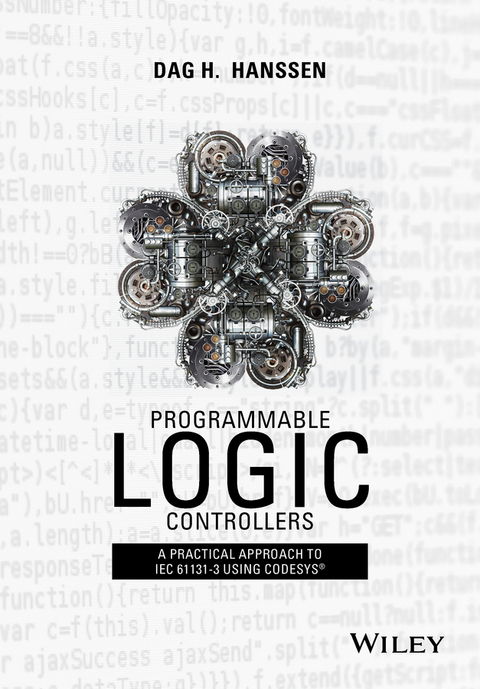
Widely used across industrial and manufacturing automation, Programmable Logic Controllers (PLCs) perform a broad range of electromechanical tasks with multiple input and output arrangements, designed specifically to cope in severe environmental conditions such as automotive and chemical plants.
Programmable Logic Controllers: A Practical Approach using CoDeSys is a hands-on guide to rapidly gain proficiency in the development and operation of PLCs based on the IEC 61131-3 standard. Using the freely-available* software tool CoDeSys, which is widely used in industrial design automation projects, the author takes a highly practical approach to PLC design using real-world examples. The design tool, CoDeSys, also features a built in simulator/soft PLC enabling the reader to undertake exercises and test the examples.
Key features:
- Introduces to programming techniques using IEC 61131-3 guidelines in the five PLC-recognised programming languages.
- Focuses on a methodical approach to programming, based on Boolean algebra, flowcharts, sequence diagrams and state-diagrams.
- Contains a useful methodology to solve problems, develop a structured code and document the programming code.
- Covers I/O like typical sensors, signals, signal formats, noise and cabling.
- Features Power Point slides covering all topics, example programs and solutions to end-of-chapter exercises via companion website.
No prior knowledge of programming PLCs is assumed making this text ideally suited to electronics engineering students pursuing a career in electronic design automation. Experienced PLC users in all fields of manufacturing will discover new possibilities and gain useful tips for more efficient and structured programming.
* Register at www.codesys.com
www.wiley.com/go/hanssen/logiccontrollers
Dag H. Hanssen works as an Assistant Professor in automation at the Institute of Engineering and Safety at the University of Tromsø. During the course of his 18 year long career with the university he has taught many different courses, but he now focusses on control technique, process automation and Application Development.
Widely used across industrial and manufacturing automation, Programmable Logic Controllers (PLCs) perform a broad range of electromechanical tasks with multiple input and output arrangements, designed specifically to cope in severe environmental conditions such as automotive and chemical plants. Programmable Logic Controllers: A Practical Approach using CoDeSys is a hands-on guide to rapidly gain proficiency in the development and operation of PLCs based on the IEC 61131-3 standard. Using the freely-available* software tool CoDeSys, which is widely used in industrial design automation projects, the author takes a highly practical approach to PLC design using real-world examples. The design tool, CoDeSys, also features a built in simulator/soft PLC enabling the reader to undertake exercises and test the examples. Key features: Introduces to programming techniques using IEC 61131-3 guidelines in the five PLC-recognised programming languages. Focuses on a methodical approach to programming, based on Boolean algebra, flowcharts, sequence diagrams and state-diagrams. Contains a useful methodology to solve problems, develop a structured code and document the programming code. Covers I/O like typical sensors, signals, signal formats, noise and cabling. Features Power Point slides covering all topics, example programs and solutions to end-of-chapter exercises via companion website. No prior knowledge of programming PLCs is assumed making this text ideally suited to electronics engineering students pursuing a career in electronic design automation. Experienced PLC users in all fields of manufacturing will discover new possibilities and gain useful tips for more efficient and structured programming. * Register at www.codesys.com www.wiley.com/go/hanssen/logiccontrollers
Dag H. Hanssen works as an Assistant Professor in automation at the Institute of Engineering and Safety at the University of Tromsø. During the course of his 18 year long career with the university he has taught many different courses, but he now focusses on control technique, process automation and Application Development.
1
About PLCs
The programmable logic controller (PLC) has its origin in relay-based control systems, also called hard-wired logic.1
Before PLCs became common in industry, all automatic control was handled by circuits composed of relays,2 switches, clocks and counters, etc (Figure 1.1). Such controls required a lot of wiring and usually filled large cabinets full of electromagnetic relays. Electricians had to assemble controls or use a prepared relay wiring diagram. The relay wiring diagrams showed how all the switches, sensors, motors, valves, relays, etc. were connected. Such relay wiring diagrams are the forerunners for the ladder diagram (LD) programming language, which is still a common programming language used in programming PLCs.
Figure 1.1 Example of a relay and a timer (mounted on a connector board)
There were many disadvantages with these mechanical controls. In addition to taking up a lot of room, they demand time and labor to implement them and to make any changes in such equipment. A relay control usually consists of hundreds of relays connected together with wires running in every direction. If the logical function needs to be changed or expanded, the entire physical unit must be rewired, something that is obviously expensive in terms of working time. Since the relays are electromechanical devices, they also had a limited service life, something that led to frequent operational interruptions with subsequent disruption.
There also was no way of testing before the control was wired up. Testing therefore had to take place by running the unit. If there was a small failure in the schematic diagram or if an electrician had connected a wire wrong, this could result in dramatic events.
1.1 History
The first PLC came into commercial production when General Motors was looking for a replacement for relay controls. Increased competition and expanded demands on the part of customers meant a demand for higher efficiency, and the natural step was to design a software-based system that could replace the relays. The requirement was that the new system should be able to:
- Compete on price with traditional relay controls
- Be flexible
- Withstand a harsh environment
- Be modular with respect to the number of inputs and outputs3
- Be easy to program and reprogram
Several corporations started work on providing a solution to the problem. Bedford Associates, Inc. from Bedford, Massachusetts, suggested something they called a “modular digital controller” (MODICON). MODICON 0844 was the first PLC that went into commercial production. The key to its success was probably the programming language, LD, which was based on the relay diagrams that electricians were familiar with. Today there is no question about the use of programmable controls; the question is rather what type to use.
The first PLCs were relatively simple in the sense that their function was to replace relay logic and nothing else. Gradually, the capabilities improved more and more and functions such as counters and time delays were added. The next step in development was analog input/output and arithmetic functions such as comparators and adders.
With the development of semiconductor technology and integrated circuits, programmable controls became widely used in industry. Particularly when microprocessors came on the market in the beginning of the 1970s, development proceeded at a rapid pace.
The PLCs of today come with development tools in the form of software with every imaginable ready-to-use function. Examples are program codes for managing communications as well as processing functions such as proportional integrator/derivative regulators, servo controls, axial control, etc. In other words, there is the same pace of development as with the PC (Figures 1.2, 1.3, and 1.4).
Figure 1.2 Omron Sysmac C20—Nonmodular PLC with digital I/O and programming terminal
Figure 1.3 PLCs from Telemecanique come in different sizes
Figure 1.4 Newer generation PLC from Wago with Profibus coupler and I/O
The communications side also experienced rapid development. Demand grew quickly for PLCs that could talk to one another and that could be placed away from the actual production lines. Around 1973 Modicon developed a communications protocol that they called Modbus. This made it possible to set up communications between PLCs, and the PLCs could therefore be located away from production. Modicon’s Modbus also provided for management of analog signals. As there became more and more manufacturers of PLCs and associated equipment, there also developed more proprietary5 and nonproprietary communications protocols. The lack of standardization, together with continual technological development, meant that PLC communication became a nightmare of incompatible protocols and various physical networks. Even today, there are problems, although manufacturers now offer solutions for communications over a selection of known and standardized protocols.
Several programming languages also came into use. Earlier LD, as we mentioned, was synonymous with PLC programming. Instruction List (IL) was also an early language that had many similarities with the assembly language that used for programming microprocessors. Later the graphical language Sequential Function Chart (SFC) was added. This was specially developed for implementation of sequential controls.
1.1.1 More Recent Developments
All of the aforementioned languages were incorporated into the international standard IEC 61131-3 (International Electrotechnical Commission, 2013). The standard also defines the function block diagram (FBD) graphic language and the structured text (ST) language. FBD has a symbol palette that is based on recognized symbols and functions from digital technology. ST is a high-level language that provides associations with Pascal and C.
Before the IEC 61131-3 standard appeared, and for many years thereafter, there were relatively large differences between PLCs from various manufacturers. This was particularly true of capabilities for selection of programming language and how the language that was implemented in the PLCs was designed. Recently, to the delight of users, manufacturers began to follow IEC 61131-3 to a greater and greater extent. This made it easier to go from one brand of PLC to another as well as making it easier, to a certain extent, for customers to know what they were getting.
There are also a number of “software-based PLCs” on the market. As the name indicates, this software is designed to control processes directly from a PC. The challenge has been to build systems that are sufficiently reliable and robust. Industry is generally critical of such solutions, mostly based on experience with many a computer crash.
Another amphibious solution is the possibility of buying a circuit board for a computer onto which the program code can be loaded. The board is made so that it is capable of carrying on with the job independently even if the computer should crash.
In recent years, manufacturers have devoted considerable resources to developing solutions for connecting instruments and actuators into a network. Such a communication bus is called a fieldbus, referring to the fact that there is communication between field instruments, in other words, instruments below the process level. Other standards and de facto6 standards are also on the market.
Work on an IEC standard for the fieldbus started as early as 1984/1985. The requirement was naturally that the standard should be an open fieldbus solution for industrial automation. It should include units such as motor controls, decentralized I/O, and PLCs, in addition to the distributed control systems (DCS) and field instruments used in the processing industry. The goal was also that the standard should cover all pertinent areas such as building automation, process automation, and general industrial automation.
It was not until the end of 1999 that those involved came to an agreement. The result was that a total of eight (partially dissimilar) systems were incorporated into a standard called IEC 61158. In other words, this was not an open solution. Even though manufacturers and suppliers argued that it was good for users to have plenty of choices, this unity did not make things much easier for engineers and others working on automation.
Several of the major manufacturers currently offer integrated solutions with I/O modules for all of the major fieldbus standards where a controller (PLC) or a gateway manages communication among the various standards simultaneously.
Another trend is that manufacturers of hardware and communication solutions offer more equipment for wireless communication (Ethernet). What is new here is that these also include individual sensors and individual instruments. In this way, it is possible to implement wireless systems right out to the sensor level.
1.2 Structure
As we said, there are a great many types of PLCs on the market. Hundreds of suppliers include PLCs of various sizes in their stock. The smallest PLCs have relatively small memory capacity and calculating capability and usually limited or no capability for expansion of the number of I/Os. The largest have processor...
| Erscheint lt. Verlag | 11.9.2015 |
|---|---|
| Sprache | englisch |
| Themenwelt | Mathematik / Informatik ► Informatik ► Theorie / Studium |
| Technik ► Elektrotechnik / Energietechnik | |
| Technik ► Maschinenbau | |
| Schlagworte | CoDeSys • Computer Engineering • computer engineering textbook • Computertechnik • Electrical & Electronics Engineering • Elektrotechnik u. Elektronik • FBD • function blocks • IEC 61131-3 • PLC • Programmable Controllers • programming • SFC - Sequential Function Chart • ST - Structured Text |
| ISBN-10 | 1-118-94922-6 / 1118949226 |
| ISBN-13 | 978-1-118-94922-1 / 9781118949221 |
| Informationen gemäß Produktsicherheitsverordnung (GPSR) | |
| Haben Sie eine Frage zum Produkt? |
 EPUB (Adobe DRM)
Kopierschutz: Adobe-DRM
Adobe-DRM ist ein Kopierschutz, der das eBook vor Mißbrauch schützen soll. Dabei wird das eBook bereits beim Download auf Ihre persönliche Adobe-ID autorisiert. Lesen können Sie das eBook dann nur auf den Geräten, welche ebenfalls auf Ihre Adobe-ID registriert sind.
Details zum Adobe-DRM
Dateiformat: EPUB (Electronic Publication)
EPUB ist ein offener Standard für eBooks und eignet sich besonders zur Darstellung von Belletristik und Sachbüchern. Der Fließtext wird dynamisch an die Display- und Schriftgröße angepasst. Auch für mobile Lesegeräte ist EPUB daher gut geeignet.
Systemvoraussetzungen:
PC/Mac: Mit einem PC oder Mac können Sie dieses eBook lesen. Sie benötigen eine
eReader: Dieses eBook kann mit (fast) allen eBook-Readern gelesen werden. Mit dem amazon-Kindle ist es aber nicht kompatibel.
Smartphone/Tablet: Egal ob Apple oder Android, dieses eBook können Sie lesen. Sie benötigen eine
Geräteliste und zusätzliche Hinweise
Buying eBooks from abroad
For tax law reasons we can sell eBooks just within Germany and Switzerland. Regrettably we cannot fulfill eBook-orders from other countries.
aus dem Bereich