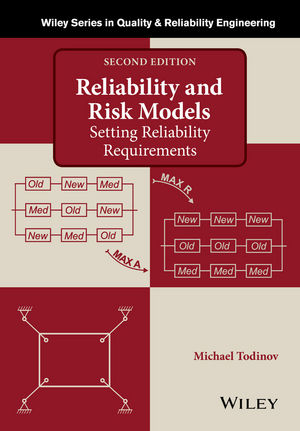
Reliability and Risk Models (eBook)
John Wiley & Sons (Verlag)
978-1-118-87325-0 (ISBN)
A comprehensively updated and reorganized new edition. The updates include comparative methods for improving reliability; methods for optimal allocation of limited resources to achieve a maximum risk reduction; methods for improving reliability at no extra cost and building reliability networks for engineering systems.
Includes:
• A unique set of 46 generic principles for reducing technical risk
• Monte Carlo simulation algorithms for improving reliability and reducing risk
• Methods for setting reliability requirements based on the cost of failure
• New reliability measures based on a minimal separation of random events on a time interval
• Overstress reliability integral for determining the time to failure caused by overstress failure modes
• A powerful equation for determining the probability of failure controlled by defects in loaded components with complex shape
• Comparative methods for improving reliability which do not require reliability data
• Optimal allocation of limited resources to achieve a maximum risk reduction
• Improving system reliability based solely on a permutation of interchangeable components
A comprehensively updated and reorganized new edition. The updates include comparative methods for improving reliability; methods for optimal allocation of limited resources to achieve a maximum risk reduction; methods for improving reliability at no extra cost and building reliability networks for engineering systems. Includes: A unique set of 46 generic principles for reducing technical risk Monte Carlo simulation algorithms for improving reliability and reducing risk Methods for setting reliability requirements based on the cost of failure New reliability measures based on a minimal separation of random events on a time interval Overstress reliability integral for determining the time to failure caused by overstress failure modes A powerful equation for determining the probability of failure controlled by defects in loaded components with complex shape Comparative methods for improving reliability which do not require reliability data Optimal allocation of limited resources to achieve a maximum risk reduction Improving system reliability based solely on a permutation of interchangeable components
Michael Todinov Oxford Brookes University, UK
Preface
A common tendency in many texts devoted to reliability is to choose either a statistical-based approach to reliability or engineering-based approach. Reliability engineering, however, is neither reliability statistics nor solely engineering principles underlying reliable designs. Rather, it is an amalgam of reliability statistics, theoretical principles and techniques and engineering principles for developing reliable products and reducing technical risk. Furthermore, in the reliability literature, the emphasis is commonly placed on reliability prediction than reliability improvement. Accordingly, the intention of this second edition is to improve the balance between the statistical-based approach and the engineering-based approach.
To demonstrate the necessity of a balanced approach to reliability and engineering risk, a new chapter (Chapter 11) has been devoted exclusively to principles and techniques for improving reliability and reducing engineering risk. The need for unity between the statistical approach and the engineering approach is demonstrated by the formulated principles, some of which are rooted in reliability statistics, while others rely on purely engineering concepts. The diverse risk reduction principles prompt reliability and risk practitioners not to limit themselves to familiar ways of improving reliability and reducing risk (such as introducing redundancy) which might lead to solutions which are far from optimal.
Using appropriate combinations of statistical and physical principles brings a considerably larger effect. The outlined key principles for reducing the risk of failure can be applied with success not only in engineering but in diverse areas of the human activity, for example in environmental sciences, financial engineering, economics, medicine, etc.
Critical failures in many industries (e.g. in the nuclear or deep-water oil and gas industry) can have disastrous environmental and health consequences. Such failures entail loss of production for very long periods of time and extremely high costs of the intervention for repair. Consequently, for industries characterised by a high cost of failure, setting quantitative reliability requirements must be driven by the cost of failure. There is a view held even by some risk experts that there is no need for setting reliability requirements. The examples in Chapter 16 demonstrate the importance of reliability requirements not only for minimising the probability of unsatisfied demand below a maximum acceptable level but also for providing an optimal balance between reliability and cost. Furthermore, many technical failures with disastrous consequences to the environment could have been easily prevented by adopting cost-of-failure-based reliability requirements for critical components.
Common, as well as little known reliability and risk models and their applications are discussed. Thus, a powerful generic equation is introduced for determining the probability of safe/failure states dependent on the relative configuration of random variables, following a homogeneous Poisson process in a finite domain. Seemingly intractable reliability problems can be solved easily using this equation which reduces a complex reliability problem to simpler problems. The equation provides a basis for the new reliability measure introduced in Chapter 16, which consists of a combination of specified minimum separation distances between random variables in a finite interval and the probability with which they must exist. The new reliability measure is at the heart of a technology for setting quantitative reliability requirements based on minimum event-free operating periods or minimum failure-free operating periods (MFFOP). A number of important applications of the new reliability measure are also considered such as limiting the probability of a collision of demands from customers using particular resource for a specified time and the probability of overloading of supply systems from consumers connecting independently and randomly.
It is demonstrated that even for a small number of random demands in a finite time interval, the probability of clustering of two or more random demands within a critical distance is surprisingly high and should always be accounted for in risk assessments.
Substantial space in the book has been allocated for load–strength (demand–capacity) models and their applications. Common problems can easily be formulated and solved using the load–strength interference concept. On the basis of counterexamples, a point has been made that for non-Gaussian distributed load and strength, the popular reliability measures ‘reliability index’ and ‘loading roughness’ can be completely misleading. In Chapter 6, the load–strength interference model has been generalised, with the time included as a variable. The derived equation is in effect a powerful model for determining reliability associated with an overstress failure mechanism.
A number of new developments made by the author in the area of reliability and risk models since the publication of the first edition in 2005 have been reflected in the second edition. Such is, for example, the revision of the Weibull distribution as a model of the probability of failure of materials controlled by defects. On the basis of probabilistic reasoning, thought experiments and real experiments, it is demonstrated in Chapter 13 that contrary to the common belief for more than 60 years, the Weibull distribution is a fundamentally flawed model for the probability of failure of materials. The Weibull distribution, with its strictly increasing function, is incapable of approximating a constant probability of failure over a loading region. The present edition also features an alternative of the Weibull model based on an equation which does not use the notions ‘flaws’ and ‘locally initiated failure by flaws’. The new equation is based on the novel concept ‘hazard stress density’. A simple and easily reproduced experiment based on artificial flaws provides a strong and convincing experimental proof that the distribution of the minimum breaking strength associated with randomly distributed flaws does not follow a Weibull distribution.
Another important addition in the second edition is the comparative method for improving reliability introduced in Chapter 14. Calculating the absolute reliability built in a product is often an extremely difficult task because in many cases reliability-critical data (failure frequencies, strength distribution of the flaws, fracture mechanism, repair times) are simply unavailable for the system components. Furthermore, calculating the absolute reliability may not be possible because of the complexity of the physical processes and physical mechanisms underlying the failure modes, the complex influence of the environment and the operational loads, the variability associated with reliability-critical design parameters and the non-robustness of the prediction models. Capturing and quantifying these types of uncertainty, necessary for a correct prediction of the reliability of the component, is a formidable task which does not need to be addressed if a comparative reliability method is employed, especially if the focus is on reliability improvement. The comparative methods do not rely on reliability data to improve the reliability of components and are especially suited for developing new designs, with no failure history.
In the second edition, the coverage of physics-of-failure models has been increased by devoting an entire chapter (Chapter 12) to ‘fast fracture’ and ‘fatigue’ – probably the two failure modes accounting for most of the mechanical failures.
The conditions for the validity of common physics-of-failure models have also been presented. A good example is the Palmgren–Miner rule. This is a very popular model in fatigue life predictions, yet no comments are made in the reliability literature regarding the cases for which this rule is applicable. Consequently, in Chapter 7, a discussion has been provided about the conditions that must be in place so that the empirical Palmgren–Miner rule can be applied for predicting fatigue life.
A new chapter (Chapter 18) has been included in the second edition which shows that the number of activities in a risky prospect is a key consideration in selecting a risky prospect. In this respect, the maximum expected profit criterion, widely used for making risk decisions, is shown to be fundamentally flawed, because it does not consider the impact of the number of risk–reward activities in the risky prospects.
The second edition also includes a new chapter on optimal allocation of resources to achieve a maximum reduction of technical risk (Chapter 19). This is an important problem facing almost all industrial companies and organisations in their risk reduction efforts, and the author felt that this problem needs to be addressed. Chapter 19 shows that the classical (0–1) knapsack dynamic programming approach for optimal allocation of safety resources could yield highly undesirable solutions, associated with significant waste of resources and very little improvement in the risk reduction. The main reason for this problem is that the standard knapsack dynamic programming approach has been devised to maximise the total value derived from items filling space with no intrinsic value. The risk reduction budget however, does have...
| Erscheint lt. Verlag | 3.9.2015 |
|---|---|
| Reihe/Serie | Quality and Reliability Engineering Series |
| Wiley Series in Quality and Reliability Engineering | Wiley Series in Quality and Reliability Engineering |
| Sprache | englisch |
| Themenwelt | Technik ► Bauwesen |
| Technik ► Elektrotechnik / Energietechnik | |
| Technik ► Maschinenbau | |
| Schlagworte | Angew. Wahrscheinlichkeitsrechn. u. Statistik / Modelle • Applied Probability & Statistics - Models • Bruchmechanik • Computer Networks • Electrical & Electronics Engineering • Electrical Components • Elektrotechnik u. Elektronik • Failure Fracture • failure models • fast fracture • Fatigue fracture • Maschinenbau • Mechanical components • mechanical engineering • optimal allocation • Qualität u. Zuverlässigkeit • Qualität u. Zuverlässigkeit • Quality & Reliability • Statistics • Statistik • Weibull model |
| ISBN-10 | 1-118-87325-4 / 1118873254 |
| ISBN-13 | 978-1-118-87325-0 / 9781118873250 |
| Informationen gemäß Produktsicherheitsverordnung (GPSR) | |
| Haben Sie eine Frage zum Produkt? |
 EPUB (Adobe DRM)
Kopierschutz: Adobe-DRM
Adobe-DRM ist ein Kopierschutz, der das eBook vor Mißbrauch schützen soll. Dabei wird das eBook bereits beim Download auf Ihre persönliche Adobe-ID autorisiert. Lesen können Sie das eBook dann nur auf den Geräten, welche ebenfalls auf Ihre Adobe-ID registriert sind.
Details zum Adobe-DRM
Dateiformat: EPUB (Electronic Publication)
EPUB ist ein offener Standard für eBooks und eignet sich besonders zur Darstellung von Belletristik und Sachbüchern. Der Fließtext wird dynamisch an die Display- und Schriftgröße angepasst. Auch für mobile Lesegeräte ist EPUB daher gut geeignet.
Systemvoraussetzungen:
PC/Mac: Mit einem PC oder Mac können Sie dieses eBook lesen. Sie benötigen eine
eReader: Dieses eBook kann mit (fast) allen eBook-Readern gelesen werden. Mit dem amazon-Kindle ist es aber nicht kompatibel.
Smartphone/Tablet: Egal ob Apple oder Android, dieses eBook können Sie lesen. Sie benötigen eine
Geräteliste und zusätzliche Hinweise
Buying eBooks from abroad
For tax law reasons we can sell eBooks just within Germany and Switzerland. Regrettably we cannot fulfill eBook-orders from other countries.
aus dem Bereich