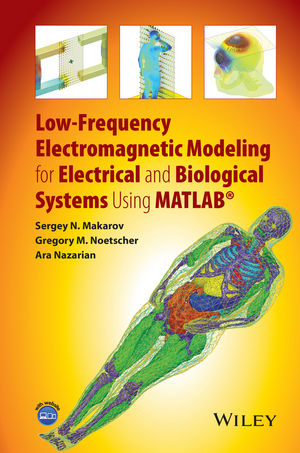
Low-Frequency Electromagnetic Modeling for Electrical and Biological Systems Using MATLAB (eBook)
John Wiley & Sons (Verlag)
978-1-119-05246-3 (ISBN)
Provides a detailed and systematic description of the Method of Moments (Boundary Element Method) for electromagnetic modeling at low frequencies and includes hands-on, application-based MATLAB® modules with user-friendly and intuitive GUI and a highly visualized interactive output.
Includes a full-body computational human phantom with over 120 triangular surface meshes extracted from the Visible Human Project® Female dataset of the National library of Medicine and fully compatible with MATLAB® and major commercial FEM/BEM electromagnetic software simulators.
This book covers the basic concepts of computational low-frequency electromagnetics in an application-based format and hones the knowledge of these concepts with hands-on MATLAB® modules. The book is divided into five parts. Part 1 discusses low-frequency electromagnetics, basic theory of triangular surface mesh generation, and computational human phantoms. Part 2 covers electrostatics of conductors and dielectrics, and direct current flow. Linear magnetostatics is analyzed in Part 3. Part 4 examines theory and applications of eddy currents. Finally, Part 5 evaluates nonlinear electrostatics. Application examples included in this book cover all major subjects of low-frequency electromagnetic theory. In addition, this book includes complete or summarized analytical solutions to a large number of quasi-static electromagnetic problems. Each Chapter concludes with a summary of the corresponding MATLAB® modules.
- Combines fundamental electromagnetic theory and application-oriented computation algorithms in the form of stand alone MATLAB® modules
- Makes use of the three-dimensional Method of Moments (MoM) for static and quasistatic electromagnetic problems
- Contains a detailed full-body computational human phantom from the Visible Human Project® Female, embedded implant models, and a collection of homogeneous human shells
Provides a detailed and systematic description of the Method of Moments (Boundary Element Method) for electromagnetic modeling at low frequencies and includes hands-on, application-based MATLAB modules with user-friendly and intuitive GUI and a highly visualized interactive output. Includes a full-body computational human phantom with over 120 triangular surface meshes extracted from the Visible Human Project Female dataset of the National library of Medicine and fully compatible with MATLAB and major commercial FEM/BEM electromagnetic software simulators. This book covers the basic concepts of computational low-frequency electromagnetics in an application-based format and hones the knowledge of these concepts with hands-on MATLAB modules. The book is divided into five parts. Part 1 discusses low-frequency electromagnetics, basic theory of triangular surface mesh generation, and computational human phantoms. Part 2 covers electrostatics of conductors and dielectrics, and direct current flow. Linear magnetostatics is analyzed in Part 3. Part 4 examines theory and applications of eddy currents. Finally, Part 5 evaluates nonlinear electrostatics. Application examples included in this book cover all major subjects of low-frequency electromagnetic theory. In addition, this book includes complete or summarized analytical solutions to a large number of quasi-static electromagnetic problems. Each Chapter concludes with a summary of the corresponding MATLAB modules. Combines fundamental electromagnetic theory and application-oriented computation algorithms in the form of stand alone MATLAB modules Makes use of the three-dimensional Method of Moments (MoM) for static and quasistatic electromagnetic problems Contains a detailed full-body computational human phantom from the Visible Human Project Female, embedded implant models, and a collection of homogeneous human shells Low-Frequency Electromagnetic Modeling for Electrical and Biological Systems UsingMATLAB is a resource for electrical and biomedical engineering students and practicing researchers, engineers, and medical doctors working on low-frequency modeling and bioelectromagnetic applications.
Sergey N. Makarov is a Professor in the Department of Electrical and Computer Engineering at Worcester Polytechnic Institute (WPI). Gregory M. Noetscher is a Senior Research Electrical Engineer at the U.S. Army Natick Soldier Research, Development and Engineering Center (NSRDEC) in Natick, MA. Ara Nazarian is an Assistant Professor of Orthopaedic Surgery, Harvard Medical School, Center for Advanced Orthopaedic Studies, Beth Israel Deaconess Medical Center (BIDMC).
1
CLASSIFICATION OF LOW-FREQUENCY ELECTROMAGNETIC PROBLEMS. POISSON AND LAPLACE EQUATIONS IN INTEGRAL FORM
INTRODUCTION
The first section of this chapter starts with a physical model of an electric circuit. This example allows us to introduce and visualize the following primary research areas of static and quasistatic analyses:
- Electrostatics
- Magnetostatics
- Direct current (DC) flow
- Eddy current quasistatic approximation
Next, we quantify the necessary physical conditions that justify static and quasistatic approximations of Maxwell’s equations. Three major dimensionless parameters encountered in static and quasistatic approximations are as follows:
- The ratio of problem dimensions to the wavelength
- The ratio of charge relaxation time to the wave period
- The ratio of problem dimensions to the skin depth
The end of the first section is devoted to nonlinear electrostatics, which is an important part of semiconductor device analysis with critical analogues to the subject of bimolecular research.
The second section introduces the Poisson and Laplace equations, along with the free-space Green’s function, and briefly outlines the Green’s function technique. We specify Dirichlet, Neumann, and mixed boundary conditions and demonstrate practical examples of each. Special attention is paid to the integral form of the Poisson and Laplace equations, which present the foundation for the boundary element method (BEM). We consider the surface charge density at boundaries as the unknown function and thus utilize the surface charge method (SCM).
We establish the continuity of the potential function at boundaries and mathematically derive the discontinuity condition for the normal potential derivative. This condition provides the framework of almost all specific integral equations for individual static and quasistatic problems of various types studied in the main text.
1.1 CLASSIFICATION OF LOW-FREQUENCY ELECTROMAGNETIC PROBLEMS
Low-frequency electromagnetics finds its applications in many areas of electrical engineering including the fields of power electronics and power lines [1–4] , semiconductor devices and integrated circuits [5, 6] , alternative energy [7] , and nondestructive testing and evaluation [8, 9] . Major biomedical applications include EEG, ECG, and EMG (cf. [10, 11] ), biomedical impedance tomography [12–18] , and rather new fields such as biomolecular electrostatics [19–22] and magnetic [23–25] and DC [26–30] brain stimulation, among many others.
1.1.1 Physical Model of an Electric Circuit
The bulk of low-frequency electromagnetic problems may be visualized with the help of a static or a quasistatic model of an electric circuit, as shown in Figure 1.1. The model includes three elements:
- A voltage power source that in the direct current (DC) case generates a constant voltage between its terminals.
- An electric load that consumes electric power. The load may be modeled as a resistant material of low conductivity.
- Two finite-conductivity conductors that extend from the source to the load. These wires form a transmission line. In the laboratory, both wires may be arbitrarily bent. However, this is not the case in power electronics and high-frequency circuits.
FIGURE 1.1 Physical model of an electric circuit depicting (a) Electrostatics and (b) Magnetostatics scenarios produced by direct current flow. Note that the electric field between the two wires decreases when moving from the source to the load. This is not the case when the wires have the infinite conductivity resulting in zero potential drop. This figure was generated using numerical modeling tools developed in the text.
Figure 1.1a shows the (computed) electric field or electric field intensity, E, everywhere in space. The subject of electrostatics is the computation of E and the associated quantities (surface charges, capacitances) when there is no load attached to the source. In other words, there is no DC flow in the conductors. In this case, the field distribution around the transmission line might be somewhat different from that shown in Figure 1.1a. However, the difference becomes negligibly small when the wires in Figure 1.1a are close to ideal—possessing a very large conductivity. The situation becomes more complicated when a dielectric material, which alters the electric field both inside and outside, is present.
Exercise 1.1: How would the voltage (or potential) of two wires in Figure 1.1a change under open-circuit conditions (the electrostatic model)?
Answer: Both wire surfaces will become strictly equipotential surfaces, say, at 1 and 0V. There will be no electric field within the wires themselves.
The subject of DC computations is the evaluation of the electric field in conductors themselves and in the surrounding space. This is exactly the problem shown in Figure 1.1a. After the electric field, E, is found, the current density, J, in the conductors is obtained as E multiplied by the conductivity (see Fig. 1.1b). DC computations deal with finite-conductivity conductors, whereas in electrostatics, any conductor is ideal. At the same time, electrostatics models dielectric materials or insulators. DC computations are typically not intended to do so since there is no current present in insulators. DC computations may deal with quite complicated current distributions in heterogeneous conducting media, for example, human tissues.
Exercise 1.2: As far as DC flow is concerned, Figure 1.1a and b has a few simplifications. What is the most significant one?
Answer: The electric field distribution and the associated current distribution within the load may be highly nonuniform, at least close to the load terminals.
The subject of magnetostatics is the computation of the magnetic field or magnetic field intensity, H, and the associated quantities (mutual and self-inductances). The magnetic field is due to currents flowing in conductors as shown in Figure 1.1b. Magnetostatics typically deals with external current excitations, which are known a priori (e.g., from DC analysis). The situation complicates when a magnetic material, which alters the magnetic field both inside and outside, is present.
Exercise 1.3: After the magnetic field H and the electric field E in Figure 1.1b are found, a vector (also shown in Fig. 1.1b) may be constructed everywhere in space. What is the intuitive feel of this vector?
Answer: This is the Poynting vector, a density-of-power flux with the units of W/m2. Its integral over the entire circuit cross section shown in Figure 1.1b will give us the total power delivered to the load.
The subject of eddy current theory (or quasistatic theory) is the effect of a time-varying magnetic field producing alternating currents. According to Faraday’s law of induction, this magnetic field will create a secondary electric field in conductors. In its turn, the secondary electric field will result in certain currents, known as eddy currents. These eddy currents may be excited in a conductor without immediate electrode contacts (which is to say, in a wireless manner). They may also affect the original alternating current distribution (via the skin layer effect). The situation greatly complicates for arbitrary geometries and in heterogeneous conducting media where eddy currents have to cross boundaries between different materials.
Exercise 1.4: As far as the eddy current theory is concerned, Figure 1.1a and b has a few simplifications. What is the most significant one?
Answer: The current distribution in thick metal wire conductors is nonuniform, even at 60Hz. The current density mostly concentrates within a skin layer close to the conductor’s surface.
Finally, the load in Figure 1.1 may be a basic semiconductor element, a diode, for example. The internal diode behavior at reverse and small forward-bias voltages is still modeled by electrostatic equations, but those equations will be nonlinear. At large forward-bias voltages, DC theory is applied, which also becomes nonlinear.
1.1.2 Starting Point of Static/Quasistatic Analysis
In order to quantitatively explain various static and quasistatic approximations, we need to start with the full set of Maxwell’s equations, which include electric field, E, measured in V/m; magnetic field, H, measured in A/m; volumetric electric current density, J, of free charges with the units of A/m2; and the (volume or surface) electric charge density, ρ, of free charges with the units of C/m3 or C/m2. Permittivity, ε, measured in F/m and permeability, μ, measured in H/m may vary in space. Maxwell’s equations are then given as
Ampere’s law modified by displacement currents
Faraday’s law
Gauss’ law for electric fields
Gauss’ law for magnetic fields (no magnetic charges)
Continuity...
| Erscheint lt. Verlag | 13.5.2015 |
|---|---|
| Sprache | englisch |
| Themenwelt | Naturwissenschaften ► Physik / Astronomie ► Elektrodynamik |
| Technik ► Elektrotechnik / Energietechnik | |
| Schlagworte | Adaptive mesh refinement • Bioelectromagnetics • Boundary element method • computational electromagnetics • Computational Human Phantoms • Direct Current Flow • Eddy Current Generation • Electrical & Electronics Engineering • Electromagnetic Compatibility • Electromagnetic fields • Electromagnetic theory • Electrostatics • Elektromagnetische Verträglichkeit • Elektromagnetische Verträglichkeit • Elektromagnetismus • Elektrotechnik u. Elektronik • FEM Human Phantoms • Human Body Meshes • Laplacian Smoothing</p> • <p>Applied Electromagnetics • magnetostatics • Mesh Deformations • Mesh Generation in MATLAB • Mesh Healing • Mesh Intersections • method of moments • Mikrowellen- u. Hochfrequenztechnik u. Theorie • Physical Principles of ECE • RF / Microwave Theory & Techniques • Tissue Meshes |
| ISBN-10 | 1-119-05246-7 / 1119052467 |
| ISBN-13 | 978-1-119-05246-3 / 9781119052463 |
| Informationen gemäß Produktsicherheitsverordnung (GPSR) | |
| Haben Sie eine Frage zum Produkt? |
 EPUB (Adobe DRM)
Kopierschutz: Adobe-DRM
Adobe-DRM ist ein Kopierschutz, der das eBook vor Mißbrauch schützen soll. Dabei wird das eBook bereits beim Download auf Ihre persönliche Adobe-ID autorisiert. Lesen können Sie das eBook dann nur auf den Geräten, welche ebenfalls auf Ihre Adobe-ID registriert sind.
Details zum Adobe-DRM
Dateiformat: EPUB (Electronic Publication)
EPUB ist ein offener Standard für eBooks und eignet sich besonders zur Darstellung von Belletristik und Sachbüchern. Der Fließtext wird dynamisch an die Display- und Schriftgröße angepasst. Auch für mobile Lesegeräte ist EPUB daher gut geeignet.
Systemvoraussetzungen:
PC/Mac: Mit einem PC oder Mac können Sie dieses eBook lesen. Sie benötigen eine
eReader: Dieses eBook kann mit (fast) allen eBook-Readern gelesen werden. Mit dem amazon-Kindle ist es aber nicht kompatibel.
Smartphone/Tablet: Egal ob Apple oder Android, dieses eBook können Sie lesen. Sie benötigen eine
Geräteliste und zusätzliche Hinweise
Buying eBooks from abroad
For tax law reasons we can sell eBooks just within Germany and Switzerland. Regrettably we cannot fulfill eBook-orders from other countries.
aus dem Bereich