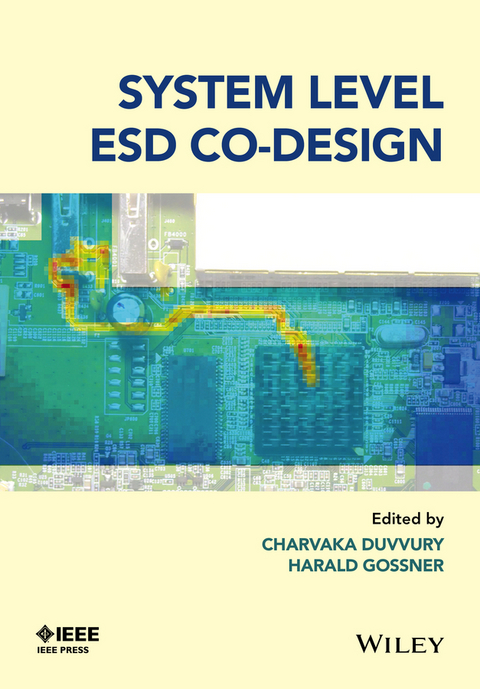
System Level ESD Co-Design (eBook)
John Wiley & Sons (Verlag)
978-1-118-86184-4 (ISBN)

An effective and cost efficient protection of electronic system against ESD stress pulses specified by IEC 61000-4-2 is paramount for any system design. This pioneering book presents the collective knowledge of system designers and system testing experts and state-of-the-art techniques for achieving efficient system-level ESD protection, with minimum impact on the system performance. All categories of system failures ranging from ‘hard’ to ‘soft’ types are considered to review simulation and tool applications that can be used.
The principal focus of System Level ESD Co-Design is defining and establishing the importance of co-design efforts from both IC supplier and system builder perspectives. ESD designers often face challenges in meeting customers' system-level ESD requirements and, therefore, a clear understanding of the techniques presented here will facilitate effective simulation approaches leading to better solutions without compromising system performance.
With contributions from Robert Ashton, Jeffrey Dunnihoo, Micheal Hopkins, Pratik Maheshwari, David Pomerenke, Wolfgang Reinprecht, and Matti Usumaki, readers benefit from hands-on experience and in-depth knowledge in topics ranging from ESD design and the physics of system ESD phenomena to tools and techniques to address soft failures and strategies to design ESD-robust systems that include mobile and automotive applications.
The first dedicated resource to system-level ESD co-design, this is an essential reference for industry ESD designers, system builders, IC suppliers and customers and also Original Equipment Manufacturers (OEMs).
Key features:
• Clarifies the concept of system level ESD protection.
• Introduces a co-design approach for ESD robust systems.
• Details soft and hard ESD fail mechanisms.
• Detailed protection strategies for both mobile and automotive applications.
• Explains simulation tools and methodology for system level ESD co-design and overviews available test methods and standards.
• Highlights economic benefits of system ESD co-design.
An effective and cost efficient protection of electronic system against ESD stress pulses specified by IEC 61000-4-2 is paramount for any system design. This pioneering book presents the collective knowledge of system designers and system testing experts and state-of-the-art techniques for achieving efficient system-level ESD protection, with minimum impact on the system performance. All categories of system failures ranging from 'hard' to 'soft' types are considered to review simulation and tool applications that can be used. The principal focus of System Level ESD Co-Design is defining and establishing the importance of co-design efforts from both IC supplier and system builder perspectives. ESD designers often face challenges in meeting customers' system-level ESD requirements and, therefore, a clear understanding of the techniques presented here will facilitate effective simulation approaches leading to better solutions without compromising system performance. With contributions from Robert Ashton, Jeffrey Dunnihoo, Micheal Hopkins, Pratik Maheshwari, David Pomerenke, Wolfgang Reinprecht, and Matti Usumaki, readers benefit from hands-on experience and in-depth knowledge in topics ranging from ESD design and the physics of system ESD phenomena to tools and techniques to address soft failures and strategies to design ESD-robust systems that include mobile and automotive applications. The first dedicated resource to system-level ESD co-design, this is an essential reference for industry ESD designers, system builders, IC suppliers and customers and also Original Equipment Manufacturers (OEMs). Key features: Clarifies the concept of system level ESD protection. Introduces a co-design approach for ESD robust systems. Details soft and hard ESD fail mechanisms. Detailed protection strategies for both mobile and automotive applications. Explains simulation tools and methodology for system level ESD co-design and overviews available test methods and standards. Highlights economic benefits of system ESD co-design.
Charvaka Duvvury, formerly Texas Instruments, USA Charvaka Duvvury, formerly of Texas Instruments, is currently working as a technical consultant on ESD design methods and ESD qualification support. He has published over 150 technical papers and holds more than 70 patents. He is a co-founder and co-chair of the Industry Council on ESD Target Levels and has been serving as Board of Director of the ESDA since 1997 promoting university education and research in ESD technology. Harald Gossner, Intel, Germany Harald Gossner is Senior Principal Engineer at Intel where for 15 years he has worked on the development of ESD protection concepts with Siemens and Infineon Technologies. In 2010 he has joined Intel Mobile Communications overseeing the development of robust mobile systems. Harald has authored and co-authored more than 100 technical papers and one book in the field of ESD and device physics. He holds more than 60 patents on the same topic. In 2006 he became cofounder and co-chair of the Industry Council on ESD Target Levels.
System Efficient ESD design (SEED) has been an active topic over recent years among ESD designers and the electronics industry as a whole. For this book, Charvaka Duvvury and Harald Gossner along with several contributing authors, have collected an extensive package of knowledge relating to electronic system EMC/ESD co-design. Challenges with EMC/ESD designs vary depending on the industry branch, and by having a specific expertise for EMC testing, semiconductors, automotive and mobile phones business area the book creates both a broad and in deep viewpoint of the SEED methodology. I strongly recommend this book to all electronics system designers to boost their knowledge and to arm them with the tools to predict and prevent ESD or EMC related challenges within future electronic designs.
Passi Tamminen, EMC Specialist at Microsoft, Finland
Acronyms
| ADB | Android debug bridge |
| ADS | Advanced Design System |
| AEC | Automotive Electronics Council |
| AMR | absolute maximum rating |
| ANSI | American National Standards Institute |
| ASIC | application specific integrated circuit |
| ASIP™ | application specific integrated passive™ |
| ASP | average selling price |
| ASTM | American Society for Testing and Materials |
| ATE | automated test equipment |
| AVL | approved vendor list |
| BCI | bulk current injection |
| BER | bit error rate |
| BGA | ball grid array |
| BOM | bill of materials |
| BSOD | blue screen of death |
| CAN | controller area network |
| CBE | charged board event |
| CCE | charged cable event |
| CCTLP | charge coupled transmission line pulse |
| CDE | cable discharge event |
| CDF | cumulative distribution function |
| CDM | charged-device model |
| CFB | chip ferrite bead |
| CM | contract manufacturer |
| CMC | common mode choke |
| CMF | common mode filter |
| CMOS | complementary metal oxide semiconductor |
| CO | central office |
| COTS | commercial off-the-shelf |
| CPE | customer premises equipment |
| CPU | central processing unit |
| CRC | cyclic redundancy check |
| dB | decibel |
| dBm | decibel-milliwatt |
| DC | direct current |
| DDR | double data rate |
| DIP | dual inline package |
| DMOS | double-diffused metal oxide semiconductor |
| DPI | direct power injection |
| DSP | digital signal processing |
| DUT | device under test |
| DVI | digital visual interface |
| ECU | electronic control unit |
| EDA | electronic design automation |
| EFT | electrical fast transients |
| EM | electromagnetic |
| EMC | electromagnetic compatibility |
| EMI | electromagnetic interference |
| EMMI | emission microscopy |
| EOS | electrical overstress |
| EPA | ESD protected area |
| eSATA | external serial advanced technology attachment |
| ESD | electrostatic discharge |
| ESDA | Electrostatic Discharge Association |
| ESR | equivalent series resistance |
| EU | European Union |
| EUT | equipment under test |
| FA | failure analysis |
| FB | ferrite bead |
| FFT | fast Fourier transform |
| FM | frequency modulation |
| FTC | Federal Trade Commission |
| GDT | gas discharge tube |
| GCNMOS | gate coupled n-channel metal oxide semiconductor |
| GGNMOS | grounded gate n-channel metal oxide semiconductor |
| GND | “ground” – negative voltage supply |
| GPIO | general purpose IO |
| GPU | graphic processing unit |
| GRP | ground reference plane |
| HBM | human body model |
| HCP | horizontal coupling plane |
| HDMI | high definition multimedia interface |
| HMM | human metal model |
| HSS | (HSSL) high speed serial link |
| IBIS | input/output buffer info specification |
| IC | integrated circuit |
| ID | identification |
| IDDQ | component quiescent supply current |
| IEC | International Electrotechnical Commission |
| IMD | inter-modulation distortion |
| IO | input/output |
| IP | intellectual property |
| IPR | intellectual property rights |
| ISO | International Organization for Standardization |
| IT | information technology |
| IT2 | failure current under ESD conditions |
| JEDEC | Joint Electronic Devices Engineering Council |
| JEITA | Japan Electronics and Information Technology Industries Association |
| LC | inductor/capacitor network |
| LCD | liquid crystal display |
| LDO | low drop out (voltage regulator) |
| LED | light emitting diode |
| LIN | local interconnect network |
| LU | latch-up |
| LVDS | low voltage differential signaling |
| MEMS | microelectromechanical system |
| MID | molded interconnect device |
| MIL-HDBK | Military Handbook |
| Mil-PRF | Military Performance Specifications |
| Mil-STD | Military Standard |
| MIPI | mobile industry processor interface |
| MM | machine model |
| MOSFET | metal oxide semiconductor field effect transistor |
| MOV | metal oxide varistor |
| NF | noise frequency |
| OBD | on-board diagnostics |
| ODM | original design manufacturer |
| OEM | original equipment manufacturer |
| OMAP | Open Media Applications Platform |
| OTG | on-the-go |
| PCB | printed circuit board |
| PERC | programmable electrical rule check |
| PHY | physical layer |
| PICC | proximity IC cards |
| PLL | phase locked loop |
| PN | silicon PN junction |
| POST | power-on self tests |
| PVS | polymer voltage suppressor |
| RC | resistor/capacitor network |
| RF | radio frequency |
| RH | relative humidity |
| RLC | resistor/inductor/capacitor network |
| RP | residual pulse |
| RPS | residual pulse stress |
| RX | receiver |
| SATA | serial advanced technology attachment |
| SAW | surface acoustic wave |
| SCR | silicon controlled rectifier |
| SD | secure digital (memory card format) |
| SERDES | serializer/deserializer |
| SIM | subscriber identity module |
| SiP | system-in-package |
| SMA | sub-miniature version A |
| SMD | surface mount device |
| SMT | surface mount technology |
| SOA | safe operating area |
| SoC | system-on-chip |
| SoF | start of... |
| Erscheint lt. Verlag | 4.8.2015 |
|---|---|
| Reihe/Serie | IEEE Press |
| Wiley - IEEE | Wiley - IEEE |
| Sprache | englisch |
| Themenwelt | Technik ► Elektrotechnik / Energietechnik |
| Schlagworte | Circuit Theory & Design • Electrical & Electronics Engineering • Elektrotechnik u. Elektronik • ESD co-design • ESD in Automotive systems • ESD in Mobile systems • ESD soft failures • Halbleiter • IEC 61000-4-2 • Leistungselektronik • PCB protection • Power Electronics • Schaltkreise - Theorie u. Entwurf • semiconductors • System ESD simulations • system level ESD • TVS diode |
| ISBN-10 | 1-118-86184-1 / 1118861841 |
| ISBN-13 | 978-1-118-86184-4 / 9781118861844 |
| Informationen gemäß Produktsicherheitsverordnung (GPSR) | |
| Haben Sie eine Frage zum Produkt? |
 EPUB (Adobe DRM)
Kopierschutz: Adobe-DRM
Adobe-DRM ist ein Kopierschutz, der das eBook vor Mißbrauch schützen soll. Dabei wird das eBook bereits beim Download auf Ihre persönliche Adobe-ID autorisiert. Lesen können Sie das eBook dann nur auf den Geräten, welche ebenfalls auf Ihre Adobe-ID registriert sind.
Details zum Adobe-DRM
Dateiformat: EPUB (Electronic Publication)
EPUB ist ein offener Standard für eBooks und eignet sich besonders zur Darstellung von Belletristik und Sachbüchern. Der Fließtext wird dynamisch an die Display- und Schriftgröße angepasst. Auch für mobile Lesegeräte ist EPUB daher gut geeignet.
Systemvoraussetzungen:
PC/Mac: Mit einem PC oder Mac können Sie dieses eBook lesen. Sie benötigen eine
eReader: Dieses eBook kann mit (fast) allen eBook-Readern gelesen werden. Mit dem amazon-Kindle ist es aber nicht kompatibel.
Smartphone/Tablet: Egal ob Apple oder Android, dieses eBook können Sie lesen. Sie benötigen eine
Geräteliste und zusätzliche Hinweise
Buying eBooks from abroad
For tax law reasons we can sell eBooks just within Germany and Switzerland. Regrettably we cannot fulfill eBook-orders from other countries.
aus dem Bereich