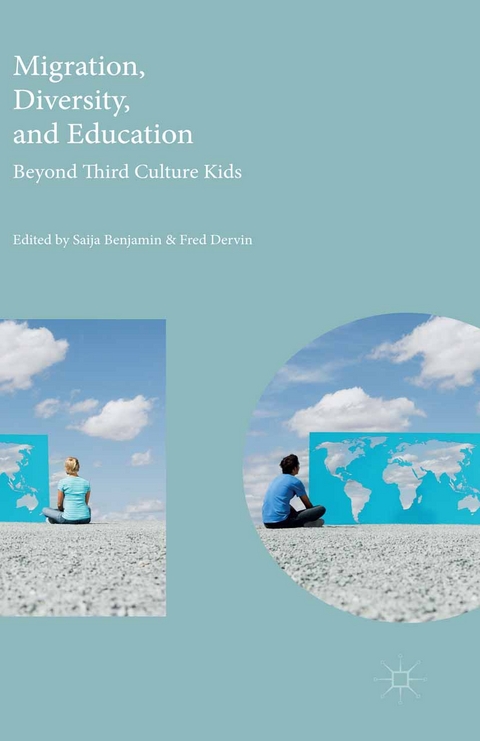
Migration, Diversity, and Education (eBook)
251 Seiten
Palgrave Macmillan UK (Verlag)
978-1-137-52466-9 (ISBN)
Saija Benjamin, University of Helsinki, Finland Janine M Bernard, Syracuse University, USA Kyoung Mi Choi, Youngstown State University, USA Fred Dervin, University of Helsinki, Finland Gabrielle Désilets, Institut National de Recherche Scientifique Centre Urbanisation, Cultures, Sociétés, Canada Yoshi Joanna Grote, Sussex University, UK Päivi Kannisto, Tilburg University, The Netherlands Nicolas Le Bigre, University of Aberdeen, UK Melissa Luke, Syracuse University, USA Heather Meyer, University of Southampton, UK Richard Pearce, International Education consultant, UK Danau Tanu, University of Western Australia, Australia Adnieszka Tr?bka, Jagiellonian University, Poland Christian Triebel, King's College London, UK Donna M Velliaris, Eynesbury Institute of Business and Technology, Australia
The concept of Third Culture Kids is often used to describe people who have spent their childhood on the move, living in many different countries and languages. This book examines the hype, relevance and myths surrounding the concept while also redefining it within a broader study of transnationality to demonstrate the variety of stories involved.
Saija Benjamin, University of Helsinki, Finland Janine M Bernard, Syracuse University, USA Kyoung Mi Choi, Youngstown State University, USA Fred Dervin, University of Helsinki, Finland Gabrielle Désilets, Institut National de Recherche Scientifique Centre Urbanisation, Cultures, Sociétés, Canada Yoshi Joanna Grote, Sussex University, UK Päivi Kannisto, Tilburg University, The Netherlands Nicolas Le Bigre, University of Aberdeen, UK Melissa Luke, Syracuse University, USA Heather Meyer, University of Southampton, UK Richard Pearce, International Education consultant, UK Danau Tanu, University of Western Australia, Australia Adnieszka Tr?bka, Jagiellonian University, Poland Christian Triebel, King's College London, UK Donna M Velliaris, Eynesbury Institute of Business and Technology, Australia
Cover 1
Half-Title 2
Series 3
Title 4
Copyright 5
Contents 6
List of Figures and Tables 8
Acknowledgments 9
Notes on Contributors 10
Introduction 14
Section I: Multi-Mobility: Mixing the Global and the Local 24
1 Toward an Interdisciplinary Analysis of the Diversity of “Third Culture Kids” 25
2 Conceptualizing Four Ecological Influences on Contemporary “Third Culture Kids” 48
3 Boundaries and the Restriction of Mobility within International School Communities: A Case Study from Germany 71
Section II: Migrant Children: Belonging or Longing to Belong? 96
4 Non-Place Kids? Marc Augé’s Non-Place and Third Culture Kids 97
5 NatioNILism: The Space of Nation-Less Belonging 112
6 Talking about “Home”: Immigrant Narratives as Context for TCKs 131
7 “Third Culture Kids” as Serial Migrants’ Children: Understanding Some of the Impacts of a Highly Mobile Transnational Upbringing 153
Section III: Being and Becoming in Transition: Ruptures, Changes, Coping 173
8 Being Connected: A Friendship Comparison among U.S., International, and Third Culture College Students 174
9 Experiences of Polish and American Third Culture Kids in a Comparative Perspective 196
Section IV: Mobility and Beyond 218
10 Adventuring and Vagrancy: Justifying Location-Independence 219
Afterword 241
Index 257
| Erscheint lt. Verlag | 10.1.2016 |
|---|---|
| Zusatzinfo | XII, 251 p. |
| Verlagsort | London |
| Sprache | englisch |
| Themenwelt | Sozialwissenschaften ► Ethnologie |
| Sozialwissenschaften ► Pädagogik ► Bildungstheorie | |
| Sozialwissenschaften ► Soziologie | |
| Technik | |
| Schlagworte | belonging • Culture • Education • Expatriation • Identity • Migrants • Migration • Mobility • Multilingualism • school • Third Culture Kids |
| ISBN-10 | 1-137-52466-9 / 1137524669 |
| ISBN-13 | 978-1-137-52466-9 / 9781137524669 |
| Informationen gemäß Produktsicherheitsverordnung (GPSR) | |
| Haben Sie eine Frage zum Produkt? |
 PDF (Wasserzeichen)
DRM: Digitales Wasserzeichen
Dieses eBook enthält ein digitales Wasserzeichen und ist damit für Sie personalisiert. Bei einer missbräuchlichen Weitergabe des eBooks an Dritte ist eine Rückverfolgung an die Quelle möglich.
Dateiformat: PDF (Portable Document Format)
Mit einem festen Seitenlayout eignet sich die PDF besonders für Fachbücher mit Spalten, Tabellen und Abbildungen. Eine PDF kann auf fast allen Geräten angezeigt werden, ist aber für kleine Displays (Smartphone, eReader) nur eingeschränkt geeignet.
Systemvoraussetzungen:
PC/Mac: Mit einem PC oder Mac können Sie dieses eBook lesen. Sie benötigen dafür einen PDF-Viewer - z.B. den Adobe Reader oder Adobe Digital Editions.
eReader: Dieses eBook kann mit (fast) allen eBook-Readern gelesen werden. Mit dem amazon-Kindle ist es aber nicht kompatibel.
Smartphone/Tablet: Egal ob Apple oder Android, dieses eBook können Sie lesen. Sie benötigen dafür einen PDF-Viewer - z.B. die kostenlose Adobe Digital Editions-App.
Buying eBooks from abroad
For tax law reasons we can sell eBooks just within Germany and Switzerland. Regrettably we cannot fulfill eBook-orders from other countries.
aus dem Bereich