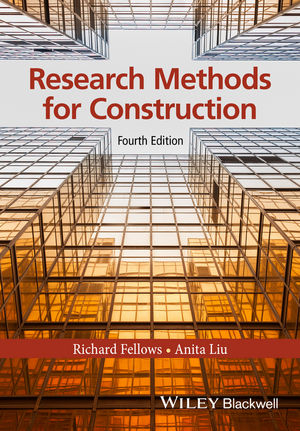
Research Methods for Construction (eBook)
John Wiley & Sons (Verlag)
978-1-118-91573-8 (ISBN)
This new edition of a valued guide for construction students will:
- instil rigour into your problem solving and the production of reports and publications
- is one of the few books to provide guidance on research formulation, methodologies, and
methods specifically for construction students - has been extended in scope to cover many areas of debate, e.g. research ethics, and quantitative
& qualitative research
Research Methods for Construction will help you instil rigour into your problem-solving, and into your reports and publications. It will be of value to construction, surveying, architecture and civil engineering students undertaking research, whether for bachelors and masters degree dissertations, or for masters and doctoral research degree theses. Now in its Fourth Edition, this remains one of the few books to provide guidance on research formulation, methodologies, and methods specifically for construction students. Three main sections Producing a Proposal, Executing the Research and Reporting the Results discuss the key issues in research and examine the primary approaches, both qualitative and quantitative. The methods adopted for scientific and engineering experiments, model building and simulations are discussed, as well as those employed for research into management, social and economic issues. The authors examine the requirements for data and analysis, including the important statistical considerations and a range of qualitative techniques that enable construction researchers to appreciate what needs to be evaluated in devising how research may be carried out effectively and efficiently. This new edition has been updated to reflect current debates and concerns, including ethical issues, legislation and codes of practice concerning the collection, processing, storage, use and disposal of data. Pressures of time and funding to carry out the empirical work all too often lead to a lack of attention to how the study should be done and why. The authors address the importance of explaining the philosophical approach adopted (ontology, epistemology) and the consequent methodology. They advocate close scrutiny of the methods available for appropriateness, both academically and practically. The fundamental theme of the book remains to facilitate a researcher s informed and justified selection of a philosophical paradigm and of appropriate methods to execute the research.
Professor Richard Fellows, Department of Civil and Building Engineering, Loughborough University Richard Fellows is Professor of Construction Business Management at Loughborough University, UK; previously, he was a Professor in the Department of Real Estate and Construction, The University of Hong Kong and Professor of Culture in Construction at Glasgow Caledonian University, UK.?He graduated from the University of Aston and has worked as a quantity surveyor for several major contractors.?Richard has a PhD from the University of Reading, has taught at a number of universities in UK and other countries and was co-ordinator for research in construction management for the Engineering and Physical Sciences Research Council in the UK.?His research interests concern economics, contracts and law, and management of people in construction - especially cultural issues as drivers of behaviour and performance.?He was a founder and for many years was joint coordinator of the CIB group, W112 - 'Culture in Construction'.?Richard has published widely in books, journals and international conferences and is qualified as a mediator. Professor Anita Liu, Department of Real Estate and Construction, University of Hong Kong Anita Liu graduated from the University of Reading.? She returned to Hong Kong to work in a quantity surveying consultancy, for the Hong Kong government, and for a major contractor before moving into academia. She obtained an MSc and a PhD from the University of Hong Kong. She has obtained many research grants from different awarding bodies, including ESRC (UK) and RGC (Hong Kong) projects and has presented papers at many international research conferences. She publishes widely in a variety of leading journals, is a regular reviewer for international journals and research awarding bodies, and is a member of several editorial boards. Anita has been chairperson of the Quantity Surveying Division of the Hong Kong Institute of Surveyors and a member of committees and boards in various professional institutions in China and in UK. Anita was chair professor of Commercial Management and Quantity Surveying at Loughborough University. Currently, she is Professor in the Department of Real Estate and Construction at The University of Hong Kong and joint co-coordinator of CIB W112: 'Culture in Construction'.
Preface to Third Edition viii
Preface to Second Edition x
Part 1 Producing a Proposal 1
1 Introduction 3
The concept of research 3
Classifications of research 7
Theories and paradigms 12
Research styles 20
Quantitative and qualitative approaches 26
Where to begin 30
Summary 32
References 32
2 Topic for Study 35
Selection of a topic 35
Writing the proposal 42
Summary 50
References 50
Part 2 Executing the Research 51
3 Initial Research 53
The research process 53
Initial search 60
Assembling the theoretical framework 66
Philosophy and methodology 67
Theoretical models and constructs 73
Proper referencing 77
Summary 77
References 78
4 Approaches to Empirical Work 81
Role of experience 81
Research design 83
Qualitative approaches 91
Quantitative approaches 97
Experimental design (including experiments and quasi-experiments) 102
Case study research 110
Modelling 114
Simulation 118
Summary 121
References 121
5 Hypotheses 125
Essentials of a valid hypothesis 125
Roles of hypotheses 129
Objective testing of hypotheses 130
Role of sampling 131
Common statistical measures 133
Null hypotheses 141
Validities 143
Summary 145
References 146
6 Data Collection 147
Data requirements 147
Collecting data from respondents 150
Sampling 159
Sample size 163
Scales of measurement 167
Obtaining data 175
Summary 183
References 183
7 Data Analysis 186
Analysing data 186
Plotting data 191
Statistical methods 194
Non-parametric tests 194
Parametric tests 202
Other analytical techniques 225
Summary 242
References 242
8 Ethics in Research 246
The concepts of morals and ethics 246
Research ethics 249
Data analysis, intellectual property and data protection 256
Summary 259
References 259
Part 3 Reporting the Results 261
9 Results, Inferences and Conclusions 263
Requirements for valid results 263
Potential sources of error 264
Reliability 265
Results 266
Inferences 270
Conclusions 276
Summary 279
References 279
10 Reports and Presentations 281
Report production 281
Communication 282
Contents of the report 284
Oral presentation 293
Summary 294
Index 295
Chapter 1
Introduction
Learning Objective
The objectives of this chapter are to:
- introduce the concept of research;
- provide awareness of different classifications of research;
- outline the essentials of theories and paradigms;
- discuss the various research styles;
- introduce quantitative and qualitative approaches;
- consider where, and how, to begin.
1.1 The concept of research
Chambers English Dictionary defines research as:
- a careful search
- investigation
- systematic investigation towards increasing the sum of knowledge.
For many people, the prospect of embarking on a research project is a daunting one. However, especially for people who are associated with a project-oriented industry, such as property development, building design, construction or facilities management, familiarity with the nature of projects and their management is a significant advantage. Dr Martin Barnes, an ex-chairperson of the Association of Project Managers (APM), has described a project as a task or an activity which has a beginning (start), a middle and an end that involves a process which leads to an output (product/solution). Despite the situation that much research is carried out as part of a long-term ‘rolling’ programme, each individual package of research is an entity which is complete in itself, while contributing to the overall programme.
Indeed, any work which assists in the advancement of knowledge, whether of society, a group or an individual, involves research; it will involve enquiry and learning also.
1.1.1 Research: a careful search/investigation
Research can be considered to be a ‘voyage of discovery’, whether anything is discovered or not. In fact, it is highly likely that some discovery will result because discovery can concern the process of investigation as well as the ‘technical subject’ (the topic of investigation). Even if no new knowledge is apparent, the investigation may lend further support for existing theory. What is discovered depends on the question(s) which the research addresses, the patterns and techniques of searching, the location and subject material investigated, the analyses carried out and, importantly, reflection by the researcher on the results of the analyses in the context of the theory and literature and methodology/methods employed. The knowledge and abilities of researchers and their associates are important in executing the investigative work and, perhaps more especially, in the production of results, discussion of them and the drawing of conclusions. Being open-minded and as objective as possible is vital for good research.
1.1.2 Research: contribution to knowledge
The Economic and Social Research Council (ESRC) defines research as ‘…any form of disciplined inquiry that aims to contribute to a body of knowledge or theory’ (ESRC, 2007). That definition demonstrates that the inquiry must be designed and structured appropriately and that it is the intent of the inquiry which is important (to distinguish from casual inquiries) rather than the outcome per se.
The Concise Oxford Dictionary (1995) provides a more extensive definition of research as ‘the systematic investigation into and study of materials, sources and so on in order to establish facts and reach new conclusions’. Here the emphasis lies on determining facts in order to reach new conclusions – hence, new knowledge. The issue of ‘facts’ is not as clear, philosophically speaking, as is commonly assumed, and will be considered later.
The dictionary continues: ‘an endeavour to discover new or collate old facts and so on by the scientific study of a subject or by a course of critical investigation’. Here there is added emphasis on the method(s) of study; the importance of being scientific and critical is reinforced.
Therefore, research comprises what (facts and conclusions) and how (scientific; critical) components. Being critical, even sceptical, rather than merely accepting, is vital; evidence to support assertions, use of methods, production of findings and so on is essential. ‘…critical analysis questions the authority and objective necessity of the normative framework that is taken for granted…also challenges the adequacy of…accounts…’ (Willmott 1993: p. 522). Further, it is concerned to ‘…situate the development and popularity of ideas and practices…in the material and historical contexts of their emergence and application…’ (ibid: p. 521).
The history of the nature of investigations constituting research is paralleled by the continuum of activities undertaken in a modern research project – description, classification, comparison, measurement, establishing (any) association, determining cause and effect (Bonoma 1985). ‘Studies toward the description end of the continuum might be associated more frequently with theory building, whereas those near the cause-and-effect end are more frequently used for theory disconfirmation [testing]’ ([..] added, ibid: p. 201).
Traditionally, the essential feature of research for a doctoral degree (PhD – Doctor of Philosophy) is that the work makes an original (incremental) contribution to knowledge. This is a requirement for a PhD, and many other research projects also make original contributions to knowledge. A vast number of research projects synthesise and analyse existing theory, ideas and findings of other research, in seeking to answer a particular question or to provide new insights. Such research is often referred to as scholarship; scholarship forms a vital underpinning for almost every type of research project (including PhD). However, the importance of scholarship is, all too often, not appreciated adequately – it informs and provides a major foundation upon which further knowledge is built, for both the topic of investigation and the methodology and methods by which investigations may be carried out.
Despite its image, research is not an activity which is limited to academics, scientists and so on; it is carried out by everyone many times each day. Some research projects are larger, need more resources and are more important than others.
Example
Consider what you would do in response to being asked, ‘What is the time, please?’ Having heard and understood the question, your response process might be:
- look at watch/clock
- read time
- formulate answer
- state answer (‘The time is…’).
In providing an answer to the original question, a certain amount of research has been done.
Clearly, it is the research question, or problem, that drives the research. Methodology, method(s), data and so on are determined to best suit answering the question validly, accurately and reliably. It is dangerous to adopt a method and then to hunt for questions and problems to which the method may be applied – it may not be (very) suitable and so, lead to difficulties and dubious results.
1.1.3 A learning process
Research is a learning process…perhaps the only learning process.
Commonly, teaching is believed to be the passing on of knowledge, via instructions given by the teacher, to the learner. Learning is the process of acquiring knowledge and understanding. Thus, teaching exists only through the presence of learning and constitutes a communication process to stimulate learning; teaching is ‘facilitation of learning’. If someone is determined not to learn, they cannot be forced to do so, although they may be persuaded to learn through forceful means.
1.1.4 Contextual factors affecting research
Research does not occur in a vacuum. Research projects take place in contexts – of the researcher's interests, expertise and experiences; of human contacts; of the physical environment and so on. Thus, despite the best intentions and rigorous precautions, it seems inevitable that circumstances, purpose and so on will impact on the work and its results (a ‘Hawthorne effect’ or a ‘halo effect’). The fact that research is being carried out will, itself, influence the results, as described in the Hawthorne investigations of Elton Mayo (1949) and noted in the writings of Karl Popper (1989) on the philosophy of research. Research is never a completely closed system. Indeed, much research is, of necessity, an open system which allows for, and accommodates, adaptability (e.g. exploratory studies, processual research).
As research is always executed in context, it is important to consider the contextual factors, the environmental variables, which may influence the results through their impacting on the data recorded. (Environmental variables and constructs are fundamental, express concerns of institutional theory; Scott 1995; Oliver 1997.) Such environmental variables merit consideration in tandem with the subject variables – dependent, independent and intervening (see Fig. 1.1) – of the topic of study. The choice of methodology/methodologies is important in assisting identification of all relevant variables, their mechanisms and amounts of impact.
| Erscheint lt. Verlag | 5.5.2015 |
|---|---|
| Sprache | englisch |
| Themenwelt | Technik ► Bauwesen |
| Schlagworte | AIM • Analyses • Applied • Assumptions • Bauausführung • Bauausführung • Baubetrieb • Bauingenieur- u. Bauwesen • Case Studies • Civil Engineering & Construction • Code of Practice • communications • Conclusions • Construction • Construction Management • constructs • contents • Copyright • Data • data protection • Definitions • Deliverables • Discourse analysis • discussion • Errors • ethics • Experience • experiments • Factor Analysis • hypothesis • inferences • Information • Informed Consent • Intellectual Property • Interpretation • Interpretivism • Interviews • levels • Limitations • Literature • Measurement • Methodology • Methods • Modelling • Models • Morals • multi-level research • non-parametric tests • Normal distribution • null-hypothesis • objectives • Objectivity • oral presentations • paradigm • parametris rests • Philosophy • plagiarism • plotting • Programme • Proposition • pure • qualitative • Quantitative • Questionnaires • recommendations • Referencing • reliabilities • Reports • Research design • response styles • Sample Size • Sampling • scales • Sequence • Simulation • Statistics • structural equations models • Surveys • Testing • theory • topic • triangulation. subject • validities |
| ISBN-10 | 1-118-91573-9 / 1118915739 |
| ISBN-13 | 978-1-118-91573-8 / 9781118915738 |
| Informationen gemäß Produktsicherheitsverordnung (GPSR) | |
| Haben Sie eine Frage zum Produkt? |
 EPUB (Adobe DRM)
Kopierschutz: Adobe-DRM
Adobe-DRM ist ein Kopierschutz, der das eBook vor Mißbrauch schützen soll. Dabei wird das eBook bereits beim Download auf Ihre persönliche Adobe-ID autorisiert. Lesen können Sie das eBook dann nur auf den Geräten, welche ebenfalls auf Ihre Adobe-ID registriert sind.
Details zum Adobe-DRM
Dateiformat: EPUB (Electronic Publication)
EPUB ist ein offener Standard für eBooks und eignet sich besonders zur Darstellung von Belletristik und Sachbüchern. Der Fließtext wird dynamisch an die Display- und Schriftgröße angepasst. Auch für mobile Lesegeräte ist EPUB daher gut geeignet.
Systemvoraussetzungen:
PC/Mac: Mit einem PC oder Mac können Sie dieses eBook lesen. Sie benötigen eine
eReader: Dieses eBook kann mit (fast) allen eBook-Readern gelesen werden. Mit dem amazon-Kindle ist es aber nicht kompatibel.
Smartphone/Tablet: Egal ob Apple oder Android, dieses eBook können Sie lesen. Sie benötigen eine
Geräteliste und zusätzliche Hinweise
Buying eBooks from abroad
For tax law reasons we can sell eBooks just within Germany and Switzerland. Regrettably we cannot fulfill eBook-orders from other countries.
aus dem Bereich