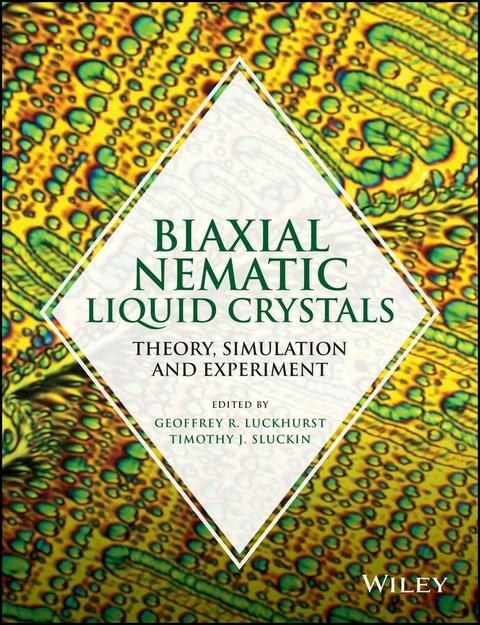
Biaxial Nematic Liquid Crystals (eBook)
John Wiley & Sons (Verlag)
978-1-118-69635-4 (ISBN)

GEOFFREY R. LUCKHURST
School of Chemistry, University of Southampton, UK
TIMOTHY J. SLUCKIN
School of Mathematics, University of Southampton, UK
In the nematic liquid crystal phase, rod-shaped molecules move randomly but remain essentially parallel to one another. Biaxial nematics, which were first predicted in 1970 by Marvin Freiser, have their molecules differentially oriented along two axes. They have the potential to create displays with fast switching times and may have applications in thin-film displays and other liquid crystal technologies. This book is the first to be concerned solely with biaxial nematic liquid crystals, both lyotropic and thermotropic, formed by low molar mass as well as polymeric systems. It opens with a general introduction to the biaxial nematic phase and covers: Order parameters and distribution functions Molecular field theory Theories for hard biaxial particles Computer simulation of biaxial nematics Alignment of the phase Display applications Characterisation and identification Lyotropic, thermotropic and colloidal systems together with material design With a consistent, coherent and pedagogical approach, this book brings together theory, simulations and experimental studies; it includes contributions from some of the leading figures in the field. It is relevant to students and researchers as well as to industry professionals working in soft matter, liquid crystals, liquid crystal devices and their applications throughout materials science, chemistry, physics, mathematics and display engineering.
GEOFFREY R. LUCKHURST School of Chemistry, University of Southampton, UK TIMOTHY J. SLUCKIN School of Mathematics, University of Southampton, UK
Chapter 1
Introduction
Geoffrey R. Luckhurst1 and Timothy J. Sluckin2
1Chemistry, Faculty of Natural and Environmental Sciences, University of Southampton, Southampton, United Kingdom
2Division of Mathematical Sciences, University of Southampton, Southampton, United Kingdom
1.1 Historical Background
Liquid crystals are so named because the original pioneers, particularly Friedrich Reinitzer and Otto Lehmann, observed fluids which exhibited what they interpreted as crystalline properties [1]. After some years it became clear that these materials were all optically anisotropic. Hitherto all optically anisotropic materials had indeed been crystalline, but nevertheless, in principle, the properties of anisotropy and of crystallinity could be regarded as distinct.
Until the discovery of liquid crystals, optical anisotropy had been regarded as a function of crystal structure, and was often regarded as part of the study of optical mineralogy. By anisotropy we mean that the velocities of light waves in a particular direction depend on the polarisation of the waves. An alternative way of considering this is to note that a light beam incident on an anisotropic material is usually split into two beams inside the material; the material is said to be doubly refracting or birefringent. From far away, the rather dramatic manifestation of this phenomenon is the appearance of two different images of the same object when viewed through a slab of such a material. When a beam is viewed through a smaller birefringent slab, the two beams may still overlap when they exit the sample. Then the two beams can interfere destructively after exiting the slab. In non-monochromatic beams (i.e. usually), the consequence will be bright interference fringes. Historically speaking, birefringent media were traditionally divided into two categories, known as uniaxial and biaxial, which we now briefly describe.
Of these the uniaxial media were rather simpler. The crystals exhibit trigonal, tetragonal or hexagonal symmetry [2]. All such materials possess a single optical axis, which is also an axis of symmetry for the crystal. The origin of the term uniaxial comes from this one axis. In general optical propagation in any given direction inside a uniaxial material divides itself into ordinary and extraordinary beams. The velocity of the ordinary waves is determined by components of the dielectric tensor in the plane perpendicular to the optical axis. Only the propagation of the extraordinary wave is affected by the dielectric component in the optical axis direction. The ordinary and extraordinary beams correspond to eigenmodes of Maxwell's equation for propagation in the direction in question. The key property of a uniaxial medium is that there is a single direction – the optical axis – along which the velocities of light with perpendicular polarisations are equal. In this case the two different optical eigenmodes become degenerate.
When we compare the optical properties of biaxial crystalline materials with uniaxial materials, we find that there are now two different axes along which the light velocity is polarisation independent. It is the existence of these two optical axes which is the origin of the term biaxial. This behaviour appears in crystal structures of monoclinic, triclinic and orthorhombic types [2–4]. The dielectric properties of the crystal structures do of course possess three distinct principal axes, which correspond to symmetry axes of the crystal, if they exist. But the optical axes do not lie along any of these principal axes, but rather lie in the plane of the largest and smallest relevant dielectric tensor component, with the principal axes bisecting the optical axes [5]. Thus, strangely, in the context of the fundamental tensor material properties, a uniaxial material has one special axis, whereas a biaxial material, notwithstanding its name, has three. We further note that even if a material is not crystalline, it will possess locally a dielectric tensor, with principal axes, and hence local optical axes.
To be mathematically precise, the existence of optical birefringence is associated with a dielectric constant with principal axis form:
In an optically isotropic medium . In a uniaxial medium two of these are equal (conventionally ), while in a biaxial medium all three components are different: .
As a matter of observation, it appeared for many years that all liquid crystals were optically uniaxial. Of course, as fluids rather than solids, the symmetry of the system would be rather than, for example, (in the case of a hexagonal crystal), but from an optical point of view this would not be crucial. Although liquid crystalline materials, in principle, exhibit relatively simple optical anisotropy properties, as is well-known, it is often difficult to prepare well-aligned samples. As a result, light passing through a liquid crystalline medium may undergo repeated scattering as the local dielectric tensor changes, leading to the characteristic turbid appearance of a liquid crystal. Alternatively, one may observe brightly coloured textures.
Phases have historically been recognised in the microscope by these characteristic textures. These textures are a consequence of the the patterns of the alignment discontinuities, which are themselves a statistical mechanical property of the phase in question. For example, the nature of the smectic C phase, first observed in 1959 by Arnold and Sackmann [6], excited much debate, for the textures included Schlieren textures characteristic of the nematic phase in addition to the focal conics and fans associated with the smectic layers. However, Arora, Fergason and Saupe [7] were able to align the smectic layers. It was then possible for Taylor, Fergason and Arora [8], using a conoscopic method that we will discuss further later in this chapter, to show that the resulting phase was optically biaxial.
This experiment was the key to understanding the smectic C phase as a layered phase with the director tilted with respect to the layer normal. The symmetry of this phase is such as to distinguish in an essential way three different axes, later conventionally labelled [9] as , the unit vector normal to the layers, , the projection of the director onto the plane perpendicular to the layers, and .
However, the biaxiality of the smectic C liquid crystal phase is, in some sense, a derivative property, which arises as a consequence of the interaction between the layers and the tilt. Smectic C phases retain some one dimensional crystalline order. In crystalline phases the birefringence – whether uniaxial or biaxial – is an orientational property which follows as a result of the crystalline order, rather than a primary property of the phase itself. By contrast, in the nematic liquid crystal phase the birefringence follows directly from the point symmetry of the phase itself. Although the smectic C only exhibits, so to say, a secondary optical biaxiality, it does beg the question of whether materials exist which are at the same time homogeneous and optically biaxial. These would be the biaxial analogue of the uniaxial nematic phase. In the simplest case, the phase would possess point symmetry, and be the natural liquid crystalline analogue of orthorhombic crystals. This was the question posed in a pioneering paper by Marvin Freiser in 1970 [10].
In this book we shall follow the scientific narrative, and discuss the present state of play, of the search for the biaxial nematic phases whose existence was first conjectured by Freiser more than forty years ago. The topic is scientifically peculiar, in that more of the early running has been made by theorists rather than by experimentalists. The projected biaxial phase turned out to be of great interest to theorists of a variety of different backgrounds. This was surely, at least in part, because the mathematics provided a playground for methods developed and previously practised in simpler cases. But, in addition, experimentalists were attracted partly because of the challenges of synthesising molecules of sufficient complexity to sustain a biaxial phase, and partly because even the act of recognising a biaxial phase turned out to be a greater challenge than one might at first think. As a final touch, more recently it has also been proposed that biaxial phases might be employed in optoelectronic devices because such materials might switch quickly.
1.2 Freiser Theory
Freiser [10] was the first to try to extend ideas first introduced in the theory of uniaxial liquid crystal phases to study more complex phases. The standard molecular paradigm for the statistical physics of the uniaxial nematic liquid crystal phase is, of course, the Maier–Saupe theory [11]. This theory balances the entropically-induced free energy cost of an orientationally ordered phase against the energy gain following as a result of molecular order. Freiser noted that although the Maier–Saupe theory supposes cylindrical molecules, in fact most organic nematogens are formed from molecules which are elongated but flat. Formally speaking, the energy interaction would presumably be minimised if the molecules were fully aligned, and this would necessarily involve a degree of biaxial order. By interpolating rather hopefully between the high temperature isotropic and low temperature biaxial regimes, he suggested that, with decreasing temperature, we might see, successively, isotropic, uniaxial nematic and biaxial nematic phases (as well as possible biaxial smectic phases). The paper was more suggestive than definitive. The use of the theory developed by...
| Erscheint lt. Verlag | 27.3.2015 |
|---|---|
| Sprache | englisch |
| Themenwelt | Naturwissenschaften ► Chemie ► Technische Chemie |
| Naturwissenschaften ► Geowissenschaften ► Mineralogie / Paläontologie | |
| Naturwissenschaften ► Physik / Astronomie ► Festkörperphysik | |
| Technik ► Maschinenbau | |
| Schlagworte | Biaxial Nematics • Chemie • Chemistry • Computational Chemistry & Molecular Modeling • Computational Chemistry u. Molecular Modeling • Display technology • Flüssigkristall • Flüssigkristall • LCD Applications • liquid crystals • Materials Science • Materialwissenschaften • molecular structure • Organised Fluids • Physikalische Chemie • Polymers • Polymer Science & Technology • Polymersynthese • polymer synthesis • Polymerwissenschaft u. -technologie • soft matter • Theory, Simulation, Experiment • Thermotropics, Lyotropics, Colloidal |
| ISBN-10 | 1-118-69635-2 / 1118696352 |
| ISBN-13 | 978-1-118-69635-4 / 9781118696354 |
| Informationen gemäß Produktsicherheitsverordnung (GPSR) | |
| Haben Sie eine Frage zum Produkt? |
 EPUB (Adobe DRM)
Kopierschutz: Adobe-DRM
Adobe-DRM ist ein Kopierschutz, der das eBook vor Mißbrauch schützen soll. Dabei wird das eBook bereits beim Download auf Ihre persönliche Adobe-ID autorisiert. Lesen können Sie das eBook dann nur auf den Geräten, welche ebenfalls auf Ihre Adobe-ID registriert sind.
Details zum Adobe-DRM
Dateiformat: EPUB (Electronic Publication)
EPUB ist ein offener Standard für eBooks und eignet sich besonders zur Darstellung von Belletristik und Sachbüchern. Der Fließtext wird dynamisch an die Display- und Schriftgröße angepasst. Auch für mobile Lesegeräte ist EPUB daher gut geeignet.
Systemvoraussetzungen:
PC/Mac: Mit einem PC oder Mac können Sie dieses eBook lesen. Sie benötigen eine
eReader: Dieses eBook kann mit (fast) allen eBook-Readern gelesen werden. Mit dem amazon-Kindle ist es aber nicht kompatibel.
Smartphone/Tablet: Egal ob Apple oder Android, dieses eBook können Sie lesen. Sie benötigen eine
Geräteliste und zusätzliche Hinweise
Buying eBooks from abroad
For tax law reasons we can sell eBooks just within Germany and Switzerland. Regrettably we cannot fulfill eBook-orders from other countries.
aus dem Bereich