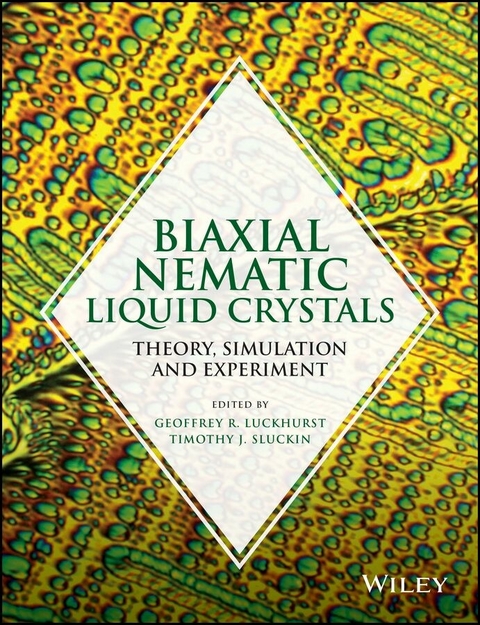
Biaxial Nematic Liquid Crystals (eBook)
John Wiley & Sons (Verlag)
978-1-118-69633-0 (ISBN)
In the nematic liquid crystal phase, rod-shaped molecules move randomly but remain essentially parallel to one another. Biaxial nematics, which were first predicted in 1970 by Marvin Freiser, have their molecules differentially oriented along two axes. They have the potential to create displays with fast switching times and may have applications in thin-film displays and other liquid crystal technologies.
This book is the first to be concerned solely with biaxial nematic liquid crystals, both lyotropic and thermotropic, formed by low molar mass as well as polymeric systems. It opens with a general introduction to the biaxial nematic phase and covers:
• Order parameters and distribution functions
• Molecular field theory
• Theories for hard biaxial particles
• Computer simulation of biaxial nematics
• Alignment of the phase
• Display applications
• Characterisation and identification
• Lyotropic, thermotropic and colloidal systems together with material design
With a consistent, coherent and pedagogical approach, this book brings together theory, simulations and experimental studies; it includes contributions from some of the leading figures in the field. It is relevant to students and researchers as well as to industry professionals working in soft matter, liquid crystals, liquid crystal devices and their applications throughout materials science, chemistry, physics, mathematics and display engineering.
GEOFFREY R. LUCKHURST
School of Chemistry, University of Southampton, UK
TIMOTHY J. SLUCKIN
School of Mathematics, University of Southampton, UK
In the nematic liquid crystal phase, rod-shaped molecules move randomly but remain essentially parallel to one another. Biaxial nematics, which were first predicted in 1970 by Marvin Freiser, have their molecules differentially oriented along two axes. They have the potential to create displays with fast switching times and may have applications in thin-film displays and other liquid crystal technologies. This book is the first to be concerned solely with biaxial nematic liquid crystals, both lyotropic and thermotropic, formed by low molar mass as well as polymeric systems. It opens with a general introduction to the biaxial nematic phase and covers: Order parameters and distribution functions Molecular field theory Theories for hard biaxial particles Computer simulation of biaxial nematics Alignment of the phase Display applications Characterisation and identification Lyotropic, thermotropic and colloidal systems together with material design With a consistent, coherent and pedagogical approach, this book brings together theory, simulations and experimental studies; it includes contributions from some of the leading figures in the field. It is relevant to students and researchers as well as to industry professionals working in soft matter, liquid crystals, liquid crystal devices and their applications throughout materials science, chemistry, physics, mathematics and display engineering.
GEOFFREY R. LUCKHURST School of Chemistry, University of Southampton, UK TIMOTHY J. SLUCKIN School of Mathematics, University of Southampton, UK
| Erscheint lt. Verlag | 23.2.2015 |
|---|---|
| Sprache | englisch |
| Themenwelt | Naturwissenschaften ► Chemie ► Technische Chemie |
| Naturwissenschaften ► Geowissenschaften ► Mineralogie / Paläontologie | |
| Naturwissenschaften ► Physik / Astronomie ► Festkörperphysik | |
| Technik ► Maschinenbau | |
| Schlagworte | Biaxial Nematics • Chemie • Chemistry • Computational Chemistry & Molecular Modeling • Computational Chemistry u. Molecular Modeling • Display technology • Flüssigkristall • Flüssigkristall • LCD Applications • liquid crystals • Materials Science • Materialwissenschaften • molecular structure • Organised Fluids • Physikalische Chemie • Polymers • Polymer Science & Technology • Polymersynthese • polymer synthesis • Polymerwissenschaft u. -technologie • soft matter • Theory, Simulation, Experiment • Thermotropics, Lyotropics, Colloidal |
| ISBN-10 | 1-118-69633-6 / 1118696336 |
| ISBN-13 | 978-1-118-69633-0 / 9781118696330 |
| Informationen gemäß Produktsicherheitsverordnung (GPSR) | |
| Haben Sie eine Frage zum Produkt? |
 PDF (Adobe DRM)
Kopierschutz: Adobe-DRM
Adobe-DRM ist ein Kopierschutz, der das eBook vor Mißbrauch schützen soll. Dabei wird das eBook bereits beim Download auf Ihre persönliche Adobe-ID autorisiert. Lesen können Sie das eBook dann nur auf den Geräten, welche ebenfalls auf Ihre Adobe-ID registriert sind.
Details zum Adobe-DRM
Dateiformat: PDF (Portable Document Format)
Mit einem festen Seitenlayout eignet sich die PDF besonders für Fachbücher mit Spalten, Tabellen und Abbildungen. Eine PDF kann auf fast allen Geräten angezeigt werden, ist aber für kleine Displays (Smartphone, eReader) nur eingeschränkt geeignet.
Systemvoraussetzungen:
PC/Mac: Mit einem PC oder Mac können Sie dieses eBook lesen. Sie benötigen eine
eReader: Dieses eBook kann mit (fast) allen eBook-Readern gelesen werden. Mit dem amazon-Kindle ist es aber nicht kompatibel.
Smartphone/Tablet: Egal ob Apple oder Android, dieses eBook können Sie lesen. Sie benötigen eine
Geräteliste und zusätzliche Hinweise
Buying eBooks from abroad
For tax law reasons we can sell eBooks just within Germany and Switzerland. Regrettably we cannot fulfill eBook-orders from other countries.
aus dem Bereich