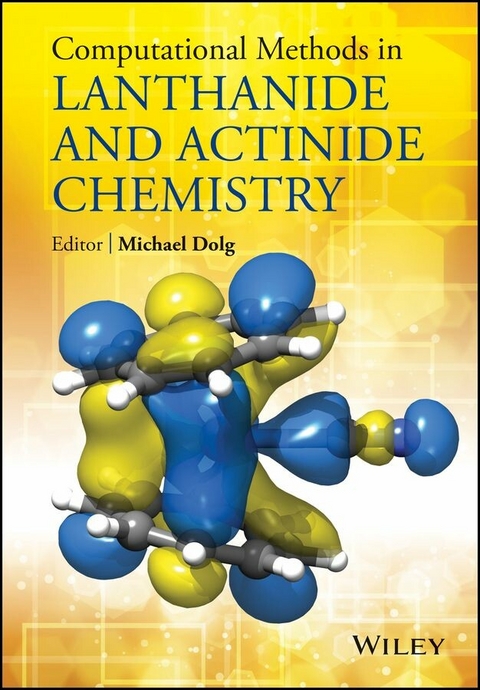
Computational Methods in Lanthanide and Actinide Chemistry (eBook)
John Wiley & Sons (Verlag)
978-1-118-68829-8 (ISBN)
Computational Methods in Lanthanide and Actinide Chemistry summarizes state-of-the-art electronic structure methods applicable for quantum chemical calculations of lanthanide and actinide systems and presents a broad overview of their most recent applications to atoms, molecules and solids. The book contains sixteen chapters, written by leading experts in method development as well as in theoretical investigations of f-element systems.
Topics covered include:
- Relativistic configuration interaction calculations for lanthanide and actinide anions
- Study of actinides by relativistic coupled cluster methods
- Relativistic all-electron approaches to the study of f- element chemistry
- Relativistic pseudopotentials and their applications
- Gaussian basis sets for lanthanide and actinide elements
- Applied computational actinide chemistry
This book will serve as a comprehensive reference work for quantum chemists and computational chemists, both those already working in, and those planning to enter the field of quantum chemistry for f-elements. Experimentalists will also find important information concerning the capabilities of modern quantum chemical methods to assist in the interpretation or even to predict the outcome of their experiments.
Michael Dolg, Institute for Theoretical Chemistry, University of Cologne, Germany. Professor Dolg works in the field of relativistic ab initio pseudopotentials, both their development and their applications. He performed the first wavefunction-based relativistic and correlated ab initio calculations on lanthanide compounds, in 1989, and in 1994 he extended his studies to actinides. He is currently working on various topics in lanthanide and actinide computational chemistry and is one of the leading scientists in this field.
The f-elements and their compounds often possess an unusually complex electronic structure, governed by the high number of electronic states arising from open f-shells as well as large relativistic and electron correlation effects. A correct theoretical description of these elements poses the highest challenges to theory. Computational Methods in Lanthanide and Actinide Chemistry summarizes state-of-the-art electronic structure methods applicable for quantum chemical calculations of lanthanide and actinide systems and presents a broad overview of their most recent applications to atoms, molecules and solids. The book contains sixteen chapters, written by leading experts in method development as well as in theoretical investigations of f-element systems. Topics covered include: Relativistic configuration interaction calculations for lanthanide and actinide anions Study of actinides by relativistic coupled cluster methods Relativistic all-electron approaches to the study of f- element chemistry Relativistic pseudopotentials and their applications Gaussian basis sets for lanthanide and actinide elements Applied computational actinide chemistry This book will serve as a comprehensive reference work for quantum chemists and computational chemists, both those already working in, and those planning to enter the field of quantum chemistry for f-elements. Experimentalists will also find important information concerning the capabilities of modern quantum chemical methods to assist in the interpretation or even to predict the outcome of their experiments.
Michael Dolg, Institute for Theoretical Chemistry, University of Cologne, Germany. Professor Dolg works in the field of relativistic ab initio pseudopotentials, both their development and their applications. He performed the first wavefunction-based relativistic and correlated ab initio calculations on lanthanide compounds, in 1989, and in 1994 he extended his studies to actinides. He is currently working on various topics in lanthanide and actinide computational chemistry and is one of the leading scientists in this field.
| Erscheint lt. Verlag | 17.2.2015 |
|---|---|
| Sprache | englisch |
| Themenwelt | Naturwissenschaften ► Chemie ► Anorganische Chemie |
| Naturwissenschaften ► Chemie ► Physikalische Chemie | |
| Technik | |
| Schlagworte | actinide • Anorganische Chemie • Chemie • Chemistry • Computational Chemistry • Computational Chemistry & Molecular Modeling • Computational Chemistry u. Molecular Modeling • Inorganic Chemistry • Lanthanoide • Quantenchemie • Quantum Chemistry • quantum chemistry, electronic structure theory, lanthanides, actinides, f-elements, relativistic effects, electron correlation effects, ab initio methods, molecules, calculations |
| ISBN-10 | 1-118-68829-5 / 1118688295 |
| ISBN-13 | 978-1-118-68829-8 / 9781118688298 |
| Informationen gemäß Produktsicherheitsverordnung (GPSR) | |
| Haben Sie eine Frage zum Produkt? |
 PDF (Adobe DRM)
Kopierschutz: Adobe-DRM
Adobe-DRM ist ein Kopierschutz, der das eBook vor Mißbrauch schützen soll. Dabei wird das eBook bereits beim Download auf Ihre persönliche Adobe-ID autorisiert. Lesen können Sie das eBook dann nur auf den Geräten, welche ebenfalls auf Ihre Adobe-ID registriert sind.
Details zum Adobe-DRM
Dateiformat: PDF (Portable Document Format)
Mit einem festen Seitenlayout eignet sich die PDF besonders für Fachbücher mit Spalten, Tabellen und Abbildungen. Eine PDF kann auf fast allen Geräten angezeigt werden, ist aber für kleine Displays (Smartphone, eReader) nur eingeschränkt geeignet.
Systemvoraussetzungen:
PC/Mac: Mit einem PC oder Mac können Sie dieses eBook lesen. Sie benötigen eine
eReader: Dieses eBook kann mit (fast) allen eBook-Readern gelesen werden. Mit dem amazon-Kindle ist es aber nicht kompatibel.
Smartphone/Tablet: Egal ob Apple oder Android, dieses eBook können Sie lesen. Sie benötigen eine
Geräteliste und zusätzliche Hinweise
Buying eBooks from abroad
For tax law reasons we can sell eBooks just within Germany and Switzerland. Regrettably we cannot fulfill eBook-orders from other countries.
aus dem Bereich