Computational Methods in Lanthanide and Actinide Chemistry (eBook)
John Wiley & Sons (Verlag)
978-1-118-68828-1 (ISBN)

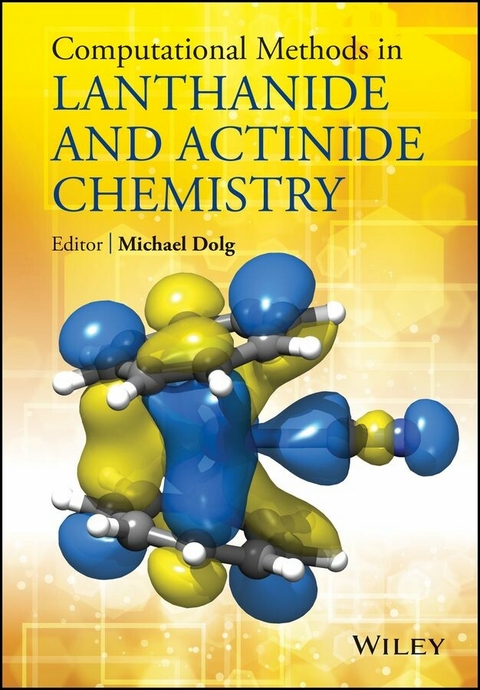
Computational Methods in Lanthanide and Actinide Chemistry summarizes state-of-the-art electronic structure methods applicable for quantum chemical calculations of lanthanide and actinide systems and presents a broad overview of their most recent applications to atoms, molecules and solids. The book contains sixteen chapters, written by leading experts in method development as well as in theoretical investigations of f-element systems.
Topics covered include:
- Relativistic configuration interaction calculations for lanthanide and actinide anions
- Study of actinides by relativistic coupled cluster methods
- Relativistic all-electron approaches to the study of f- element chemistry
- Relativistic pseudopotentials and their applications
- Gaussian basis sets for lanthanide and actinide elements
- Applied computational actinide chemistry
This book will serve as a comprehensive reference work for quantum chemists and computational chemists, both those already working in, and those planning to enter the field of quantum chemistry for f-elements. Experimentalists will also find important information concerning the capabilities of modern quantum chemical methods to assist in the interpretation or even to predict the outcome of their experiments.
The f-elements and their compounds often possess an unusually complex electronic structure, governed by the high number of electronic states arising from open f-shells as well as large relativistic and electron correlation effects. A correct theoretical description of these elements poses the highest challenges to theory. Computational Methods in Lanthanide and Actinide Chemistry summarizes state-of-the-art electronic structure methods applicable for quantum chemical calculations of lanthanide and actinide systems and presents a broad overview of their most recent applications to atoms, molecules and solids. The book contains sixteen chapters, written by leading experts in method development as well as in theoretical investigations of f-element systems. Topics covered include: Relativistic configuration interaction calculations for lanthanide and actinide anions Study of actinides by relativistic coupled cluster methods Relativistic all-electron approaches to the study of f- element chemistry Relativistic pseudopotentials and their applications Gaussian basis sets for lanthanide and actinide elements Applied computational actinide chemistry This book will serve as a comprehensive reference work for quantum chemists and computational chemists, both those already working in, and those planning to enter the field of quantum chemistry for f-elements. Experimentalists will also find important information concerning the capabilities of modern quantum chemical methods to assist in the interpretation or even to predict the outcome of their experiments.
Michael Dolg, Institute for Theoretical Chemistry, University of Cologne, Germany. Professor Dolg works in the field of relativistic ab initio pseudopotentials, both their development and their applications. He performed the first wavefunction-based relativistic and correlated ab initio calculations on lanthanide compounds, in 1989, and in 1994 he extended his studies to actinides. He is currently working on various topics in lanthanide and actinide computational chemistry and is one of the leading scientists in this field.
1
Relativistic Configuration Interaction Calculations for Lanthanide and Actinide Anions
Donald R. Beck1,* Steven M. O’Malley2 and Lin Pan3
1Department of Physics, Michigan Technological University
2Atmospheric and Environmental Research
3Physics Department, Cedarville University
1.1 Introduction
Lanthanide and actinide atoms and ions are of considerable technological importance. In condensed matter, they may be centers of lasing activity, or act as high temperature superconductors. Because the f-electrons remain quite localized in going from the atomic to the condensed state, a lot of knowledge gained from atoms is transferable to the condensed state. As atoms, they are constituents of high intensity lamps, may provide good candidates for parity non-conservation studies, and provide possible anti-proton laser cooling using bound-to-bound transitions in anions such as La– [1].
In this chapter we will concentrate on our anion work [2–4], which has identified 114 bound states in the lanthanides and 41 bound states in the actinides, over half of which are new predictions. In two anions, Ce– and La–, bound opposite parity states were found, making a total of 3 [Os– was previously known]. Bound-to-bound transitions have been observed in Ce– [5] and may have been observed in La– [6]. We have also worked on many properties of lanthanide and actinide atoms and positive ions. A complete list of publications can be found elsewhere [7].
1.2 Bound Rare Earth Anion States
In 1994, we began our first calculations on the electron affinities of the rare earths [8]. These are the most difficult atoms to treat, due to the open f -subshells, followed by the transition metal atoms with their open d-subshells. At that time, some accelerator mass spectrometry (AMS) measurements of the lanthanides existed [9, 10] which were rough. Larger values might be due to multiple bound states, states were uncharacterized as to dominant configuration, etc.
Local density calculations done in the 1980s had suggested anions were formed by 4f attachments to the incomplete 4f subshell. Pioneering computational work done by Vosko [11] in the early 1990s on the seemingly simple Lu– and La– anions using a combination of Dirac-Fock and local density results suggested instead that the attachment process in forming the anions involved p, not f, electrons.
Our 1994 calculation on a possible Tm anion was consistent with this, in that it showed 4f attachment was not a viable attachment process. Our calculations are done using a Relativistic Configuration Interaction (RCI) methodology [12], which does a Dirac-Hartree-Fock (DHF) calculation [13] for the reference function (s) (dominant configurations). The important correlation configurations (e.g., single and pair valence excitations from the reference configuration[s]) are then added in, using the DHF radials and relativistic screened hydrogenic function (called virtuals), whose effective charge (Z*) is found by minimization of the energy matrix, to which the Breit contributions may be added, if desired.
Experience gained in the mid-1990s suggested that good candidates for bound anion states might be found by combining observed ground and excited state neutral spectra with the computational knowledge that closing an s-subshell might lower the energy ~1.0 eV or adding a 6p-electron to a neutral atom state (7p in the actinides) might lower the energy ~0.25 eV. The variety of energetically low-lying configurations in the observed spectrum of La and Ce suggests a potential for a large number of bound anion states, which has now been computationally confirmed.
As an example of the process, a Tm–4f146s2 anion state might be bound if there were a 4f146s1 state observed in the neutral atom that was less than 1 eV above the ground state. The use of excited states with s/p attachment also has the computationally attractive feature that it avoids, to a good level of approximation, having to compute correlation effects for d and/or f electrons. An s attachment to an excited state can be equivalent to a d attachment to the ground state. The angular momentum expansions for such pair excitations converge slowly, and a lot of energy is associated with (nearly) closed d and/or f subshells. Clearly, it is best to reduce such problems if usable experimental results exist.
It has always been our position to use no more than moderately size d wavefunction expansions. Current limits are about 20,000 symmetry adapted wavefunctions built from fewer than 1 million Slater determinants, and use of two virtuals per l, per shell (n). This allows the “physics” (systematics) to be more visible and reduces the need for “large” computational resources that were frequently unavailable in the “old” days. Development of systematic “rules” is one of the main goals of our research. Some examples follow: (i) determining which correlation effects are most important for a specific property [14, 15], (ii) near conservation of f-value sums for nearly degenerate states [15, 16], (iii) similar conservation of g-value sums [16], (iv) similar conservation of magnetic dipole hyperfine constants [17, 18]. This approach does mean near maximal use of symmetry, creating extra auxiliary computer codes, and increases the necessity of automating data preparation and file manipulation. Much stricter development of this automation is one of the two factors that reduced calculation of the entire actinide row to less than the time it used to take to complete the calculation for one anion (>4 months for Nd–). Use of moderately sized wavefunctions also requires careful selection of which property-specific configurations to include and careful optimization of the virtual radial functions.
1.3 Lanthanide and Actinide Anion Survey
In 2008 and 2009 our group presented a series of three papers [2–4] representing an unprecedented and complete survey of the bound lanthanide and actinide anion states predicted by valence level RCI calculations. The first of these [2] was a study of all 6p attachments to 4fn 6s2 ground and excited states of the lanthanide neutral spectra (then and throughout the discussion here we use n as an occupancy of N-2 where N is the total number of valence electrons in the neutral atom configuration, including the core like 4f /5f subshells). The second paper [3] completed the lanthanide survey with 6p attachments to 4fm 5d 6s2 thresholds and 6s attachments to 4fm 5d2 6s thresholds (m ≡ N — 3). The final paper in the series [4] included the equivalent 7s and 7p attachments to corresponding actinide neutral thresholds as well as additional states in Th– and Pa– representing 7p attachments to 5fq 6d2 7s2 thresholds (q = N – 4). The approach used to handle the complexity of these calculations represented the culmination of over three decades of group experience in developing techniques and computational tools for RCI basis set construction. The path that led to this comprehensive lanthanide and actinide anion survey was somewhat circuitous and developed originally through adjustments to increasing difficulties with each step toward more complex systems. In the following subsections we discuss some milestones leading up to the survey, the computational issues and solutions, the improved analytical tools that were needed, and a summary of results of the survey.
1.3.1 Prior Results and Motivation for the Survey
Throughout the 1990s and early 2000s our group had been steadily pushing our methodology towards more and more complex atomic systems. The ability to do so was partly from techniques described in Section 1.3.2 but also largely due to ever-increasing computer power. Mid-row transition metal studies had become fairly routine, e.g., binding energies of Ru– [19], Os– [20], and Tc– [21]. However, the added complexity of a near-half-full f subshell over that of a d had relegated us for the most part to the outer edges of the lanthanide and actinide rows, e.g., Ce– [22, 23], Th– [24], Pr– [25], U– [26], Pa– [27], La– [28], and Lu– [29]. During the mid-to late-1990s, we were twice enticed by the unique case of Tb to attempt to skip to the center of the lanthanide row [30]. The Tb ground state is 4f9 6s2, but the low-lying first excited state (~35 meV [31]) is of the opposite parity 4f8 5d 6s2 configuration, and the possibility of opposite parity Tb– bound anion states resulting from the same 6p attachment mechanism was a tempting prize. Unfortunately, those initial attempts at this mid-row anion were premature and Tb– would have to wait to use basis set construction techniques that we eventually developed in the mid-2000s.
As we were gradually working our way inwards from the ends of the lanthanide and actinide rows, our papers began to take on a back-and-forth dialog with the work of the experimental atomic physics group at University of Nevada, Reno (Thompson and...
| Erscheint lt. Verlag | 17.2.2015 |
|---|---|
| Sprache | englisch |
| Themenwelt | Naturwissenschaften ► Chemie ► Anorganische Chemie |
| Naturwissenschaften ► Chemie ► Physikalische Chemie | |
| Technik | |
| Schlagworte | actinide • Anorganische Chemie • Chemie • Chemistry • Computational Chemistry • Computational Chemistry & Molecular Modeling • Computational Chemistry u. Molecular Modeling • Inorganic Chemistry • Lanthanoide • Quantenchemie • Quantum Chemistry • quantum chemistry, electronic structure theory, lanthanides, actinides, f-elements, relativistic effects, electron correlation effects, ab initio methods, molecules, calculations |
| ISBN-10 | 1-118-68828-7 / 1118688287 |
| ISBN-13 | 978-1-118-68828-1 / 9781118688281 |
| Informationen gemäß Produktsicherheitsverordnung (GPSR) | |
| Haben Sie eine Frage zum Produkt? |
 EPUB (Adobe DRM)
Kopierschutz: Adobe-DRM
Adobe-DRM ist ein Kopierschutz, der das eBook vor Mißbrauch schützen soll. Dabei wird das eBook bereits beim Download auf Ihre persönliche Adobe-ID autorisiert. Lesen können Sie das eBook dann nur auf den Geräten, welche ebenfalls auf Ihre Adobe-ID registriert sind.
Details zum Adobe-DRM
Dateiformat: EPUB (Electronic Publication)
EPUB ist ein offener Standard für eBooks und eignet sich besonders zur Darstellung von Belletristik und Sachbüchern. Der Fließtext wird dynamisch an die Display- und Schriftgröße angepasst. Auch für mobile Lesegeräte ist EPUB daher gut geeignet.
Systemvoraussetzungen:
PC/Mac: Mit einem PC oder Mac können Sie dieses eBook lesen. Sie benötigen eine
eReader: Dieses eBook kann mit (fast) allen eBook-Readern gelesen werden. Mit dem amazon-Kindle ist es aber nicht kompatibel.
Smartphone/Tablet: Egal ob Apple oder Android, dieses eBook können Sie lesen. Sie benötigen eine
Geräteliste und zusätzliche Hinweise
Buying eBooks from abroad
For tax law reasons we can sell eBooks just within Germany and Switzerland. Regrettably we cannot fulfill eBook-orders from other countries.
aus dem Bereich