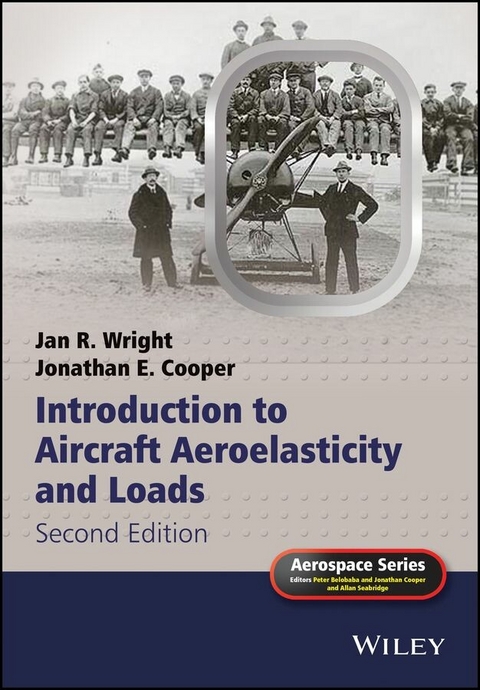
Introduction to Aircraft Aeroelasticity and Loads (eBook)
John Wiley & Sons (Verlag)
978-1-118-70043-3 (ISBN)
Introduction to Aircraft Aeroelasticity and Loads, Second Edition is an updated new edition offering comprehensive coverage of the main principles of aircraft aeroelasticity and loads. For ease of reference, the book is divided into three parts and begins by reviewing the underlying disciplines of vibrations, aerodynamics, loads and control, and then goes on to describe simplified models to illustrate aeroelastic behaviour and aircraft response and loads for the flexible aircraft before introducing some more advanced methodologies. Finally, it explains how industrial certification requirements for aeroelasticity and loads may be met and relates these to the earlier theoretical approaches used.
Key features of this new edition include:
- Uses a unified simple aeroelastic model throughout the book
- Major revisions to chapters on aeroelasticity
- Updates and reorganisation of chapters involving Finite Elements
- Some reorganisation of loads material
- Updates on certification requirements
- Accompanied by a website containing a solutions manual, and MATLAB® and SIMULINK® programs that relate to the models used
Introduction to Aircraft Aeroelasticity and Loads, Second Edition is a must-have reference for researchers and practitioners working in the aeroelasticity and loads fields, and is also an excellent textbook for senior undergraduate and graduate students in aerospace engineering.
Jan R. Wright
University of Manchester, UK
Jonathan E. Cooper
University of Bristol, UK
Introduction to Aircraft Aeroelasticity and Loads, Second Edition is an updated new edition offering comprehensive coverage of the main principles of aircraft aeroelasticity and loads. For ease of reference, the book is divided into three parts and begins by reviewing the underlying disciplines of vibrations, aerodynamics, loads and control, and then goes on to describe simplified models to illustrate aeroelastic behaviour and aircraft response and loads for the flexible aircraft before introducing some more advanced methodologies. Finally, it explains how industrial certification requirements for aeroelasticity and loads may be met and relates these to the earlier theoretical approaches used. Key features of this new edition include: Uses a unified simple aeroelastic model throughout the book Major revisions to chapters on aeroelasticity Updates and reorganisation of chapters involving Finite Elements Some reorganisation of loads material Updates on certification requirements Accompanied by a website containing a solutions manual, and MATLAB and SIMULINK programs that relate to the models used Introduction to Aircraft Aeroelasticity and Loads, Second Edition is a must-have reference for researchers and practitioners working in the aeroelasticity and loads fields, and is also an excellent textbook for senior undergraduate and graduate students in aerospace engineering.
Jan R. Wright University of Manchester, UK Jonathan E. Cooper University of Bristol, UK
"I strongly recommend this textbook to under-graduates and researchers, not only due to how principles and concepts are explained, but also because it clearly shows the multidisciplinary nature of modern engineering techniques." (The Aeronautical Journal, 1 November 2015)
Preface to the First Edition
Aeroelasticity is the study of the interaction of aerodynamic, elastic and inertia forces. For fixed wing aircraft there are two key areas: (a) static aeroelasticity, where the deformation of the aircraft influences the lift distribution can lead to the statically unstable condition of divergence and will normally reduce the control surface effectiveness, and (b) dynamic aeroelasticity, which includes the critical area of flutter where the aircraft can become dynamically unstable in a condition where the structure extracts energy from the air stream.
Aircraft are also subject to a range of static and dynamic loads resulting from flight manoeuvres (equilibrium/steady and dynamic), ground manoeuvres and gust/turbulence encounters. These load cases are responsible for the critical design loads over the aircraft structure and hence influence the structural design. Determination of such loads involves consideration of aerodynamic, elastic and inertia effects and requires the solution of the dynamic responses; consequently there is a strong link between aeroelasticity and loads.
The aircraft vibration characteristics and response are a result of the flexible modes combining with the rigid body dynamics, with the inclusion of the Flight Control System (FCS) if it is present. In this latter case, the aircraft will be a closed loop system and the FCS affects both the aeroelasticity and loads behaviour. The interaction between the FCS and the aeroelastic system is often called aeroservoelasticity.
This book aims to embrace the range of basic aeroelastic and loads topics that might be encountered in an aircraft design office and to provide an understanding of the main principles involved. Colleagues in industry have often remarked that it is not appropriate to give some of the classical books on aeroelasticity to new graduate engineers as many of the books are too theoretical for a novice aeroelastician. Indeed, the authors have found much of the material in them to be too advanced to be used in the undergraduate level courses that they have taught. Also, the topics of aeroelasticity and loads have tended to be treated separately in textbooks, whereas in industry the fields have become much more integrated. This book is seen as providing some grounding in the basic analysis techniques required which, having been mastered, can then be supplemented via more advanced texts, technical papers and industry reports.
Some of the material covered in this book developed from undergraduate courses given at Queen Mary College, University of London and at the University of Manchester. In the UK, many entrants into the aerospace industry do not have an aerospace background, and almost certainly will have little knowledge of aeroelasticity or loads. To begin to meet this need, during the early 1990s the authors presented several short courses on Aeroelasticity and Structural Dynamics to young engineers in the British aerospace industry, and this has influenced the content and approach of this book. A further major influence was the work by Hancock, Simpson and Wright (1985) on the teaching of flutter, making use of a simplified flapping and pitching wing model with strip theory aerodynamics (including a simplified unsteady aerodynamics model) to illustrate the fundamental principles of flutter. This philosophy has been employed here for the treatment of static aeroelasticity and flutter, and has been extended into the area of loads by focusing on a simplified flexible whole aircraft model in order to highlight key features of modelling and analysis.
The intention of the book is to provide the reader with the technical background to understand the underlying concepts and application of aircraft aeroelasticity and loads. As far as possible, simplified mathematical models for the flexible aircraft are used to illustrate the phenomena and also to demonstrate the link between these models, industrial practice and the certification process. Thus, fairly simple continuum models based upon a small number of assumed modes (so avoiding partial differential equations) have been used. Consequently, much of the book is based upon strip theory aerodynamics and the Rayleigh–Ritz assumed modes method. By using this approach, it has been possible to illustrate most concepts using a maximum of three degrees of freedom. Following on from these continuum models, basic discretized structural and aerodynamic models are introduced in order to demonstrate some underlying approaches in current industrial practice. The book aims to be suitable for final year undergraduate or Masters level students, or engineers in industry who are new to the subject. For example, it could provide the basis of two taught modules in aeroelasticity and loads. It is hoped that the book will fill a gap in providing a broad and relatively basic introductory treatment of aeroelastics and loads.
A significant number of different topics are covered in order to achieve the goals of this book, namely structural dynamics, steady and unsteady aerodynamics, loads, control, static aeroelastic effects, flutter, flight manoeuvres (both steady/equilibrium and dynamic), ground manoeuvres (e.g. landing, taxiing), gust and turbulence encounters, calculation of loads and, finally, Finite Element and three-dimensional panel methods. In addition, a relatively brief explanation is given as to how these topics might typically be approached in industry when seeking to meet the certification requirements. Most of the focus is on commercial and not military aircraft, though of course all of the underlying principles, and much of the implementation, are common between the two.
The notation employed has not been straightforward to define, as many of these disciplines have tended to use the same symbols for different variables and so inevitably this exercise has been a compromise. A further complication is the tendency for aeroelasticity textbooks from the USA to use the reduced frequency k for unsteady aerodynamics, as opposed to the frequency parameter ν that is often used elsewhere. The reduced frequency has been used throughout this textbook to correspond with the classical textbooks of aeroelasticity.
The book is split into three parts. After a brief introduction to aeroelasticity and loads, Part A provides some essential background material on the fundamentals of single and multiple degree of freedom (DoF) vibrations for discrete parameter systems and continuous systems (Rayleigh–Ritz and Finite Element), steady aerodynamics, loads and control. The presentation is not very detailed, assuming that a reader having a degree in engineering will have some background in most of these topics and can reference more comprehensive material if desired.
Part B is the main part of the book, covering the basic principles and concepts required to provide a bridge to begin to understand current industry practice. The chapters on aeroelasticity include static aeroelasticity (lift distribution, divergence and control effectiveness), unsteady aerodynamics, dynamic aeroelasticity (i.e. flutter) and aeroservoelasticity; the treatment is based mostly on a simple two-DoF flapping/pitching wing model, sometimes attached to a rigid fuselage free to heave and pitch. The chapters on loads include equilibrium and dynamic flight manoeuvres, gusts and turbulence encounters, ground manoeuvres and internal loads. The loads analyses are largely based on a three-DoF whole aircraft model with heave and pitch rigid body motions and a free–free flexible mode whose characteristics may be varied, so allowing fuselage bending, wing bending or wing torsional deformation to be dominant. Part B concludes with an introduction to three-dimensional aerodynamic panel methods and simple coupled discrete aerodynamic and structural models in order to move on from the Rayleigh–Ritz assumed modes and strip theory approaches to more advanced methods, which provide the basis for much of the current industrial practice.
The basic theory introduced in Parts I and II provides a suitable background to begin to understand Part III, which provides an outline of industrial practice that might typically be involved in aircraft design and certification, including aeroelastic modelling, static aeroelasticity and flutter, flight manoeuvre and gust/turbulence loads, ground manoeuvre loads and finally testing relevant to aeroelastics and loads. A number of MATLAB/SIMULINK programs are available on a companion website for this book at http://www.wiley/go/wright&cooper.
The authors are grateful to the input from a number of colleagues in the UK university sector: John Ackroyd, Philip Bonello, Grigorios Dimitriadis, Zhengtao Ding, Dominic Diston, Barry Lennox and Gareth Vio. The authors greatly valued the input on industrial practice from Mark Hockenhull, Tom Siddall, Peter Denner, Paul Bruss, Duncan Pattrick, Mark Holden and Norman Wood. The authors also appreciated useful discussions with visiting industrial lecturers to the University of Manchester (namely Rob Chapman, Brian Caldwell, Saman Samarasekera, Chris Fielding and Brian Oldfield). Some of the figures and calculations were provided by Colin Leung, Graham Kell and Gareth Vio. Illustrations were provided with kind agreement of Airbus, Messier-Dowty, DLR, DGA/CEAT, ONERA, Royal Aeronautical Society and ESDU. Use of software was provided by MATLAB.
The authors would also like to acknowledge the encouragement they have received over the years in relation to research and teaching activities in the areas of structural dynamics, aircraft structures, loads and aeroelasticity, namely Alan Simpson (University of Bristol),...
| Erscheint lt. Verlag | 16.12.2014 |
|---|---|
| Reihe/Serie | Aerospace Series |
| Aerospace Series (PEP) | Aerospace Series (PEP) |
| Mitarbeit |
Herausgeber (Serie): Jonathan Cooper, Peter Belobaba, Allan Seabridge |
| Sprache | englisch |
| Themenwelt | Technik ► Fahrzeugbau / Schiffbau |
| Technik ► Luft- / Raumfahrttechnik | |
| Technik ► Maschinenbau | |
| Schlagworte | aerodynamic • AEROELASTIC • aeroelasticity • Aeronautic & Aerospace Engineering • aeroservoelasticity • Aerospace • Aircraft • Bauingenieur- u. Bauwesen • Baustatik u. Baumechanik • Civil Engineering & Construction • Control • Control Process & Measurements • Dynamics • elastic • engineering graduate • engineering professor • engineering student • engineering undergraduate • Finite Element • Flight • Flutter • Industry • Inertia • Lift • loads • Luft- u. Raumfahrttechnik • Maschinenbau • mechanical engineering • Mess- u. Regeltechnik • Performance • Practice • Stiffness • Structural Theory & Structural Mechanics • theory • vibrations |
| ISBN-10 | 1-118-70043-0 / 1118700430 |
| ISBN-13 | 978-1-118-70043-3 / 9781118700433 |
| Informationen gemäß Produktsicherheitsverordnung (GPSR) | |
| Haben Sie eine Frage zum Produkt? |
 EPUB (Adobe DRM)
Kopierschutz: Adobe-DRM
Adobe-DRM ist ein Kopierschutz, der das eBook vor Mißbrauch schützen soll. Dabei wird das eBook bereits beim Download auf Ihre persönliche Adobe-ID autorisiert. Lesen können Sie das eBook dann nur auf den Geräten, welche ebenfalls auf Ihre Adobe-ID registriert sind.
Details zum Adobe-DRM
Dateiformat: EPUB (Electronic Publication)
EPUB ist ein offener Standard für eBooks und eignet sich besonders zur Darstellung von Belletristik und Sachbüchern. Der Fließtext wird dynamisch an die Display- und Schriftgröße angepasst. Auch für mobile Lesegeräte ist EPUB daher gut geeignet.
Systemvoraussetzungen:
PC/Mac: Mit einem PC oder Mac können Sie dieses eBook lesen. Sie benötigen eine
eReader: Dieses eBook kann mit (fast) allen eBook-Readern gelesen werden. Mit dem amazon-Kindle ist es aber nicht kompatibel.
Smartphone/Tablet: Egal ob Apple oder Android, dieses eBook können Sie lesen. Sie benötigen eine
Geräteliste und zusätzliche Hinweise
Buying eBooks from abroad
For tax law reasons we can sell eBooks just within Germany and Switzerland. Regrettably we cannot fulfill eBook-orders from other countries.
aus dem Bereich