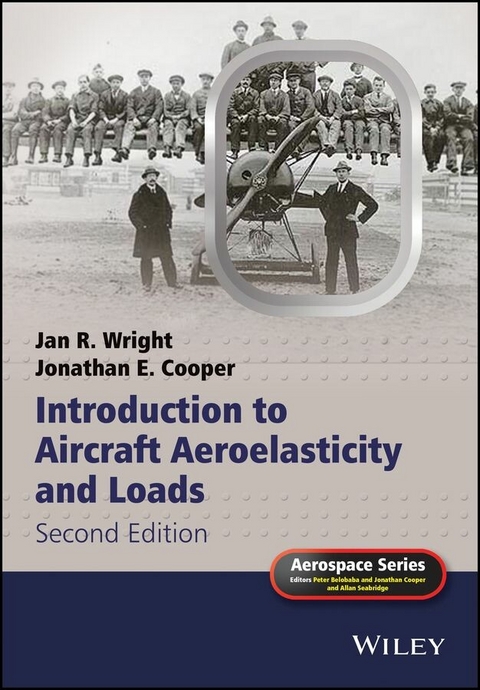
Introduction to Aircraft Aeroelasticity and Loads (eBook)
John Wiley & Sons (Verlag)
978-1-118-70042-6 (ISBN)
Introduction to Aircraft Aeroelasticity and Loads, Second Edition is an updated new edition offering comprehensive coverage of the main principles of aircraft aeroelasticity and loads. For ease of reference, the book is divided into three parts and begins by reviewing the underlying disciplines of vibrations, aerodynamics, loads and control, and then goes on to describe simplified models to illustrate aeroelastic behaviour and aircraft response and loads for the flexible aircraft before introducing some more advanced methodologies. Finally, it explains how industrial certification requirements for aeroelasticity and loads may be met and relates these to the earlier theoretical approaches used.
Key features of this new edition include:
- Uses a unified simple aeroelastic model throughout the book
- Major revisions to chapters on aeroelasticity
- Updates and reorganisation of chapters involving Finite Elements
- Some reorganisation of loads material
- Updates on certification requirements
- Accompanied by a website containing a solutions manual, and MATLAB® and SIMULINK® programs that relate to the models used
Introduction to Aircraft Aeroelasticity and Loads, Second Edition is a must-have reference for researchers and practitioners working in the aeroelasticity and loads fields, and is also an excellent textbook for senior undergraduate and graduate students in aerospace engineering.
Jan R. Wright
University of Manchester, UK
Jonathan E. Cooper
University of Bristol, UK
Introduction to Aircraft Aeroelasticity and Loads, Second Edition is an updated new edition offering comprehensive coverage of the main principles of aircraft aeroelasticity and loads. For ease of reference, the book is divided into three parts and begins by reviewing the underlying disciplines of vibrations, aerodynamics, loads and control, and then goes on to describe simplified models to illustrate aeroelastic behaviour and aircraft response and loads for the flexible aircraft before introducing some more advanced methodologies. Finally, it explains how industrial certification requirements for aeroelasticity and loads may be met and relates these to the earlier theoretical approaches used. Key features of this new edition include: Uses a unified simple aeroelastic model throughout the book Major revisions to chapters on aeroelasticity Updates and reorganisation of chapters involving Finite Elements Some reorganisation of loads material Updates on certification requirements Accompanied by a website containing a solutions manual, and MATLAB and SIMULINK programs that relate to the models used Introduction to Aircraft Aeroelasticity and Loads, Second Edition is a must-have reference for researchers and practitioners working in the aeroelasticity and loads fields, and is also an excellent textbook for senior undergraduate and graduate students in aerospace engineering.
Jan R. Wright University of Manchester, UK Jonathan E. Cooper University of Bristol, UK
"I strongly recommend this textbook to under-graduates and researchers, not only due to how principles and concepts are explained, but also because it clearly shows the multidisciplinary nature of modern engineering techniques." (The Aeronautical Journal, 1 November 2015)
| Erscheint lt. Verlag | 16.12.2014 |
|---|---|
| Reihe/Serie | Aerospace Series | Aerospace Series (PEP) |
| Mitarbeit |
Herausgeber (Serie): Jonathan Cooper, Peter Belobaba, Allan Seabridge |
| Sprache | englisch |
| Themenwelt | Technik ► Fahrzeugbau / Schiffbau |
| Technik ► Luft- / Raumfahrttechnik | |
| Technik ► Maschinenbau | |
| Schlagworte | aerodynamic • AEROELASTIC • aeroelasticity • Aeronautic & Aerospace Engineering • aeroservoelasticity • Aerospace • Aircraft • Bauingenieur- u. Bauwesen • Baustatik u. Baumechanik • Civil Engineering & Construction • Control • Control Process & Measurements • Dynamics • elastic • engineering graduate • engineering professor • engineering student • engineering undergraduate • Finite Element • Flight • Flutter • Industry • Inertia • Lift • loads • Luft- u. Raumfahrttechnik • Maschinenbau • mechanical engineering • Mess- u. Regeltechnik • Performance • Practice • Stiffness • Structural Theory & Structural Mechanics • theory • vibrations |
| ISBN-10 | 1-118-70042-2 / 1118700422 |
| ISBN-13 | 978-1-118-70042-6 / 9781118700426 |
| Informationen gemäß Produktsicherheitsverordnung (GPSR) | |
| Haben Sie eine Frage zum Produkt? |
 PDF (Adobe DRM)
Kopierschutz: Adobe-DRM
Adobe-DRM ist ein Kopierschutz, der das eBook vor Mißbrauch schützen soll. Dabei wird das eBook bereits beim Download auf Ihre persönliche Adobe-ID autorisiert. Lesen können Sie das eBook dann nur auf den Geräten, welche ebenfalls auf Ihre Adobe-ID registriert sind.
Details zum Adobe-DRM
Dateiformat: PDF (Portable Document Format)
Mit einem festen Seitenlayout eignet sich die PDF besonders für Fachbücher mit Spalten, Tabellen und Abbildungen. Eine PDF kann auf fast allen Geräten angezeigt werden, ist aber für kleine Displays (Smartphone, eReader) nur eingeschränkt geeignet.
Systemvoraussetzungen:
PC/Mac: Mit einem PC oder Mac können Sie dieses eBook lesen. Sie benötigen eine
eReader: Dieses eBook kann mit (fast) allen eBook-Readern gelesen werden. Mit dem amazon-Kindle ist es aber nicht kompatibel.
Smartphone/Tablet: Egal ob Apple oder Android, dieses eBook können Sie lesen. Sie benötigen eine
Geräteliste und zusätzliche Hinweise
Buying eBooks from abroad
For tax law reasons we can sell eBooks just within Germany and Switzerland. Regrettably we cannot fulfill eBook-orders from other countries.
aus dem Bereich