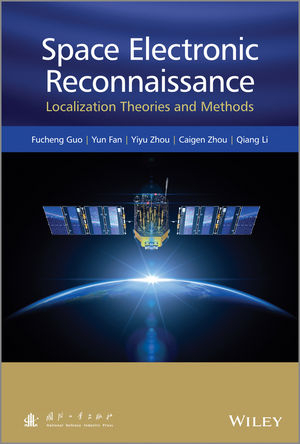
Space Electronic Reconnaissance (eBook)
John Wiley & Sons (Verlag)
978-1-118-54222-4 (ISBN)
Presents the theories and applications of determining the position of an object in space through the use of satellites
As the importance of space reconnaissance technology intensifies, more and more countries are investing money in building their own space reconnaissance satellites. Due to the secrecy and sensitivity of the operations, it is hard to find published papers and journals on the topic outside of military and governmental agencies. This book aims to fill the gap by presenting the various applications and basic principles of a very modern technology. The space electronic reconnaissance system in mono/multi-satellite platforms is a critical feature which can be used for detection, localization, tracking or identification of the various kinds of signal sources from radar, communication or navigation systems.
Localization technology in space electronic reconnaissance uses single or multiple satellite receivers which receive signals from radar, communication and navigation emitters in the ground, ocean and space to specify the location of emitter. The methods, principles and technologies of different space electronic reconnaissance localization systems are introduced in this book, as are their performances, and the various methods are explained and analysed. Digital simulations illustrate the results.
- Presents the theories and applications of determining the position of an object in space through the use of satellites
- Introduces methods, principles and technologies of localization and tracking in the space electronic reconnaissance system, the localization algorithm and error in satellite system and near space platform system, and the tracking algorithm and error in single satellite-to-satellite tracking system
- Provides the fundamentals, the mathematics, the limitations, the measurements, and systems, of localization with emphasis on defence industry applications
Highly relevant for Engineers working in avionics, radar, communication, navigation and electronic warfare.
Chapters include:- the introduction of space electronic reconnaissance localization technology, knowledge about the satellite orbit and basic terminology of passive localization, single satellite geolocation technology based on direction finding, three-satellite geolocation technology based on time difference of arrival (TDOA), two-satellite geolocation technology based on TDOA and frequency difference of arrival (FDOA), the single satellite localization technology based on kinematics theory, localization principles of near-space platform electronic reconnaissance systems, the orbit determination of single satellite-to-satellite tracking using bearings only(BO) information, the orbit determination of single satellite-to-satellite tracking using bearings and frequency information, the orbit determination of single satellite-to-satellite tracking using frequency only(FO) information. Each chapter ends with a problem and solution section, some using Matlab code.
Fucheng Guo, National University of Defense Technology, P.R. China
Yun Fan, National University of Defense Technology, P.R. China
Yiyu Zhou, National University of Defense Technology, P.R. China
Caigen Zhou, National University of Defense Technology, P.R. China
Qiang Li, National University of Defense Technology, P.R. China
Presents the theories and applications of determining the position of an object in space through the use of satellites As the importance of space reconnaissance technology intensifies, more and more countries are investing money in building their own space reconnaissance satellites. Due to the secrecy and sensitivity of the operations, it is hard to find published papers and journals on the topic outside of military and governmental agencies. This book aims to fill the gap by presenting the various applications and basic principles of a very modern technology. The space electronic reconnaissance system in mono/multi-satellite platforms is a critical feature which can be used for detection, localization, tracking or identification of the various kinds of signal sources from radar, communication or navigation systems. Localization technology in space electronic reconnaissance uses single or multiple satellite receivers which receive signals from radar, communication and navigation emitters in the ground, ocean and space to specify the location of emitter. The methods, principles and technologies of different space electronic reconnaissance localization systems are introduced in this book, as are their performances, and the various methods are explained and analysed. Digital simulations illustrate the results. Presents the theories and applications of determining the position of an object in space through the use of satellites Introduces methods, principles and technologies of localization and tracking in the space electronic reconnaissance system, the localization algorithm and error in satellite system and near space platform system, and the tracking algorithm and error in single satellite-to-satellite tracking system Provides the fundamentals, the mathematics, the limitations, the measurements, and systems, of localization with emphasis on defence industry applications Highly relevant for Engineers working in avionics, radar, communication, navigation and electronic warfare. Chapters include:- the introduction of space electronic reconnaissance localization technology, knowledge about the satellite orbit and basic terminology of passive localization, single satellite geolocation technology based on direction finding, three-satellite geolocation technology based on time difference of arrival (TDOA), two-satellite geolocation technology based on TDOA and frequency difference of arrival (FDOA), the single satellite localization technology based on kinematics theory, localization principles of near-space platform electronic reconnaissance systems, the orbit determination of single satellite-to-satellite tracking using bearings only(BO) information, the orbit determination of single satellite-to-satellite tracking using bearings and frequency information, the orbit determination of single satellite-to-satellite tracking using frequency only(FO) information. Each chapter ends with a problem and solution section, some using Matlab code.
Fucheng Guo, National University of Defense Technology, P.R. China Yun Fan, National University of Defense Technology, P.R. China Yiyu Zhou, National University of Defense Technology, P.R. China Caigen Zhou, National University of Defense Technology, P.R. China Qiang Li, National University of Defense Technology, P.R. China
Chapter 1
Introduction to Space Electronic Reconnaissance Geolocation
1.1 Introduction
With the rapid development of aerospace technology, space has gradually become the strategic commanding point for defending national security and providing benefits. As the electronic reconnaissance satellite is able to acquire the full-time, all-weather, large-area, detailed, near real-time battlefield information (such as force deployment, military equipment, and operation information), it has become a powerful way to acquire information and plays an important role in ensuring information superiority [1, 2]. In the early 1960s, the United States launched the first general electronic reconnaissance satellites in the world—Grab and Poppy – to collect electronic intelligence (ELINT) on Soviet air defense radar signals. Intelligence from Grab and Poppy provided the location and capabilities of Soviet radar sites and ocean surveillance information to the US Navy and for use by the US Air Force. This effort provided significant ELINT support to US forces throughout the war in Vietnam [3].
Space electronic reconnaissance (SER) refers to the process in which signals from various electromagnetic transmitters are intercepted with the help of man-made satellites, and then features of signal are analyzed, contents of signal are extracted, and the position of transmitters are located [1–5]. The main tasks for space reconnaissance includes: intercepting signals from various transmitting sources such as radars, communication devices, navigation beacons, and identification friend or foe (IFF) transponders, determining the tactical or technological parameters and location, and identifying its type, purpose, and the related air defense system and weapon system; intercepting and analyzing signals of remote control and telemetry and estimating its weapon system performance, experimental situations and development trend; intercepting and monitoring radio communications, analyzing the signal features and determining the location of the transmitters, interpreting and deciphering the communication contents from which the potential military actions and operation plans can be perceived; long-term monitoring of the changes in the electromagnetic transmitters and obtaining the information such as electronic equipment development status and rules of force deployment and activities.
According to the intended purpose, the application of the SER system can be classified into radio frequency spectrum surveillance, ELINT, communication intelligence (COMINT), signal intelligence (SIGINT), battlefield surveillance, and characteristic measurement intelligence reconnaissance. The major reconnaissance objects are transmitters from air, space, land, and sea. The major reconnaissance signal types include radio signals, short wave and ultra-short communication signals, satellite communication signals, microwave and troposcatter communication signals, data link signals, IFF signals, navigation signals, and space data link signals. The band of the reconnaissance objects ranges from short wave, ultra-short wave, VHF (very high frequency), UHF (ultra-high frequency, L band, S band, C band, X band, Ku band, Ka band to EHF (extremely high frequency) band, while the frequency can range from 0.3 MHz to 70 GHz.
Generally speaking, SER tasks are mainly conducted by electronic reconnaissance satellites on a low earth orbit (LEO) (which includes a sun synchronous orbit, polar orbit, the orbit with the inclination near the critical value, and an inclined orbit) and electronic reconnaissance satellites on a medium earth orbit (MEO) and a high earth orbit (HEO) (highly elliptical orbit or geostationary orbit), and a near-SER (vehicle in the stratosphere or a suborbital vehicle). The altitude of the electronic reconnaissance satellites on a low orbit is relatively low, most often 300–1100 km with an inclination greater than 50°. Thus a relatively accurate location for the transmitters can be achieved. These satellites can also be applied to monitor the emitters on the sea through the reconnaissance and location of the radar or communication signal on vessels. The reconnaissance can be run with one satellite or a multiple-satellite network. Typical reconnaissance systems are the US Semos-F series electronic reconnaissance satellite, the US White Cloud series electronic ocean surveillance satellite and the former USSR Tselina series electronic reconnaissance satellite. The orbit altitude of a synchronous orbit reconnaissance satellite is generally about 36 000 km. The significant advantages are its wide coverage, stability over earth and all-weather, 7/24 continuous reconnaissance, and monitor of the electromagnetic signals from one particular area on earth. A typical HEO reconnaissance system is the US Magnum series electronic reconnaissance satellite. A highly elliptical orbit electronic reconnaissance satellite is primarily used for the continuous reconnaissance and monitoring of the areas with high altitude. It can make up for the disadvantages of poor reconnaissance performance of a synchronous orbit electronic reconnaissance satellite in such areas. A typical system is the US Jump Seat series electronic reconnaissance satellite.
As position information is one of the most important parts in the intelligence generated from the electronic reconnaissance (ER) system, location technology plays a crucial role in the SER and determines the means of operation for the entire reconnaissance satellite. This book introduces various concepts, theories, and methods on electronic reconnaissance geolocation in great detail, and discusses the direction-finding geolocation, geolocation based on TDOA (time difference of arrival), geolocation based on TDOA–FDOA (frequency difference of arrival), geolocation by a single satellite based on kinematics, and geolocation based on a near-space platform, and at the same time analyzes and explores in depth the orbit determination of a satellite using direction finding and frequency information from a space platform.
1.2 An Overview of Space Electronic Reconnaissance Geolocation Technology
According to the space location of the transmitters, two types of signals can be intercepted from space: the transmitters on the earth's surface (land, sea, and air) and the satellite transmitters in space. According to different observation platforms, the electronic reconnaissance system can be based on a satellite or a near-space platform. Therefore, three reconnaissance geolocation technologies are discussed here, that is, geolocation of a ground emitter, geolocation of a space emitter, and geolocation using a near-space platform.
1.2.1 Geolocation of an Emitter on the Earth
Through the geolocation of the transmitters of the earth's surface, information from various radars, wireless communication stations, and navigation stations can be revealed, which is rather meaningful and valuable for the military. The earth's surface here is in a broad sense that covers land, sea, and lake surface and low altitude air.
The fundamental characteristic of SER geolocation is to locate the satellite through the intersection between the geolocation line and the a priori information of the ground emitter on the earth's surface, as shown in Figure 1.1. According to the number of electronic reconnaissance satellites, the geolocation method can be classified into the geolocation method by a single satellite, the geolocation method by dual-satellite, and the geolocation method by multiple satellites.
Figure 1.1 Geolocation of an emitter on the earth's surface by a single LEO reconnaissance satellite
1.2.1.1 Geolocation Method by a Single Satellite
Naturally, using this method, the geolocation can be done using one satellite. This method can be further classified into:
- The geolocation method by a single satellite based on the line of sight (LOS).
This is a traditional and widely used method [6–10], which locates the transmitters through the intersection between the oriented LOS generated from the two dimensional (2D) direction finding system on the satellite with the earth's surface, as shown in Figure 1.2. The advantage of this method is that it can realize ‘instantaneous’ geolocation, sometimes called a ‘single-pulse geolocation’. However, as the LOS in a 3D space must be determined with the 2D direction finding antenna array or a multiple beam antenna, large numbers of antennas and receivers are, generally speaking, required. In addition, the attitude measurements of the observing satellite, including yaw, pitch, and roll angle, also need to be accurate enough.
Figure 1.2 The geolocation method used by a single satellite based on the line of sight (LOS)
- The geolocation method by a single satellite based on particle kinematic parameters.
This novel method locates the transmitters by the rate of changing information, such as the frequency of the received signal and/or the time of arrival (TOA), or the phase rate of changing information of a long baseline interferometer (LBI) over a period of time. It draws the relative moving information from kinematic features of the transmitters against the satellite observatory platform. Featured with a payload of small volume, light weight, and low power consumption, it is suitable for a microsatellite or a nanosatellite.
According to the orbit altitude, the geolocation by a single...
| Erscheint lt. Verlag | 5.5.2014 |
|---|---|
| Sprache | englisch |
| Themenwelt | Technik ► Elektrotechnik / Energietechnik |
| Technik ► Luft- / Raumfahrttechnik | |
| Schlagworte | Aeronautic & Aerospace Engineering • Caigen Zhou • defense industry • Electrical & Electronics Engineering • Elektrotechnik u. Elektronik • ELINT satellites • Fernerkundung • Fucheng Guo • Luft- u. Raumfahrttechnik • Maschinenbau • mechanical engineering • passive localization • Qiang Li • Reconnaissance satellite • Remote Sensing • Satellite communications • Satellitenkommunikation • satellite orbit • Space Electronic Reconnaissance: Localization Principles and Technologies • space electronic reconnaissance localization technology • Yiyu Zhou • Yun Fan |
| ISBN-10 | 1-118-54222-3 / 1118542223 |
| ISBN-13 | 978-1-118-54222-4 / 9781118542224 |
| Informationen gemäß Produktsicherheitsverordnung (GPSR) | |
| Haben Sie eine Frage zum Produkt? |
 EPUB (Adobe DRM)
Kopierschutz: Adobe-DRM
Adobe-DRM ist ein Kopierschutz, der das eBook vor Mißbrauch schützen soll. Dabei wird das eBook bereits beim Download auf Ihre persönliche Adobe-ID autorisiert. Lesen können Sie das eBook dann nur auf den Geräten, welche ebenfalls auf Ihre Adobe-ID registriert sind.
Details zum Adobe-DRM
Dateiformat: EPUB (Electronic Publication)
EPUB ist ein offener Standard für eBooks und eignet sich besonders zur Darstellung von Belletristik und Sachbüchern. Der Fließtext wird dynamisch an die Display- und Schriftgröße angepasst. Auch für mobile Lesegeräte ist EPUB daher gut geeignet.
Systemvoraussetzungen:
PC/Mac: Mit einem PC oder Mac können Sie dieses eBook lesen. Sie benötigen eine
eReader: Dieses eBook kann mit (fast) allen eBook-Readern gelesen werden. Mit dem amazon-Kindle ist es aber nicht kompatibel.
Smartphone/Tablet: Egal ob Apple oder Android, dieses eBook können Sie lesen. Sie benötigen eine
Geräteliste und zusätzliche Hinweise
Buying eBooks from abroad
For tax law reasons we can sell eBooks just within Germany and Switzerland. Regrettably we cannot fulfill eBook-orders from other countries.
aus dem Bereich