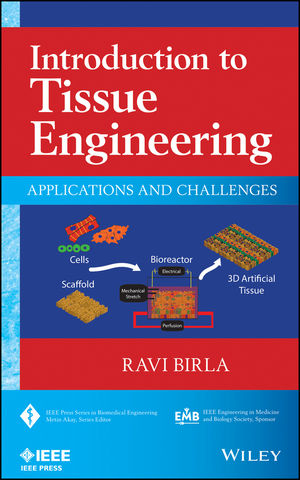
Introduction to Tissue Engineering (eBook)
John Wiley & Sons (Verlag)
978-1-118-82801-4 (ISBN)
A comprehensive reference and teaching aid on tissue engineering-covering everything from the basics of regenerative medicine to more advanced and forward thinking topics such as the artificial liver, bladder, and trachea
Regenerative medicine/tissue engineering is the process of replacing or regenerating human cells, tissues, or organs to restore or establish normal function. It is an incredibly progressive field of medicine that may, in the near future, help with the shortage of life-saving organs available through donation for transplantation.
Introduction to Tissue Engineering: Applications and Challenges makes tissue engineering more accessible to undergraduate and graduate students alike. It provides a systematic and logical eight-step process for tissue fabrication. Specific chapters have been dedicated to provide in-depth principles for many of the supporting and enabling technologies during the tissue fabrication process and include biomaterial development and synthesis, bioreactor design, and tissue vascularization. The tissue fabrication process is further illustrated with specific examples for liver, bladder, and trachea. Section-coverage includes an overall introduction of tissue engineering; enabling and supporting technologies; clinical applications; and case studies and future challenges.
Introduction to Tissue Engineering:
- Presents medical applications of stem cells in tissue engineering
- Deals with the effects of chemical stimulation (growth factors and hormones)
- Covers current disease pathologies and treatment options (pacemakers, prosthesis)
- Explains bioengineering, design and fabrication, and critical challenges during tissue fabrication
- Offers PowerPoint slides for instructors
- Features case studies and a section on future directions and challenges
As pioneering individuals look ahead to the possibility of generating entire organ systems, students may turn to this text for a comprehensive understanding and preparation for the future of regenerative medicine.
RAVI BIRLA, PHD, is Associate Professor in the Department of Biomedical Engineering at the University of Houston. Dr. Birla's research focuses on the fabrication of 3D cardiovascular constructs, including bioengineering 3D artificial heart muscle, cell-based cardiac pumps, tissue engineering ventricles, and bioartificial hearts.
A comprehensive reference and teaching aid on tissue engineering covering everything from the basics of regenerative medicine to more advanced and forward thinking topics such as the artificial liver, bladder, and trachea Regenerative medicine/tissue engineering is the process of replacing or regenerating human cells, tissues, or organs to restore or establish normal function. It is an incredibly progressive field of medicine that may, in the near future, help with the shortage of life-saving organs available through donation for transplantation. Introduction to Tissue Engineering: Applications and Challenges makes tissue engineering more accessible to undergraduate and graduate students alike. It provides a systematic and logical eight-step process for tissue fabrication. Specific chapters have been dedicated to provide in-depth principles for many of the supporting and enabling technologies during the tissue fabrication process and include biomaterial development and synthesis, bioreactor design, and tissue vascularization. The tissue fabrication process is further illustrated with specific examples for liver, bladder, and trachea. Section-coverage includes an overall introduction of tissue engineering; enabling and supporting technologies; clinical applications; and case studies and future challenges. Introduction to Tissue Engineering: Presents medical applications of stem cells in tissue engineering Deals with the effects of chemical stimulation (growth factors and hormones) Covers current disease pathologies and treatment options (pacemakers, prosthesis) Explains bioengineering, design and fabrication, and critical challenges during tissue fabrication Offers PowerPoint slides for instructors Features case studies and a section on future directions and challenges As pioneering individuals look ahead to the possibility of generating entire organ systems, students may turn to this text for a comprehensive understanding and preparation for the future of regenerative medicine.
RAVI BIRLA, PHD, is Associate Professor in the Department of Biomedical Engineering at the University of Houston. Dr. Birla's research focuses on the fabrication of 3D cardiovascular constructs, including bioengineering 3D artificial heart muscle, cell-based cardiac pumps, tissue engineering ventricles, and bioartificial hearts.
| Erscheint lt. Verlag | 5.6.2014 |
|---|---|
| Reihe/Serie | IEEE Press Series on Biomedical Engineering |
| IEEE Press Series on Biomedical Engineering | IEEE Press Series on Biomedical Engineering |
| Sprache | englisch |
| Themenwelt | Medizin / Pharmazie ► Gesundheitsfachberufe |
| Medizin / Pharmazie ► Medizinische Fachgebiete | |
| Medizin / Pharmazie ► Pflege | |
| Medizin / Pharmazie ► Physiotherapie / Ergotherapie ► Orthopädie | |
| Technik ► Umwelttechnik / Biotechnologie | |
| Schlagworte | 3-D Tissue Constructs • Artificial heart • Artificial Pancreas • biomaterials • biomedical engineering • Biomedizintechnik • bioreactor design • Bioreactor Fabrication • bioreactors • Blood Vessel Tissue Engineering • Cell Therapies & Tissue Engineering • Cell Transplants • central nervous system • Clinical applications • embryonic stem cell • gene therapy • heart valves • Hydrogels • Medical Science • Medizin • myocardial regeneration • polymer scaffolds • Regenerative medicine • Rehabilitation Engineering & Prosthetics • Reha-Technik u. Prothesen • Scaffold Cellularization • Stem Cell • Stem Cell Engineering • Tissue Architecture • Tissue, Cell, and Genetic Engineering • Tissue engineering • Tissue Explants • Zell-, Gewebe- u. Gen-Engineering • Zelltherapien u. Tissue Engineering |
| ISBN-10 | 1-118-82801-1 / 1118828011 |
| ISBN-13 | 978-1-118-82801-4 / 9781118828014 |
| Informationen gemäß Produktsicherheitsverordnung (GPSR) | |
| Haben Sie eine Frage zum Produkt? |
 PDF (Adobe DRM)
Kopierschutz: Adobe-DRM
Adobe-DRM ist ein Kopierschutz, der das eBook vor Mißbrauch schützen soll. Dabei wird das eBook bereits beim Download auf Ihre persönliche Adobe-ID autorisiert. Lesen können Sie das eBook dann nur auf den Geräten, welche ebenfalls auf Ihre Adobe-ID registriert sind.
Details zum Adobe-DRM
Dateiformat: PDF (Portable Document Format)
Mit einem festen Seitenlayout eignet sich die PDF besonders für Fachbücher mit Spalten, Tabellen und Abbildungen. Eine PDF kann auf fast allen Geräten angezeigt werden, ist aber für kleine Displays (Smartphone, eReader) nur eingeschränkt geeignet.
Systemvoraussetzungen:
PC/Mac: Mit einem PC oder Mac können Sie dieses eBook lesen. Sie benötigen eine
eReader: Dieses eBook kann mit (fast) allen eBook-Readern gelesen werden. Mit dem amazon-Kindle ist es aber nicht kompatibel.
Smartphone/Tablet: Egal ob Apple oder Android, dieses eBook können Sie lesen. Sie benötigen eine
Geräteliste und zusätzliche Hinweise
Buying eBooks from abroad
For tax law reasons we can sell eBooks just within Germany and Switzerland. Regrettably we cannot fulfill eBook-orders from other countries.
aus dem Bereich