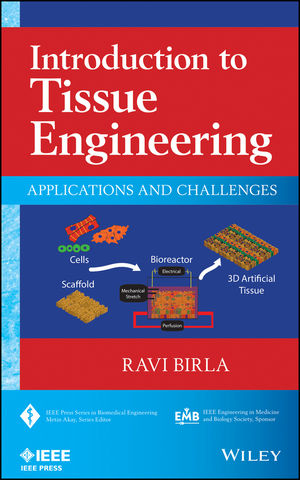
Introduction to Tissue Engineering (eBook)
John Wiley & Sons (Verlag)
978-1-118-62969-7 (ISBN)
RAVI BIRLA, PHD, is Associate Professor in the Department of Biomedical Engineering at the University of Houston. Dr. Birla's research focuses on the fabrication of 3D cardiovascular constructs, including bioengineering 3D artificial heart muscle, cell-based cardiac pumps, tissue engineering ventricles, and bioartificial hearts.
Important Terminology and Concepts
- TISSUE ENGINEERING—Tissue engineering is a multidisciplinary field bringing together experts from engineering, life sciences and medicine, utilizing the building blocks of cells, biomaterials and bioreactors for the development of 3D artificial tissue and organs which can be used to augment, repair and/or replace damaged and/or diseased tissue.
- CELL-MATRIX INTERACTIONS—When a cell sees any given ECM protein, the cell scans the protein molecule to identify specific binding sites for which it has integrins; for example, the integrin α5β1 binds to the RGD site of the fibronectin molecule. Although the fibronectin molecule is large, there is only a sequence of three amino acids that are recognized by cells having the α5β1 integrin; the binding of the α5β1 integrin to the RGD site on the fibronectin molecule is referred to as a specific cell-matrix interaction.
- CELL-CELL INTERACTIONS—Cells communicate with other cells via cell-cell interactions, and these are critical in maintaining cell phenotype and tissue function. There are 4 types of cell signaling, known as endocrine, paracrine, autocrine, and contact-dependent signaling. In addition, cellular junctions provide various functions at the cell-cell; gap junctions are one example. The functional coupling of cells with other cells is known as cell-cell interaction.
- AUTOLOGOUS CELLS—Autologous cells are cells that have been isolated from a tissue biopsy of the person who will also be recipient of these cells; the donor and recipient for autologous cells is the same.
- ALLOGENEIC CELLS—Allogeneic cells are isolated from a donor and then transplanted into a recipient patient, with the donor and recipient being different people.
- CELL TRANSPLANTATION—Cell transplantation has been defined as the process by which cells are delivered to the site of injury in order to improve the functional performance of injured tissue. Whole blood transfusions, packed red cell transfusions, platelet transfusions, and bone marrow transplants are examples of cell therapy.
- STEM CELL TRANSPLANTATION—Stem cell transplantation is a specialized case of cell transplantation, in which the cells being delivered are stem cells. Use of embryonic stem cells, induced pluripotent stem cells, and adult stem cells fall under the classification of stem cell transplantation.
- CENTRAL DOGMA OF MOLECULAR BIOLOGY—The central dogma of molecular biology states that DNA is transcribed to RNA, which is then translated to proteins.
- CHARACTERISTICS OF STEM CELLS—Stem cells have three important characteristics that distinguish them from other cell types: self-renewal, unspecialized function, and differentiation potential.
- CELL POTENCY—Cell potency refers to the differentiation potential of stem cells.
- BIOMATERIALS—A biomaterial is any substance that simulates the extracellular matrix by functionally interacting with isolated cells to support fabrication and maturation of 3D artificial tissue.
- TENSILE PROPERTIES OF BIOMATERIALS—The tensile properties of a material are used very frequently in engineering design as an important criterion for material selection. The tensile properties of a material provide information about the strength of the material, its ability to withstand a particular load, and information about elastic properties. All of these properties are extremely important for material selection during tissue fabrication.
- BIOMATERIAL DEGRADATION—Biomaterial degradation refers to the gradual breakdown of a biomaterial mediated in a controlled manner to support the fabrication of 3D artificial tissue
- BIOMATERIAL BIOCOMPATIBILITY—The ability of 3D artificial tissue to be accepted by host defense mechanisms upon implantation, while maintaining functional capacity, is known as biocompatibility.
- BIOMIMETIC BIOMATERIALS—A two-part definition of biomimetic biomaterials has been provided in a recent article: 1) The development of biomaterials for tissue engineering applications has recently focused on the design of biomimetic materials that are able to interact with surrounding tissues by biomolecular recognition, 2) The design of biomimetic materials is an attempt to make the materials such that they are capable of eliciting specific cellular responses and directing new tissue formation mediated by specific interactions, which can be manipulated by altering design parameters instead of by non-specifically adsorbed ECM proteins.
- CLASSIFICATION OF BIOMATERIALS—Biomaterials are frequently classified based on source (natural and synthetic), based on degradation (biodegradable and non-biodegradable), and based on interatomic bonding forces (metals, polymers, and ceramics).
- BIOMATERIAL PLATFORMS—There are four platforms that have been widely used for tissue engineering applications: polymeric scaffolds, biodegradable hydrogels, decellular matrices, and self-organization strategies.
- DECELLULARIZED MATICES—This strategy is based on the utilization of naturally occurring extracellular matrix as the scaffolding material for 3D tissue formation. Tissue specimens are obtained from cadaveric or xenogeneic sources, and cells are completely removed using one of several potential strategies. Removal of cellular components from tissue specimens is known as decellularization, and the material that is obtained after removal of the cells is known as an acellular scaffold.
- HYRDOGELS—The term hydrogel is composed of “hydro” (water) and “gel,” and refers to aqueous (water-containing) gels. To be more precise, it refers to polymer networks that are insoluble in water; they swell to an equilibrium volume but retain their shapes.
- POLYMERS—Polymers can be viewed as molecules of a high molecular weight that are composed of repeating monomer units.
- SELF-ORGANIZATION STRATEGIES—Self-organization is prevalent in biological systems; it involves the physical interaction of molecules in a steady-state structure. In a broad sense, self-organization can be viewed as a process that occurs in the absence of any constraining conditions, thereby providing a greater degree of freedom and flexibility.
- SMART MATERIALS—The most recent generation of biomaterials has been designed to respond to changes in the cellular environment. These materials, known as smart materials, are receptive to changes in the physiological environment and are adaptive to changes in the degree of tissue maturation.
- TISSUE FABRICATION TECHNOLOGIES—Tissue fabrication technologies can be classified into six categories, which include scaffold-free methods, cell patterning techniques, scaffold-based methods, rapid prototyping technologies, printing technology, and “organ-on-a-chip” models.
- SELF-ORGANIZATION TECHNOLOGY—Self-organization technology is based on the fabrication of extracellular matrix by cells that then use the newly formed ECM to support artificial tissue fabrication. This technology is an example of a scaffold-free tissue fabrication process and does not require external or synthetic scaffolding; rather, scaffolding is produced by cells.
- CELL PRINTING—Bioprinting process used for 2D cell patterning by depositing bio-ink on the surface of biopaper.
- ORGAN PRINTING—Bioprinting process used for fabrication of 3D tissue by depositing bio-ink on the surface of biopaper.
- SOLID FREEFORM FABRICATION—Solid freeform fabrication refers to a group of technologies that build 3D scaffolds using a layer-by-layer approach. Collectively, these technologies are known as rapid prototyping methods.
- SOFT LITHOGRAPHY—Soft lithography is a microfabrication technology used to engineer microfluidic devices, particularly microvascular networks.
- CELL PATTERNING—The process by which the spatial placement of cells is controlled to create an organized pattern of cell monolayers or 3D tissue is known as cell patterning.
- VASCULOGENESIS—Vasculogenesis refers to initial events in vascular growth in which endothelial cell precursors (angioblasts) migrate to discrete locations, differentiate in situ, and assemble into solid endothelial cords, later forming a plexus with endothelial tubes.
- ANGIOGENESIS—Angiogenesis refers to the growth, expansion, and remodeling of primitive blood vessels formed during vasculogenesis to form a mature vascular network.
- ARTERIOGENESIS—Arteriogenesis is the process by which blood vessels increase in diameter to form muscular arteries and incorporate smooth muscle cells and vaso-contraction and vaso-relaxation properties.
- THERAPEUTIC ANGIOGENESIS—Therapeutic angiogenesis refers to the stimulation of angiogenesis for therapeutic purposes.
- BIOLOGICALLY REPLICATED VASCULARIZATION STRATEGIES—Biologically replicated processes are influenced by molecular biology, with the objective being the understanding of biological phenomena and defining...
| Erscheint lt. Verlag | 5.6.2014 |
|---|---|
| Reihe/Serie | IEEE Press Series on Biomedical Engineering |
| IEEE Press Series on Biomedical Engineering | IEEE Press Series on Biomedical Engineering |
| Sprache | englisch |
| Themenwelt | Medizin / Pharmazie ► Gesundheitsfachberufe |
| Medizin / Pharmazie ► Medizinische Fachgebiete | |
| Medizin / Pharmazie ► Pflege | |
| Medizin / Pharmazie ► Physiotherapie / Ergotherapie ► Orthopädie | |
| Technik ► Umwelttechnik / Biotechnologie | |
| Schlagworte | 3-D Tissue Constructs • Artificial heart • Artificial Pancreas • biomaterials • biomedical engineering • Biomedizintechnik • bioreactor design • Bioreactor Fabrication • bioreactors • Blood Vessel Tissue Engineering • Cell Therapies & Tissue Engineering • Cell Transplants • central nervous system • Clinical applications • embryonic stem cell • gene therapy • heart valves • Hydrogels • Medical Science • Medizin • myocardial regeneration • polymer scaffolds • Regenerative medicine • Rehabilitation Engineering & Prosthetics • Reha-Technik u. Prothesen • Scaffold Cellularization • Stem Cell • Stem Cell Engineering • Tissue Architecture • Tissue, Cell, and Genetic Engineering • Tissue engineering • Tissue Explants • Zell-, Gewebe- u. Gen-Engineering • Zelltherapien u. Tissue Engineering |
| ISBN-10 | 1-118-62969-8 / 1118629698 |
| ISBN-13 | 978-1-118-62969-7 / 9781118629697 |
| Informationen gemäß Produktsicherheitsverordnung (GPSR) | |
| Haben Sie eine Frage zum Produkt? |
 EPUB (Adobe DRM)
Kopierschutz: Adobe-DRM
Adobe-DRM ist ein Kopierschutz, der das eBook vor Mißbrauch schützen soll. Dabei wird das eBook bereits beim Download auf Ihre persönliche Adobe-ID autorisiert. Lesen können Sie das eBook dann nur auf den Geräten, welche ebenfalls auf Ihre Adobe-ID registriert sind.
Details zum Adobe-DRM
Dateiformat: EPUB (Electronic Publication)
EPUB ist ein offener Standard für eBooks und eignet sich besonders zur Darstellung von Belletristik und Sachbüchern. Der Fließtext wird dynamisch an die Display- und Schriftgröße angepasst. Auch für mobile Lesegeräte ist EPUB daher gut geeignet.
Systemvoraussetzungen:
PC/Mac: Mit einem PC oder Mac können Sie dieses eBook lesen. Sie benötigen eine
eReader: Dieses eBook kann mit (fast) allen eBook-Readern gelesen werden. Mit dem amazon-Kindle ist es aber nicht kompatibel.
Smartphone/Tablet: Egal ob Apple oder Android, dieses eBook können Sie lesen. Sie benötigen eine
Geräteliste und zusätzliche Hinweise
Buying eBooks from abroad
For tax law reasons we can sell eBooks just within Germany and Switzerland. Regrettably we cannot fulfill eBook-orders from other countries.
aus dem Bereich