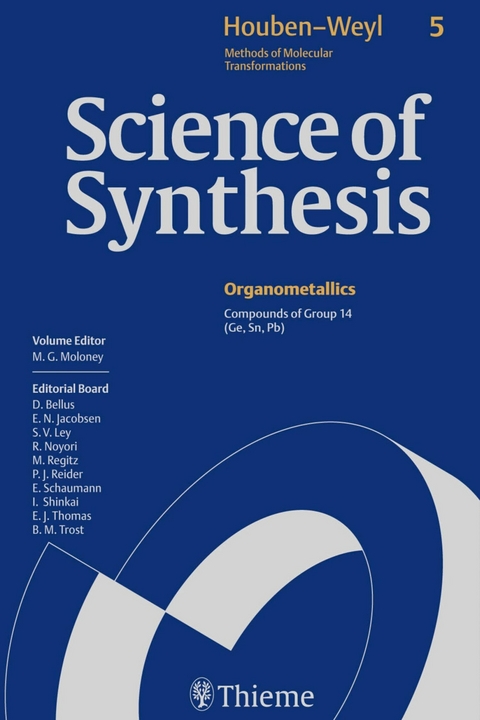
Science of Synthesis: Houben-Weyl Methods of Molecular Transformations Vol. 5 (eBook)
911 Seiten
Georg Thieme Verlag KG
9783131779410 (ISBN)
Mark G. Moloney
Mark G. Moloney
Science of Synthesis – Volume 5: Compounds of Group 14 (Ge, Sn, Pb) 1
Title page 3
Imprint 5
Preface 6
Overview 8
Table of Contents 14
Introduction 48
5.1 Product Class 1: Germanium Compounds 50
5.1.1 Product Subclass 1: Germanium Hydrides 56
Synthesis of Product Subclass 1 56
5.1.1.1 Method 1: By Reactions of (Organogermyl)alkali Metal Compounds 56
5.1.1.1.1 Variation 1: From Tetraarylgermanes 56
5.1.1.1.2 Variation 2: From Digermanium Compounds 57
5.1.1.1.3 Variation 3: From Trialkyl- and Triarylgermanium Halides 59
5.1.1.2 Method 2: Reduction of Germanium Halides 60
5.1.1.2.1 Variation 1: Reduction with Lithium Aluminum Hydride 60
5.1.1.2.2 Variation 2: Reduction with Group 14 Hydrides 63
5.1.1.2.3 Variation 3: Substitution of Halogen with a Carbanion 63
5.1.1.3 Method 3: Substitution of Halo(organo)germanium Hydrides 64
5.1.1.3.1 Variation 1: Halogenation of Alkyl- and Arylgermanium Hydrides (Substitution of Hydrogen by Halogen) 65
5.1.1.3.2 Variation 2: Substitution of Halogen in Halo(organo)germanium Hydrides 66
Applications of Product Subclass 1 in Organic Synthesis 67
5.1.1.4 Method 4: Reduction of Organic Halides 68
5.1.1.5 Method 5: Hydrogermylation of Carbon--Carbon Multiple Bonds 69
5.1.1.6 Method 6: Reduction of Carbonyl Compounds 70
5.1.1.7 Method 7: Action of Acids and Bases 71
5.1.2 Product Subclass 2: Digermenes and Digermanes 74
Synthesis of Product Subclass 2 75
5.1.2.1 Method 1: Digermenes from Germanium(II) Complexes 75
5.1.2.2 Method 2: Digermenes by Photolysis of Trigermiranes or Bis(silyl)germanes 76
5.1.2.3 Method 3: Digermenes by Reductive Coupling of Dihalogermanes 77
5.1.2.4 Method 4: Digermanes from Halogermanes 77
5.1.3 Product Subclass 3: Metalated Germanium Compounds 80
Synthesis of Product Subclass 3 81
5.1.3.1 Method 1: Reactions of Tetravalent Germanium Compounds with Metals 81
5.1.3.2 Method 2: Metathesis 81
5.1.3.3 Method 3: Oxidative Addition 82
5.1.3.4 Method 4: From Germylenes 82
5.1.4 Product Subclass 4: Germanium Oxides, Sulfides, Selenides, and Tellurides (Double Bonded) 86
Synthesis of Product Subclass 4 87
5.1.4.1 Method 1: Chalcogenation of Germylenes 87
5.1.5 Product Subclass 5: Iminogermanes 90
Synthesis of Product Subclass 5 90
5.1.5.1 Method 1: From Germylenes 90
5.1.6 Product Subclass 6: Germenes 94
Synthesis of Product Subclass 6 94
5.1.6.1 Method 1: From Germylenes 94
5.1.7 Product Subclass 7: Germylenes 98
Synthesis of Product Subclass 7 98
5.1.7.1 Method 1: From Divalent Germanium Compounds with Organolithiums or Grignard Reagents 98
5.1.8 Product Subclass 8: Organogermanium Halides 102
Synthesis of Product Subclass 8 102
5.1.8.1 Method 1: From Germanium Halides by Substitution 102
5.1.8.2 Method 2: Methylene Insertion into the Germanium--Halogen Bond 105
5.1.8.3 Method 3: By Halogenation of Germanium Compounds 106
5.1.8.3.1 Variation 1: From Alkyl- or Arylgermanes 106
5.1.8.3.2 Variation 2: From Germyl Ethers 108
5.1.8.3.3 Variation 3: From Metallic Germanium 109
5.1.8.3.4 Variation 4: From Germanium Hydrides 110
5.1.8.4 Method 4: Comproportionation of Organogermanium Compounds and Germanium Halides 111
5.1.8.5 Method 5: Addition Reactions of Germanium Compounds 113
5.1.8.5.1 Variation 1: Addition of Germanium Hydrides to Unsaturated Compounds 113
5.1.8.5.2 Variation 2: Reactions of Germylenes 116
5.1.9 Product Subclass 9: Germanium Oxides 122
Synthesis of Product Subclass 9 122
5.1.9.1 Method 1: By Substitution 122
5.1.9.1.1 Variation 1: From Organogermanium Halides 122
5.1.9.1.2 Variation 2: From Organogermanium Oxy Compounds 123
5.1.9.2 Method 2: Insertion of Oxo Fragments into Germanium--Heteroatom Bonds 124
5.1.9.3 Method 3: Reactions of Metallogermanium Compounds 125
5.1.9.4 Method 4: Reactions of Germylenes 126
5.1.9.5 Method 5: Thermolyses 127
5.1.10 Product Subclass 10: Germanium Carboxylates, Phosphates, and Related Compounds 132
Synthesis of Product Subclass 10 132
5.1.10.1 Method 1: From Organogermanium Halides by Substitution 132
5.1.11 Product Subclass 11: Germanium Sulfides, Sulfoxides, and Related Compounds 136
Synthesis of Product Subclass 11 136
5.1.11.1 Method 1: From Germanium Halides by Substitution 136
5.1.12 Product Subclass 12: Germanium Selenides, Tellurides, and Related Compounds 140
Synthesis of Product Subclass 12 140
5.1.13 Product Subclass 13: Germylamines 144
Synthesis of Product Subclass 13 144
5.1.13.1 Method 1: Synthesis by Substitution 144
5.1.13.1.1 Variation 1: From Organogermanium Halides 144
5.1.13.1.2 Variation 2: Substitutions in Other Organogermanium Compounds 145
5.1.13.2 Method 2: From Germanium(II) Compounds by Oxidative Addition 146
5.1.14 Product Subclass 14: Germanium Phosphines, Arsines, and Stibines 148
Synthesis of Product Subclass 14 148
5.1.14.1 Method 1: From Organogermanium Halides by Substitution 148
5.1.14.2 Method 2: Substitutions in Other Organogermanium Compounds 149
5.1.15 Product Subclass 15: Germanium Cyanides 152
Synthesis of Product Subclass 15 153
5.1.16 Product Subclass 16: Acylgermanes 156
Synthesis of Product Subclass 16 156
5.1.16.1 Method 1: From Carboxylic Acid Derivatives by Substitution Using Metallogermanes 156
5.1.16.2 Method 2: From a-Hydroxyalkylgermanes by Oxidation 157
5.1.16.3 Method 3: From Germyl Enol Ethers by Hydrolysis 158
5.1.16.4 Method 4: From a,a-Diheterosubstituted Germanes by Hydrolysis 159
Applications of Product Subclass 16 in Organic Synthesis 159
5.1.17 Product Subclass 17: Imidoylgermanes (a-Iminoalkylgermanes) and a-Diazoalkylgermanes 162
Synthesis of Product Subclass 17 163
5.1.17.1 Method 1: Imidoylgermanes from Imidoyl Chlorides by Substitution 163
5.1.17.2 Method 2: a-Hydrazonoalkylgermanes from Acylgermanes by Condensation 164
5.1.17.3 Method 3: a-Diazoalkylgermanes by Substitution Using Diazoalkane Derivatives 164
5.1.17.4 Method 4: a-Diazoalkylgermanes from a-Metalated Organogermanes and Tosyl Azide (Diazo Transfer) 165
5.1.18 Product Subclass 18: a-Halo- and a-Alkoxyvinylgermanes 168
Synthesis of Product Subclass 18 170
5.1.18.1 Method 1: a-Alkoxyvinylgermanes from a-Metallovinyl Ethers by Substitution 170
5.1.18.2 Method 2: a-Halovinylgermanes from a,a-Dihaloalkylgermanes by Elimination 170
5.1.19 Product Subclass 19: a-Halo-, a-Hydroxy-, a-Alkoxy-, and a-Aminoalkylgermanes 174
Synthesis of Product Subclass 19 175
5.1.19.1 Method 1: a-Hetero and a-Haloalkylgermanes from Halogermanes by Substitution 175
5.1.19.1.1 Variation 1: Using Group 1 Organometallics 176
5.1.19.1.2 Variation 2: Using Group 12 Organometallics 176
5.1.19.2 Method 2: a-Haloalkylgermanes by Direct Halogenation 177
5.1.19.3 Method 3: a-Halo and a-Alkoxyalkylgermanes by Insertion 178
5.1.19.3.1 Variation 1: By Germylene Insertion 178
5.1.19.3.2 Variation 2: By Methylenation 178
5.1.19.4 Method 4: a-Hydroxyalkylgermanes from Aldehydes/Ketones by Addition of Metallogermanes 179
5.1.19.5 Method 5: a-Hydroxyalkylgermanes from Acylgermanes by Addition 180
5.1.20 Product Subclass 20: Alkynylgermanes 184
Synthesis of Product Subclass 20 186
5.1.20.1 Method 1: From Halogermanes by Substitution 186
5.1.20.2 Method 2: From Group 14 Metalloalkynyls by Metathesis with Halogermanes 186
Applications of Product Subclass 20 in Organic Synthesis 187
5.1.21 Product Subclass 21: Germylketenes and Germylketenimines 190
Synthesis of Product Subclass 21 191
5.1.21.1 Method 1: Germylketenes from Halogermanes by Substitution with Ynolates 191
5.1.21.2 Method 2: Germylketenes from (Alkoxyalkynyl)germanes by Thermal Decomposition 192
5.1.21.3 Method 3: Germylketenes from a-Diazo-ß-oxoalkylgermanes by Wolff Rearrangement 192
5.1.22 Product Subclass 22: Aryl- and Heteroarylgermanes 196
Synthesis of Product Subclass 22 197
5.1.22.1 Method 1: From Halogermanes by Substitution with Arylmetals 197
5.1.22.1.1 Variation 1: Using Preformed Arylmetals 198
5.1.22.1.2 Variation 2: Using Barbier-Type Reactions 199
5.1.22.2 Method 2: From Aryl Halides by Palladium(0)-Mediated Coupling with Digermanes 199
5.1.22.3 Method 3: From Aryl Halides by Insertion of Dichlorogermylene 200
5.1.22.4 Method 4: Heteroarylgermanes by Cycloaddition 201
Applications of Product Subclass 22 in Organic Synthesis 201
5.1.23 Product Subclass 23: Vinylgermanes 206
Synthesis of Product Subclass 23 207
5.1.23.1 Method 1: From Vinyllithium and Vinyl Grignard Reagents by Transmetalation with Halogermanes 207
5.1.23.2 Method 2: From ß-Heterogermanes by Elimination 208
5.1.23.2.1 Variation 1: By Addition of a-Metalated Organogermanes to Aldehydes/Ketones 208
5.1.23.2.2 Variation 2: By Wittig-Based Methods 209
5.1.23.3 Method 3: From Alkynes by Germylene Insertion 210
5.1.23.4 Method 4: From Alkynes by Hydro-, Hetero-, and Metallogermylation 210
5.1.23.4.1 Variation 1: By Hydrogermylation 211
5.1.23.4.2 Variation 2: By Palladium(0)-Mediated Germylation 212
5.1.23.4.3 Variation 3: By Metallogermylation 213
Applications of Product Subclass 23 in Organic Synthesis 214
5.1.24 Product Subclass 24: Propargyl- and Allenylgermanes 218
Synthesis of Product Subclass 24 219
5.1.24.1 Method 1: Propargyl- or Allenylgermanes by Substitution 219
5.1.24.2 Method 2: Propargyl- and Allenylgermanes from Propargyl and Allenyl Halides by Germylene Insertion 220
5.1.25 Product Subclass 25: Benzylgermanes 224
Synthesis of Product Subclass 25 225
5.1.25.1 Method 1: From Halogermanes by Substitution with Benzylmetals 225
5.1.26 Product Subclass 26: Allylgermanes 228
Synthesis of Product Subclass 26 229
5.1.26.1 Method 1: From Allyl Acetates by Substitution with Metallogermanes 229
5.1.26.2 Method 2: From Halogermanes by Substitution with Allylmetals 230
5.1.26.3 Method 3: From Allyl Halides or Dienes by Germylene Insertion 230
5.1.26.4 Method 4: From Allyl Halides by Palladium(0)-Mediated Coupling with Metallogermanes 231
Applications of Product Subclass 26 in Organic Synthesis 232
5.1.27 Product Subclass 27: Alkylgermanes 236
Synthesis of Product Subclass 27 237
5.1.27.1 Method 1: From Alkyl Halides by Substitution with Metallogermanes 237
5.1.27.2 Method 2: From Halogermanes by Substitution with Alkylmetals 237
5.1.27.3 Method 3: From Alkenes by Hydrogermylation 238
5.2 Product Class 2: Tin Compounds 242
5.2.1 Product Subclass 1: Tin Hydrides 252
Synthesis of Product Subclass 1 254
5.2.1.1 Method 1: From Tin Halides by Reduction 254
5.2.1.1.1 Variation 1: Reduction of Tin Halides with Lithium Aluminum Hydride 255
5.2.1.1.2 Variation 2: Reduction of Tin Halides with Sodium Borohydride 257
5.2.1.1.3 Variation 3: Reduction of Tin Halides with Dialkylaluminum Hydrides 258
5.2.1.2 Method 2: From Organotin Oxides, Alkoxides, and Amides by Reduction 259
5.2.1.3 Method 3: From Organostannyllithium, Sodium, Potassium, and Magnesium Compounds by Reactions with Electrophiles 260
5.2.1.4 Method 4: By Reduction of Sn--Sn Bonds 261
5.2.1.5 Method 5: By Exchange Reactions 261
Applications of Product Subclass 1 in Organic Synthesis 262
5.2.1.6 Method 6: Reduction of Carbon--Halogen, C--O, C--N, C--S, C--Se, and C--Te Bonds without Rearrangement 266
5.2.1.6.1 Variation 1: Reduction of Carbon--Halogen Bonds 267
5.2.1.6.2 Variation 2: Reduction of C--O Bonds 271
5.2.1.6.3 Variation 3: Reduction of C--N Bonds 274
5.2.1.6.4 Variation 4: Reduction of C--S, C--Se, and C--Te Bonds 276
5.2.1.7 Method 7: Elimination Reactions 278
5.2.1.8 Method 8: Addition of Triorganostannanes to C--C, C--O, C--N, and C--S Multiple Bonds 281
5.2.1.8.1 Variation 1: Addition to C--C Multiple Bonds 281
5.2.1.8.2 Variation 2: Addition to C--O Multiple Bonds 288
5.2.1.8.3 Variation 3: Addition to C--N and C--S Multiple Bonds 290
5.2.1.9 Method 9: Mediation of Intermolecular Radical Addition Reactions 291
5.2.1.10 Method 10: Mediation of Intramolecular Radical Addition Reactions 298
5.2.1.10.1 Variation 1: Radicals Generated by Homolysis of C--I, C--Br, C--Cl, C--SR, and C--SeR Bonds 301
5.2.1.10.2 Variation 2: Radicals Generated by Homolysis of N--Cl, N--O(CO)Ph, N--SPh, and N--NMe(CS)SMe Bonds 304
5.2.1.10.3 Variation 3: Intramolecular Reactions of Radicals Generated by Addition of Tin Hydrides to Unsaturated Groups 306
5.2.2 Product Subclass 2: Distannenes and Distannanes 320
Synthesis of Product Subclass 2 320
5.2.2.1 Method 1: Distannenes by Coupling of Two Stannylenes 320
5.2.2.2 Method 2: Distannanes by Dehydrogenation of Tin Hydrides 322
5.2.2.2.1 Variation 1: Catalytic or Thermal Decomposition of Tin Hydrides 323
5.2.2.2.2 Variation 2: Homolytic Abstraction of Hydrogen from Tin Hydrides 324
5.2.2.3 Method 3: Distannanes by Hydrostannolysis of Organotin Amides, Oxides, or Alkoxides 324
5.2.2.4 Method 4: Distannanes by Reaction of Organotin Halides with Metalated Organotin Compounds 326
5.2.3 Product Subclass 3: Metalated Tin Compounds 332
Synthesis of Product Subclass 3 334
5.2.3.1 Method 1: Synthesis by Deprotonation of Tin Hydrides 334
5.2.3.1.1 Variation 1: Deprotonation with Organometallic Compounds or Metal Hydrides 334
5.2.3.1.2 Variation 2: Deprotonation with Metal Amides or Metal Alkoxides 335
5.2.3.2 Method 2: Synthesis by Reductive Metalation of Distannanes 336
5.2.3.3 Method 3: Synthesis by Reaction of Distannanes with Organometallic Compounds or Metal Hydrides 337
5.2.3.4 Method 4: Synthesis by Reaction of Tin Halides with Metals 338
5.2.3.5 Method 5: Synthesis by Transmetalation 340
5.2.4 Product Subclass 4: Tin Oxides, Sulfides, Selenides, and Tellurides (Double Bonded) 346
Synthesis of Product Subclass 4 347
5.2.4.1 Method 1: Chalcogenation of Stannylenes 347
5.2.5 Product Subclass 5: Iminostannanes 350
Synthesis of Product Subclass 5 350
5.2.6 Product Subclass 6: Stannenes 354
Synthesis of Product Subclass 6 355
5.2.7 Product Subclass 7: Stannylenes 358
Synthesis of Product Subclass 7 359
5.2.7.1 Method 1: From Divalent Tin Compounds 359
5.2.7.2 Method 2: Reduction of Dihalostannanes 359
5.2.8 Product Subclass 8: Tin Halides and Organotin Halides 362
Synthesis of Product Subclass 8 362
5.2.8.1 Tin(IV) Halides by Direct Combination of Elements 362
5.2.8.1.1 Method 1: Chlorine, Bromine, and Iodine as the Halogen 362
5.2.8.2 Tin(IV) Halides by Halide Exchange 364
5.2.8.2.1 Method 1: Fluoride/Chloride Exchange 364
5.2.8.3 Organotin Halides by Direct Synthesis with Metallic Tin 365
5.2.8.3.1 Method 1: Reaction of Alkyl Halides with Metallic Tin 365
5.2.8.3.2 Method 2: Metal-Catalyzed Reaction of Alkyl Halides with Metallic Tin 366
5.2.8.3.3 Method 3: Metal-Catalyzed Reaction of Alkyl Halides with Metallic Tin in the Presence of Alcohols 366
5.2.8.3.4 Method 4: Metal--Salt-Catalyzed Reaction of Alkyl Halides with Metallic Tin 367
5.2.8.3.4.1 Variation 1: Catalysis with Copper(I) Iodide in the Presence of Hexamethylphosphoric Triamide 367
5.2.8.3.4.2 Variation 2: Catalysis with Antimony and Arsenic Halides 368
5.2.8.3.4.3 Variation 3: Catalysis with Mercury(II) Chloride in the Presence of Triethylamine 369
5.2.8.3.5 Method 5: Triethylamine/Iodine-Catalyzed Reaction of Alkyl Halides with Metallic Tin 369
5.2.8.3.6 Method 6: Phosphonium Salt Catalyzed Reaction of Alkyl Halides with Metallic Tin 370
5.2.8.4 Organotin Halides by Reactions Involving Tin(II) Halides 371
5.2.8.4.1 Method 1: Phosphonium Salt Catalyzed Reaction of Alkyl Halides with Tin(II) Halides 371
5.2.8.4.2 Method 2: Reaction of Alkyl Halides with Tin(II) Chloride in a Salt Melt 371
5.2.8.4.3 Method 3: Reaction of Tin(II) Halides with Organomercury, Organothallium, and Organolead Compounds 373
5.2.8.5 Organotin Halides by Partial Alkylation of Tin(IV) Halides 374
5.2.8.5.1 Method 1: Organotin Halides by Partial Alkylation of Tin(IV) Halides with Main Group Organometallic Reagents 374
5.2.8.5.1.1 Variation 1: Using Grignard Reagents 374
5.2.8.5.1.2 Variation 2: Using Trialkylaluminum Reagents 376
5.2.8.5.1.3 Variation 3: Using Dialkylmercury(II) Reagents 376
5.2.8.5.2 Method 2: Organotin Halides by Comproportionation 377
5.2.8.5.2.1 Variation 1: Using Tetraorganotin Reagents and Tin(IV) Halides 377
5.2.8.5.2.2 Variation 2: Using Tetraorganotin Reagents and Tin(IV) Halides in the Presence of a Catalyst 379
5.2.8.5.2.3 Variation 3: Using Tetraorganotin Reagents and Tin(IV) Halides in a Polar Medium 380
5.2.8.5.2.4 Variation 4: Using Diorganotin Dihalides and Tin(IV) Halides 380
5.2.8.5.2.5 Variation 5: Using Polymeric “Diorganostannane” Reagents and Tin(IV) Halides 381
5.2.8.5.3 Method 3: Organotin Halides by Partial Alkylation of Tin(IV) Halides with Diazoalkanes 382
5.2.8.6 Organotin Halides by Cleavage of C--Sn Bonds 382
5.2.8.6.1 Method 1: Organotin Halides by Cleavage of C--Sn Bonds with Halogens 382
5.2.8.6.2 Method 2: Organotin Halides by Cleavage of C--Sn Bonds with Hydrogen Halides 384
5.2.8.6.3 Method 3: Organotin Halides by Cleavage of C--Sn Bonds with Organotin Halides 385
5.2.8.7 Organotin Halides by Cleavage of Sn--Sn Bonds 385
5.2.8.7.1 Method 1: Cleavage of Hexaorganodistannane Reagents with Halogens 385
5.2.8.7.2 Method 2: Cleavage of Polymeric “Diorganostannane” Reagents with Halogens 386
5.2.8.7.3 Method 3: Disproportionation Between Polymeric “Diorganostannane” Reagents and Diorganotin Dihalides 386
5.2.8.8 Organotin Halides from Organotin--Oxygen Compounds 386
5.2.8.8.1 Method 1: Organotin Halides from Organo(oxo)stannols and Hydrogen Halides 387
5.2.8.8.2 Method 2: Organotin Halides from Organotin Oxides and Hydrogen Halides 387
5.2.8.8.3 Method 3: Organotin Halides from Organotin Oxides and Ammonium Halides 387
5.2.8.9 Additional Methods 388
5.2.8.9.1 Method 1: Organotin Halides by Halide Exchange 388
5.2.8.9.2 Method 2: Tin(II) Halides from Metallic Tin 389
5.2.8.9.3 Method 3: Tin(II) Halides from Tin(II) Oxide 390
5.2.8.9.4 Method 4: Tin(II) Halides by Halide Exchange 390
5.2.9 Product Subclass 9: Tin Oxides 400
Synthesis of Product Subclass 9 403
5.2.9.1 Method 1: From Organotin Oxides 403
5.2.9.1.1 Variation 1: Hexaorganodistannoxanes with Dialkyl Carbonates 403
5.2.9.1.2 Variation 2: Hexaorganodistannoxanes with Hydroxy Compounds 403
5.2.9.1.3 Variation 3: Triorganotin Alkoxides with Hydroxy Compounds 404
5.2.9.1.4 Variation 4: Dibutyltin Oxide with Hydroxy Compounds 404
5.2.9.1.5 Variation 5: Diorganotin Oxides with Diorganotin Compounds 405
Applications of Product Subclass 9 in Organic Synthesis 405
5.2.9.2 Method 2: Selective Benzylation of Carbohydrates via Organotin Alkoxides 405
5.2.9.3 Method 3: Selective Oxidation of Diols via Organotin Alkoxides 406
5.2.10 Product Subclass 10: Tin Carboxylates and Phosphates 410
Synthesis of Product Subclass 10 412
5.2.10.1 Method 1: From Organotin Halides 412
5.2.10.2 Method 2: From Organotin Oxides 412
Applications of Product Subclass 10 in Organic Synthesis 413
5.2.11 Product Subclass 11: Tin Enol Ethers 416
Synthesis of Product Subclass 11 420
5.2.11.1 Method 1: From Organotin Hydrides 420
5.2.11.2 Method 2: From Organotin Halides 421
5.2.11.3 Method 3: From Organotin Alkoxides 422
5.2.11.4 Method 4: From Organotin Oxides 422
Applications of Product Subclass 11 in Organic Synthesis 423
5.2.11.5 Method 5: 1,4-Dicarbonyl Compounds from Organotin Enolates and a-Halo Ketones 423
5.2.11.6 Method 6: 1,5-Dicarbonyl Compounds by Michael Addition of Organotin Enolates to a,ß-Unsaturated Carbonyl Compounds 423
5.2.11.7 Method 7: a-Aryl Ketones from Organotin Enolates and Aromatic Halides under Palladium Catalysis 424
5.2.11.8 Method 8: Synthesis of Substituted Pent-4-enones from Organotin Enolates and Allylic Acetates under Palladium Catalysis 425
5.2.11.9 Method 9: a-Alkyl-ß-hydroxy Ketones from Organotin Enolates and Aldehydes 425
5.2.11.9.1 Variation 1: Under Diastereoselective Conditions 426
5.2.12 Product Subclass 12: Tin Sulfides, Thioalkoxides, and Related Compounds 430
Synthesis of Product Subclass 12 434
5.2.12.1 Method 1: From Organotin Hydrides 434
5.2.12.2 Method 2: From Organotin Halides 434
5.2.12.2.1 Variation 1: With Thiols 434
5.2.12.2.2 Variation 2: With Sodium Sulfide 435
5.2.12.2.3 Variation 3: With Sodium Thiolates 435
5.2.12.3 Method 3: From Organotin Oxides 436
Applications of Product Subclass 12 in Organic Synthesis 436
5.2.12.4 Method 4: Sulfenyl Halides from Organotin Thiocarboxylates 436
5.2.12.5 Method 5: Unsymmetrical Sulfides from Organotin Thiolates and Organic Halides 437
5.2.13 Product Subclass 13: Tin Selenides and Tellurides 440
Synthesis of Product Subclass 13 442
5.2.13.1 Method 1: From Hexaorganodistannanes 442
5.2.13.2 Method 2: From Organotin Halides 442
5.2.13.2.1 Variation 1: Using Lithium Selenide 442
5.2.13.2.2 Variation 2: Using Sodium Organoselenides 443
Applications of Product Subclass 13 in Organic Synthesis 444
5.2.13.3 Method 3: Diorganoselenides from Bis(triphenylstannyl) Selenide 444
5.2.14 Product Subclass 14: Organostannylamines and Related Compounds 448
Synthesis of Product Subclass 14 451
5.2.14.1 Method 1: From Organotin Halides Using Lithium Amides 451
5.2.14.2 Method 2: From Hexaorganodistannoxanes Using Lithium Amides 452
5.2.14.3 Method 3: From Organotin Alkoxides Using Nitrogen Heterocycles 452
5.2.14.4 Method 4: From Organostannylamines 453
5.2.14.5 Method 5: From Organotin Azides by Cycloaddition 453
Applications of Product Subclass 14 in Organic Synthesis 454
5.2.15 Product Subclass 15: Organostannylphosphines 456
Synthesis of Product Subclass 15 457
5.2.15.1 Method 1: From Organotin Halides and Phospholylmetals 457
Applications of Product Subclass 15 in Organic Synthesis 458
5.2.16 Product Subclass 16: Tin Cyanides and Fulminates 460
Synthesis of Product Subclass 16 460
5.2.16.1 Method 1: Tin Cyanides from Organotin Hydrides and Isocyanides 460
5.2.16.2 Method 2: Tin Cyanides from Tetraorganotin Compounds and Cyanogen Halides 461
5.2.16.3 Method 3: Tin Cyanides by Substitution of Tin Halides 461
5.2.16.3.1 Variation 1: Using Trimethylsilyl Cyanide 461
5.2.16.3.2 Variation 2: Using Silver Cyanide 462
5.2.16.3.3 Variation 3: Using Group 1 Metal Cyanides 462
5.2.16.4 Method 4: Tin Cyanides from Tin Hydroxides Using Hydrogen Cyanide 463
5.2.16.5 Method 5: Tin Cyanides from Tin Alkoxides Using Acyl Cyanides 463
5.2.16.6 Method 6: Tin Cyanides from Stannylamines Using Hydrogen Cyanide 464
5.2.16.7 Method 7: Tin Fulminates by Substitution of Tin Halides 465
Applications of Product Subclass 16 in Organic Synthesis 465
5.2.16.8 Method 8: Cyanation of Carbonyl Compounds 465
5.2.16.9 Method 9: Cyanation of Imines 467
5.2.17 Product Subclass 17: Acylstannanes (Including S, Se, and Te Analogues) 470
Synthesis of Product Subclass 17 471
5.2.17.1 Method 1: From Organostannyllithium Species and Carbon Dioxide or Carbon Disulfide 471
5.2.17.2 Method 2: From Organostannyllithium Species and Isocyanates 472
5.2.17.3 Method 3: Acylstannanes and Stannanecarboxamides by Acylation of Organostannyllithium Species 472
5.2.17.3.1 Variation 1: Acylation Using Halocarboxamides 472
5.2.17.3.2 Variation 2: Acylation Using Acyl Halides, Esters, and Thioesters 473
5.2.17.4 Method 4: By Reaction of Organostannylmetal Species and Aldehydes with In Situ Oxidation 474
5.2.17.5 Method 5: By Reaction of Organotin Halides with Lithium Carboxamide Species 475
Applications of Product Subclass 17 in Organic Synthesis 475
5.2.17.6 Method 6: Amides by Palladium-Mediated Cross Coupling of Stannanecarboxamides with Aryl and Alkenyl Halides 475
5.2.17.7 Method 7: 1,2-Dicarbonyl Compounds by Acylation of Acylstannanes 476
5.2.18 Product Subclass 18: Imidoylstannanes, Diazoalkylstannanes, Tin Isocyanates, and Tin Isothiocyanates 480
Synthesis of Product Subclass 18 480
5.2.18.1 Method 1: Imidoylstannanes by the Reactions of Organostannyllithiums with Imidoyl Chlorides 480
5.2.18.2 Method 2: Imidoylstannanes by the Reactions of Organotin Halides with Lithiated Imines 481
5.2.18.3 Method 3: Imidoylstannanes by the Reactions of Acylstannanes with Amines 482
5.2.18.4 Method 4: Stannylated Diazoalkanes by the Reactions of Tin Halides with Lithiated Diazoalkanes 482
5.2.18.5 Method 5: Stannylated Diazoalkanes by the Reactions of Stannylamines with Diazoalkanes 483
5.2.18.6 Method 6: Tin Isocyanates and Isothiocyanates by the Substitution of Tin Halides 484
Applications of Product Subclass 18 in Organic Synthesis 485
5.2.18.7 Method 7: Imidoylstannanes as Imidoyl Anion Equivalents 485
5.2.18.7.1 Variation 1: Oxo Imines by the Acylation of Imidoylstannanes 485
5.2.19 Product Subclass 19: 1-Halo-, 1-Alkoxy-, and 1-Aminovinylstannanes 488
Synthesis of Product Subclass 19 488
5.2.19.1 Method 1: From 1-Halo-, 1-Alkoxy-, or 1-Amino Carbanions and Trialkylhalostannanes 488
5.2.19.1.1 Variation 1: Using 1-Halo-, 1-Alkoxy-, or 1-Aminovinyl Anions 489
5.2.19.1.2 Variation 2: Using 1-Halo or 1-Alkoxy Saturated Carbanions Followed by Elimination 490
5.2.19.2 Method 2: 1-Halovinylstannanes by Substitution Using Trialkylstannane Reagents 491
5.2.19.3 Method 3: 1-Halo- or 1-Alkoxyvinylstannanes by Stannylation of a 1-Halo- or 1-Alkoxyalk-1-yne 491
5.2.19.4 Method 4: 1-Alkoxyvinylstannanes from Acyl Derivatives 492
5.2.19.4.1 Variation 1: Using Enolization Followed by Palladium(0) Coupling 493
5.2.19.4.2 Variation 2: Using Enolization of an Acylstannane 494
5.2.19.4.3 Variation 3: Using Stannylation Followed by Elimination 494
Applications of Product Subclass 19 in Organic Synthesis 495
5.2.19.5 Method 5: Transmetalation of 1-Heterovinylstannanes To Give 1-Heterovinyllithiums 495
5.2.19.6 Method 6: Palladium(0)-Catalyzed Cross-Coupling Reactions of 1-Heterovinylstannanes 495
5.2.20 Product Subclass 20: 1-Halo-, 1-Hydroxy-, 1-Alkoxy-, and 1-Aminoalkylstannanes 498
Synthesis of Product Subclass 20 498
5.2.20.1 Method 1: From 1-Halo-, 1-Alkoxy-, or 1-Amino Carbanions and Trialkyl(halo)stannanes 498
5.2.20.2 Method 2: Substitution of Alkylstannanes with a Leaving Group in the a-Position 500
5.2.20.3 Method 3: Functional Group Interconversion of 1-Hydroxy- and 1-Aminoalkylstannanes 501
5.2.20.4 Method 4: 1-Hydroxyalkylstannanes by Reduction of Acylstannanes 501
5.2.20.5 Method 5: Addition to Trialkylstannane Reagents 502
5.2.20.5.1 Variation 1: Using Carbonyls or Acetals 503
5.2.20.5.2 Variation 2: Using Iminium Ions 504
Applications of Product Subclass 20 in Organic Synthesis 505
5.2.20.6 Method 6: Transmetalation of 1-Heteroalkylstannanes To Give 1-Heteroalkyllithiums 505
5.2.21 Product Subclass 21: Alkynylstannanes 510
Synthesis of Product Subclass 21 510
5.2.21.1 Method 1: From Alkynyl Anions by Reaction with Trialkyl- or Triaryltin Halides 510
5.2.21.1.1 Variation 1: Using Grignard Reagents 510
5.2.21.1.2 Variation 2: Using Organolithium Reagents 511
5.2.21.1.3 Variation 3: Using Organolithium Reagents Derived from Elimination Reactions 512
5.2.21.2 Method 2: From Terminal Alkynes by Reaction with Tin Amides and Oxides 513
5.2.21.2.1 Variation 1: Using Trialkyltin Amides 514
5.2.21.2.2 Variation 2: Using Trialkyltin Oxides or Bis(trialkyltin) Oxides 515
5.2.21.3 Method 3: From Silylalkynes by Reaction with Bis(trialkyltin) Oxides and Fluoride Anion 515
5.2.21.4 Methods 4: Additional Methods 516
Applications of Product Subclass 21 in Organic Synthesis 516
5.2.21.5 Method 5: Metal--Tin Exchange of Alkynylstannanes 517
5.2.21.6 Method 6: Electrophilic Substitution of Alkynylstannanes 518
5.2.21.7 Method 7: Metal-Catalyzed Couplings of Alkynylstannanes 520
5.2.22 Product Subclass 22: Ketenylstannanes and Derivatives 526
Synthesis of Product Subclass 22 527
5.2.22.1 Method 1: From Alkynolates and Trialkyltin Halides 527
5.2.22.2 Method 2: From the Thermal Decomposition of Alkoxyethynylstannanes 528
5.2.22.3 Method 3: Additional Methods 528
Applications of Product Subclass 22 in Organic Synthesis 529
5.2.22.4 Method 4: Reaction with Nucleophiles 529
5.2.23 Product Subclass 23: Allenylstannanes 532
Synthesis of Product Subclass 23 533
5.2.23.1 Method 1: From Allenyl Anions by Reaction with Trialkyl- or Triaryltin Halides 533
5.2.23.1.1 Variation 1: Using Propargyl Bromide and Zinc 533
5.2.23.1.2 Variation 2: Using Grignard Reagents 534
5.2.23.1.3 Variation 3: Using Organolithium Reagents 534
5.2.23.2 Method 2: From Propargyl Compounds by SN2' Displacement 535
5.2.23.2.1 Variation 1: Using Stannylcuprates 536
5.2.23.2.2 Variation 2: Using Magnesium and Lead(II) Bromide 537
5.2.23.3 Method 3: From Chromium Carbenes by Hydrostannylation 538
5.2.23.4 Method 4: From the Rearrangement of Propargylstannanes 538
5.2.23.5 Methods 5: Additional Methods 539
Applications of Product Subclass 23 in Organic Synthesis 539
5.2.23.6 Method 6: Substitution with Electrophiles 539
5.2.23.7 Method 7: Lewis Acid Catalyzed Additions to Electrophiles 540
5.2.23.8 Method 8: Transmetalation with Organolithium Reagents 542
5.2.24 Product Subclass 24: Arylstannanes 546
Synthesis of Product Subclass 24 546
5.2.24.1 Method 1: From Aryl Anions by Reaction with Trialkyl- or Triaryltin Halides 546
5.2.24.1.1 Variation 1: Using a Preformed Grignard Reagent 547
5.2.24.1.2 Variation 2: Using a Grignard Reagent Formed In Situ (Barbier Conditions) 547
5.2.24.1.3 Variation 3: Using Anions of Aryllithiums Formed by Directed Lithiations 548
5.2.24.1.4 Variation 4: Using Anions of Aryllithiums Formed from Aryl Halides 550
5.2.24.2 Method 2: From Aryl Sulfones by Reaction with Trialkyltin Hydrides 550
5.2.24.3 Method 3: From Palladium-Catalyzed Coupling of an Aryl Halide or Trifluoromethanesulfonate with a Hexaalkyldistannane 551
5.2.24.4 Method 4: From an Aryl Halide by Nucleophilic Aromatic Substitution with Trialkyl- or Triaryltin Anions 552
5.2.24.5 Method 5: From Cycloaddition Reactions of Alkynylstannanes 553
5.2.24.5.1 Variation 1: Using [4 + 2] Cycloadditions of Alkynylstannanes 554
5.2.24.5.2 Variation 2: Using Metal-Mediated Cycloadditions of Alkynylstannanes 556
5.2.24.5.3 Variation 3: Using 1,3-Cycloadditions of Alkynylstannanes 557
5.2.24.6 Methods 6: Additional Methods 557
Applications of Product Subclass 24 in Organic Synthesis 558
5.2.24.7 Method 7: Metal--Tin Exchange of Aryl- and Heteroarylstannanes 558
5.2.24.8 Method 8: Electrophilic Substitution of Aryl- and Heteroarylstannanes 560
5.2.24.8.1 Variation 1: Protiodestannylation 560
5.2.24.8.2 Variation 2: Halodestannylation 561
5.2.24.8.3 Variation 3: Using Other Electrophiles 562
5.2.25 Product Subclass 25: Alk-1-enylstannanes 568
Synthesis of Product Subclass 25 568
5.2.25.1 Method 1: From Alkenyl Anions by Reaction with Trialkyl- or Triaryltin Halides 568
5.2.25.1.1 Variation 1: Using Preformed Grignard Reagents 569
5.2.25.1.2 Variation 2: Using Anions of Alkenyllithiums Formed from Directed Lithiation 570
5.2.25.1.3 Variation 3: Using Anions of Alkenyllithiums Formed from Alkenyl Halides 571
5.2.25.1.4 Variation 4: Using Other Alkenyl Anions 571
5.2.25.2 Method 2: From the Palladium-Catalyzed Coupling of Alkenyl Electrophiles with Distannanes 573
5.2.25.3 Method 3: From Alkenyl Sulfones by Reaction with Trialkyltin Hydrides 574
5.2.25.4 Method 4: From Alkenylsilanes and Fluoride Ion 574
5.2.25.5 Method 5: From the Hydrostannylation of an Alkyne 575
5.2.25.5.1 Variation 1: By Radical Addition of a Trialkyltin Hydride 576
5.2.25.5.2 Variation 2: By Metal-Catalyzed Addition of a Trialkyltin Hydride 576
5.2.25.6 Method 6: From the Addition of Trialkyltin Metals Across an Alkyne 578
5.2.25.6.1 Variation 1: Using Stannylcuprates 578
5.2.25.6.2 Variation 2: Using Distannanes 579
5.2.25.6.3 Variation 3: Using Borylstannanes 580
5.2.25.7 Method 7: From Aldehydes using Chromium(II) Halides 581
5.2.25.8 Method 8: From the Hydrostannylation of an Allene 582
5.2.25.9 Method 9: From the [4+2] Cycloaddition of Alkynylstannanes to Dienes 583
5.2.25.10 Method 10: From Other Stannanes 583
5.2.25.11 Methods 11: Additional Methods 586
Applications of Product Subclass 25 in Organic Synthesis 586
5.2.25.12 Method 12: Metal--Tin Exchange of Alkenylstannanes 587
5.2.25.13 Method 13: Electrophilic Substitution of Alkenylstannanes 588
5.2.25.13.1 Variation 1: Protiodestannylation 588
5.2.25.13.2 Variation 2: Halodestannylation 589
5.2.25.13.3 Variation 3: Using Other Electrophiles 591
5.2.26 Product Subclass 26: Propargylstannanes 596
Synthesis of Product Subclass 26 596
5.2.26.1 Method 1: From Propargyl Grignard Reagents and Tin Halides 596
5.2.26.2 Method 2: Transmetalations of Intermediate Allenylmetal Species 597
5.2.26.2.1 Variation 1: Kinetic Stannylation of Lithium Reagents 597
5.2.26.2.2 Variation 2: From Allenyltitanium Species 598
5.2.26.3 Method 3: From Propargylic Substrates and Stannylmetal Species 599
5.2.26.3.1 Variation 1: With Stannyllithium Species 599
5.2.26.3.2 Variation 2: With Stannylcopper(I) Species 600
5.2.26.4 Methods 4: Additional Methods 601
Applications of Product Subclass 26 in Organic Synthesis 602
5.2.26.5 Method 5: Allenylation and/or Propargylation Reactions 602
5.2.26.5.1 Variation 1: Addition to Carbon Electrophiles 602
5.2.27 Product Subclass 27: Benzylstannanes 606
Synthesis of Product Subclass 27 606
5.2.27.1 Method 1: From Trialkylstannyllithiums 606
5.2.27.2 Method 2: From Organomagnesium Derivatives and Organotin Halides 607
5.2.27.2.1 Variation 1: From Benzyl Halides by Barbier Reactions 607
5.2.27.2.2 Variation 2: Sonication-Promoted Barbier Reactions 607
5.2.27.3 Method 3: From Organozinc Derivatives and Organotin Halides 608
5.2.27.3.1 Variation 1: Zinc and/or Copper Mediated Synthesis 608
5.2.27.3.2 Variation 2: From Benzylic Zinc/Copper Halides 609
5.2.27.4 Method 4: From Benzyl Anions and Organotin Halides 611
5.2.27.4.1 Variation 1: From Cresols, by Formation of the Dianion Followed by Stannylation 611
5.2.27.4.2 Variation 2: By Stannylation of Methylquinolines 611
5.2.27.4.3 Variation 3: Stannylation of Terpenes 612
5.2.27.5 Method 5: Synthesis From Tetraalkylammonium Salts 613
5.2.27.6 Method 6: Via Silicon--Tin Transmetalation 614
5.2.27.7 Method 7: Palladium-Catalyzed Hydrostannylation of Alkenes 615
Applications of Product Subclass 27 in Synthesis 615
5.2.27.8 Method 8: Preparation of 1-Benzyl-1,2-dihydroisoquinolines 615
5.2.27.9 Method 9: Synthesis of New Non-opioid Analgesics 616
5.2.28 Product Subclass 28: Allylstannanes 620
Synthesis of Product Subclass 28 620
5.2.28.1 Method 1: Synthesis via Grignards: Reaction of Organomagnesium Reagents with Trialkylhalostannanes 621
5.2.28.1.1 Variation 1: Direct Formation of the Allyl Grignard 621
5.2.28.1.2 Variation 2: Via Barbier Reaction 622
5.2.28.1.3 Variation 3: Sonication-Promoted Barbier Reactions 623
5.2.28.1.4 Variation 4: Sonication-Promoted Barbier Reactions with Hexabutyldistannoxane [Bis(tributyltin) Oxide] 623
5.2.28.2 Method 2: Allylstannanes via Trialkylstannyllithium Reagents 624
5.2.28.3 Method 3: Synthesis via Deprotonation of Alkenes 625
5.2.28.3.1 Variation 1: Allylstannanes by Deprotonation/Stannylation of Alkenes 625
5.2.28.3.2 Variation 2: Stannylation of Terpenes 626
5.2.28.4 Method 4: From Allylic Sulfur Derivatives (Sulfides, Sulfones, and Thiols) 626
5.2.28.4.1 Variation 1: From Allylic Sulfides Using Tributylstannane 626
5.2.28.4.2 Variation 2: From Allylic Sulfides Using Tributylstannyllithium 627
5.2.28.4.3 Variation 3: From Allylic Sulfones 628
5.2.28.4.4 Variation 4: From Allylic S-Substituted S-Methyl Dithiocarbonates 629
5.2.28.5 Method 5: From Allylic Acetates and Phosphates 630
5.2.28.5.1 Variation 1: Via Palladium(0) Complexes with Diethyl(tributylstannyl)aluminum 630
5.2.28.5.2 Variation 2: Via Palladium(0) Complexes, Samarium(II) Iodide, and Trialkylhalostannanes 631
5.2.28.6 Method 6: From the Hydrolysis of Boronylallylic Stannanes 632
5.2.28.7 Method 7: a-Substituted Allylstannanes by Selenoxide Elimination 633
5.2.28.8 Method 8: Synthesis via Wittig Reactions 633
5.2.28.9 Method 9: Substituted Allylic Stannanes From ß-Stannyl Enolate Esters 635
5.2.28.10 Method 10: Via Silicon--Tin Transmetalation 636
5.2.28.11 Method 11: Palladium-Catalyzed Hydrostannylation of Allenes 637
5.2.28.12 Method 12: From Allylic Alcohols 638
5.2.28.13 Methods 13: Additional Methods 639
Applications of Product Subclass 28 in Synthesis 639
5.2.28.14 Method 14: Radical Reactions 639
5.2.28.15 Method 15: Transmetalations 641
5.2.28.16 Method 16: Cross-Coupling Reactions with Alkyl and Allyl Halides 643
5.2.29 Product Subclass 29: Alkylstannanes 654
Synthesis of Product Subclass 29 655
5.2.29.1 Method 1: From Trialkylstannyl Anions with Haloalkanes or Tosylates 655
5.2.29.2 Method 2: From Tin Metal and Haloalkanes 657
5.2.29.3 Method 3: From Alkyl Grignard Reagents and Bis(trialkyltin) Oxides 658
5.2.29.4 Method 4: From Alkylmetal Reagents and Alkylchlorostannanes 659
5.2.29.4.1 Variation 1: Using Alkylsodium Reagents and Alkylchlorostannanes 659
5.2.29.4.2 Variation 2: Using Alkyllithium Reagents and Alkylchlorostannanes 660
5.2.29.4.3 Variation 3: Using Alkylzinc Reagents and Alkylchlorostannanes 660
5.2.29.5 Method 5: From Hydrostannylation of Alkenes 661
5.2.29.5.1 Variation 1: At Atmospheric Pressure 661
5.2.29.5.2 Variation 2: Using Elevated Pressures 661
5.2.29.6 Methods 6: Additional Methods 662
Applications of Product Subclass 29 in Synthesis 662
5.2.29.7 Method 7: Transmetalation 662
5.2.29.7.1 Variation 1: With Palladium 662
5.2.29.7.2 Variation 2: Tin--Lithium Exchange 663
5.3 Product Class 3: Lead Compounds 666
5.3.1 Product Subclass 1: Lead Hydrides 674
Synthesis of Product Subclass 1 675
5.3.1.1 Method 1: From Organolead Halides by Reduction 675
5.3.1.1.1 Variation 1: Using Potassium Borohydride 675
5.3.1.1.2 Variation 2: Using Diborane 676
5.3.1.1.3 Variation 3: Using Lithium Aluminum Hydride 676
5.3.1.1.4 Variation 4: Using Diisobutylaluminum Hydride 677
5.3.1.1.5 Variation 5: Using Tributylstannane 677
5.3.1.2 Method 2: From Lead Alkoxides and Acetates by Reduction 677
5.3.1.2.1 Variation 1: Using Diborane 678
5.3.1.2.2 Variation 2: Using Triorganotin Hydrides 678
5.3.1.3 Method 3: From Lead Imidazoles by Reduction 678
Applications of Product Subclass 1 in Organic Synthesis 679
5.3.1.4 Method 4: Hydroplumbylation 679
5.3.2 Product Subclass 2: Diplumbenes and Diplumbanes 684
Synthesis of Product Subclass 2 684
5.3.2.1 Method 1: Diplumbenes from Grignard Reagents 684
5.3.3 Product Subclass 3: Metalated Lead Compounds 688
Synthesis of Product Subclass 3 688
5.3.3.1 Method 1: Reactions between Tetravalent Lead Compounds and Metals 688
5.3.3.2 Method 2: Metathesis 689
5.3.3.3 Method 3: Oxidative Addition 689
5.3.4 Product Subclass 4: Organoplumbyl, Sulfides, Selenides, and Tellurides (Double Bonded) 692
5.3.5 Product Subclass 5: Plumbylenes 696
Synthesis of Product Subclass 5 696
5.3.5.1 Method 1: From Divalent Lead Compounds 696
5.3.6 Product Subclass 6: Halo(organo)plumbanes 700
Synthesis of Product Subclass 6 700
5.3.6.1 Method 1: Reaction of Hexaorganodiplumbanes with Halide Sources 700
5.3.6.1.1 Variation 1: Reaction with Halogens 701
5.3.6.1.2 Variation 2: Reaction with Other Halide Sources 701
5.3.6.2 Method 2: Metathesis Reactions of Organoplumbanes with Halides 702
5.3.6.2.1 Variation 1: Reaction of Hexaaryldiplumboxanes with Hydrogen Halides 702
5.3.6.2.2 Variation 2: Reaction of Bis(acetoxy)diorganoplumbanes with Hydrogen Halides 703
5.3.6.3 Method 3: Reaction of Tetraorganoplumbanes with Halogens 704
5.3.6.3.1 Variation 1: Reaction with Free Halogen To Form Halotriorganoplumbanes 704
5.3.6.3.2 Variation 2: Reaction with Free Halogen To Form Dihalodiorganoplumbanes 705
5.3.6.4 Method 4: Reaction of Tetraorganoplumbanes with Hydrogen Halides 705
5.3.6.4.1 Variation 1: Reaction with Hydrogen Halides To Form Halotriorganoplumbanes 705
5.3.6.4.2 Variation 2: Reaction with Hydrogen Halides To Form Dihalodiorganoplumbanes 706
5.3.6.5 Method 5: Reaction of Tetraorganoplumbanes with Other Halide Sources 706
5.3.6.6 Method 6: Other Synthetic Methods 707
5.3.6.6.1 Variation 1: Reaction of Dinitrogen Tetroxide with Tetraorganoplumbanes 707
5.3.6.6.2 Variation 2: Reaction of Hydrogen Halides with Diethyllead Sulfite 708
Applications of Product Subclass 6 in Organic Synthesis 708
5.3.7 Product Subclass 7: Organoplumboxanes and Related Compounds 712
Synthesis of Product Subclass 7 712
5.3.7.1 Method 1: Preparation of Organoplumbanols by the Oxidation of Hexaorganodiplumbanes 712
5.3.7.2 Method 2: Organoplumbanols, Alkoxy(organo)plumbanes, and Alkyl-peroxy(organo)plumbanes from Halo(organo)plumbanes 713
5.3.7.2.1 Variation 1: Reaction of Halo(organo)plumbanes with Wet Silver(I) Oxide 714
5.3.7.2.2 Variation 2: Reaction of Halo(organo)plumbanes with Alkali Metal Alkoxides 714
5.3.7.3 Method 3: Preparation of Alkoxyplumbanes by Transalcoholysis and Dehydration Reactions 715
5.3.7.3.1 Variation 1: Reaction of Organoplumbanols with Alcohols or Phenols 715
5.3.7.3.2 Variation 2: Reaction of Alkoxy(organo)plumbanes with Alcohols or Phenols 716
5.3.7.3.3 Variation 3: Reaction of Alkoxy(organo)plumbanes with Hydrogen Peroxide 716
5.3.7.4 Method 4: Preparation of Alkoxyplumbanes from Tetraorganoplumbanes 716
Applications of Product Subclass 7 in Organic Synthesis 717
5.3.8 Product Subclass 8: Acyloxy(organo)plumbanes 720
Synthesis of Product Subclass 8 720
5.3.8.1 Method 1: Direct Plumbation of Arenes To Form Tris(acyloxy)arylplumbanes 720
5.3.8.1.1 Variation 1: Plumbation of Arenes To Form Tri(acyloxy)arylplumbanes 720
5.3.8.1.2 Variation 2: Plumbation of Arenes in the Presence of Monohaloacetic Acids Followed by Metathesis To Form Tris(acetoxy)arylplumbanes 721
5.3.8.1.3 Variation 3: Plumbation of Arenes in the Presence of Dihaloacetic Acids Followed by Metathesis To Form Tris(acetoxy)arylplumbanes 722
5.3.8.1.4 Variation 4: Plumbation of Arenes in the Presence of Trihaloacetic Acids Followed by Metathesis To Form Tris(acetoxy)arylplumbanes 722
5.3.8.2 Method 2: Tin--Lead Transmetalations To Form Tris(acetoxy)organoplumbanes 723
5.3.8.3 Method 3: Boron--Lead Transmetalations To Form Tris(acetoxy)organoplumbanes 724
5.3.8.3.1 Variation 1: Boron--Lead Transmetalations To Form Bis(acetoxy)diorganoplumbanes 725
5.3.8.4 Method 4: Mercury--Lead Transmetalations To Form Tris(acetoxy)organoplumbanes 725
Applications of Product Subclass 8 in Organic Synthesis 726
5.3.8.5 Method 5: Arylation of Phenols Using Tris(acetoxy)organoplumbanes 726
5.3.8.6 Method 6: Arylation of Dicarbonyls and Derivatives with Tris(acetoxy)organoplumbanes 727
5.3.8.6.1 Variation 1: Reaction of ß-Diketones and Derivatives with Tris(acetoxy)organoplumbanes 728
5.3.8.6.2 Variation 2: Reaction of ß-Oxo Esters with Tris(acetoxy)organoplumbanes 728
5.3.8.6.3 Variation 3: Reaction of ß-Dicarbonyl Vinylogues with Tris(acetoxy)organoplumbanes 729
5.3.8.6.4 Variation 4: Arylation of Malonic Acid Derivatives with Tris(acetoxy)organoplumbanes 730
5.3.8.6.5 Variation 5: Arylation of a-Cyano Esters and Malononitriles with Tris(acetoxy)organoplumbanes 731
5.3.8.7 Method 7: Arylation of Ketones and Derivatives with Tris(acetoxy)organoplumbanes 732
5.3.8.7.1 Variation 1: Arylation of Ketones with Tris(acetoxy)organoplumbanes 732
5.3.8.7.2 Variation 2: Arylation of Enamines with Tris(acetoxy)organoplumbanes 732
5.3.8.8 Method 8: Arylation of Nitroalkanes and Nitroacetic Acid Derivatives with Tris(acetoxy)organoplumbanes 733
5.3.8.9 Method 9: Copper-Catalyzed N-Arylation with Tris(acetoxy)organoplumbanes 734
5.3.8.9.1 Variation 1: Arylation of Azoles with Tris(acetoxy)organoplumbanes 734
5.3.9 Product Subclass 9: Plumbyl Enol Ethers 740
Synthesis of Product Subclass 9 740
5.3.9.1 Method 1: Reaction of Trimethylsilyl Enol Ethers with Tris(acetoxy)arylplumbanes 740
5.3.9.2 Method 2: Reaction of Organoplumbanes with Ketene 741
5.3.10 Product Subclass 10: Organoplumbane Sulfur Compounds 744
Synthesis of Product Subclass 10 744
5.3.10.1 Method 1: Preparation of (Organosulfanyl)plumbanes by Reaction of Hexaorganodiplumbanes with Organic Disulfides 744
5.3.10.2 Method 2: Organo(organosulfanyl)plumbanes from Halo(organo)plumbanes 745
5.3.10.2.1 Variation 1: Reaction of Halotriorganoplumbanes with Lead(II) Thiolates 745
5.3.10.2.2 Variation 2: Reaction of Halotriorganoplumbanes with Thiols 746
5.3.11 Product Subclass 11: Organoplumbyl Selenides, Tellurides, and Related Compounds 750
Synthesis of Product Subclass 11 751
5.3.11.1 Method 1: Organoplumbyl Selenides or Tellurides from [(Triorganoplumbyl)selenenyl]lithium or [(Triorganoplumbyl)tellanyl]lithium and Halotriorganoplumbanes 751
5.3.11.1.1 Variation 1: Reaction of Lithium Triorganoplumbyl Selenides or Tellurides with Halotriorganoplumbanes 751
5.3.11.1.2 Variation 2: Organoplumbyl Tellurides from [(Triorganogermyl)tellanyl]-lithium and Halotriorganoplumbanes 751
5.3.12 Product Subclass 12: Organoplumbanamines and Related Compounds 754
Synthesis of Product Subclass 12 754
5.3.12.1 Method 1: Organoplumbanamines from Halo(organo)plumbanes 754
5.3.12.2 Method 2: Organoplumbanamines from Organoplumbanols 755
5.3.12.3 Method 3: Organoplumbanamines from Tetraorganoplumbanes and N-Halogenated Organic Compounds 756
5.3.13 Product Subclass 13: Organoplumbyl Phosphines and Phosphine Oxides 758
Synthesis of Product Subclass 13 758
5.3.14 Product Subclass 14: Triorganolead Cyanides and Triorganolead Cyanates 760
Synthesis of Product Subclass 14 760
5.3.14.1 Method 1: Triorganolead Cyanides from Hexaaryldiplumbanes by Disproportionation with Cyanogen Halides 760
5.3.15 Product Subclass 15: Acylplumbanes 764
Synthesis of Product Subclass 15 765
5.3.15.1 Method 1: Acylplumbanes from (Triarylplumbyl)lithiums by Substitution with Acyl Halides or Chloroformates 765
5.3.16 Product Subclass 16: Lead Isocyanates, Isothiocyanates, Diazoplumbanes, and Iminoplumbanes 768
Synthesis of Product Subclass 16 768
5.3.16.1 Method 1: Isocyanates and Isothiocyanates from Triorganolead Derivatives by Substitution 768
5.3.16.2 Method 2: Diazomethyl(trimethyl)plumbanes from N-(Trimethylplumbyl)-N,N-bis(trimethylsilyl)amine by Reactions with Diazomethanes 769
5.3.16.3 Method 3: Plumbylimines from Triarylplumbyllithiums by Reactions with Chloroimines 769
5.3.16.4 Method 4: Iminoplumbanes from Triorganoplumbanes by Reactions with Phenyl Isocyanide 770
5.3.16.5 Method 5: Pyrazolylplumbanes from Alkynylplumbanes by 1,3-Dipolar Cycloaddition Reactions with Diazomethane 770
5.3.17 Product Subclass 17: 1- or 2-Alkoxy- and 1- or 2-(Alkylsulfanyl) and1- or 2-Aminoalkenyl(triorgano)plumbanes 774
Synthesis of Product Subclass 17 774
5.3.17.1 Method 1: 1-Alkoxy- and 1-(Alkylsulfanyl)alkenyl(triorgano)plumbanes from (Triethylplumbyl)metals by Addition to Alkynyl Ethers and Alkylsulfanylethynes 774
5.3.17.2 Method 2: 1-Alkoxymethyl-1-vinylplumbanes from Trimethyl[1-(trimethylplumbyl)vinyl]plumbanes 774
5.3.18 Product Subclass 18: 1-Halo-, 1-Alkoxy-, 1-Hydroxy-, and 1-Aminoalkylplumbanes 778
Synthesis of Product Subclass 18 778
5.3.18.1 Method 1: Perfluoroalkyltriorganoplumbanes from Triaryl- or Trialkylplumbyl Derivatives by Reactions with Bis(perfluoroalkyl)cadmium Adducts 778
5.3.18.2 Method 2: Triaryl(trihalomethyl)plumbanes from Triarylplumbyl Derivatives by Reactions with Trihaloacetyl Compounds 780
5.3.18.3 Method 3: Alkyl(perfluoroalkyl)plumbanes from Tetraalkylplumbanes by Radical Substitutions with Perfluoroalkyl Halides 781
5.3.18.4 Method 4: Perfluoroalkylplumbanes from Tetraaryl- and Tetraalkylplumbanes by Radical Exchange with Perfluoroalkylmetal Derivatives 781
5.3.18.4.1 Variation 1: From Tetraalkylplumbanes by Reactions with Perfluoroalkylmercury Compounds 781
5.3.18.4.2 Variation 2: From Tetraarylplumbanes by Reactions with Perfluoroalkylstannanes 782
5.3.18.5 Method 5: Trialkyl(trihalomethyl)- or Triaryl(halomethyl)plumbanes from Triorganolead Alkoxides and Haloforms 782
5.3.18.6 Method 6: Triaryl(trichloromethyl)plumbanes and Triaryl(dichloromethyl)plumbanes from (Triarylplumbyl)metals by Reactions with Halomethanes 783
5.3.18.7 Method 7: Triaryl(1,1-dichloroalkyl)plumbanes from [(Triaryl)(dichloro)plumbyl]methyl]lithiums by Reactions with Electrophiles 783
5.3.18.8 Method 8: Bromomethyl(triphenyl)plumbane from [(Triphenylplumbyl)methyl]lithium and 1,2-Dibromoethane 784
5.3.18.9 Method 9: (1-Haloalkyl)triorganoplumbanes from Triorganolead Halides by Reactions with (1-Haloalkyl)lithiums or the Simmons--Smith Reagent 784
5.3.18.10 Method 10: (1-Haloalkyl)plumbanes by Miscellaneous Procedures 786
5.3.18.11 Method 11: (1-Alkoxyalkyl)(trialkyl)plumbanes from (Trialkylplumbyl)lithiums and 1-Chloroalkyl Ethers 786
5.3.18.12 Method 12: (1-Alkoxyalkyl)triorganoplumbanes from Triorganolead Halides and Phenyl (Triphenylplumbyl)methyl Sulfide from Chlorotriphenylplumbane 786
Applications of Product Subclass 18 in Organic Synthesis 787
5.3.19 Product Subclass 19: Alkynylplumbanes 792
Synthesis of Product Subclass 19 792
5.3.19.1 Method 1: Alkynylplumbanes from (Trialkylplumbyl)sodiums and 1-Haloalkynes 792
5.3.19.2 Method 2: Alkynylplumbanes and Alkynyldiplumbanes from Trialkyl- and Triarylhaloplumbanes and Alkynylmetals 793
5.3.19.3 Method 3: Alkynylplumbanes or Alkynyldiplumbanes from Trialkyl- or Triarylhaloplumbanes and Alkynylsodiums 793
5.3.19.4 Method 4: Tetraalkynylplumbanes from Lead(IV) Salts and Alkynylmetals 795
5.3.19.5 Method 5: Alkynylplumbanes from Trialkyllead or Triaryllead Hydroxides, Silazides, or Alkoxides by Condensation with Alkynes 795
5.3.20 Product Subclass 20: Allenylplumbanes 798
Synthesis of Product Subclass 20 798
5.3.20.1 Method 1: Allenylplumbanes from (Triarylplumbyl)magnesium Bromide and 3-Haloalk-1-ynes 798
5.3.21 Product Subclass 21: Arylplumbanes 802
Synthesis of Product Subclass 21 802
5.3.21.1 Method 1: Trialkyl(perfluoroaryl)plumbanes from Trialkylplumbyl Halides by Reactions with Bromo(fluoro)arenes and Triaminophosphines 802
5.3.21.2 Method 2: Triaryl(perfluoroaryl)plumbanes from Triaryllead (Perfluoroaryl)carboxylates by Decarboxylation 803
5.3.21.3 Method 3: Tetraarylplumbanes from Hexaaryldiplumbanes by Disproportionation 803
5.3.21.4 Method 4: Trialkyl(aryl)plumbanes from (Trialkylplumbyl)sodiums by Reaction with Aryl Halides 804
5.3.21.5 Method 5: Nonsymmetrical Tetraarylplumbanes from Triaryllead Halides by Reactions with Arylmetals 804
5.3.21.6 Method 6: Alkyl(aryl)plumbanes from Alkyllead Halides by Reactions with Arylmetals 805
5.3.21.7 Method 7: Arylalkylplumbanes from Lead Salts by Reactions with Arylmetals and Alkyl Halides 806
5.3.21.8 Method 8: Symmetrical Tetraarylplumbanes from Lead Salts by Reactions with Aryltrifluorosilanes 807
5.3.21.9 Method 9: Symmetrical Tetraarylplumbanes from Lead Salts by Reactions with Arylmetals and Aryl Halides 807
5.3.22 Product Subclass 22: Vinylplumbanes 810
Synthesis of Product Subclass 22 810
5.3.22.1 Method 1: Tetravinylplumbanes from Lead Chlorides or Metal Hexachloroplumbates by Reactions with Vinylmagnesium Halides 810
5.3.22.2 Method 2: Vinylplumbanes from Trialkyl- or Triarylplumbylmetals by Reactions with Haloalkenes 811
5.3.22.3 Method 3: Vinylplumbanes from Alkyl- or Aryllead Halides and Vinylmetals 812
5.3.22.4 Method 4: Alkyl(trivinyl)plumbanes from Lead(II) Chloride by Reactions with Vinylmagnesium Halides and Haloalkanes 812
5.3.22.5 Method 5: Vinylplumbanes from Trialkyllead Salts and Alkynes 813
5.3.22.6 Method 6: [(1-Hydroxyalkyl)vinyl]plumbanes from [1-(Triorgano-plumbyl)ethenyl]lithiums and Carbonyl Compounds 814
5.3.23 Product Subclass 23: Benzylplumbanes 816
Synthesis of Product Subclass 23 816
5.3.23.1 Method 1: Benzylplumbanes from (Triorganoplumbyl)metals and Benzyl Halides 816
5.3.23.2 Method 2: Benzylplumbanes from Halotriorganoplumbanes and Benzylmetals 817
5.3.23.3 Method 3: Tetrabenzylplumbanes from Lead(II) Chloride and Benzylmagnesium Halides 818
5.3.24 Product Subclass 24: Allylplumbanes 820
Synthesis of Product Subclass 24 820
5.3.24.1 Method 1: Allyl(triorgano)plumbanes from Grignard and Analogous Reagents 820
5.3.24.1.1 Variation 1: From (Triorganoplumbyl)metals and Allyl Halides 820
5.3.24.1.2 Variation 2: From Triorganolead Halides or Hydroxides by Reactions with Allylmagnesium Halides 821
5.3.24.1.3 Variation 3: From Lead(II) Chloride, Grignard Reagents, and Allyl Halides 822
5.3.25 Product Subclass 25: Alkylplumbanes 826
Synthesis of Product Subclass 25 826
5.3.25.1 Method 1: Nonsymmetrical Tetraalkylplumbanes and Alkyl(aryl)-plumbanes from (Triorganoplumbyl)metals and Electrophiles 826
5.3.25.2 Method 2: Nonsymmetrical Tetraalkylplumbanes and Alkyl(aryl)-plumbanes from Organolead Halides and Metal Alkyls 827
5.3.25.3 Method 3: Alkyl(triaryl)plumbanes from [(Triarylplumbyl)methyl]lithiumsand Electrophiles 828
5.3.25.4 Method 4: Alkylplumbanes from Lead Salts and Metal Alkyls 828
5.3.25.4.1 Variation 1: From Alkali Metal Alkylboronates and Aluminates 829
5.3.25.4.2 Variation 2: From Lead Dihalides, Metal Alkyls, and Alkyl Halides 829
5.3.25.5 Method 5: Tetraalkylplumbanes from Lead, Alkyl Halides, and Reducing Agents 830
5.3.25.6 Method 6: Synthesis of Tetraalkylplumbanes by Electrolysis 831
5.3.25.6.1 Variation 1: From Metal Tetraalkylborates or Tetraalkylaluminates 831
5.3.25.6.2 Variation 2: Electrolysis of Alkylmagnesium Halides 832
5.3.25.6.3 Variation 3: Electrolysis of Alkyl Halides at a Zinc Cathode and a Lead Anode 833
5.3.25.6.4 Variation 4: Electrolysis of Alkyl Halides at a Lead Cathode 834
5.3.25.7 Method 7: Tetraalkylplumbanes from Hexaalkyldiplumbanes 834
5.3.25.8 Method 8: Nonsymmetrical Tetraalkylplumbanes from Symmetrical Tetraalkylplumbanes by Radical Redistribution 835
5.3.25.9 Method 9: Tetraalkylplumbanes by Miscellaneous Routes 835
Applications of Product Subclass 25 in Organic Synthesis 836
5.3.25.10 Method 10: Application of Tetraalkylplumbanes in the Alkylation of Aldehydes 836
Keyword Index 840
Author Index 870
Abbreviations 906
| Erscheint lt. Verlag | 14.5.2014 |
|---|---|
| Verlagsort | Stuttgart |
| Sprache | englisch |
| Themenwelt | Naturwissenschaften ► Chemie ► Organische Chemie |
| Technik | |
| Schlagworte | Chemie • Chemische Synthese • chemistry of organic compound • chemistry organic reaction • chemistry reference work • C HEMISTRY REFERENCE WORK • chemistry synthetic methods • compound functional group • compound organic synthesis • Germanium • lead • Mechanism • methods in organic synthesis • methods peptide synthesis • Organic Chemistry • organic chemistry functional groups • organic chemistry reactions • organic chemistry review • organic chemistry synthesis • ORGANIC CHEM ISTRY SYNTHESIS • organic method • organic reaction • organic reaction mechanism • ORGANI C REACTION MECHANISM • Organic Syntheses • organic synthesis • organic synthesis reference work • Organisch-chemische Synthese • Organische Chemie • Organometallic Chemistry • organometallic compound • ORGANOMETALLIC COMPOUN D • organometallic reactions • Organometallic Synthesis • organometallic transformation • Peptide synthesis • Practical • practical organic chemistry • Reaction • reference work • Review • review organic synthesis • review synthetic methods • REVIEW SYNTHE TIC METHODS • Synthese • synthetic applications • Synthetic chemistry • Synthetic Methods • Synthetic Organic Chemistry • synthetic transformation • TIN |
| ISBN-13 | 9783131779410 / 9783131779410 |
| Informationen gemäß Produktsicherheitsverordnung (GPSR) | |
| Haben Sie eine Frage zum Produkt? |
 EPUB (Wasserzeichen)
DRM: Digitales Wasserzeichen
Dieses eBook enthält ein digitales Wasserzeichen und ist damit für Sie personalisiert. Bei einer missbräuchlichen Weitergabe des eBooks an Dritte ist eine Rückverfolgung an die Quelle möglich.
Dateiformat: EPUB (Electronic Publication)
EPUB ist ein offener Standard für eBooks und eignet sich besonders zur Darstellung von Belletristik und Sachbüchern. Der Fließtext wird dynamisch an die Display- und Schriftgröße angepasst. Auch für mobile Lesegeräte ist EPUB daher gut geeignet.
Systemvoraussetzungen:
PC/Mac: Mit einem PC oder Mac können Sie dieses eBook lesen. Sie benötigen dafür die kostenlose Software Adobe Digital Editions.
eReader: Dieses eBook kann mit (fast) allen eBook-Readern gelesen werden. Mit dem amazon-Kindle ist es aber nicht kompatibel.
Smartphone/Tablet: Egal ob Apple oder Android, dieses eBook können Sie lesen. Sie benötigen dafür eine kostenlose App.
Geräteliste und zusätzliche Hinweise
Buying eBooks from abroad
For tax law reasons we can sell eBooks just within Germany and Switzerland. Regrettably we cannot fulfill eBook-orders from other countries.
aus dem Bereich