


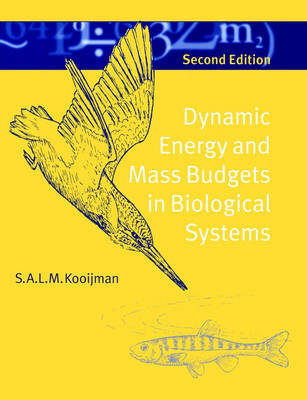
Dynamic Energy and Mass Budgets in Biological Systems
Seiten
2000
|
2nd Revised edition
Cambridge University Press (Verlag)
978-0-521-78608-9 (ISBN)
Cambridge University Press (Verlag)
978-0-521-78608-9 (ISBN)
- Titel erscheint in neuer Auflage
- Artikel merken
Zu diesem Artikel existiert eine Nachauflage
Develops a unifying theory which links different levels of biological organisation (cells, organisms and populations) by considering the underlying energetics of living systems. All living organisms are covered in a single framework, the predictions of which are tested against a variety of experimental results.
The Dynamic Energy Budget theory unifies the commonalties between organisms, as prescribed by the implications of energetics, and links different levels of biological organisation (cells, organisms and populations). The theory presents simple mechanistic rules that describe the uptake and use of energy and nutrients and the consequences for physiological organization throughout an organism's life cycle. All living organisms are covered in a single quantitative framework, the predictions of which are tested against a variety of experimental results at a range of levels of organisation. The theory explains many general observations, such as the body size scaling relationships of certain physiological traits, and provides a theoretical underpinning to the method of indirect calorimetry. In each case, the theory is developed in elementary mathematical terms, but a more detailed discussion of the methodological aspects of mathematical modelling is also included.
The Dynamic Energy Budget theory unifies the commonalties between organisms, as prescribed by the implications of energetics, and links different levels of biological organisation (cells, organisms and populations). The theory presents simple mechanistic rules that describe the uptake and use of energy and nutrients and the consequences for physiological organization throughout an organism's life cycle. All living organisms are covered in a single quantitative framework, the predictions of which are tested against a variety of experimental results at a range of levels of organisation. The theory explains many general observations, such as the body size scaling relationships of certain physiological traits, and provides a theoretical underpinning to the method of indirect calorimetry. In each case, the theory is developed in elementary mathematical terms, but a more detailed discussion of the methodological aspects of mathematical modelling is also included.
Preface; 1. Energetics and models; 2. Basic concepts; 3. Energy acquisition and use; 4. Uptake and use of essential compounds; 5. Multivariate DEB models; 6. Uptake and effects of non-essential compounds; 7. Case studies; 8. Comparison of species; 9. Living together; 10 Evaluation; Bibliography; Glossary; Notation and symbols.
| Erscheint lt. Verlag | 23.3.2000 |
|---|---|
| Zusatzinfo | 17 Tables, unspecified; 2 Halftones, unspecified; 330 Line drawings, unspecified |
| Verlagsort | Cambridge |
| Sprache | englisch |
| Maße | 190 x 247 mm |
| Gewicht | 995 g |
| Themenwelt | Naturwissenschaften ► Biologie |
| Technik ► Umwelttechnik / Biotechnologie | |
| ISBN-10 | 0-521-78608-8 / 0521786088 |
| ISBN-13 | 978-0-521-78608-9 / 9780521786089 |
| Zustand | Neuware |
| Informationen gemäß Produktsicherheitsverordnung (GPSR) | |
| Haben Sie eine Frage zum Produkt? |
Mehr entdecken
aus dem Bereich


aus dem Bereich
Wegweiser vom Honigtau zum Waldhonig
Buch | Hardcover (2024)
Leopold Stocker Verlag
CHF 36,40
Ein aktueller Blick auf das Mosaik der Menschwerdung
Buch | Hardcover (2025)
Springer (Verlag)
CHF 69,95


