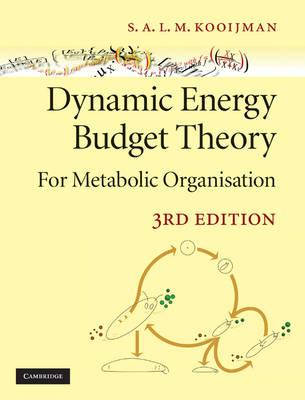
Dynamic Energy Budget Theory for Metabolic Organisation
Cambridge University Press (Verlag)
978-0-521-13191-9 (ISBN)
The Dynamic Energy Budget theory unifies the commonalities between organisms, as prescribed by the implications of energetics, and links different levels of biological organisation (cells, organisms and populations). The theory presents simple mechanistic rules that describe the uptake and use of energy and nutrients and the consequences for physiological organisation throughout an organism's life cycle, including the energetics of ageing and contact with toxic compounds. This new edition includes a new chapter on evolutionary aspects, and discusses methods to quantify entropy for living individuals, isotope dynamics, a mechanism behind reserve dynamics, and toxicity of complex mixtures of compounds. An updated ageing module now also applies to demand systems, new methods for parameter estimation, adaptation of substrate uptake, the use of otiliths for reconstruction of food level trajectories, the differentiated growth of body parts (such as tumours and organs) linked to their function, and many more topics.
Bas Kooijman is Professor of Applied Theoretical Biology at the Vrije Universiteit in Amsterdam and is head of the University's Department of Theoretical Biology. He maintains a long-held and active interest in field biology, with his research focusing on mathematical biology, in particular the physical-chemical foundations of quantitative aspects of life.
Preface; 1. Basic concepts; 2. Standard DEB model in time, length and energy; 3. Energy, compounds and metabolism; 4. Univariate DEB models; 5. Multivariate DEB models; 6. Effects of compounds on budgets; 7. Extensions of DEB models; 8. Co-variation of DEB parameter values; 9. Living together; 10. Evolution; 11. Evaluation; Bibliography; Glossary; Notation and symbols; Taxonomic index; Subject index.
| Erscheint lt. Verlag | 15.10.2009 |
|---|---|
| Zusatzinfo | 27 Tables, unspecified |
| Verlagsort | Cambridge |
| Sprache | englisch |
| Maße | 191 x 247 mm |
| Gewicht | 1140 g |
| Themenwelt | Naturwissenschaften ► Biologie ► Botanik |
| Naturwissenschaften ► Biologie ► Ökologie / Naturschutz | |
| Naturwissenschaften ► Biologie ► Zoologie | |
| ISBN-10 | 0-521-13191-X / 052113191X |
| ISBN-13 | 978-0-521-13191-9 / 9780521131919 |
| Zustand | Neuware |
| Informationen gemäß Produktsicherheitsverordnung (GPSR) | |
| Haben Sie eine Frage zum Produkt? |
aus dem Bereich