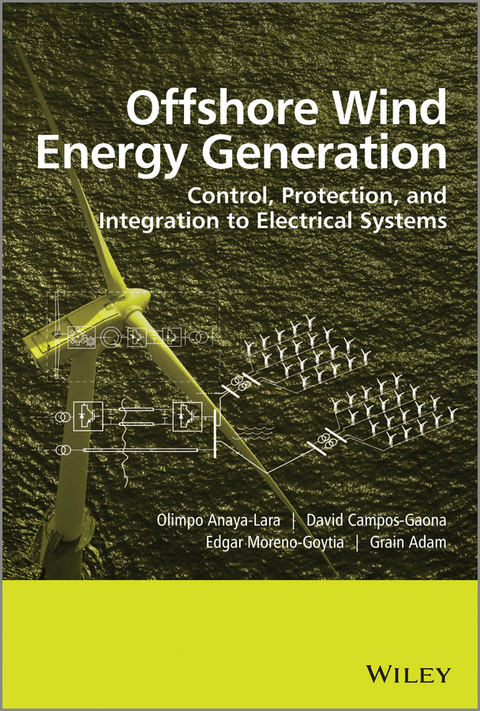
Offshore Wind Energy Generation (eBook)
John Wiley & Sons (Verlag)
978-1-118-70153-9 (ISBN)
The offshore wind sector's trend towards larger turbines, bigger wind farm projects and greater distance to shore has a critical impact on grid connection requirements for offshore wind power plants. This important reference sets out the fundamentals and latest innovations in electrical systems and control strategies deployed in offshore electricity grids for wind power integration.
Includes:
- All current and emerging technologies for offshore wind integration and trends in energy storage systems, fault limiters, superconducting cables and gas-insulated transformers
- Protection of offshore wind farms illustrating numerous system integration and protection challenges through case studies
- Modelling of doubly-fed induction generators (DFIG) and full-converter wind turbines structures together with an explanation of the smart grid concept in the context of wind farms
- Comprehensive material on power electronic equipment employed in wind turbines with emphasis on enabling technologies (HVDC, STATCOM) to facilitate the connection and compensation of large-scale onshore and offshore wind farms
- Worked examples and case studies to help understand the dynamic interaction between HVDC links and offshore wind generation
- Concise description of the voltage source converter topologies, control and operation for offshore wind farm applications
- Companion website containing simulation models of the cases discussed throughout
Equipping electrical engineers for the engineering challenges in utility-scale offshore wind farms, this is an essential resource for power system and connection code designers and pratitioners dealing with integation of wind generation and the modelling and control of wind turbines. It will also provide high-level support to academic researchers and advanced students in power and renewable energy as well as technical and research staff in transmission and distribution system operators and in wind turbine and electrical equipment manufacturers.
Edgar Lenymirko Moreno-Goytia, Reader, Instituto Tecnológico de Morelia, MéxicoDr Moreno-Goytia has researched power electronic-based equipment and measurement systems development. He designed and built a Thyristor Controlled Series Compensator and its control to operate in a voltage fluctuations environment, and has been involved in evaluating the impact of wind generation on the electrical grid. Dr Moreno-Goytia has published over thirty papers in international conferences and journals and is a member of IEEE and IET.
Olimpo Anaya-Lara, Senior Lecturer, Institute for Energy and Environment , University of Strathclyde, Glasgow, UKDr Anaya-Lara has researched power electronic equipment, control systems development, and stability and control of power systems with increased wind energy penetration. He has developed control strategies for Flexible Alternating Current Transmission System devices (FACTS), and designed control schemes for marine applications using advanced control techniques. He is a member of the CIGRE Working Group B4-39, two International Energy Agency Annexes, also the IEEE and IET. He has published over thirty-five journals, ninety papers and co-authored three books.
David Campos-Gaona, Research Assistant, Instituto Tecnológico de Morelia, MéxicoMr Campos-Gaona has investigated electronics-based solutions to electrical networks such as digital power meters, DSP based protection algorithms, and protection systems for wind turbines. He developed electronic equipment such as residential digital power meter with a wireless communication port. He was a research assistant with the SUPERGEN FlexNet, and is member of the IEEE. He has published several papers and conference proceedings.
Grain Philip Adam, Research Fellow, University of Strathclyde, Glasgow, UKGrain received a Ph.D. degree in power electronics from Strathclyde University in 2007. He is currently with the Department of Electronic and Electrical Engineering, Strathclyde University, and his research interests are multilevel inverters, electrical machines and power systems control and stability.The offshore wind sector s trend towards larger turbines, bigger wind farm projects and greater distance to shore has a critical impact on grid connection requirements for offshore wind power plants. This important reference sets out the fundamentals and latest innovations in electrical systems and control strategies deployed in offshore electricity grids for wind power integration. Includes: All current and emerging technologies for offshore wind integration and trends in energy storage systems, fault limiters, superconducting cables and gas-insulated transformers Protection of offshore wind farms illustrating numerous system integration and protection challenges through case studies Modelling of doubly-fed induction generators (DFIG) and full-converter wind turbines structures together with an explanation of the smart grid concept in the context of wind farms Comprehensive material on power electronic equipment employed in wind turbines with emphasis on enabling technologies (HVDC, STATCOM) to facilitate the connection and compensation of large-scale onshore and offshore wind farms Worked examples and case studies to help understand the dynamic interaction between HVDC links and offshore wind generation Concise description of the voltage source converter topologies, control and operation for offshore wind farm applications Companion website containing simulation models of the cases discussed throughout Equipping electrical engineers for the engineering challenges in utility-scale offshore wind farms, this is an essential resource for power system and connection code designers and pratitioners dealing with integation of wind generation and the modelling and control of wind turbines. It will also provide high-level support to academic researchers and advanced students in power and renewable energy as well as technical and research staff in transmission and distribution system operators and in wind turbine and electrical equipment manufacturers.
Edgar Lenymirko Moreno-Goytia, Reader, Instituto Tecnológico de Morelia, MéxicoDr Moreno-Goytia has researched power electronic-based equipment and measurement systems development. He designed and built a Thyristor Controlled Series Compensator and its control to operate in a voltage fluctuations environment, and has been involved in evaluating the impact of wind generation on the electrical grid. Dr Moreno-Goytia has published over thirty papers in international conferences and journals and is a member of IEEE and IET. Olimpo Anaya-Lara, Senior Lecturer, Institute for Energy and Environment , University of Strathclyde, Glasgow, UKDr Anaya-Lara has researched power electronic equipment, control systems development, and stability and control of power systems with increased wind energy penetration. He has developed control strategies for Flexible Alternating Current Transmission System devices (FACTS), and designed control schemes for marine applications using advanced control techniques. He is a member of the CIGRE Working Group B4-39, two International Energy Agency Annexes, also the IEEE and IET. He has published over thirty-five journals, ninety papers and co-authored three books. David Campos-Gaona, Research Assistant, Instituto Tecnológico de Morelia, MéxicoMr Campos-Gaona has investigated electronics-based solutions to electrical networks such as digital power meters, DSP based protection algorithms, and protection systems for wind turbines. He developed electronic equipment such as residential digital power meter with a wireless communication port. He was a research assistant with the SUPERGEN FlexNet, and is member of the IEEE. He has published several papers and conference proceedings. Grain Philip Adam, Research Fellow, University of Strathclyde, Glasgow, UKGrain received a Ph.D. degree in power electronics from Strathclyde University in 2007. He is currently with the Department of Electronic and Electrical Engineering, Strathclyde University, and his research interests are multilevel inverters, electrical machines and power systems control and stability.
Offshore Wind Energy Generation 3
Contents 7
Preface 13
About the Authors 15
Acronyms and Symbols 17
1 Offshore Wind Energy Systems 25
1.1 Background 25
1.2 Typical Subsystems 25
1.3 Wind Turbine Technology 28
1.3.1 Basics 28
1.3.2 Architectures 30
1.3.3 Offshore Wind Turbine Technology Status 31
1.4 Offshore Transmission Networks 32
1.5 Impact on Power System Operation 33
1.5.1 Power System Dynamics and Stability 34
1.5.2 Reactive Power and Voltage Support 34
1.5.3 Frequency Support 35
1.5.4 Wind Turbine Inertial Response 35
1.6 Grid Code Regulations for the Connection of Wind Generation 36
Acknowledgement 37
References 38
2 DFIG Wind Turbine 39
2.1 Introduction 39
2.1.1 Induction Generator (IG) 39
2.1.2 Back-to-Back Converter 40
2.1.3 Gearbox 40
2.1.4 Crowbar Protection 40
2.1.5 Turbine Transformer 41
2.2 DFIG Architecture and Mathematical Modelling 41
2.2.1 IG in the abc Reference Frame 41
2.2.2 IG in the dq0 Reference Frame 47
2.2.3 Mechanical System 51
2.2.4 Crowbar Protection 53
2.2.5 Modelling of the DFIG B2B Power Converter 54
2.2.6 Average Modelling of Power Electronic Converters 57
2.2.7 The dc Circuit 59
2.3 Control of the DFIG WT 60
2.3.1 PI Control of Rotor Speed 60
2.3.2 PI Control of DFIG Reactive Power 63
2.3.3 PI Control of Rotor Currents 65
2.3.4 PI Control of dc Voltage 66
2.3.5 PI Control of Grid-side Converter Currents 69
2.4 DFIG Dynamic Performance Assessment 71
2.4.1 Three-phase Fault 71
2.4.2 Symmetrical Voltage Dips 75
2.4.3 Asymmetrical Faults 77
2.4.4 Single-Phase-to-Ground Fault 78
2.4.5 Phase-to-Phase Fault 79
2.4.6 Torque Behaviour under Symmetrical Faults 80
2.4.7 Torque Behaviour under Asymmetrical Faults 82
2.4.8 Effects of Faults in the Reactive Power Consumption of the IG 83
2.5 Fault Ride-Through Capabilities and Grid Code Compliance 84
2.5.1 Advantages and Disadvantages of the Crowbar Protection 84
2.5.2 Effects of DFIG Variables over Its Fault Ride-Through Capabilities 85
2.6 Enhanced Control Strategies to Improve DFIG Fault Ride-Through Capabilities 86
2.6.1 The Two Degrees of Freedom Internal Model Control (IMC) 86
2.6.2 IMC Controller of the Rotor Speed 89
2.6.3 IMC Controller of the Rotor Currents 90
2.6.4 IMC Controller of the dc Voltage 91
2.6.5 IMC Controller of the Grid-Side Converter Currents 93
2.6.6 DFIG IMC Controllers Tuning for Attaining Robust Control 94
2.6.7 The Robust Stability Theorem 94
References 96
3 Fully-Rated Converter Wind Turbine (FRC-WT) 97
3.1 Synchronous Machine Fundamentals 97
3.1.1 Synchronous Generator Construction 97
3.1.2 The Air-Gap Magnetic Field of the Synchronous Generator 98
3.2 Synchronous Generator Modelling in the dq Frame 103
3.2.1 Steady-State Operation 105
3.2.2 Synchronous Generator with Damper Windings 106
3.3 Control of Large Synchronous Generators 109
3.3.1 Excitation Control 110
3.3.2 Prime Mover Control 111
3.4 Fully-Rated Converter Wind Turbines 112
3.5 FRC-WT with Synchronous Generator 113
3.5.1 Permanent Magnets Synchronous Generator 114
3.5.2 FRC-WT Based on Permanent Magnet Synchronous Generator 116
3.5.3 Generator-Side Converter Control 117
3.5.4 Modelling of the dc Link 120
3.5.5 Network-Side Converter Control 122
3.6 FRC-WT with Squirrel-Cage Induction Generator 124
3.6.1 Control of the FRC-IG Wind Turbine 124
3.7 FRC-WT Power System Damper 129
3.7.1 Power System Oscillations Damping Controller 129
3.7.2 Influence of Wind Generation on Network Damping 131
3.7.3 Influence of FRC-WT Damping Controller on Network Damping 132
Acknowledgements 37
References 38
4 Offshore Wind Farm Electrical Systems 137
4.1 Typical Components 137
4.2 Wind Turbines for Offshore – General Aspects 137
4.3 Electrical Collectors 139
4.3.1 Wind Farm Clusters 142
4.4 Offshore Transmission 142
4.4.1 HVAC Transmission 142
4.4.2 HVDC Transmission 144
4.4.3 CSC-HVDC Transmission 146
4.4.4 VSC-HVDC Transmission 152
4.4.5 Multi-Terminal VSC-HVDC Networks 164
4.5 Offshore Substations 165
4.6 Reactive Power Compensation Equipment 168
4.6.1 Static Var Compensator (SVC) 168
4.6.2 Static Compensator (STATCOM) 171
4.7 Subsea Cables 174
4.7.1 Ac Subsea Cables 174
4.7.2 Dc Subsea Cables 174
4.7.3 Modelling of Underground and Subsea Cables 174
Acknowledgements 175
References 175
5 Grid Integration of Offshore Wind Farms – Case Studies 179
5.1 Background 179
5.2 Offshore Wind Farm Connection Using Point-to-Point VSC-HVDC Transmission 180
5.3 Offshore Wind Farm Connection Using HVAC Transmission 183
5.4 Offshore Wind Farm Connected Using Parallel HVAC/VSC-HVDC Transmission 185
5.5 Offshore Wind Farms Connected Using a Multi-Terminal VSC-HVDC Network 188
5.6 Multi-Terminal VSC-HVDC for Connection of Inter-Regional Power Systems 192
Acknowledgements 195
References 195
6 Offshore Wind Farm Protection 197
6.1 Protection within the Wind Farm ac Network 197
6.1.1 Wind Generator Protection Zone 198
6.1.2 Feeder Protection Zone 202
6.1.3 Busbar Protection Zone 203
6.1.4 High-Voltage Transformer Protection Zone 204
6.2 Study of Faults in the ac Transmission Line of an Offshore DFIG Wind Farm 204
6.2.1 Case Study 1 205
6.2.2 Case Study 2 205
6.3 Protections for dc Connected Offshore Wind Farms 208
6.3.1 VSC-HVDC Converter Protection Scheme 208
6.3.2 Analysis of dc Transmission Line Fault 209
6.3.3 Pole-to-Pole Faults 210
6.3.4 Pole-to-Earth Fault 211
6.3.5 HVDC dc Protections: Challenges and Trends 212
6.3.6 Simulation Studies of Faults in the dc Transmission Line of an Offshore DFIG Wind Farm 212
Acknowledgements 216
References 216
7 Emerging Technologies for Offshore Wind Integration 217
7.1 Wind Turbine Advanced Control for Load Mitigation 217
7.1.1 Blade Pitch Control 217
7.1.2 Blade Twist Control 218
7.1.3 Variable Diameter Rotor 218
7.1.4 Active Flow Control 219
7.2 Converter Interface Arrangements and Collector Design 219
7.2.1 Converters on Turbine 219
7.2.2 Converters on Platform 222
7.2.3 Ac Collection Options: Fixed or Variable Frequency 224
7.2.4 Evaluation of > Higher (>
7.3 Dc Transmission Protection 227
7.4 Energy Storage Systems (EESs) 228
7.4.1 Batteries 229
7.4.2 Super-Capacitors 229
7.4.3 Flywheel Storage System 229
7.4.4 Pumped-Hydro Storage 230
7.4.5 Compressed-Air Storage Systems 230
7.4.6 Superconducting Magnetic Energy Storage (SMES) 230
7.5 Fault Current Limiters (FCLs) 231
7.6 Sub-Sea Substations 231
7.7 HTSCs, GITs and GILs 232
7.7.1 HTSCs (High-Temperature Superconducting Cables) 232
7.7.2 GITs (Gas-Insulated Transformers) 232
7.7.3 GILs (Gas-Insulated Lines) 233
7.8 Developments in Condition Monitoring 233
7.8.1 Partial Discharge Monitoring in HV Cables 233
7.8.2 Transformer Condition Monitoring 234
7.8.3 Gas-Insulated Switchgear Condition Monitoring 235
7.8.4 Power Electronics Condition Monitoring 235
7.9 Smart Grids for Large-Scale Offshore Wind Integration 237
7.9.1 VPP Control Approach 240
7.9.2 Phasor Measurement Units 241
Acknowledgements 241
References 242
A Voltage Source Converter Topologies 247
A.1 Two-Level Converter 247
A.1.1 Operation 247
A.1.2 Voltage Source Converter Square-Mode Operation 248
A.1.3 Pulse Width Modulation 249
A.2 Neutral-Point Clamped Converter 264
A.2.1 Selective Harmonic Elimination 266
A.2.2 Sinusoidal Pulse Width Modulation 268
A.3 Flying Capacitor (FC) Multilevel Converter 271
A.4 Cascaded Multilevel Converter 272
A.5 Modular Multilevel Converter 273
References 282
B Worked-out Examples 295
Exercise 1 295
Exercise 2 296
Exercise 3 298
Exercise 4 298
Exercise 5 300
Exercise 6 301
Index 303
OFFSHORE WINDENERGY GENERATIONCONTROL, PROTECTION, ANDINTEGRATION TO ELECTRICALSYSTEMS 5
| Erscheint lt. Verlag | 20.3.2014 |
|---|---|
| Sprache | englisch |
| Themenwelt | Technik ► Elektrotechnik / Energietechnik |
| Schlagworte | Computer Science • Control • critical impact • Electrical • Energie • Energietechnik • Energy • fundamentals • Grid Connection • important • Informatik • Innovations • Integration • Latest • Offshore • offshore electricity • Parallel and Distributed Computing • Paralleles u. Verteiltes Rechnen • Power Technology & Power Engineering • Projects • Reference • Requirements • Sectors • Storage • Strategies • Turbines • Wind • Windenergie • Wind Energy |
| ISBN-10 | 1-118-70153-4 / 1118701534 |
| ISBN-13 | 978-1-118-70153-9 / 9781118701539 |
| Informationen gemäß Produktsicherheitsverordnung (GPSR) | |
| Haben Sie eine Frage zum Produkt? |
 PDF (Adobe DRM)
Kopierschutz: Adobe-DRM
Adobe-DRM ist ein Kopierschutz, der das eBook vor Mißbrauch schützen soll. Dabei wird das eBook bereits beim Download auf Ihre persönliche Adobe-ID autorisiert. Lesen können Sie das eBook dann nur auf den Geräten, welche ebenfalls auf Ihre Adobe-ID registriert sind.
Details zum Adobe-DRM
Dateiformat: PDF (Portable Document Format)
Mit einem festen Seitenlayout eignet sich die PDF besonders für Fachbücher mit Spalten, Tabellen und Abbildungen. Eine PDF kann auf fast allen Geräten angezeigt werden, ist aber für kleine Displays (Smartphone, eReader) nur eingeschränkt geeignet.
Systemvoraussetzungen:
PC/Mac: Mit einem PC oder Mac können Sie dieses eBook lesen. Sie benötigen eine
eReader: Dieses eBook kann mit (fast) allen eBook-Readern gelesen werden. Mit dem amazon-Kindle ist es aber nicht kompatibel.
Smartphone/Tablet: Egal ob Apple oder Android, dieses eBook können Sie lesen. Sie benötigen eine
Geräteliste und zusätzliche Hinweise
Buying eBooks from abroad
For tax law reasons we can sell eBooks just within Germany and Switzerland. Regrettably we cannot fulfill eBook-orders from other countries.
aus dem Bereich