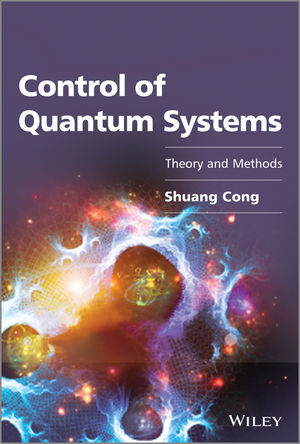
Control of Quantum Systems (eBook)
John Wiley & Sons (Verlag)
978-1-118-60815-9 (ISBN)
Advanced research reference examining the closed and open quantum systems
Control of Quantum Systems: Theory and Methods provides an insight into the modern approaches to control of quantum systems evolution, with a focus on both closed and open (dissipative) quantum systems. The topic is timely covering the newest research in the field, and presents and summarizes practical methods and addresses the more theoretical aspects of control, which are of high current interest, but which are not covered at this level in other text books.
The quantum control theory and methods written in the book are the results of combination of macro-control theory and microscopic quantum system features. As the development of the nanotechnology progresses, the quantum control theory and methods proposed today are expected to be useful in real quantum systems within five years. The progress of the quantum control theory and methods will promote the progress and development of quantum information, quantum computing, and quantum communication.
Equips readers with the potential theories and advanced methods to solve existing problems in quantum optics/information/computing, mesoscopic systems, spin systems, superconducting devices, nano-mechanical devices, precision metrology.
Ideal for researchers, academics and engineers in quantum engineering, quantum computing, quantum information, quantum communication, quantum physics, and quantum chemistry, whose research interests are quantum systems control.
Advanced research reference examining the closed and open quantum systems Control of Quantum Systems: Theory and Methods provides an insight into the modern approaches to control of quantum systems evolution, with a focus on both closed and open (dissipative) quantum systems. The topic is timely covering the newest research in the field, and presents and summarizes practical methods and addresses the more theoretical aspects of control, which are of high current interest, but which are not covered at this level in other text books. The quantum control theory and methods written in the book are the results of combination of macro-control theory and microscopic quantum system features. As the development of the nanotechnology progresses, the quantum control theory and methods proposed today are expected to be useful in real quantum systems within five years. The progress of the quantum control theory and methods will promote the progress and development of quantum information, quantum computing, and quantum communication. Equips readers with the potential theories and advanced methods to solve existing problems in quantum optics/information/computing, mesoscopic systems, spin systems, superconducting devices, nano-mechanical devices, precision metrology. Ideal for researchers, academics and engineers in quantum engineering, quantum computing, quantum information, quantum communication, quantum physics, and quantum chemistry, whose research interests are quantum systems control.
Shuang Cong University of Science and Technology of China
Cover 1
Title Page 5
Copyright 6
Contents 7
About the Author 15
Preface 17
Chapter 1 Introduction 21
1.1 Quantum States 22
1.2 Quantum Systems Control Models 23
1.2.1 Schrödinger Equation 24
1.2.2 Liouville Equation 24
1.2.3 Markovian Master Equations 25
1.2.4 Non-Markovian Master Equations 25
1.3 Structures of Quantum Control Systems 26
1.4 Control Tasks and Objectives 28
1.5 System Characteristics Analyses 29
1.5.1 Controllability 29
1.5.2 Reachability 29
1.5.3 Observability 30
1.5.4 Stability 30
1.5.5 Convergence 30
1.5.6 Robustness 30
1.6 Performance of Control Systems 31
1.6.1 Probability 31
1.6.2 Fidelity 31
1.6.3 Purity 32
1.7 Quantum Systems Control 33
1.7.1 Description of Control Problems 33
1.7.2 Quantum Control Theory and Methods 33
1.8 Overview of the Book 36
References 38
Chapter 2 State Transfer and Analysis of Quantum Systems on the Bloch Sphere 41
2.1 Analysis of a Two-level Quantum System State 41
2.1.1 Pure State Expression on the Bloch Sphere 41
2.1.2 Mixed States in the Bloch Sphere 44
2.1.3 Control Trajectory on the Bloch Sphere 46
2.2 State Transfer of Quantum Systems on the Bloch Sphere 47
2.2.1 Control of a Single Spin-1/2 Particle 48
2.2.2 Situation with the Minimum ?t of Control Fields 50
2.2.3 Situation with a Fixed Time T 51
2.2.4 Numerical Simulations and Results Analyses 53
References 57
Chapter 3 Control Methods of Closed Quantum Systems 59
3.1 Improved Optimal Control Strategies Applied in Quantum Systems 59
3.1.1 Optimal Control of Quantum Systems 60
3.1.2 Improved Quantum Optimal Control Method 62
3.1.3 Krotov-Based Method of Optimal Control 63
3.1.4 Numerical Simulation and Performance Analysis 65
3.2 Control Design of High-Dimensional Spin-1/2 Quantum Systems 68
3.2.1 Coherent Population Transfer Approaches 68
3.2.2 Relationships between the Hamiltonian of Spin-1/2 Quantum Systems under Control and the Sequence of Pulses 69
3.2.3 Design of the Control Sequence of Pulses 72
3.2.4 Simulation Experiments of Population Transfer 73
3.3 Comparison of Time Optimal Control for Two-Level Quantum Systems 77
3.3.1 Description of System Model 78
3.3.2 Geometric Control 79
3.3.3 Bang-Bang Control 81
3.3.4 Time Comparisons of Two Control Strategies 84
3.3.5 Numerical Simulation Experiments and Results Analyses 86
References 91
Chapter 4 Manipulation of Eigenstates-Based on Lyapunov Method 93
4.1 Principle of the Lyapunov Stability Theorem 94
4.2 Quantum Control Strategy Based on State Distance 95
4.2.1 Selection of the Lyapunov Function 96
4.2.2 Design of the Feedback Control Law 97
4.2.3 Analysis and Proof of the Stability 98
4.2.4 Application to a Spin-1/2 Particle System 100
4.3 Optimal Quantum Control Based on the Lyapunov Stability Theorem 101
4.3.1 Description of the System Model 102
4.3.2 Optimal Control Law Design and Property Analysis 104
4.3.3 Simulation Experiments and the Results Comparisons 106
4.4 Realization of the Quantum Hadamard Gate Based on the Lyapunov Method 108
4.4.1 Mathematical Model 109
4.4.2 Realization of the Quantum Hadamard Gate 110
4.4.3 Design of Control Fields 112
4.4.4 Numerical Simulations and Comparison Results Analyses 114
References 116
Chapter 5 Population Control Based on the Lyapunov Method 119
5.1 Population Control of Equilibrium State 119
5.1.1 Preliminary Notions 119
5.1.2 Control Laws Design 120
5.1.3 Analysis of the Largest Invariant Set 121
5.1.4 Considerations on the Determination of P 124
5.1.5 Illustrative Example 125
5.1.6 Appendix: Proof of Theorem 5.1 127
5.2 Generalized Control of Quantum Systems in the Frame of Vector Treatment 130
5.2.1 Design of Control Law 130
5.2.2 Convergence Analysis 133
5.2.3 Numerical Simulation on a Spin-1/2 System 134
5.3 Population Control of Eigenstates 137
5.3.1 System Model and Control Laws 137
5.3.2 Largest Invariant Set of Control Systems 138
5.3.3 Analysis of the Eigenstate Control 138
5.3.4 Simulation Experiments 139
References 143
Chapter 6 Quantum General State Control Based on Lyapunov Method 145
6.1 Pure State Manipulation 145
6.1.1 Design of Control Law and Discussion 145
6.1.2 Control System Simulations and Results Analyses 149
6.2 Optimal Control Strategy of the Superposition State 151
6.2.1 Preliminary Knowledge 152
6.2.2 Control Law Design 153
6.2.3 Numerical Simulations 154
6.3 Optimal Control of Mixed-State Quantum Systems 155
6.3.1 Model of the System to be Controlled 156
6.3.2 Control Law Design 157
6.3.3 Numerical Simulations and Results Analyses 162
6.4 Arbitrary Pure State to a Mixed-State Manipulation 165
6.4.1 Transfer from an Arbitrary Pure State to an Eigenstate 166
6.4.2 Transfer from an Eigenstate to a Mixed State by Interaction Control 167
6.4.3 Control Design for a Mixed-State Transfer 169
6.4.4 Numerical Simulation Experiments 171
References 174
Chapter 7 Convergence Analysis Based on the Lyapunov Stability Theorem 175
7.1 Population Control of Quantum States Based on Invariant Subsets with the Diagonal Lyapunov Function 175
7.1.1 System Model and Control Design 175
7.1.2 Correspondence between any Target Eigenstate and the Value of the Lyapunov Function 176
7.1.3 Invariant Set of Control Systems 177
7.1.4 Numerical Simulations 181
7.1.5 Summary and Discussion 184
7.2 A Convergent Control Strategy of Quantum Systems 185
7.2.1 Problem Description 185
7.2.2 Construction Method of the Observable Operator 186
7.2.3 Proof of Convergence 188
7.2.4 Route Extension Strategy 193
7.2.5 Numerical Simulations 194
7.3 Path Programming Control Strategy of Quantum State Transfer 196
7.3.1 Control Law Design Based on the Lyapunov Method in the Interaction Picture 197
7.3.2 Transition Path Programming Control Strategy 198
7.3.3 Numerical Simulations and Results Analyses 202
References 206
Chapter 8 Control Theory and Methods in Degenerate Cases 207
8.1 Implicit Lyapunov Control of Multi-Control Hamiltonian Systems Based on State Error 207
8.1.1 Control Design 208
8.1.2 Convergence Proof 212
8.1.3 Relation between Two Lyapunov Functions 213
8.1.4 Numerical Simulation and Result Analysis 213
8.2 Quantum Lyapunov Control Based on the Average Value of an Imaginary Mechanical Quantity 215
8.2.1 Control Law Design and Convergence Proof 215
8.2.2 Numerical Simulation and Result Analysis 219
8.3 Implicit Lyapunov Control for the Quantum Liouville Equation 220
8.3.1 Description of Problem 221
8.3.2 Derivation of Control Laws 222
8.3.3 Convergence Analysis 225
8.3.4 Numerical Simulations 229
References 231
Chapter 9 Manipulation Methods of the General State 233
9.1 Quantum System Schmidt Decomposition and its Geometric Analysis 233
9.1.1 Schmidt Decomposition of Quantum States 234
9.1.2 Definition of Entanglement Degree Based on the Schmidt Decomposition 235
9.1.3 Application of the Schmidt Decomposition 236
9.2 Preparation of Entanglement States in a Two-Spin System 240
9.2.1 Construction of the Two-Spin Systems Model in the Interaction Picture 240
9.2.2 Design of the Control Field Based on the Lyapunov Method 243
9.2.3 Proof of Convergence for the Bell States 246
9.2.4 Numerical Simulations 247
9.3 Purification of the Mixed State for Two-Dimensional Systems 250
9.3.1 Purification by Means of a Probe 250
9.3.2 Purification by Interaction Control 252
9.3.3 Numerical Experiments and Results Comparisons 253
9.3.4 Discussion 254
References 255
Chapter 10 State Control of Open Quantum Systems 257
10.1 State Transfer of Open Quantum Systems with a Single Control Field 257
10.1.1 Dynamical Model of Open Quantum Systems 257
10.1.2 Derivation of Optimal Control Law 258
10.1.3 Control System Design 261
10.1.4 Numerical Simulations and Results Analyses 262
10.2 Purity and Coherence Compensation through the Interaction between Particles 266
10.2.1 Method of Compensation for Purity and Coherence 267
10.2.2 Analysis of System Evolution 270
10.2.3 Numerical Simulations 273
10.2.4 Discussion 275
Appendix 10.A Proof of Equation 10.59 277
References 278
Chapter 11 State Estimation, Measurement, and Control of Quantum Systems 281
11.1 State Estimation Methods in Quantum Systems 281
11.1.1 Background of State Estimation of Quantum Systems 282
11.1.2 Quantum State Estimation Methods Based on the Measurement of Identical Copies 282
11.1.3 Quantum State Reconstruction Methods Based on System Theory 287
11.2 Entanglement Detection and Measurement of Quantum Systems 288
11.2.1 Entanglement States 289
11.2.2 Entanglement Witnesses 291
11.2.3 Entanglement Measures 293
11.2.4 Non-linear Separability Criteria 297
11.3 Decoherence Control Based on Weak Measurement 298
11.3.1 Construction of a Weak Measurement Operator 299
11.3.2 Applicability of Weak Measurement 300
11.3.3 Effects on States 302
Appendix 11.A Proof of Normed Linear Space(A, ?•?) 306
References 307
Chapter 12 State Preservation of Open Quantum Systems 311
12.1 Coherence Preservation in a ?-Type Three-Level Atom 311
12.1.1 Models and Objectives 312
12.1.2 Design of Control Field 314
12.1.3 Analysis of Singularities Issues 317
12.1.4 Numerical Simulations 319
12.2 Purity Preservation of Quantum Systems by a Resonant Field 321
12.2.1 Problem Description 322
12.2.2 Purity Property Preservation 323
12.2.3 Discussion 326
12.3 Coherence Preservation in Markovian Open Quantum Systems 327
12.3.1 Problem Formulation 328
12.3.2 Design of Control Variables 331
12.3.3 Numerical Simulations 333
12.3.4 Discussion 335
Appendix 12.A Derivation of HC 336
References 337
Chapter 13 State Manipulation in Decoherence-Free Subspace 341
13.1 State Transfer and Coherence Maintainance Based on DFS for a Four-Level Energy Open Quantum System 341
13.1.1 Construction of DFS and the Desired Target State 342
13.1.2 Design of the Lyapunov-Based Control Law for State Transfer 345
13.1.3 Numerical Simulations 346
13.2 State Transfer Based on a Decoherence-Free Target State for a ?-Type N-Level Atomic System 348
13.2.1 Construction of the Decoherence-Free Target State 348
13.2.2 Design of the Lyapunov-Based Control Law for State Transfer 351
13.2.3 Numerical Simulations and Results Analyses 352
13.3 Control of Quantum States Based on the Lyapunov Method in Decoherence-Free Subspaces 356
13.3.1 Problem Description 356
13.3.2 Control Design in the Interaction Picture 358
13.3.3 Construction of P and Convergence Analysis 359
13.3.4 Numerical Simulation Examples and Discussion 365
References 368
Chapter 14 Dynamic Decoupling Quantum Control Methods 371
14.1 Phase Decoherence Suppression of an n-Level Atom in ? -Configuration with Bang-Bang Controls
14.1.1 Dynamical Decoupling Mechanism 372
14.1.2 Design of the Bang-Bang Operations Group in Phase Decoherence 375
14.1.3 Examples of Design 377
14.2 Optimized Dynamical Decoupling in ?-Type n-Level Atom 380
14.2.1 Periodic Dynamical Decoupling 381
14.2.2 Uhrig Dynamical Decoupling 381
14.2.3 Behaviors of Quantum Coherence under Various Dynamical Decoupling Schemes 382
14.2.4 Examples 385
14.2.5 Discussion 386
14.3 An Optimized Dynamical Decoupling Strategy to Suppress Decoherence 386
14.3.1 Universal Dynamical Decoupling for a Qubit 387
14.3.2 An Optimized Dynamical Decoupling Scheme 389
14.3.3 Simulation and Comparison 389
14.3.4 Discussion 395
References 398
Chapter 15 Trajectory Tracking of Quantum Systems 401
15.1 Orbit Tracking of Quantum States Based on the Lyapunov Method 402
15.1.1 Description of the System Model 402
15.1.2 Design of Control Law 404
15.1.3 Numerical Simulation Experiments and Results Analysis 405
15.2 Orbit Tracking Control of Quantum Systems 409
15.2.1 System Model and Control Law Design 410
15.2.2 Numerical Simulation Experiments 411
15.3 Adaptive Trajectory Tracking of Quantum Systems 414
15.3.1 Description of the System Model 416
15.3.2 Control System Design and Characteristic Analysis 418
15.3.3 Numerical Simulation and Result Analysis 420
15.4 Convergence of Orbit Tracking for Quantum Systems 422
15.4.1 Description of the Control System Model 423
15.4.2 Control Law Derivation 424
15.4.3 Convergence Analysis 424
15.4.4 Applications and Experimental Results Analyses 431
References 436
Index 439
| Erscheint lt. Verlag | 27.2.2014 |
|---|---|
| Sprache | englisch |
| Themenwelt | Naturwissenschaften ► Physik / Astronomie ► Quantenphysik |
| Technik ► Elektrotechnik / Energietechnik | |
| Technik ► Maschinenbau | |
| Schlagworte | Analysis • APPROACHES • Aspects • Book • Control • Control Process & Measurements • Electrical & Electronics Engineering • Elektrotechnik u. Elektronik • fi eld • focus • high current • insight • Level • Maschinenbau • mechanical engineering • MEMS • Mess- u. Regeltechnik • newest • Physics • Physik • Practical methods • Quantenphysik u. Feldtheorie • quantum • Quantum Physics & Field Theory • Research • summarizes • System • Systems • Systems Theory • textbooks • Theoretical • Timely • topic |
| ISBN-10 | 1-118-60815-1 / 1118608151 |
| ISBN-13 | 978-1-118-60815-9 / 9781118608159 |
| Informationen gemäß Produktsicherheitsverordnung (GPSR) | |
| Haben Sie eine Frage zum Produkt? |
 PDF (Adobe DRM)
Größe: 17,5 MB
Kopierschutz: Adobe-DRM
Adobe-DRM ist ein Kopierschutz, der das eBook vor Mißbrauch schützen soll. Dabei wird das eBook bereits beim Download auf Ihre persönliche Adobe-ID autorisiert. Lesen können Sie das eBook dann nur auf den Geräten, welche ebenfalls auf Ihre Adobe-ID registriert sind.
Details zum Adobe-DRM
Dateiformat: PDF (Portable Document Format)
Mit einem festen Seitenlayout eignet sich die PDF besonders für Fachbücher mit Spalten, Tabellen und Abbildungen. Eine PDF kann auf fast allen Geräten angezeigt werden, ist aber für kleine Displays (Smartphone, eReader) nur eingeschränkt geeignet.
Systemvoraussetzungen:
PC/Mac: Mit einem PC oder Mac können Sie dieses eBook lesen. Sie benötigen eine
eReader: Dieses eBook kann mit (fast) allen eBook-Readern gelesen werden. Mit dem amazon-Kindle ist es aber nicht kompatibel.
Smartphone/Tablet: Egal ob Apple oder Android, dieses eBook können Sie lesen. Sie benötigen eine
Geräteliste und zusätzliche Hinweise
Zusätzliches Feature: Online Lesen
Dieses eBook können Sie zusätzlich zum Download auch online im Webbrowser lesen.
Buying eBooks from abroad
For tax law reasons we can sell eBooks just within Germany and Switzerland. Regrettably we cannot fulfill eBook-orders from other countries.
 EPUB (Adobe DRM)
Kopierschutz: Adobe-DRM
Adobe-DRM ist ein Kopierschutz, der das eBook vor Mißbrauch schützen soll. Dabei wird das eBook bereits beim Download auf Ihre persönliche Adobe-ID autorisiert. Lesen können Sie das eBook dann nur auf den Geräten, welche ebenfalls auf Ihre Adobe-ID registriert sind.
Details zum Adobe-DRM
Dateiformat: EPUB (Electronic Publication)
EPUB ist ein offener Standard für eBooks und eignet sich besonders zur Darstellung von Belletristik und Sachbüchern. Der Fließtext wird dynamisch an die Display- und Schriftgröße angepasst. Auch für mobile Lesegeräte ist EPUB daher gut geeignet.
Systemvoraussetzungen:
PC/Mac: Mit einem PC oder Mac können Sie dieses eBook lesen. Sie benötigen eine
eReader: Dieses eBook kann mit (fast) allen eBook-Readern gelesen werden. Mit dem amazon-Kindle ist es aber nicht kompatibel.
Smartphone/Tablet: Egal ob Apple oder Android, dieses eBook können Sie lesen. Sie benötigen eine
Geräteliste und zusätzliche Hinweise
Buying eBooks from abroad
For tax law reasons we can sell eBooks just within Germany and Switzerland. Regrettably we cannot fulfill eBook-orders from other countries.
aus dem Bereich