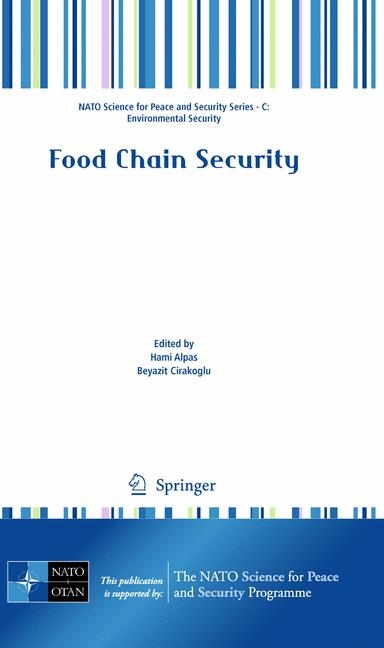
Food Chain Security (eBook)
XII, 146 Seiten
Springer Netherland (Verlag)
978-90-481-9558-9 (ISBN)
The pilot study on Food Chain Security was launched in 2003 by NATO Public Diplomacy Division Science for Peace and Security Section (SPS) under the leadership of Turkey. The purpose of the study was to study the safety and security of food stuffs in the face of their careless/ignorant handling as well as against expected terrorist attacks at the system which may destroy and/or degrade it at the source during distribution, processing and in the consumption phase. The study included the protective and response measures which may have to be taken to reduce the risk and mitigate the consequences of these threats to the food system. The final outputs of this pilot study were agreed to be mainly: To allow comparison between country partners To identify common weaknesses of the food systems As a result of the terrible September 11, 2001 attacks in the United States the nature of the terrorist threat appears to be more uncertain and diffused, therefore the terrorist threat against the food system which comprises production, processing, distribution, restaurants, and retail can be very diverse and unpredictable and involve chemical, biological, and radiological agents of various kinds. Preparing for all possible contingencies was not practical, so a “risk management approach” was used in this study based on risk management principles that acknowledge while risk generally cannot be eliminated, enhancing protection from known or potential threats can reduce it.
Preface. Contributors. Food Chain Security Pilot Study: Findings and recommendations;H. Alpas.- Food Chain Security and Vulnerability; S. Brunet et al.- The Contribution of Food Safety Management Systems to the Prevention of Deliberate Food Contamination; M. Smith.- Issues of Food Chain Security and Case Studies in the Czech Army; A. Komar and P. Vasicka.-Food Chain Security in Romania; L.-D. Galatchi and D. Lacramioara Mihalache.-New system of food control in Russia; I. Ermakova.- Food Chain Defense in the United States; L. Jackson.- Food Safety Strategies in the Federal Republic of Germany; J. Gaus.- Assessing security of supply – three methods used in Finland; H. Sivonen.-Food chain defense and its potential implications on traditional foods. The Portuguese case; A. Veiga and J. Empis.- Subject Index.
| Reihe/Serie | NATO Science for Peace and Security Series |
|---|---|
| Verlagsort | Dordrecht |
| Sprache | englisch |
| Themenwelt | Technik ► Bauwesen |
| Technik ► Lebensmitteltechnologie | |
| Technik ► Maschinenbau | |
| Schlagworte | amines • Food Safety • food security • food terrorism • Management • Safety |
| ISBN-10 | 90-481-9558-6 / 9048195586 |
| ISBN-13 | 978-90-481-9558-9 / 9789048195589 |
| Informationen gemäß Produktsicherheitsverordnung (GPSR) | |
| Haben Sie eine Frage zum Produkt? |
 PDF (Adobe DRM)
Kopierschutz: Adobe-DRM
Adobe-DRM ist ein Kopierschutz, der das eBook vor Mißbrauch schützen soll. Dabei wird das eBook bereits beim Download auf Ihre persönliche Adobe-ID autorisiert. Lesen können Sie das eBook dann nur auf den Geräten, welche ebenfalls auf Ihre Adobe-ID registriert sind.
Details zum Adobe-DRM
Dateiformat: PDF (Portable Document Format)
Mit einem festen Seitenlayout eignet sich die PDF besonders für Fachbücher mit Spalten, Tabellen und Abbildungen. Eine PDF kann auf fast allen Geräten angezeigt werden, ist aber für kleine Displays (Smartphone, eReader) nur eingeschränkt geeignet.
Systemvoraussetzungen:
PC/Mac: Mit einem PC oder Mac können Sie dieses eBook lesen. Sie benötigen eine
eReader: Dieses eBook kann mit (fast) allen eBook-Readern gelesen werden. Mit dem amazon-Kindle ist es aber nicht kompatibel.
Smartphone/Tablet: Egal ob Apple oder Android, dieses eBook können Sie lesen. Sie benötigen eine
Geräteliste und zusätzliche Hinweise
Buying eBooks from abroad
For tax law reasons we can sell eBooks just within Germany and Switzerland. Regrettably we cannot fulfill eBook-orders from other countries.
aus dem Bereich