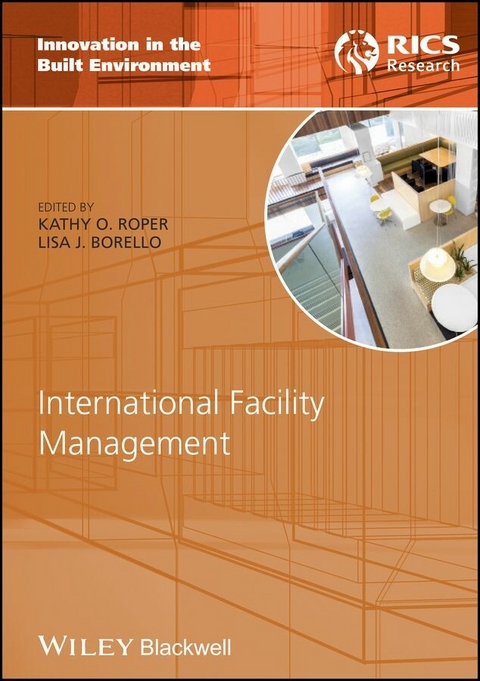
International Facility Management (eBook)
John Wiley & Sons (Verlag)
978-1-118-77171-6 (ISBN)
This up-to-date compilation of topics on the maturity and changes occurring within facility management worldwide offers insights into the growth and development of FM and its impact on today’s business organisations.
International Facility Management presents a comprehensive and diverse collection of topics that provides current, cutting edge research in the evolving field of FM. The editors here offer a holistic approach to both the study and the practice of facility management, incorporating the perspective of scholars and practitioners from across the globe.
Topics covered deal with the changes occurring in the field today and include key research areas for both academics and practitioners. The focus is on actual practice of FM organizations – rather than on what FM should be - and the authors examine the latest techniques, models and case studies to provide a unique exploration of the new global world of facility management.
Chapters here cover the changing spectrum of topics including sustainability and energy conservation, and workplace transitions for greater collaboration. The international scope and emphasis on maturity and professionalism of the field further sets this book apart from its competitors.
Lisa J. Borello is an Editor and Grants Manager at Auburn University with more than 13 years of experience writing and editing scholarly and non-scholarly work. She is completing her doctorate degree in Sociology of Science & Technology at Georgia Institute of Technology.
Kathy O. Roper is Associate Professor and Chair Integrated Facility Management at Georgia Institute of Technology where she teaches graduate courses in facility management, project management, and corporate real estate. Following a 23-year career in corporate, government and non-for-profit facility and real estate management, she is also co-founder and co-editor of the open access International Facility Management Journal.
This up-to-date compilation of topics on the maturity and changes occurring within facility management worldwide offers insights into the growth and development of FM and its impact on today's business organisations. International Facility Management presents a comprehensive and diverse collection of topics that provides current, cutting edge research in the evolving field of FM. The editors here offer a holistic approach to both the study and the practice of facility management, incorporating the perspective of scholars and practitioners from across the globe. Topics covered deal with the changes occurring in the field today and include key research areas for both academics and practitioners. The focus is on actual practice of FM organizations rather than on what FM should be - and the authors examine the latest techniques, models and case studies to provide a unique exploration of the new global world of facility management. Chapters here cover the changing spectrum of topics including sustainability and energy conservation, and workplace transitions for greater collaboration. The international scope and emphasis on maturity and professionalism of the field further sets this book apart from its competitors.
Lisa J. Borello is an Editor and Grants Manager at Auburn University with more than 13 years of experience writing and editing scholarly and non-scholarly work. She is completing her doctorate degree in Sociology of Science & Technology at Georgia Institute of Technology. Kathy O. Roper is Associate Professor and Chair Integrated Facility Management at Georgia Institute of Technology where she teaches graduate courses in facility management, project management, and corporate real estate. Following a 23-year career in corporate, government and non-for-profit facility and real estate management, she is also co-founder and co-editor of the open access International Facility Management Journal.
About the Authors vii
Abbreviations ix
Introduction xi
Chapter 1 Facility Management: Changing Global Viewpoints and
Maturity 1
Kathy O. Roper and Lisa J. Borello
Chapter 2 Competencies, Credentials, Education, and Training
5
Robert L. Barnes
Chapter 3 FM Consultancy and Client-Provider
Relationships 39
Kathy O. Roper
Chapter 4 Globalization of Facility Management 53
Kathy O. Roper
Chapter 5 Sustainability and Carbon Reporting 67
Chris Hodges
Chapter 6 Emergency Preparedness and Business Continuity
91
Robert Friedmann and Bob Hayes
Chapter 7 Changing Workplaces and Distributed Work
109
Kathy O. Roper
Chapter 8 Measuring Work 123
Matthew Tucker
Chapter 9 Industry-Specific Needs 141
Sarel Lavy and Manish Dixit
Chapter 10 Evolution and the Future of Facility Management
167
Kathy O. Roper
Index 179
1
Facility Management: Changing Global Viewpoints and Maturity
Kathy O. Roper and Lisa J. Borello
Georgia Institute of Technology, Atlanta, GA
While aspects of the profession have been practiced for decades, facility management is considered a relatively new profession. From its origins with the term facility management (FM) in the late 1970s, the two primary drivers of its creation were the acceptance of open-office concepts across Europe and the United States and the integration of computing technology into the general workforce. These two drivers essentially changed the landscape of workplaces, opening designs and providing a new focus for management as they moved out of hard-walled offices to oversee their employees, and as employees and managers began to transmit information electronically. Volumes have been written on each of these phenomena, but dramatic shifts are underway again today that rival the changes within workplaces; these shifts are changing the nature and the value of the FM profession, causing FM to become more strategic, more valued, and a critical component of businesses today.
As workplace design changed in the 1970s and 1980s to accommodate computing technologies and reveal less enclosed working areas, the developed nations of Europe and North America began to study the impacts and effects that these new workplaces provided. Early research in the United Kingdom helped to set the first FM research agenda focused on learning, as well as educating individuals in the new art and science of FM. Around the same time, US researchers began to see value in understanding how the environment impacts workers and their productivity. This “holy grail” of understanding and calculating productivity remains at the forefront of research today. In the ensuing 30-plus years, more has been learned and gradual shifts in the business environment are accommodating the elevation of FM “from the boiler room to the board room.”
Today, we see new drivers of change in workplaces and workplace management. Facility professionals across the world are now being asked, “What is our carbon footprint?” “How can we meet new guidelines and regulations around sustainability?” “Have we ensured that our facilities are secure and prepared for emergencies and disasters?” And “How can we use our workplace to attract and retain the best employees?” These and other questions now drive the FM function to be more strategic and more involved in business decision making, and elevate the FM professional to a new level of expert who is prepared to help guide the organization environmentally, socially, and, of course, financially.
Primarily driven by the sustainability movement across the world, facility professionals not only deal with the design, construction, and operation of facilities but also now provide these functions with an eye toward improving triple-bottom-line accounting. Because FM is the second largest expense behind employee salaries, and is an influence on the productivity of those salaried employees, FM professionals are indeed valuable contributors to any organization’s senior management team.
As organizations become more integrated in world markets, the number of multinational organizations is expanding. From 1991 to 2001, headcounts within multinationals surged from 24 to 54 million, and their turnover doubled (Delmas-Marty, 2008). Even organizations operating in only one country now often utilize outsourced labor, or procure materials from various international locations, so global awareness has become a new competency of the facility professional. In addition to global expansion, the breadth of knowledge required to effectively manage facilities has become tremendous. As technology, sustainability, and demographics lurch forward, facility professionals add responsibilities to an already broad array of demands.
Overview of the Volume
This chapter provides a broad overview of the dramatic change currently underway in business and its impacts on FM. As businesses grow and expand, facility professionals grow and expand their roles. This volume explores a range of issues of growing importance to the field of FM now and in the future.
Authored by Robert Barnes, Chapter 2 provides a complete view of the skills, education, and knowledge required for effective FM today. Barnes offers an overview of many resources for facility professionals and provides a framework to consider if one is attempting to advance within the profession. He also provides a summary of the various organizations that support FM broadly or by industry. Certifications are also described as a means of demonstrating competency at varying levels of FM. As Barnes suggests, as the nature of the field changes and as modern buildings become even more sophisticated, the need for new skills and formal training of FM professionals is critical.
In Chapter 3, Kathy Roper provides an update to information on service provider relationships. Originally published in 2011 in Managing the Professional Practice in the Built Environment, this chapter includes an update to focus global information on the provision side of FM. Originally titled “How Thin to Win?” the chapter and its updates provide a clear view of the need for both the hiring organization and service provider to work amicably to support one another in order to provide a win–win relationship.
Globalization is the topic for Chapter 4 and provides an overview of major differences in perspective in various regions of the world, as well as updates on research foci from each of the regions. Author Kathy Roper explores trends and FM needs, as well as the education and training outlook, in Africa, Asia, Australasia, South America, the Middle East, Europe, and North America. While local demands and priorities exist, the desire to advance FM worldwide is promoted with suggestions on learning across regions. Even industrialized nations can learn from some of the newer tricks being used within the industrializing nations. The ability to share information and learning will benefit the profession worldwide.
Chapter 5, titled “Sustainability and Carbon Reporting,” evaluates the role of the facility manager in sustainability and carbon reporting. While the facility manager is typically not in the role of making organizational decisions related to overall operations, author Chris Hodges argues that in the area of sustainability, the FM professional can play an important consulting role by persuasively demonstrating the value of sustainability efforts and the impact they provide to the overall organization. A thorough review of how facilities impact carbon emissions and a global reporting methodology are covered here, as well as more general principles of sustainability and sustainability guidelines.
Preparing for emergencies – both natural and man-made – is critical for ensuring that businesses and operations run smoothly. In Chapter 6, authors Robert Friedmann and Bob Hayes outline the core framework for developing a business continuity program (BCP), and they outline BCP planning principles that can be adapted to a variety of organizations and can be utilized by facility managers in executing comprehensive business continuity and emergency response plans. As developers of the Security Executive Council, the authors have provided direct resources that corporations and other large organizations can use to develop their emergency preparedness and business continuity planning.
As workplaces and the very concept of “the workplace” have changed, facility managers have new challenges and opportunities. In Chapter 7, Kathy Roper explores the dramatic changes to Knowledge Age work, the rise of distributed work, new management challenges, and the impacts to FM, offering suggestions on how facility managers can play a role in changing the workplace itself, provide motivation for increased productivity of workers, and benefit the bottom line of the organization.
In Chapter 8, Matthew Tucker explores performance measurement, benchmarking, and their applications to the FM field, and he provides information on tools such as the balanced scorecard and key performance indicators for consideration and use. He argues that FM performance measurement needs to go beyond just quantitative indicators, such as the physical infrastructure and numerical measures, to qualitative measures that focus on the organization and on improving the quality of service delivery. By understanding the importance of measuring people, processes, and place within an organization and their integration with the core business function, he argues that the efficiency of measuring the quality of FM services will improve.
Sarel Lavy and Manish Dixit provide an in-depth look at four major industries in Chapter 9, exploring the needs and demographics of each. Examining education facilities, public sector buildings, healthcare facilities, and office buildings, Lavy and Dixit outline some of the common themes found among these four major types of facilities, as well as significant differences, with implications for the FM professional.
The book concludes with Chapter 10, which provides an outlook to the future. While we have not found the FM crystal ball, we have found a number of indicators of important issues that will influence the field over the next decade. Beyond that time horizon, we shudder to imagine the scenarios, be they Mad Max: Beyond Thunderdome and Fury Road, or more akin to 2010: A Space Odyssey (updated to 2050, of...
| Erscheint lt. Verlag | 26.11.2013 |
|---|---|
| Reihe/Serie | Innovation in the Built Environment |
| Innovation in the Built Environment | Innovation in the Built Environment |
| Sprache | englisch |
| Themenwelt | Technik ► Bauwesen |
| Wirtschaft ► Betriebswirtschaft / Management ► Unternehmensführung / Management | |
| Schlagworte | Approach • Bauingenieur- u. Bauwesen • Civil Engineering & Construction • Collection • Compilation • Edge • Editors • evolving • Facilities Management • Facility • Facility Management • Field • FM • Gebäudeausrüstung u. -management • Gebäudeausrüstung u. -management • Globe • growth • holistic • Insights • international • Maturity • Practice • Practitioners • provides current • Research • Study • Topics • uptodate • worldwide offers |
| ISBN-10 | 1-118-77171-0 / 1118771710 |
| ISBN-13 | 978-1-118-77171-6 / 9781118771716 |
| Informationen gemäß Produktsicherheitsverordnung (GPSR) | |
| Haben Sie eine Frage zum Produkt? |
 EPUB (Adobe DRM)
Kopierschutz: Adobe-DRM
Adobe-DRM ist ein Kopierschutz, der das eBook vor Mißbrauch schützen soll. Dabei wird das eBook bereits beim Download auf Ihre persönliche Adobe-ID autorisiert. Lesen können Sie das eBook dann nur auf den Geräten, welche ebenfalls auf Ihre Adobe-ID registriert sind.
Details zum Adobe-DRM
Dateiformat: EPUB (Electronic Publication)
EPUB ist ein offener Standard für eBooks und eignet sich besonders zur Darstellung von Belletristik und Sachbüchern. Der Fließtext wird dynamisch an die Display- und Schriftgröße angepasst. Auch für mobile Lesegeräte ist EPUB daher gut geeignet.
Systemvoraussetzungen:
PC/Mac: Mit einem PC oder Mac können Sie dieses eBook lesen. Sie benötigen eine
eReader: Dieses eBook kann mit (fast) allen eBook-Readern gelesen werden. Mit dem amazon-Kindle ist es aber nicht kompatibel.
Smartphone/Tablet: Egal ob Apple oder Android, dieses eBook können Sie lesen. Sie benötigen eine
Geräteliste und zusätzliche Hinweise
Buying eBooks from abroad
For tax law reasons we can sell eBooks just within Germany and Switzerland. Regrettably we cannot fulfill eBook-orders from other countries.
aus dem Bereich