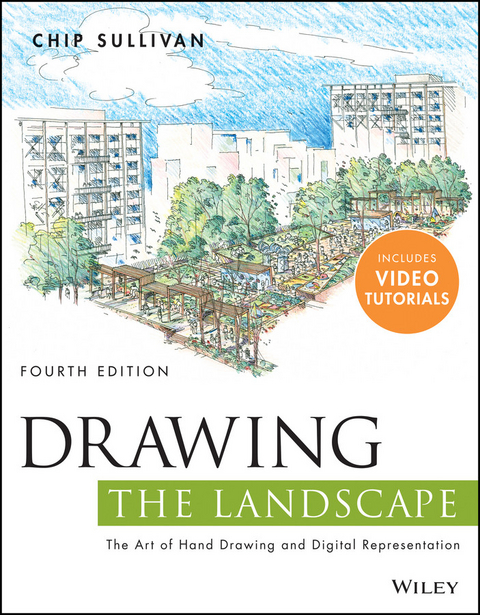
Drawing the Landscape (eBook)
352 Seiten
Wiley (Verlag)
978-1-118-80832-0 (ISBN)
This elegant Fourth Edition of Chip Sullivan's classic Drawing the Landscape shows how to use drawing as a path towards understanding the natural and built environment. It offers guidance for tapping into and exploring personal creative potential and helps readers master the essential principles, tools, and techniques required to prepare professional graphic representations in landscape architecture and architecture. It illustrates how to create a wide range of graphic representations using step-by-step tutorials, exercises and hundreds of samples.
Chip Sullivanis Professor of Landscape Architecture at the University of California, Berkeley. Numerous articles have been written by and about Mr. Sullivan, who continues to show his work in galleries across the country. He is the recipient of many prestigious awards, including the Rome Prize. Earlier in his career, he taught at Harvard University and worked at Sasaki Associates.
This elegant Fourth Edition of Chip Sullivan's classic Drawing the Landscape shows how to use drawing as a path towards understanding the natural and built environment. It offers guidance for tapping into and exploring personal creative potential and helps readers master the essential principles, tools, and techniques required to prepare professional graphic representations in landscape architecture and architecture. It illustrates how to create a wide range of graphic representations using step-by-step tutorials, exercises and hundreds of samples.
Preface
Every true work of art is the attainment of a state of being, a state of high functioning, a more than ordinary moment of existence.
Robert Henri
The Art Spirit
My original idea for the first edition of Drawing the Landscape was to write a technical manual on graphics for landscape architects. However, I was fortunate enough to come across a copy of Robert Henri’s The Art Spirit before I began writing. I read from the book every morning on the 6:00 a.m. bus to campus. After the first chapter I had an epiphany that Drawing the Landscape could be much more than just a book on graphic instruction; it could inspire readers to find their own sources of creativity and to develop their intuitive impulses to draw.
The publication of this fourth edition of Drawing the Landscape is a good indication that I have exceeded my original expectations. I am constantly receiving letters and emails about how the book inspired readers to draw, to develop confidence in their own creativity, and even to decide to become landscape architects. I’m equally pleased that Drawing the Landscape was referenced by Bradley Cantrell and Wes Michaels as an inspiration for their award-winning book Digital Drawing for Landscape Architecture.
Recent scholarship is proving that drawing remains an essential tool for cognitive thinking and design. The plethora of new academic titles on drawing, landscape representation, and visualization has been accompanied by an explosion across the country of organized sketch crawls, “drink-and-draws,” sketching clubs, and figure drawing groups. Judging by the fact that enrollment in my drawing classes has been increasing dramatically, it is clear that not only has drawing survived into the twenty-first century, but it is thriving.
Jim Richards, author, educator, and landscape architect, has summed up this movement as a “drawing renaissance.” A recent exhibition at the Oakland Museum of California titled “Pixar: 25 Years of Animation” confirmed this idea. The Pixar creative formula makes extensive use of hand drawing throughout the creative process. John Lasseter, chief creative officer at Pixar Animation Studios, remarked that “we have almost as many artists at Pixar working in traditional media—hand drawing, painting, pastels, sculpture—as we do in digital media.”1 Pixar offers its own in-house classes in drawing, painting, and design. Elyse Klaidman, director of Pixar University and Archives, has said, “These classes offered everybody at Pixar the opportunity to learn to draw—or, more accurately, to learn to see and develop additional visual skills.”2 Pixar’s magic clearly affects people across the world; its creative formula serves as an excellent example of how critical it is to integrate drawing into the design process in an electronic age.
The two revised chapters in this fourth edition, Chapter 12 “Animating the Landscape,” and Chapter 13 “The Hybrid Drawing,” explore innovative and exciting new developments in the employment of drawing for design expression. I am even more passionate now about the importance of drawing as a method of learning to see than I was when I first wrote this book. I am more convinced than ever that drawing has the potential to help a person better comprehend the environment and attain a higher level of consciousness. I still believe that landscape architecture is as much of an art form as are painting, sculpture, and literature. I hope the merging of the methods and techniques put forth in this new edition can lay a foundation to achieve these goals.
It all begins with the simplicity of putting pencil to paper.3
Elyse Klaidman
Notes
1. Oakland Museum of California, Pixar: 25 Years of Animation (San Francisco: Chronicle Books, 2010), 9.
2. Ibid., 10.
3. Ibid., 13.
With this edition, the Online Supplementary Material (available at www.wiley.com/go/drawingthelandscape) has been expanded with the addition of tutorial videos. The videos address some of the techniques that students and self-learners have often found difficult. The videos are extensions of the text and address some basic concepts in the landscape drawing process including equipment and drawing instruments, techniques for trees and plants, and freehand perspective drawing. The following icon is used throughout the text to indicate topics that are featured in a corresponding tutorial video:
Preface to the Third Edition
After Michelangelo died, someone found in his studio a piece of paper on which he had written a note to his apprentice in the handwriting of his old age, “Draw, Antonio, draw, Antonio, draw and do not waste time.”
ANNIE DILLARD
The Writing Life
I love to draw! I love to draw almost more than anything else in the world. It brings me solace, excitement, and the thrill of experimentation. When I am feeling low, drawing can make me happy. With a single piece of paper and a mark-making tool, I can create whole new worlds.
Drawing allows you to design environments capable of transporting the viewer. Learning to draw is a gift that brings a lifetime of creative excitement. Drawing is a form of personal freedom. The space around you becomes your possession. Once you have the ability to draw, it can’t be taken away from you, for drawing is the ultimate weapon of visual expression. It is also an inexpensive tool, accessible to everyone. The ultimate goal of this book is to introduce and nurture the creative potential for the novice, student, artist, and accomplished professional. The exercises are intended to allow both experienced and inexperienced artists to progressively gain creativity, skill, and confidence in their drawing.
I have always believed that landscape architectural drawing is an art form. Throughout my career I have struggled to get my landscape drawings seen where other forms of art are exhibited. Since the end of Beaux- Arts training, the quality of landscape architectural drawing has declined. Typical landscape drawings are stilted, formalistic, one-dimensional, stylized, and affected. The drawing program I have presented in this book is personal, intuitive, and expressive. I hope that through this process your own personal vision will flourish.
Anyone can learn to draw. All it takes is patience, persistence, and most of all practice. If you are a beginner, you will be frustrated, but you must draw every day to slowly overcome your frustration. Most of all, you need a strong desire; as you gain confidence in your ideas and abilities you will eventually produce truly magnificent and satisfying work. The ability to express yourself and to gain an intimate connection to your thoughts and subconscious will be yours with practice and will increase your ability to design innovative landscapes.
When you draw the landscape, you empathize with it; you become part of nature in a way that technology can’t. The act of drawing is essential in understanding how to design environments more sympathetic to natural systems. In order to reverse the current state of environmental degradation we must retain the sanctity of hand-drawing as a foundation for building the future. If we can learn to truly see nature, perhaps we can gain insight into how to repair it. Leonardo da Vinci, with his instinctive and fluid sketches that combined thinking and visualization, is an excellent role model. Too much design today exists in a world far from the integrated thought and drawing process of da Vinci. A strong faculty in drawing and visual perception should not be abandoned because of a new infatuation with technology.
The third edition of this book is released at a time when my faith in drawing is stronger than ever. It is easy to be seduced by computer-aided graphics, but drawing has not been eclipsed by digital media. On the contrary, the use of digital media has underscored the necessity of acquiring proficiency in drawing by hand. Being distracted by the technology of representation can result in a built landscape that ends up looking more like a simulation than the real thing. But integrating hand drawings with digital media enhances the visual experience of the landscape and enriches one’s environmental sensibilities.
When the artist is well equipped with conscious feeling, memory, and balanced sensibilities, he intensifies his concepts by penetrating his subjects and by condensing his experience into a reality of the spirit complete in itself. Thus he creates a new reality in terms of the medium.
(Hofmann 1967, 539)
The resurgence in drawing is reinforced by the demand for additional drawing studios. I now teach more drawing classes than I ever have, and they are filled to capacity. As I travel the country lecturing and giving drawing workshops, I see this renewed desire of students, artists, and professionals to express themselves through drawing.
The growing awareness of the vital role of drawing in the design process became even more apparent when a group of students asked me to create a special class in quick rendering techniques. They observed that during their summer internships the professionals who could quickly express design concepts were usually the ones executing the design. These interns were impressed by the designers who could swiftly and magically visualize the client’s intentions right before their eyes.
The major exhibitions of drawings that have been presented recently in New York City confirm the renewed interest in the art form. At the onset of the new millennium, these shows gleaned worldwide attention and...
| Erscheint lt. Verlag | 18.11.2013 |
|---|---|
| Sprache | englisch |
| Themenwelt | Kunst / Musik / Theater ► Allgemeines / Lexika |
| Kunst / Musik / Theater ► Malerei / Plastik | |
| Technik ► Architektur | |
| ISBN-10 | 1-118-80832-0 / 1118808320 |
| ISBN-13 | 978-1-118-80832-0 / 9781118808320 |
| Informationen gemäß Produktsicherheitsverordnung (GPSR) | |
| Haben Sie eine Frage zum Produkt? |
 EPUB (Adobe DRM)
Größe: 122,4 MB
Kopierschutz: Adobe-DRM
Adobe-DRM ist ein Kopierschutz, der das eBook vor Mißbrauch schützen soll. Dabei wird das eBook bereits beim Download auf Ihre persönliche Adobe-ID autorisiert. Lesen können Sie das eBook dann nur auf den Geräten, welche ebenfalls auf Ihre Adobe-ID registriert sind.
Details zum Adobe-DRM
Dateiformat: EPUB (Electronic Publication)
EPUB ist ein offener Standard für eBooks und eignet sich besonders zur Darstellung von Belletristik und Sachbüchern. Der Fließtext wird dynamisch an die Display- und Schriftgröße angepasst. Auch für mobile Lesegeräte ist EPUB daher gut geeignet.
Systemvoraussetzungen:
PC/Mac: Mit einem PC oder Mac können Sie dieses eBook lesen. Sie benötigen eine
eReader: Dieses eBook kann mit (fast) allen eBook-Readern gelesen werden. Mit dem amazon-Kindle ist es aber nicht kompatibel.
Smartphone/Tablet: Egal ob Apple oder Android, dieses eBook können Sie lesen. Sie benötigen eine
Geräteliste und zusätzliche Hinweise
Buying eBooks from abroad
For tax law reasons we can sell eBooks just within Germany and Switzerland. Regrettably we cannot fulfill eBook-orders from other countries.
aus dem Bereich