


Drawing the Landscape (eBook)
John Wiley & Sons (Verlag)
978-1-118-79919-2 (ISBN)
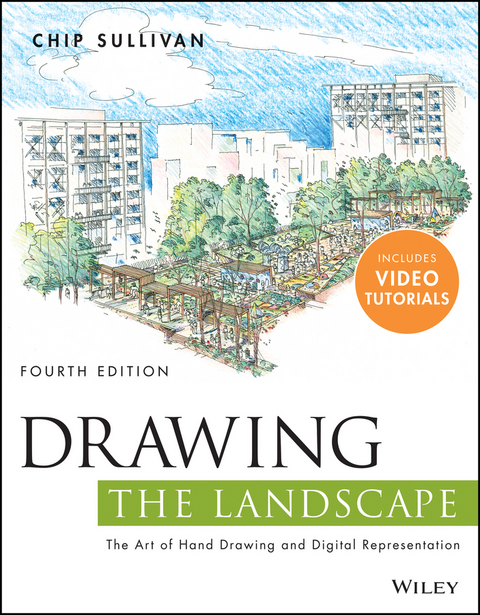
This elegant Fourth Edition of Chip Sullivan's classic Drawing the Landscape shows how to use drawing as a path towards understanding the natural and built environment. It offers guidance for tapping into and exploring personal creative potential and helps readers master the essential principles, tools, and techniques required to prepare professional graphic representations in landscape architecture and architecture. It illustrates how to create a wide range of graphic representations using step-by-step tutorials, exercises and hundreds of samples.
Chip Sullivanis Professor of Landscape Architecture at the University of California, Berkeley. Numerous articles have been written by and about Mr. Sullivan, who continues to show his work in galleries across the country. He is the recipient of many prestigious awards, including the Rome Prize. Earlier in his career, he taught at Harvard University and worked at Sasaki Associates.
This elegant Fourth Edition of Chip Sullivan's classic Drawing the Landscape shows how to use drawing as a path towards understanding the natural and built environment. It offers guidance for tapping into and exploring personal creative potential and helps readers master the essential principles, tools, and techniques required to prepare professional graphic representations in landscape architecture and architecture. It illustrates how to create a wide range of graphic representations using step-by-step tutorials, exercises and hundreds of samples.
Chip Sullivanis Professor of Landscape Architecture at the University of California, Berkeley. Numerous articles have been written by and about Mr. Sullivan, who continues to show his work in galleries across the country. He is the recipient of many prestigious awards, including the Rome Prize. Earlier in his career, he taught at Harvard University and worked at Sasaki Associates.
Preface vii
Preface to the Third Edition ix
Acknowledgments xiii
1 The Essence of Drawing 1
Definition of Drawing 3
Drawing as Conceptualizing 7
Drawing as Seeing 7
Freedom and Structure 12
The Power of Drawing 16
The Spirit of Drawing 17
2 The Daybook 19
Types of Daybooks 27
Media 29
Mixed Media 31
Doodles 32
Daybook Variations 33
3 The Creative Environment 43
The Studio 44
The Artistic Community 50
Inspiration 56
The Creative Process 60
4 Equipment and Drawing Instruments 65
Equipment 66
The Pencil 69
Drawing Paper 72
Soft Media 73
Pen and Ink 76
Technical Pens 77
Colored Pencils 80
Watercolor 84
5 Preliminary Drawing Exercises 93
Holding the Drawing Instrument 94
6 Tone and Texture 111
Light, Shade, and Shadow 112
Tone and Value 113
Hatching 114
Crosshatching 115
Chiaroscuro 116
Light 116
Shadow 117
Basic Solids in Tone 119
Texture 122
7 Drawing Techniques for Trees and Plants 131
Contour Drawing 133
Gesture 136
Plant Forms 137
Plant Structure 137
Foliage 140
Shadow 147
Tree and Plant Massing 154
8 Composing the Landscape Drawing 157
The Picture Plane 162
Drawing Paper 164
The Classic Landscape Composition 169
Optical Devices 171
9 Freehand Perspective Drawing 181
Linear Perspective 183
Freehand Landscape Perspective 186
Horizon Line 187
Viewpoints and Vanishing Points 189
Proportional Relationships 191
Developing the Gestural Quality of Freehand
Perspective 200
Architectural Perspective 203
10 Drawing the Landscape in Plan, Elevation, and Section207
The Landscape Plan 209
Frame of Reference 211
Scale 212
The Freehand Conceptual Plan 216
The Measured Plan 218
Ground Plane Treatments 219
Ground Plane Textures 220
Water 221
Architecture 224
Trees and Vegetation 225
Shadows 227
The Elevation 228
The Section 230
Illustrating the Elevation and Section 231
Elevation Perspective 233
11 Axonometric and Isometric Landscape Drawing 235
The Axonometric 239
The Isometric 242
Freehand Bird's-Eye 243
The Exploded View 244
Illustrating the Axonometric and
Isometric 246
Composing the Paraline Drawing 250
12 Animating the Landscape: Visual Narratives, Storyboards,and Moving Drawings 251
The Figure in Space 252
Comics and the Visual Narrative 259
Storyboarding the Landscape 263
Moving Drawings: Animating the Storyboard 271
13 The Hybrid Drawing 275
The Joy of Graphite 277
Embellishing the Wireframe 280
Digital Rendering Techniques 281
Drawing over Photographs 285
The Cézanne Effect and the
Impressionist Image 286
Techniques of Sequential Artists 288
Tea and Coffee Cocktail Washes 291
The Scanned Wash 291
Special Effects for Texturing Digital Prints 292
Overpainting with Oils 293
The Tableau 294
Summary 297
14 The Art of Presentation 299
The Mock-up 302
Lettering 309
The Competition Drawing 310
Experimental Media: A Gallery of Ideas 312
Conclusion 319
Afterword 323
References 325
Index 327
| Erscheint lt. Verlag | 8.11.2013 |
|---|---|
| Sprache | englisch |
| Themenwelt | Kunst / Musik / Theater ► Allgemeines / Lexika |
| Kunst / Musik / Theater ► Malerei / Plastik | |
| Technik ► Architektur | |
| Schlagworte | Architecture • Architektur • Design, Drawing & Presentation • Drawing landscape, Drawing the Landscape, landscape drawing, landscape drawings, landscape architect, drawings landscape, draw landscape, landscape designer, drawing of landscape, landscape architects, landscape software, landscape design, Chip Sullivan, Drawing the Landscape Fourth Edition • Entwurf, Zeichnung u. Präsentation • Entwurf, Zeichnung u. Präsentation • Landscape Design • Landschaftsarchitektur |
| ISBN-10 | 1-118-79919-4 / 1118799194 |
| ISBN-13 | 978-1-118-79919-2 / 9781118799192 |
| Informationen gemäß Produktsicherheitsverordnung (GPSR) | |
| Haben Sie eine Frage zum Produkt? |
 PDF (Adobe DRM)
Kopierschutz: Adobe-DRM
Adobe-DRM ist ein Kopierschutz, der das eBook vor Mißbrauch schützen soll. Dabei wird das eBook bereits beim Download auf Ihre persönliche Adobe-ID autorisiert. Lesen können Sie das eBook dann nur auf den Geräten, welche ebenfalls auf Ihre Adobe-ID registriert sind.
Details zum Adobe-DRM
Dateiformat: PDF (Portable Document Format)
Mit einem festen Seitenlayout eignet sich die PDF besonders für Fachbücher mit Spalten, Tabellen und Abbildungen. Eine PDF kann auf fast allen Geräten angezeigt werden, ist aber für kleine Displays (Smartphone, eReader) nur eingeschränkt geeignet.
Systemvoraussetzungen:
PC/Mac: Mit einem PC oder Mac können Sie dieses eBook lesen. Sie benötigen eine
eReader: Dieses eBook kann mit (fast) allen eBook-Readern gelesen werden. Mit dem amazon-Kindle ist es aber nicht kompatibel.
Smartphone/Tablet: Egal ob Apple oder Android, dieses eBook können Sie lesen. Sie benötigen eine
Geräteliste und zusätzliche Hinweise
Buying eBooks from abroad
For tax law reasons we can sell eBooks just within Germany and Switzerland. Regrettably we cannot fulfill eBook-orders from other countries.
aus dem Bereich


