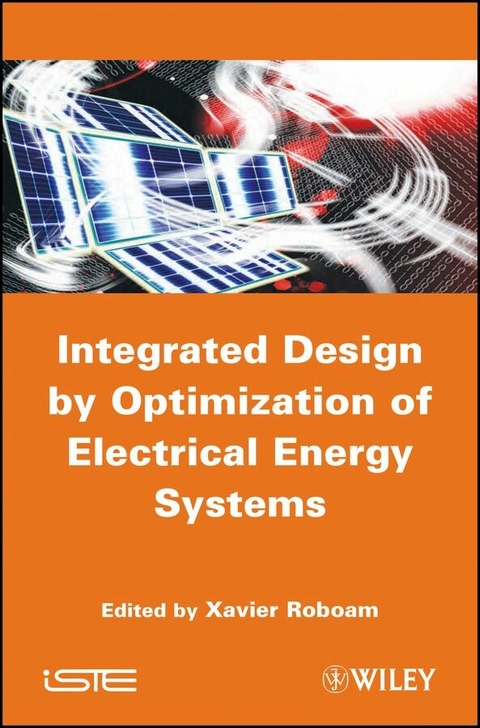
Integrated Design by Optimization of Electrical Energy Systems (eBook)
John Wiley & Sons (Verlag)
978-1-118-58800-0 (ISBN)
This book proposes systemic design methodologies applied to electrical energy systems, in particular integrated optimal design with modeling and optimization methods and tools.
It is made up of six chapters dedicated to integrated optimal design. First, the signal processing of mission profiles and system environment variables are discussed. Then, optimization-oriented analytical models, methods and tools (design frameworks) are proposed. A 'multi-level optimization' smartly coupling several optimization processes is the subject of one chapter. Finally, a technico-economic optimization especially dedicated to electrical grids completes the book.
The aim of this book is to summarize design methodologies based in particular on a systemic viewpoint, by considering the system as a whole. These methods and tools are proposed by the most important French research laboratories, which have many scientific partnerships with other European and international research institutions. Scientists and engineers in the field of electrical engineering, especially teachers/researchers because of the focus on methodological issues, will find this book extremely useful, as will PhD and Masters students in this field.
Xavier ROBOAM, Institut National Polytechnique de Toulouse, France.
This book proposes systemic design methodologies applied to electrical energy systems, in particular integrated optimal design with modeling and optimization methods and tools. It is made up of six chapters dedicated to integrated optimal design. First, the signal processing of mission profiles and system environment variables are discussed. Then, optimization-oriented analytical models, methods and tools (design frameworks) are proposed. A multi-level optimization smartly coupling several optimization processes is the subject of one chapter. Finally, a technico-economic optimization especially dedicated to electrical grids completes the book. The aim of this book is to summarize design methodologies based in particular on a systemic viewpoint, by considering the system as a whole. These methods and tools are proposed by the most important French research laboratories, which have many scientific partnerships with other European and international research institutions. Scientists and engineers in the field of electrical engineering, especially teachers/researchers because of the focus on methodological issues, will find this book extremely useful, as will PhD and Masters students in this field.
Xavier ROBOAM, Institut National Polytechnique de Toulouse, France.
Preface xi
Chapter 1. Mission and Environmental Data Processing1
Amine JAAFAR, Bruno SARENI and Xavier ROBOAM
1.1. Introduction 1
1.2. Considerations of the mission and environmental variables3
1.3. New approach for the characterization of a"representative mission" 6
1.4. Classification of missions and environmental variables16
1.5. Synthesis of mission and environmental variable profiles21
1.6. From classification to simultaneous design by optimizationof a hybrid traction chain 25
1.7. Conclusion 39
1.8. Bibliography 41
Chapter 2. Analytical Sizing Models for Electrical EnergySystems Optimization 45
Christophe ESPANET, Daniel DEPERNET, Anne-Claire SAUTTER andZhenwei WU
2.1. Introduction 45
2.2. The problem of modeling for synthesis 46
2.3. System decomposition and model structure 55
2.4. General information about the modeling of the variouspossible components in an electrical energy system 60
2.5. Development of an electrical machine analytical model61
2.6. Development of an analytical static converter model 73
2.7. Development of a mechanical transmission analytical model82
2.8. Development of an analytical energy storage device model91
2.9. Use of models for the optimum sizing of a system 91
2.10. Conclusions 102
2.11. Bibliography 103
Chapter 3. Simultaneous Design by Means of EvolutionaryComputation 107
Bruno SARENI and Xavier ROBOAM
3.1. Simultaneous design of energy systems 107
3.2. Evolutionary algorithms and artificial evolution 113
3.3. Consideration of multiple objectives 119
3.4. Consideration of design constraints 123
3.5. Integration of robustness into the simultaneous designprocess 126
3.6. Example applications 130
3.7. Conclusions 150
3.8. Bibliography 151
Chapter 4. Multi-Level Design Approaches forElectro-Mechanical Systems Optimization 155
Stéphane BRISSET, Frédéric GILLON and PascalBROCHET
4.1. Introduction 155
4.2. Multi-level approaches 156
4.3. Optimization using models with different granularities160
4.4. Hierarchical decomposition of an optimization problem178
4.5. Conclusion 187
4.6. Bibliography 188
Chapter 5. Multi-criteria Design and Optimization Tools193
Benoit DELINCHANT, Laurence ESTRABAUD, Laurent GERBAUD andFrédéric WURTZ
5.1. The CADES framework: example of a new tools approach194
5.2. The system approach: a break from standard tools 195
5.3. Components ensuring interoperability around a framework203
5.4. Some calculation modeling formalisms for optimization210
5.5. The principles of automatic Jacobian generation 218
5.6. Services using models and their Jacobian 223
5.7. Applications of CADES in system optimization 227
5.8. Perspectives 231
5.9. Conclusions 238
5.10. Bibliography 239
Chapter 6. Technico-economic Optimization of Energy Networks247
Guillaume SANDOU, Philippe DESSANTE, Marc PETIT and HenriBORSENBERGER
6.1. Introduction 247
6.2. Energy network modeling 249
6.3. Resolution of the energy network optimization problem for adeterministic case 255
6.4. Introduction to uncertainty consideration 266
6.5. Consideration of uncertainties on consumer demand 269
6.6. Consideration of uncertainties over production costs273
6.7. From optimization to control 279
6.8. Conclusions 280
6.9. Bibliography 281
List of Authors 287
Index 291
| Erscheint lt. Verlag | 2.4.2013 |
|---|---|
| Sprache | englisch |
| Themenwelt | Technik ► Elektrotechnik / Energietechnik |
| Schlagworte | amine jaafar • Approach • characterization • classification • Considerations • Design • Energie • Energietechnik • Energy • hybrid • Mission • missions • Models • New • Optimization • Power Technology & Power Engineering • representative • Simultaneous • Sizing • synthesis • traction chain • Variables |
| ISBN-10 | 1-118-58800-2 / 1118588002 |
| ISBN-13 | 978-1-118-58800-0 / 9781118588000 |
| Informationen gemäß Produktsicherheitsverordnung (GPSR) | |
| Haben Sie eine Frage zum Produkt? |
 PDF (Adobe DRM)
Kopierschutz: Adobe-DRM
Adobe-DRM ist ein Kopierschutz, der das eBook vor Mißbrauch schützen soll. Dabei wird das eBook bereits beim Download auf Ihre persönliche Adobe-ID autorisiert. Lesen können Sie das eBook dann nur auf den Geräten, welche ebenfalls auf Ihre Adobe-ID registriert sind.
Details zum Adobe-DRM
Dateiformat: PDF (Portable Document Format)
Mit einem festen Seitenlayout eignet sich die PDF besonders für Fachbücher mit Spalten, Tabellen und Abbildungen. Eine PDF kann auf fast allen Geräten angezeigt werden, ist aber für kleine Displays (Smartphone, eReader) nur eingeschränkt geeignet.
Systemvoraussetzungen:
PC/Mac: Mit einem PC oder Mac können Sie dieses eBook lesen. Sie benötigen eine
eReader: Dieses eBook kann mit (fast) allen eBook-Readern gelesen werden. Mit dem amazon-Kindle ist es aber nicht kompatibel.
Smartphone/Tablet: Egal ob Apple oder Android, dieses eBook können Sie lesen. Sie benötigen eine
Geräteliste und zusätzliche Hinweise
Buying eBooks from abroad
For tax law reasons we can sell eBooks just within Germany and Switzerland. Regrettably we cannot fulfill eBook-orders from other countries.
aus dem Bereich