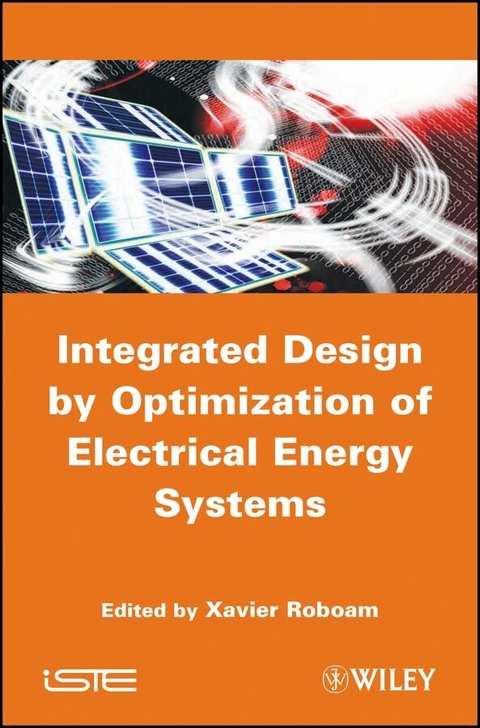
Integrated Design by Optimization of Electrical Energy Systems (eBook)
John Wiley & Sons (Verlag)
978-1-118-58795-9 (ISBN)
This book proposes systemic design methodologies applied to electrical energy systems, in particular integrated optimal design with modeling and optimization methods and tools.
It is made up of six chapters dedicated to integrated optimal design. First, the signal processing of mission profiles and system environment variables are discussed. Then, optimization-oriented analytical models, methods and tools (design frameworks) are proposed. A “multi-level optimization” smartly coupling several optimization processes is the subject of one chapter. Finally, a technico-economic optimization especially dedicated to electrical grids completes the book.
The aim of this book is to summarize design methodologies based in particular on a systemic viewpoint, by considering the system as a whole. These methods and tools are proposed by the most important French research laboratories, which have many scientific partnerships with other European and international research institutions. Scientists and engineers in the field of electrical engineering, especially teachers/researchers because of the focus on methodological issues, will find this book extremely useful, as will PhD and Masters students in this field.
This book proposes systemic design methodologies applied to electrical energy systems, in particular integrated optimal design with modeling and optimization methods and tools. It is made up of six chapters dedicated to integrated optimal design. First, the signal processing of mission profiles and system environment variables are discussed. Then, optimization-oriented analytical models, methods and tools (design frameworks) are proposed. A multi-level optimization smartly coupling several optimization processes is the subject of one chapter. Finally, a technico-economic optimization especially dedicated to electrical grids completes the book. The aim of this book is to summarize design methodologies based in particular on a systemic viewpoint, by considering the system as a whole. These methods and tools are proposed by the most important French research laboratories, which have many scientific partnerships with other European and international research institutions. Scientists and engineers in the field of electrical engineering, especially teachers/researchers because of the focus on methodological issues, will find this book extremely useful, as will PhD and Masters students in this field.
Xavier ROBOAM, Institut National Polytechnique de Toulouse, France.
Preface xi
Chapter 1. Mission and Environmental Data Processing1
Amine JAAFAR, Bruno SARENI and Xavier ROBOAM
1.1. Introduction 1
1.2. Considerations of the mission and environmental variables3
1.3. New approach for the characterization of a"representative mission" 6
1.4. Classification of missions and environmental variables16
1.5. Synthesis of mission and environmental variable profiles21
1.6. From classification to simultaneous design by optimizationof a hybrid traction chain 25
1.7. Conclusion 39
1.8. Bibliography 41
Chapter 2. Analytical Sizing Models for Electrical EnergySystems Optimization 45
Christophe ESPANET, Daniel DEPERNET, Anne-Claire SAUTTER andZhenwei WU
2.1. Introduction 45
2.2. The problem of modeling for synthesis 46
2.3. System decomposition and model structure 55
2.4. General information about the modeling of the variouspossible components in an electrical energy system 60
2.5. Development of an electrical machine analytical model61
2.6. Development of an analytical static converter model 73
2.7. Development of a mechanical transmission analytical model82
2.8. Development of an analytical energy storage device model91
2.9. Use of models for the optimum sizing of a system 91
2.10. Conclusions 102
2.11. Bibliography 103
Chapter 3. Simultaneous Design by Means of EvolutionaryComputation 107
Bruno SARENI and Xavier ROBOAM
3.1. Simultaneous design of energy systems 107
3.2. Evolutionary algorithms and artificial evolution 113
3.3. Consideration of multiple objectives 119
3.4. Consideration of design constraints 123
3.5. Integration of robustness into the simultaneous designprocess 126
3.6. Example applications 130
3.7. Conclusions 150
3.8. Bibliography 151
Chapter 4. Multi-Level Design Approaches forElectro-Mechanical Systems Optimization 155
Stéphane BRISSET, Frédéric GILLON and PascalBROCHET
4.1. Introduction 155
4.2. Multi-level approaches 156
4.3. Optimization using models with different granularities160
4.4. Hierarchical decomposition of an optimization problem178
4.5. Conclusion 187
4.6. Bibliography 188
Chapter 5. Multi-criteria Design and Optimization Tools193
Benoit DELINCHANT, Laurence ESTRABAUD, Laurent GERBAUD andFrédéric WURTZ
5.1. The CADES framework: example of a new tools approach194
5.2. The system approach: a break from standard tools 195
5.3. Components ensuring interoperability around a framework203
5.4. Some calculation modeling formalisms for optimization210
5.5. The principles of automatic Jacobian generation 218
5.6. Services using models and their Jacobian 223
5.7. Applications of CADES in system optimization 227
5.8. Perspectives 231
5.9. Conclusions 238
5.10. Bibliography 239
Chapter 6. Technico-economic Optimization of Energy Networks247
Guillaume SANDOU, Philippe DESSANTE, Marc PETIT and HenriBORSENBERGER
6.1. Introduction 247
6.2. Energy network modeling 249
6.3. Resolution of the energy network optimization problem for adeterministic case 255
6.4. Introduction to uncertainty consideration 266
6.5. Consideration of uncertainties on consumer demand 269
6.6. Consideration of uncertainties over production costs273
6.7. From optimization to control 279
6.8. Conclusions 280
6.9. Bibliography 281
List of Authors 287
Index 291
Chapter 1
Mission and Environmental Data Processing1
1.1. Introduction
Energy systems design, particularly electrical, is nowadays increasingly influenced by social issues linked to energy economy policies and reducing the impact on the environment. To this end, numerous technical demands are added, such as volume and mass, lifetime, reliability (see Chapter 8, [ROB 12]), quality (susceptibility, harmonic pollution), stability (see Chapter 5 [ROB 12]), and recyclability. Being strongly linked to cost criteria, these demands require design to be tackled according to a “technicoeconomic” approach. Thus, the end of the 20th Century was marked by a notable evolution towards a more complete evaluation of costs over the whole of the lifecycle of the system (production, maintenance, and usage costs, even dismantling/recycling costs). Faced with these new considerations, designers are called upon to consider the environment in which their systems will evolve in more detail. Fundamentally, it is imperative to evolve toward a “systems design” approach from the outset; thus enabling an understanding of the coupling between system constituents and facilitation and the integration of the utility of the device and environmental variables.
This heterogeneous and complex set of requirements is pushing designers towards a “simultaneous design” approach, which truly integrates systems design, as indicated in this introductory chapter (see also Chapter 1 of [ROB 12]). Simultaneous design is an approach that considers the system as a whole, where the fundamental questions of system architecture, sizing and management are integrated (see Figure 1.2). As we will see in Chapter 3 of this book, simultaneous design can be handled using optimization techniques, which is where multiple levels of difficulty are jointly associated with the design problem.
Figure 1.1. Simultaneous systems design approach
The integration of the “mission” (or finality) and environmental variables into the design process is particularly difficult, as the mission profile duration, and environmental variables (such as temperature, wind, and sunshine) are generally longer than the dominant time constants of the system, leading to significant processing times (simulation, optimization), which limit research into optimum solutions. This difficulty becomes all the more critical from the moment the system under design needs to satisfy not only a unique profile (mission and/or environmental variable), but a family or class of profiles with occasionally different characteristics. Indeed, in a profile database, there is generally no single “dominant” profile with regards to the set of design criteria and constraints (indicators); frequently, only a single part of a profile is “relevant” with regards to a first indicator, whereas another profile part is particularly constraining with regards to a second indicator, etc. The selection of a representative “sizing” profile is not therefore straightforward and constitutes an essential stage; it is an “integral part” of the systems design process.
Therefore, this current chapter presents a methodological approach aimed at mission and, more generally, environmental variable (mission, storage, boundary conditions) “profile processing”. This approach constitutes the essential upstream phase of a systems design process. The first incontrovertible phase of the design process, the “classification” and “synthesis” of profiles relative to the environmental variables of the system, guarantees the quality of the device under design, and this is conditional on pertinent design criteria and constraints.
We place particular emphasis in this chapter on the contribution of our approach in the context of design by optimization, dealt with in Chapter 3, which, as it requires a large number of iterations (design solution evaluation), forces the use of “compact profiles” at a data level (such as time, frequency and statistical).
In this chapter, we provide a brief overview of how the mission and environmental variables are taken into account in the design process. We highlight the basic concepts of our new approach to processing these variables. We describe two applications, which will serve to illustrate our proposal; these examples concern the processing of railway missions for the design of a hybrid locomotive and the processing of wind energy resources. For each example, we formulate the set of pertinent indicators with regards to design criteria and constraints. These two deliberately very distinct examples enable the generic nature of the proposed methodological approach to be illustrated. Then, we discuss the classification of missions and environmental variables according to the design indicators, and describe the representative reduced duration mission synthesis process for which the characterization indicators correspond to the real data reference characteristics. Finally, we apply this approach to the “simultaneous design” by optimization of an economic hybrid locomotive in terms of energy and environmental respect.
1.2. Considerations of the mission and environmental variables
In this section, we propose innovations regarding integration and consideration of missions and environmental variables in systems design, particularly in electrical engineering and, more generally, for multiphysical energy devices.
1.2.1. Mission representation through a nominal operating point
The design of certain artifacts, such as electric motors, is often tackled by considering sizing at a nominal operating point [MES 98]. This point is easily identifiable for industrial applications, where the charge is considered to be constant and where the “traction” speed is set. This relatively simple approach is immediately challenged for electrical traction applications under variable conditions, where the operating points follow torque-speed trajectories. In principle, it is not easy to reduce the unit from a trajectory to a single nominal operating point, nor is it very pertinent. For the nominal sizing point, a possible simplification consists of considering a point relative to the maximum torque and speed of the trajectories, i.e. a point that energetically controls the trajectory points. This approach enables a response to the problem of energetic sizing, but mostly results in an undersizing of the system relative to the total requirement. In addition, the energy efficiency of the system is optimized in an operating zone close to the nominal point, which does not necessarily correspond to points of the highest occurrence points. It is therefore possible, within a second approach, to consider as a sizing point some particular operating points (such as the point of highest occurrence), but this solution may conversely result in “oversizing”, which does not enable the whole of the trajectory to be satisfied. Finally, the recent experience of the LAPLACE/GENESYS research group [DEA 12] has shown that certain points that were not energetically relevant could turn out to be critical, with regards to certain design criteria or constraints; one example is the case of normative quality constraints of wave forms at the input of an actuation system, which are violated during low speed, yet “power hungry” operation.
1.2.2. Extraction of a “sizing” temporal chronogram
Here, this type of approach is illustrated using the design of an electrical aeronautical emergency network as an example [LAN 06]. This involved the sizing of a basic hybrid emergency network for a ram air turbine (RAT) acting as a source of energy, ensuring a power level close to the average power associated with a storage element acting as a power source in order to feed the fluctuating part of the mission. In this scenario, the power required is defined through the use of “essential” network charges in the case of total motor loss. An emergency mission sample is then established indicating the different flight phases in the case of complete motor loss. As this sample is specified over a long time interval (around 30 minutes), it may be useless, and tiresome, to apply this to the whole mission, as that would lead to rather prohibitive simulation times. Therefore, the aim is to analyze the dynamic behavior of the system with adequate modeling levels. For this emergency mission, only the most critical energy need has been extracted by expertly localizing a phase considered to be “relevant” and of reasonable duration with regards to the objectives of systems analysis; this phase, which corresponds to a low altitude and low speed turbulent environment configuration, constitutes a critical part for the emergency source. Indeed, this refers to a phase during which the principal charges fed in emergency mode and the flight controls are the subject of high-powered maneuvers, whereas the relative wind at the RAT is of low intensity.
This simple and pragmatic approach has been well used in systems design. However, its main disadvantage is with regards to the representativeness of the extracted profile, which is not formally assured as far as all of the design indicators (criteria/constraints) are concerned.
1.2.3. Representation of an environmental variable or mission resulting from statistical analysis
1.2.3.1. Use of statistical distributions of environmental variables
The taking into account of relative statistical occurrences at operating points of a system is fundamental if we...
| Erscheint lt. Verlag | 13.12.2012 |
|---|---|
| Sprache | englisch |
| Themenwelt | Technik ► Elektrotechnik / Energietechnik |
| Schlagworte | amine jaafar • Approach • characterization • classification • Considerations • Design • Energie • Energietechnik • Energy • hybrid • Mission • missions • Models • New • Optimization • Power Technology & Power Engineering • representative • Simultaneous • Sizing • synthesis • traction chain • Variables |
| ISBN-10 | 1-118-58795-2 / 1118587952 |
| ISBN-13 | 978-1-118-58795-9 / 9781118587959 |
| Informationen gemäß Produktsicherheitsverordnung (GPSR) | |
| Haben Sie eine Frage zum Produkt? |
 EPUB (Adobe DRM)
Kopierschutz: Adobe-DRM
Adobe-DRM ist ein Kopierschutz, der das eBook vor Mißbrauch schützen soll. Dabei wird das eBook bereits beim Download auf Ihre persönliche Adobe-ID autorisiert. Lesen können Sie das eBook dann nur auf den Geräten, welche ebenfalls auf Ihre Adobe-ID registriert sind.
Details zum Adobe-DRM
Dateiformat: EPUB (Electronic Publication)
EPUB ist ein offener Standard für eBooks und eignet sich besonders zur Darstellung von Belletristik und Sachbüchern. Der Fließtext wird dynamisch an die Display- und Schriftgröße angepasst. Auch für mobile Lesegeräte ist EPUB daher gut geeignet.
Systemvoraussetzungen:
PC/Mac: Mit einem PC oder Mac können Sie dieses eBook lesen. Sie benötigen eine
eReader: Dieses eBook kann mit (fast) allen eBook-Readern gelesen werden. Mit dem amazon-Kindle ist es aber nicht kompatibel.
Smartphone/Tablet: Egal ob Apple oder Android, dieses eBook können Sie lesen. Sie benötigen eine
Geräteliste und zusätzliche Hinweise
Buying eBooks from abroad
For tax law reasons we can sell eBooks just within Germany and Switzerland. Regrettably we cannot fulfill eBook-orders from other countries.
aus dem Bereich