Solar Energy at Urban Scale (eBook)
John Wiley & Sons (Verlag)
978-1-118-61392-4 (ISBN)
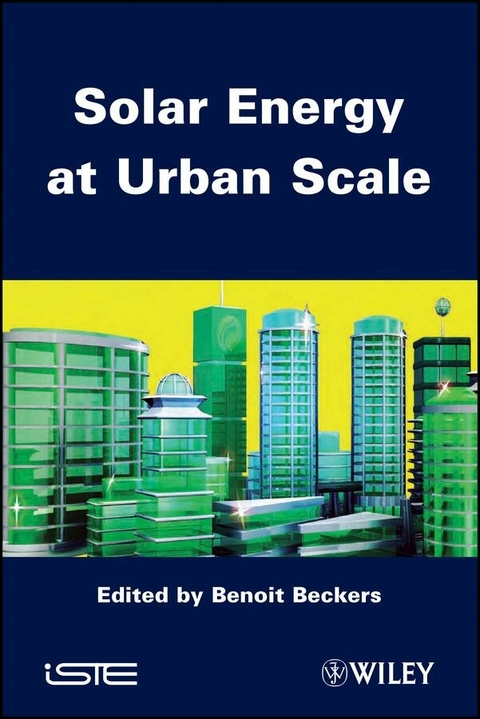
Increasing urbanization throughout the world, the depletion of fossil fuels and concerns about global warming have transformed the city into a physical problem of prime importance. This book proposes a multi-disciplinary and systematic approach concerning specialities as different as meteorology, geography, architecture and urban engineering systems, all surrounding the essential problem of solar radiation.
It collects the points of view of 18 specialists from around the world on the interaction between solar energy and constructions, combining territorial, urban and architectural scales to better regulate energetic efficiency and light comfort for the sustainable city.
The main subjects covered are: measures and models of solar irradiance (satellite observations, territorial and urban ground measurements, sky models, satellite data and urban mock-up), radiative contribution to the urban climate (local heat balance, radiative-aerodynamics coupling, evapotranspiration, Urban Heat Island), light and heat modeling (climate-based daylight modeling, geometrical models of the city, solar radiation modeling for urban environments, thermal simulation methods and algorithms) and urban planning, with special considerations for solar potential, solar impact and daylight rights in the temperate, northern and tropical climates, and the requirement of urban solar regulation.
Contents
1. The Odyssey of Remote Sensing from Space: Half a Century of Satellites for Earth Observations, Théo Pirard.
2. Territorial and Urban Measurements, Marius Paulescu and Viorel Badescu.
3. Sky Luminance Models, Matej Kobav and Grega Bizjak.
4. Satellite Images Applied to Surface Solar Radiation Estimation, Bella Espinar and Philippe Blanc.
5. Worldwide Aspects of Solar Radiation Impact, Benoit Beckers.
6. Local Energy Balance, Pierre Kastendeuch.
7. Evapotranspiration, Marjorie Musy.
8. Multiscale Daylight Modeling for Urban Environments, John Mardaljevic and George Janes.
9. Geometrical Models of the City, Daniel G. Aliaga.
10. Radiative Simulation Methods, Pierre Beckers and Benoit Beckers.
11. Radiation Modeling Using the Finite Element Method, Tom van Eekelen.
12. Dense Cities in the Tropical Zone, Edward Ng.
13. Dense Cities in Temperate Climates: Solar and Daylight Rights, Guedi Capeluto.
14. Solar Potential and Solar Impact, Frédéric Monette and Benoit Beckers.
Appendix 1. Table of Europe’s Platforms (Micro- and Minisatellites) for Earth Observations, Théo Pirard.
Appendix 2. Commercial Operators of Earth Observation (EO) Satellites (as of January 1, 2012), Théo Pirard.
Appendix 3. Earth’s Annual Global Mean Energy Budget, Benoit Beckers.
Increasing urbanization throughout the world, the depletion of fossil fuels and concerns about global warming have transformed the city into a physical problem of prime importance. This book proposes a multi-disciplinary and systematic approach concerning specialities as different as meteorology, geography, architecture and urban engineering systems, all surrounding the essential problem of solar radiation. It collects the points of view of 18 specialists from around the world on the interaction between solar energy and constructions, combining territorial, urban and architectural scales to better regulate energetic efficiency and light comfort for the sustainable city. The main subjects covered are: measures and models of solar irradiance (satellite observations, territorial and urban ground measurements, sky models, satellite data and urban mock-up), radiative contribution to the urban climate (local heat balance, radiative-aerodynamics coupling, evapotranspiration, Urban Heat Island), light and heat modeling (climate-based daylight modeling, geometrical models of the city, solar radiation modeling for urban environments, thermal simulation methods and algorithms) and urban planning, with special considerations for solar potential, solar impact and daylight rights in the temperate, northern and tropical climates, and the requirement of urban solar regulation.
Benoit Beckers is Associate professor, Compiègne University of Technology, France.
| Erscheint lt. Verlag | 4.3.2013 |
|---|---|
| Sprache | englisch |
| Themenwelt | Technik ► Bauwesen |
| Technik ► Elektrotechnik / Energietechnik | |
| Technik ► Umwelttechnik / Biotechnologie | |
| Schlagworte | Applications • Century • challenges • earth • earths • Energie • Energy • environmental • GIS • Global • Half • icts • Introduction • measurements • observations • Observers • odyssey • Orbit • Pirard • Radiation • remote • Revolution • Satellites • sensing • Solarenergie • Solarenergie u. Photovoltaik • Solar Energy & Photovoltaics • space • weather forecasts |
| ISBN-10 | 1-118-61392-9 / 1118613929 |
| ISBN-13 | 978-1-118-61392-4 / 9781118613924 |
| Informationen gemäß Produktsicherheitsverordnung (GPSR) | |
| Haben Sie eine Frage zum Produkt? |
 EPUB (Adobe DRM)
Größe: 10,4 MB
Kopierschutz: Adobe-DRM
Adobe-DRM ist ein Kopierschutz, der das eBook vor Mißbrauch schützen soll. Dabei wird das eBook bereits beim Download auf Ihre persönliche Adobe-ID autorisiert. Lesen können Sie das eBook dann nur auf den Geräten, welche ebenfalls auf Ihre Adobe-ID registriert sind.
Details zum Adobe-DRM
Dateiformat: EPUB (Electronic Publication)
EPUB ist ein offener Standard für eBooks und eignet sich besonders zur Darstellung von Belletristik und Sachbüchern. Der Fließtext wird dynamisch an die Display- und Schriftgröße angepasst. Auch für mobile Lesegeräte ist EPUB daher gut geeignet.
Systemvoraussetzungen:
PC/Mac: Mit einem PC oder Mac können Sie dieses eBook lesen. Sie benötigen eine
eReader: Dieses eBook kann mit (fast) allen eBook-Readern gelesen werden. Mit dem amazon-Kindle ist es aber nicht kompatibel.
Smartphone/Tablet: Egal ob Apple oder Android, dieses eBook können Sie lesen. Sie benötigen eine
Geräteliste und zusätzliche Hinweise
Buying eBooks from abroad
For tax law reasons we can sell eBooks just within Germany and Switzerland. Regrettably we cannot fulfill eBook-orders from other countries.
 PDF (Adobe DRM)
Kopierschutz: Adobe-DRM
Adobe-DRM ist ein Kopierschutz, der das eBook vor Mißbrauch schützen soll. Dabei wird das eBook bereits beim Download auf Ihre persönliche Adobe-ID autorisiert. Lesen können Sie das eBook dann nur auf den Geräten, welche ebenfalls auf Ihre Adobe-ID registriert sind.
Details zum Adobe-DRM
Dateiformat: PDF (Portable Document Format)
Mit einem festen Seitenlayout eignet sich die PDF besonders für Fachbücher mit Spalten, Tabellen und Abbildungen. Eine PDF kann auf fast allen Geräten angezeigt werden, ist aber für kleine Displays (Smartphone, eReader) nur eingeschränkt geeignet.
Systemvoraussetzungen:
PC/Mac: Mit einem PC oder Mac können Sie dieses eBook lesen. Sie benötigen eine
eReader: Dieses eBook kann mit (fast) allen eBook-Readern gelesen werden. Mit dem amazon-Kindle ist es aber nicht kompatibel.
Smartphone/Tablet: Egal ob Apple oder Android, dieses eBook können Sie lesen. Sie benötigen eine
Geräteliste und zusätzliche Hinweise
Buying eBooks from abroad
For tax law reasons we can sell eBooks just within Germany and Switzerland. Regrettably we cannot fulfill eBook-orders from other countries.
aus dem Bereich