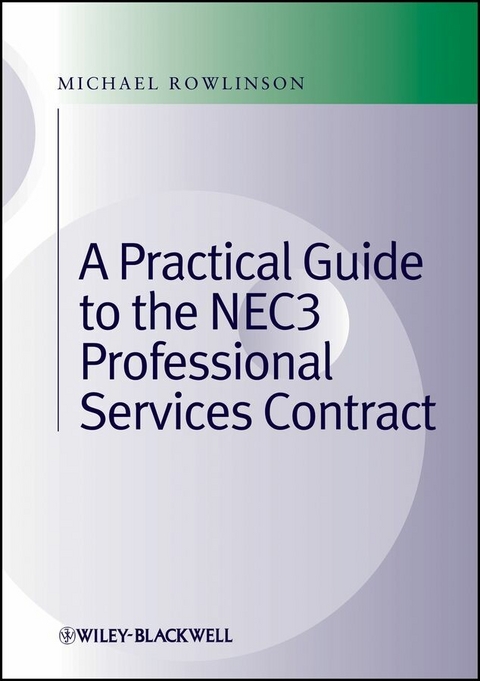
Practical Guide to the NEC3 Professional Services Contract (eBook)
John Wiley & Sons (Verlag)
978-1-118-40639-7 (ISBN)
This book is a practical guide to the application of the PSC. Starting with a brief discussion of the background and philosophy behind the PSC, it identifies the roles and responsibilities of each of the named functions within the contract, explains the approaches required to achieve a successful working relationship between all parties, and examines all the procedures in the PSC. The book explains the links between the various sections of the contract to assist the reader with cross referencing, and covers all the variations created by the Main and Secondary Options. As a very practical guide it will aid users in the transition from their use and understanding of the other standard contracts to the collaborative project management-based approach of the PSC.
Written for anyone working in the construction and related industries using the PSC to procure or provide consultancy services in relation to a construction project, it will be of interest to the complete construction supply chain, particularly architects, structural engineers, services (M&E) engineers, civil engineers, quantity surveyors and interior designers, together with Contractors and Sub-Contractors who have a design liability and employ consultants to assist them. It will also be of interest to consultants and lawyers advising any of these parties, either in the preparation of contract documentation or the resolution of problem situations which may arise.
Michael Rowlinson MSc, DipArb, MRICS, FCIOB, FCIArb, FCICES, is a Director of Alway Associates (London) Ltd. He is an experienced construction professional, having qualified initially as a Chartered Quantity Surveyor and later as a Chartered Builder. After over 20 years with private practice and contractors Michael joined Alway Associates in 1998, specialising in Construction Contracts and Law. As part of his work Michael has lectured extensively for the Construction Study Centre and direct for his own clients, predominantly on the NEC suite of Contracts. He has written a number of articles on this suite of contracts which have been published in the Civil Engineering Surveyor and the NEC User Group's Newsletter, as well as on the Alway Associates website. This is his second book about a contract from the NEC3 suite.
Currently in its third edition, the NEC suite has become one of the UK s leading families of standard forms of contract for major construction and civil engineering projects. Part of the NEC suite, the Professional Services Contract (PSC) was drafted with the same process-based approach and objectives, offering a standard contract for the appointment of consultants providing professional services in an engineering or construction project. Embodying best practice in terms of project management, the basic philosophy of the PSC differs from the principles and approach of other standard contracts used to appoint consultants. This book is a practical guide to the application of the PSC. Starting with a brief discussion of the background and philosophy behind the PSC, it identifies the roles and responsibilities of each of the named functions within the contract, explains the approaches required to achieve a successful working relationship between all parties, and examines all the procedures in the PSC. The book explains the links between the various sections of the contract to assist the reader with cross referencing, and covers all the variations created by the Main and Secondary Options. As a very practical guide it will aid users in the transition from their use and understanding of the other standard contracts to the collaborative project management-based approach of the PSC. Written for anyone working in the construction and related industries using the PSC to procure or provide consultancy services in relation to a construction project, it will be of interest to the complete construction supply chain, particularly architects, structural engineers, services (M&E) engineers, civil engineers, quantity surveyors and interior designers, together with Contractors and Sub-Contractors who have a design liability and employ consultants to assist them. It will also be of interest to consultants and lawyers advising any of these parties, either in the preparation of contract documentation or the resolution of problem situations which may arise.
Michael Rowlinson MSc, DipArb, MRICS, FCIOB, FCIArb, FCICES, is a Director of Alway Associates (London) Ltd. He is an experienced construction professional, having qualified initially as a Chartered Quantity Surveyor and later as a Chartered Builder. After over 20 years with private practice and contractors Michael joined Alway Associates in 1998, specialising in Construction Contracts and Law. As part of his work Michael has lectured extensively for the Construction Study Centre and direct for his own clients, predominantly on the NEC suite of Contracts. He has written a number of articles on this suite of contracts which have been published in the Civil Engineering Surveyor and the NEC User Group's Newsletter, as well as on the Alway Associates website. This is his second book about a contract from the NEC3 suite.
A Practical Guide to the NEC3 Professional Services Contract 5
Contents 7
1 Introduction 13
1.1 General 13
1.2 Mechanics not law 14
1.3 A simple formula for understanding a contract 14
1.4 Mandatory or discretionary 15
1.5 Conditions precedent 16
1.6 Note on use of upper case in key words and phrases 16
2 Background to the NEC Family of Contracts 18
2.1 The background: First editions 18
2.2 The second edition 19
2.3 The third edition 20
2.4 Endorsement of NEC3 by the Office of Government Commerce 20
2.5 General philosophy: Aims and objectives 21
2.6 Flexibility 21
2.7 Clarity and simplicity 22
2.8 Stimulus to good management 23
2.9 Other characteristics 24
3 The Options: An Overview 25
3.1 General arrangement of the PSC 25
3.2 Other documents referred to 27
3.3 Contract Data 28
3.4 The published documents 28
3.5 Main options: General outline 29
4 ‘Spirit of Mutual Trust and Cooperation’ 30
4.1 Introduction 30
4.2 Core clause 10.1 30
4.2.1 ‘Shall act’ 30
4.2.2 The first requirement 31
4.2.3 The second requirement 31
4.2.4 Discretionary actions 32
4.3 What does it mean? 32
4.4 Practical issues 33
4.4.1 Co-location 33
4.4.2 Attitudes and behaviour 34
4.4.3 Appreciating each other’s goals 35
4.4.4 Communicating 35
5 The Cast of Characters 37
5.1 Introduction 37
5.2 The Employer 37
5.3 The Employer’s Agent 39
5.4 The Consultant 41
5.5 The Adjudicator 41
5.6 Subconsultants 42
5.7 ‘Others’ 42
5.8 CDM Coordinator 43
5.9 Principal Contractor 44
5.10 Practical issues 44
5.10.1 Roles not job titles 44
5.10.2 People bring success 45
5.10.3 More than one Employer’s Agent 45
6 Communications, Early Warnings and other General Matters 46
6.1 Introduction 46
6.2 Communications: The clause 46
6.3 Communications: Practical issues 48
6.3.1 Good practice 48
6.3.2 Single-issue communications 49
6.3.3 Electronic communication systems 49
6.3.4 Different addresses for the receipt of different classes of communication 49
6.4 Early warnings: The clause 50
6.5 Early warnings: Practical issues 51
6.5.1 Purpose 51
6.5.2 Risk management in practice 52
6.5.3 Recognising the purpose of the Risk Register 52
6.5.4 Increases to the Consultant’s cost 53
6.5.5 Volume of early warnings 53
6.5.6 Contents of the Risk Register 53
6.5.7 Removing expired risks 54
6.5.8 Preparing the Risk Register for following Contracts 54
6.6 Other matters: The clauses 54
6.6.1 Navigation tools 54
6.6.2 Consultant remains responsible 55
6.6.3 Ambiguities, discrepancies and impossibilities 55
6.6.4 Prevention 55
6.6.5 Law and interpretation 56
6.7 Other matters: Practical issues 56
6.7.1 Completing the Contract Data 56
6.7.2 Prevention 57
7 The Parties’ Main Responsibilities 58
7.1 Introduction 58
7.2 The Employer’s obligations 58
7.3 The Consultant’s obligations 59
7.4 Other matters 60
7.4.1 People 60
7.4.2 Coordination 62
7.5 Practical issues 64
7.5.1 Importance of the Scope 64
7.5.2 Forecasting the Time Charge 64
7.5.3 The importance of key people 64
7.5.4 Access to people, places and things not listed in the Contract Data 65
8 Subconsulting 67
8.1 Introduction 67
8.2 Definition of a Subconsultant 67
8.3 The core clauses 68
8.4 Provisions in the main options 68
8.5 Practical issues 69
8.5.1 Shortcuts to the process 69
8.5.2 Accepting the supply chain 69
8.6 Using the PSC as a Subcontract 70
9 Quality 71
9.1 Introduction 71
9.2 Quality management system 71
9.3 What is a Defect? 72
9.4 The Defects procedure 73
9.5 Uncorrected Defects 74
9.6 Practical issues 74
9.6.1 Compatibility of quality management systems 74
9.6.2 Communications policy 75
9.6.3 Multiple defects dates 75
9.6.4 Correction of everyday defects 75
10 Rights to Material 77
10.1 Introduction 77
10.2 The core clauses 77
10.3 Secondary option X9 78
10.4 Practical issues 79
10.4.1 Managing rights to material across several consultancy agreements 79
10.4.2 Maintaining title after termination 79
11 Indemnity, Insurance and Liability 80
11.1 Introduction 80
11.2 The core clauses 80
11.2.1 Allocation of risk 80
11.2.2 Insurances to be provided 81
11.2.3 Limitation on liability 82
11.3 Secondary option X18: Limitation of liability 82
11.4 Practical issues 83
11.4.1 Insurance of Employer’s property 83
11.4.2 Self insuring by Employers 84
11.4.3 Project insurance 84
11.4.4 Employer’s option if Consultant does not insure 85
12 Time 86
12.1 Introduction 86
12.2 The programme: Contents 87
12.2.1 Fixed and variable dates 87
12.2.2 The Consultant’s activities 88
12.2.3 The activities of the Employer and Others 89
12.2.4 Supporting statements 90
12.2.5 Other information 91
12.2.6 Summary 91
12.3 The programme: Submitting, accepting and revising 91
12.4 The programme: Practical issues 94
12.4.1 Accept the inaccuracies 94
12.4.2 Proportionality 94
12.4.3 Developing the programme 96
12.4.4 Key Dates and Conditions 97
12.4.5 Float 98
12.4.6 Time risk allowances 99
12.4.7 A family of documents 99
12.4.8 Resourced programme 100
12.4.9 Using programming software 101
12.4.10 Showing access as being later than the access date 102
12.5 Starting and finishing 102
12.5.1 Starting work 102
12.5.2 Completion 103
12.5.3 Key Dates 104
12.5.4 Option G 105
12.6 Other matters 105
12.6.1 Stopping and starting work 105
12.6.2 Acceleration 106
12.7 Secondary options related to Time 107
12.7.1 General 107
12.7.2 Sectional Completion: Secondary option X5 107
12.7.3 Bonus for early Completion: Secondary option X6 108
12.7.4 Delay damages: Secondary option X7 108
12.8 Practical issues 109
12.8.1 Instructions to stop or not start any work 109
12.8.2 Bonuses for early Completion 110
12.8.3 Using the bonus for early Completion and delay damages secondary options together 111
13 Payment 112
13.1 Introduction 112
13.2 The payment process 112
13.2.1 The assessment process 112
13.2.2 Interest 114
13.3 Payments in multiple currencies 114
13.4 The amount due and the Price for Services Provided to Date 115
13.4.1 Main option A 117
13.4.2 Main options C and E 117
13.4.3 Main option G 119
13.5 Supporting documents and records 119
13.5.1 Activity Schedule 119
13.5.2 Task Schedule 121
13.5.3 Task Orders 121
13.5.4 Records 122
13.6 The Consultant’s share 123
13.7 The Consultant’s share: Practical issues 124
13.7.1 Principles and accuracy 124
13.7.2 ‘Win-win’ outcome 124
13.7.3 Guaranteed Maximum Price 125
13.7.4 Target exceeded before Completion 125
13.8 Special provisions for the UK 126
13.8.1 From 1 May 1998 126
13.8.2 From 1 October 2011 127
13.9 Related secondary options 128
13.9.1 X1 : Price adjustment for inflation 128
13.10 Practical issues 130
13.10.1 Interest 130
13.10.2 Taxes 131
14 Compensation Events: Theory and Events 132
14.1 Introduction 132
14.2 The theory 132
14.2.1 Underlying principles 132
14.2.2 What is a compensation event? 133
14.2.3 What other contractual entitlements apply? 133
14.3 The events 134
14.3.1 Event 1 135
14.3.2 Event 2 135
14.3.3 Event 3 135
14.3.4 Event 4 136
14.3.5 Event 5 136
14.3.6 Event 6 137
14.3.7 Event 7 137
14.3.8 Event 8 138
14.3.9 Event 9 138
14.3.10 Event 10 138
14.3.11 Event 11 139
14.3.12 Event 12 139
14.3.13 Event 13 (main option G) 140
14.3.14 Event 14 (main option G) 140
14.3.15 Event 15 (main option G) 140
14.3.16 Clause 60.2 (main option G) 141
14.3.17 Secondary option X2 141
14.3.18 Secondary option X12 141
14.3.19 Secondary option Y( UK )2 142
14.3.20 Additional compensation events 142
14.4 Practical issues 142
14.4.1 Events not in the list 142
15 Compensation Events: Procedures 144
15.1 Introduction 144
15.2 Notification by the Employer 145
15.2.1 Of actual compensation events 145
15.2.2 Of potential compensation events 147
15.3 Notification by the Consultant and the Employer’s reply 148
15.3.1 The notification 148
15.3.2 The reply 149
15.4 Other matters associated with notifying compensation events 151
15.4.1 Failure to give an early warning 151
15.4.2 Latest time for notifying an event 152
15.4.3 Giving assumptions 152
15.5 Quotations: Substance 153
15.5.1 What is a quotation? 153
15.5.2 Status of quotations: If instructed 153
15.5.3 Status of quotations: If not instructed 154
15.5.4 Cost of preparing quotations 154
15.6 Quotations: Submission and reply 154
15.6.1 The requirement for quotations 154
15.6.2 Procedure and timetable 155
15.6.3 Revised quotations 156
15.6.4 The timetable simplified 157
15.6.5 Extended time for quotations and replies 157
15.6.6 Failure to reply to quotations 158
15.7 Assessments by the Employer 159
15.7.1 The trigger events 159
15.7.2 Assessing the programme 159
15.7.3 Timing of the Employer’s assessment 160
15.7.4 If the Employer fails to do the assessment 160
15.8 Implementing compensation events 160
15.8.1 Procedure and timing 160
15.8.2 Effect of implementation 161
15.9 Practical issues 161
15.9.1 Employer’s instructions and other notifications 161
15.9.2 Events which do not constitute compensation events 162
15.9.3 Not identifying compensation events when instructing change 162
15.9.4 Simplifying the quotation procedure 163
15.9.5 The time periods are not long enough! 165
15.9.6 Compensation events and main option E 165
16 Compensation Events: Assessment 166
16.1 Introduction 166
16.2 Changes to the Prices 167
16.2.1 Basic principle 167
16.2.2 Cost risk allowances 168
16.2.3 Assumption that the Consultant reacts competently and promptly 169
16.2.4 Reduction in Prices 169
16.2.5 No staff rates 170
16.2.6 Deduction of insurable factors 171
16.3 Changes to the Completion Date and any Key Dates 171
16.3.1 The key principles 171
16.3.2 Time risk allowances 173
16.3.3 Assumption that the Consultant reacts competently and promptly 173
16.4 Employer’s assumptions 174
16.5 Other related matters 175
16.5.1 Failure to give early warning 175
16.5.2 Assessing the effects of ambiguities or inconsistencies 176
16.5.3 Change to the Condition for a Key Date 177
16.6 Practical issues 177
16.6.1 The Accepted Programme contains all the clues 177
16.6.2 The time effect of a number of small compensation events 178
17 Termination 180
17.1 Introduction 180
17.2 Reasons for termination 180
17.2.1 Employer and Consultant defaults 181
17.2.2 Employer-only defaults 181
17.2.3 Consultant-only default 182
17.2.4 For other reasons 182
17.2.5 For convenience 182
17.3 Secondary option X11: Termination by the Employer 183
17.4 Implementing termination 183
17.5 Procedures after termination 184
17.6 Payment on termination 185
17.6.1 Under the core clause 185
17.6.2 Main options 186
17.7 Practical issues 186
17.7.1 Maintaining title after termination 186
17.7.2 Avoiding duplication when assessing the amount due 187
18 Dispute Resolution 188
18.1 Introduction 188
18.2 Option W1 189
18.2.1 Appointment of the Adjudicator 189
18.2.2 Referral to the Adjudicator 189
18.2.3 Powers of the Adjudicator 191
18.2.4 Review by the tribunal 191
18.3 Option W2 192
18.3.1 Appointment of the Adjudicator 193
18.3.2 Referral to the Adjudicator 193
18.3.3 Powers of the Adjudicator 194
18.3.4 Review by the tribunal 196
18.4 Practical issues 197
18.4.1 A dispute resolution option is not selected 197
18.4.2 Continuing as if nothing is wrong 197
18.4.3 Identifying differences before they become disputes 198
18.4.4 Resolving differences before they become formal disputes 198
18.4.5 Evolving common law 199
19 Secondary Options 200
19.1 Introduction 200
19.2 X2: Changes in the law 200
19.3 X4: Parent company guarantee 201
19.4 X8: Collateral warranty agreements 201
19.5 X12: Partnering 202
19.5.1 Introduction 202
19.5.2 Entries in Contract Data Part One 202
19.5.3 Role of the Partnering Information 203
19.5.4 Identifying the Partners 203
19.5.5 Actions of the Partners 204
19.5.6 Actions of the Core Group 205
19.5.7 Incentives 206
19.6 X13: Performance bond 206
19.7 X20: Key Performance Indicators 207
19.8 Y(UK)3: The Contracts (Rights of Third Parties) Act 1999 208
19.9 Z: Additional conditions of contract 208
19.10 Practical issues 209
19.10.1 Selection of options 209
19.10.2 Electronic changes 209
20 Completing the Contract Data 211
20.1 Introduction 211
20.2 Purpose and form of the Contract Data 211
20.3 Part One: Data for the core clauses 212
20.3.1 Standard entries 212
20.3.2 Optional statements 215
20.4 Part One: Data for the main option clauses 216
20.4.1 Main option A 216
20.4.2 Main options C, E or G 216
20.4.3 Main option C 217
20.5 Part One: Data for the secondary option clauses 217
20.5.1 Option X1 217
20.5.2 Option X2 217
20.5.3 Option X3 218
20.5.4 Options X5 , X6 and X7 218
20.5.5 Option X8 218
20.5.6 Option X10 219
20.5.7 Option X12 219
20.5.8 Option X13 219
20.5.9 Option X18 219
20.5.10 Option X20 220
20.5.11 Option Y( UK )3 220
20.5.12 Option Z 220
20.6 Part Two: Data for the core clauses 221
20.7 Part Two: Data for the optional statements 221
20.8 Practical issues 223
20.8.1 Failing to fully complete the Contract Data 223
20.8.2 Using a previous project as the template 223
20.8.3 Rearranging the entries 224
20.8.4 Expenses to be paid to the Consultant 224
20.8.5 Controlling allowable expenses 225
21 The Supporting Documents: Need and Content 226
21.1 Introduction 226
21.2 Scope 226
21.2.1 Introduction 226
21.2.2 Importance and purpose 227
21.2.3 Location 227
21.2.4 General contents: Specifies and describes 228
21.2.5 General contents: Constraints 228
21.2.6 The work to be done by Completion: Clause 11.2(2) 229
21.2.7 Form of retained documents: Clause 13.6 229
21.2.8 Exchanging information with Others: Clause 23.1 229
21.2.9 Attendance at and number of meetings: Clause 23.2 230
21.2.10 Matters relating to Subconsultants: Clause 24 230
21.2.11 Health and safety requirements: Clause 25.4 230
21.2.12 Any additional information to be included in the programme: Clause 31.2 230
21.2.13 Quality management system: Clause 40.1 231
21.2.14 Quality policy statement and quality plan: Clause 40.2 231
21.2.15 Details to be included in invoices: Clause 50.2 231
21.2.16 Permitted purpose for the use of material provided by the Consultant: Clause 70.1 232
21.2.17 Use of material provided by the Consultant for other purposes: Clause 70.4 232
21.2.18 Parent company guarantee: Clause X4 .1 232
21.2.19 Transfer of rights: Clause X9 .1 233
21.2.20 Performance Bond: Clause X13 .1 233
21.3 Practical issues 233
21.3.1 ‘The Scope is in’ 233
21.3.2 Using ‘constraints’ 234
21.3.3 Reference to Work Stages 234
21.3.4 Developing services from concept to detail 235
Bibliography 236
Further Reading 237
Appendix 1 Tables of Clause Numbers, Case Law and Statutes 238
Appendix 2 Tables of Employer’s, Consultant’s and Adjudicator’s Actions 245
| Erscheint lt. Verlag | 18.5.2012 |
|---|---|
| Sprache | englisch |
| Themenwelt | Recht / Steuern ► EU / Internationales Recht |
| Recht / Steuern ► Öffentliches Recht | |
| Recht / Steuern ► Privatrecht / Bürgerliches Recht ► Baurecht (privat) | |
| Technik ► Bauwesen | |
| Schlagworte | Appointment • Baubetrieb • Bauingenieur- u. Bauwesen • Baurecht • become • Best Practice • Civil Engineering & Construction • construction law • Construction Management • Consultants • Contract • currently • Engineering • Families • forms • leading • Major • Part • Philosophy • processbased • Professional • PSC • Standard • standard contract • Suite • Terms • Third • uks |
| ISBN-10 | 1-118-40639-7 / 1118406397 |
| ISBN-13 | 978-1-118-40639-7 / 9781118406397 |
| Informationen gemäß Produktsicherheitsverordnung (GPSR) | |
| Haben Sie eine Frage zum Produkt? |
 PDF (Adobe DRM)
Kopierschutz: Adobe-DRM
Adobe-DRM ist ein Kopierschutz, der das eBook vor Mißbrauch schützen soll. Dabei wird das eBook bereits beim Download auf Ihre persönliche Adobe-ID autorisiert. Lesen können Sie das eBook dann nur auf den Geräten, welche ebenfalls auf Ihre Adobe-ID registriert sind.
Details zum Adobe-DRM
Dateiformat: PDF (Portable Document Format)
Mit einem festen Seitenlayout eignet sich die PDF besonders für Fachbücher mit Spalten, Tabellen und Abbildungen. Eine PDF kann auf fast allen Geräten angezeigt werden, ist aber für kleine Displays (Smartphone, eReader) nur eingeschränkt geeignet.
Systemvoraussetzungen:
PC/Mac: Mit einem PC oder Mac können Sie dieses eBook lesen. Sie benötigen eine
eReader: Dieses eBook kann mit (fast) allen eBook-Readern gelesen werden. Mit dem amazon-Kindle ist es aber nicht kompatibel.
Smartphone/Tablet: Egal ob Apple oder Android, dieses eBook können Sie lesen. Sie benötigen eine
Geräteliste und zusätzliche Hinweise
Buying eBooks from abroad
For tax law reasons we can sell eBooks just within Germany and Switzerland. Regrettably we cannot fulfill eBook-orders from other countries.
aus dem Bereich