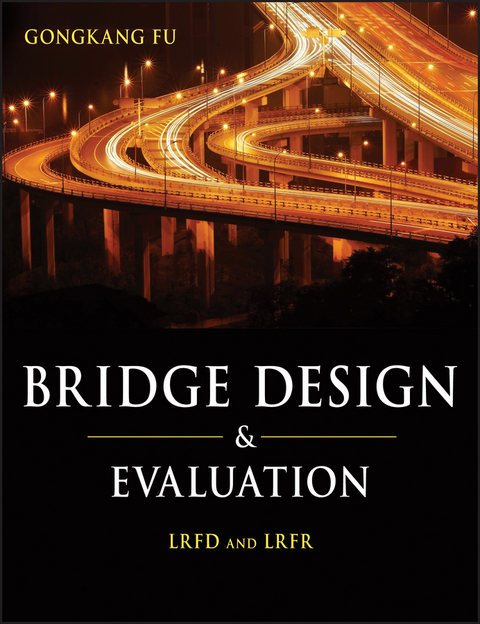
Bridge Design and Evaluation (eBook)
448 Seiten
John Wiley & Sons (Verlag)
978-1-118-32993-1 (ISBN)
design and evaluation
Load and Resistance Factor Design (LRFD) and Load and Resistance
Factor Rating (LRFR) are design and evaluation methods that have
replaced or offered alternatives to other traditional methods as
the new standards for designing and load-rating U.S. highway
bridges. Bridge Design and Evaluation covers complete bridge
systems (substructure and superstructure) in one succinct,
manageable package. It presents real-world bridge examples
demonstrating both their design and evaluation using LRFD and LRFR.
Designed for a 3- to 4-credit undergraduate or graduate-level
course, it presents the fundamentals of the topic without expanding
needlessly into advanced or specialized topics.
Important features include:
* Exclusive focus on LRFD and LRFR
* Hundreds of photographs and figures of real bridges to connect
the theoretical with the practical
* Design and evaluation examples from real bridges including
actual bridge plans and drawings and design methodologies
* Numerous exercise problems
* Specific design for a 3- to 4-credit course at the
undergraduate or graduate level
* The only bridge engineering textbook to cover the important
topics of bridge evaluation and rating
Bridge Design and Evaluation is the most up-to-date and
inclusive introduction available for students in civil engineering
specializing in structural and transportation engineering.
Gongkang Fu is Professor of Civil Engineering and Chairman of Department of Civil, Architectural, and Environmental Engineering at Illinois Institute of Technology, and Changjiang Scholar Chair Professor of the Chinese Education Ministry at Tongji University, China. He was head of structures research with the New York State Department of Transportation (DOT) for seven years, and has worked on design and research projects for the FHWA and the California, Georgia, New York, Michigan, and Ohio DOTs. He is an active member of the American Society of Civil Engineers.
Preface xi
1 Introduction 1
1.1 Bridge Engineering and Highway Bridge Network 1
1.2 Types of Highway Bridges 2
1.3 Bridge Construction and Its Relation to Design 7
1.4 AASHTO Specifications and Design and Evaluation Methods 9
1.5 Goals for Bridge Design and Evaluation 11
1.6 Preliminary Design versus Detailed Design 11
1.7 Organization of This Book 12
References 14
2 Requirements for Bridge Design and Evaluation 15
2.1 General Requirements 15
2.2 Limit States 16
2.3 Constructability 20
2.4 Safety 21
2.5 Serviceability 31
2.6 Inspectability 41
2.7 Economy 41
2.8 Aesthetics 42
2.9 Summary 44
References 45
Problems 45
3 Loads, Load Effects, and Load Combinations 47
3.1 Introduction 47
3.2 Permanent Loads 48
3.3 Transient Loads 63
3.4 Load Combinations 83
References 92
Problems 92
4 Superstructure Design 101
4.1 Introduction 101
4.2 Highway Bridge Superstructure Systems 103
4.3 Primary Components of Highway Bridge Superstructure 106
4.4 Deck Systems 110
4.5 Deck-Supporting Systems 121
4.6 Design of Reinforced Concrete Deck Slabs 135
4.7 Design of Steel I Beams 177
4.8 Design of Prestressed Concrete I Beams 247
References 300
Problems 300
5 Bearing Design 303
5.1 Introduction 303
5.2 Types of Bridge Bearing 304
5.3 Appropriate Selection of Bearings 313
5.4 Design of Elastomeric Bearings 314
References 333
Problems 333
6 Substructure Design 335
6.1 Introduction 335
6.2 Piers 340
6.3 Abutments 346
6.4 Foundations 349
6.5 Design of Piers 353
6.6 Design of Abutments 357
References 393
Problems 393
7 Highway Bridge Evaluation 395
7.1 Introduction 395
7.2 Inspection and Condition Rating 397
7.3 Load Rating 401
7.4 Fatigue Evaluation for Steel Components 416
References 419
Problems 419
Index 421
| Erscheint lt. Verlag | 25.1.2013 |
|---|---|
| Sprache | englisch |
| Themenwelt | Technik ► Bauwesen |
| Schlagworte | Bauingenieur- u. Bauwesen • Civil Engineering & Construction • Stahlhochbau u. Brückenbau • Stahlhochbau u. Brückenbau • Steel Construction & Bridge Engineering |
| ISBN-10 | 1-118-32993-7 / 1118329937 |
| ISBN-13 | 978-1-118-32993-1 / 9781118329931 |
| Informationen gemäß Produktsicherheitsverordnung (GPSR) | |
| Haben Sie eine Frage zum Produkt? |
 EPUB (Adobe DRM)
Kopierschutz: Adobe-DRM
Adobe-DRM ist ein Kopierschutz, der das eBook vor Mißbrauch schützen soll. Dabei wird das eBook bereits beim Download auf Ihre persönliche Adobe-ID autorisiert. Lesen können Sie das eBook dann nur auf den Geräten, welche ebenfalls auf Ihre Adobe-ID registriert sind.
Details zum Adobe-DRM
Dateiformat: EPUB (Electronic Publication)
EPUB ist ein offener Standard für eBooks und eignet sich besonders zur Darstellung von Belletristik und Sachbüchern. Der Fließtext wird dynamisch an die Display- und Schriftgröße angepasst. Auch für mobile Lesegeräte ist EPUB daher gut geeignet.
Systemvoraussetzungen:
PC/Mac: Mit einem PC oder Mac können Sie dieses eBook lesen. Sie benötigen eine
eReader: Dieses eBook kann mit (fast) allen eBook-Readern gelesen werden. Mit dem amazon-Kindle ist es aber nicht kompatibel.
Smartphone/Tablet: Egal ob Apple oder Android, dieses eBook können Sie lesen. Sie benötigen eine
Geräteliste und zusätzliche Hinweise
Buying eBooks from abroad
For tax law reasons we can sell eBooks just within Germany and Switzerland. Regrettably we cannot fulfill eBook-orders from other countries.
aus dem Bereich