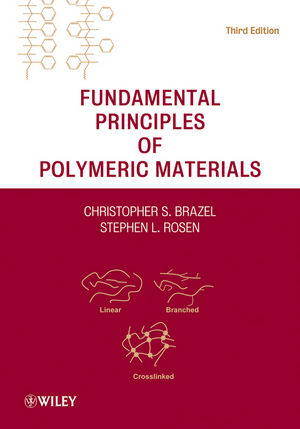
Fundamental Principles of Polymeric Materials (eBook)
John Wiley & Sons (Verlag)
9781118275290 (ISBN)
New edition brings classic text up to date with the latest science, techniques, and applications
With its balanced presentation of polymer chemistry, physics, and engineering applications, the Third Edition of this classic text continues to instill readers with a solid understanding of the core concepts underlying polymeric materials. Both students and instructors have praised the text for its clear explanations and logical organization. It begins with molecular-level considerations and then progressively builds the reader's knowledge with discussions of bulk properties, mechanical behavior, and processing methods.
Following a brief introduction, Fundamental Principles of Polymeric Materials is divided into four parts:
-
Part 1: Polymer Fundamentals
-
Part 2: Polymer Synthesis
-
Part 3: Polymer Properties
-
Part 4: Polymer Processing and Performance
Thoroughly Updated and Revised
Readers familiar with the previous edition of this text will find that the organization and style have been updated with new material to help them grasp key concepts and discover the latest science, techniques, and applications. For example, there are new introductory sections on organic functional groups focusing on the structures found in condensation polymerizations. The text also features new techniques for polymer analysis, processing, and microencapsulation as well as emerging techniques such as atom transfer radical polymerization.
At the end of each chapter are problems-including many that are new to this edition-to test the reader's grasp of core concepts as they advance through the text. There are also references leading to the primary literature for further investigation of individual topics.
A classic in its field, this text enables students in chemistry, chemical engineering, materials science, and mechanical engineering to fully grasp and apply the fundamentals of polymeric materials, preparing them for more advanced coursework.
Christopher S. Brazel, PHD, CHE, is Associate Professor of Chemical and Biological Engineering at The University of Alabama. His research interests include stimuli-responsive polymers, composite materials with magnetic nanoparticles, targeted block copolymer micelles, gels and networks for drug delivery, and microencapsulation. Previously, Dr. Brazel was a Fulbright Distinguished Scholar and Visiting Professor at the Institute for Science and Technology in Medicine, Keele University, UK.
Stephen L. Rosen, PHD, CHE, is a former Professor of Chemical Engineering at the University of Missouri-Rolla. Dr. Rosen authored the two previous editions of Fundamental Principles of Polymeric Materials.
New edition brings classic text up to date with the latest science, techniques, and applications With its balanced presentation of polymer chemistry, physics, and engineering applications, the Third Edition of this classic text continues to instill readers with a solid understanding of the core concepts underlying polymeric materials. Both students and instructors have praised the text for its clear explanations and logical organization. It begins with molecular-level considerations and then progressively builds the reader's knowledge with discussions of bulk properties, mechanical behavior, and processing methods. Following a brief introduction, Fundamental Principles of Polymeric Materials is divided into four parts: Part 1: Polymer Fundamentals Part 2: Polymer Synthesis Part 3: Polymer Properties Part 4: Polymer Processing and Performance Thoroughly Updated and Revised Readers familiar with the previous edition of this text will find that the organization and style have been updated with new material to help them grasp key concepts and discover the latest science, techniques, and applications. For example, there are new introductory sections on organic functional groups focusing on the structures found in condensation polymerizations. The text also features new techniques for polymer analysis, processing, and microencapsulation as well as emerging techniques such as atom transfer radical polymerization. At the end of each chapter are problems including many that are new to this edition to test the reader's grasp of core concepts as they advance through the text. There are also references leading to the primary literature for further investigation of individual topics. A classic in its field, this text enables students in chemistry, chemical engineering, materials science, and mechanical engineering to fully grasp and apply the fundamentals of polymeric materials, preparing them for more advanced coursework.
Christopher S. Brazel, PHD, CHE, is Associate Professor of Chemical and Biological Engineering at The University of Alabama. His research interests include stimuli-responsive polymers, composite materials with magnetic nanoparticles, targeted block copolymer micelles, gels and networks for drug delivery, and microencapsulation. Previously, Dr. Brazel was a Fulbright Distinguished Scholar and Visiting Professor at the Institute for Science and Technology in Medicine, Keele University, UK. Stephen L. Rosen, PHD, CHE, is a former Professor of Chemical Engineering at the University of Missouri-Rolla. Dr. Rosen authored the two previous editions of Fundamental Principles of Polymeric Materials.
Preface to the 3rd Edition
Preface to the 2nd Edition
Acknowledgments
1.Introduction
Part I. Polymer Fundamentals
2. Types of Polymers
3. Molecular Structure of Polymers
4. Polymer Morphology
5. Characterization of Molecular Weight
6. Thermal Transitions in Polymers
7. Polymer Solubility and Solutions
Part 2. Polymer Synthesis
8. Step-Growth (Condensation) Polymerization
9. Free Radical Addition (Chain-Growth) Polymerization
10. Advanced Polymerization Methods
11. Copolymerization
12. Polymerization Practice
Part 3. Polymer Properties
13. Rubber Elasticity
14. Introduction to Viscous Flow and the Pheolgical Behavior of Polymers
15. Linear Viscoelasticity
16. Polymer Mechanical Properties
Part 4. Polymer Processing and Performance
17. Processing
18. Polymer Applications: Plastics and Plastic Additives
19. Rubbers and Thermoplastic Elastomers
20. Polymer Applications: Synthetic Fibers
21. Polymer Applications: Surface Finishes and Coatings
22. Polymer Applications: Adhesives
Index
"Thus, this is a felicitous compilation on polymer chemistry, physics and engineering, which I can recommend to any of my undergraduate students." (Materials Views, 31 January 2014)
"With its balanced presentation of polymer chemistry, physics, and engineering applications, the updated and revised third edition of Fundamental principles of polymeric materialsprovides a solid understanding of the main concepts underlying polymeric materials." (RFP Rubber Fibres Plastics International, 1 January 2014)
"This is certainly an excellent book from which to learn about various aspects of polymer chemistry." (IEEE Electrical Insulation Magazine, 1 January 2014)
"Recommended. Upper-division undergraduates and lower-level graduate students." (Choice, 1 December 2012)
| Erscheint lt. Verlag | 8.5.2012 |
|---|---|
| Sprache | englisch |
| Themenwelt | Naturwissenschaften ► Chemie ► Organische Chemie |
| Naturwissenschaften ► Chemie ► Technische Chemie | |
| Technik ► Maschinenbau | |
| Technik ► Umwelttechnik / Biotechnologie | |
| Schlagworte | chemical engineering • Chemische Verfahrenstechnik • Materialeigenschaften • Materials Science • Materialwissenschaften • Polymere • polymerization, intro to polymers, basics of polymers, intro text polymers, polymers intro text, intro course polymers text, chemical engineering, polymer science • Polymer Science & Technology • Polymerwissenschaft u. -technologie • properties of materials |
| ISBN-13 | 9781118275290 / 9781118275290 |
| Informationen gemäß Produktsicherheitsverordnung (GPSR) | |
| Haben Sie eine Frage zum Produkt? |
 PDF (Adobe DRM)
Kopierschutz: Adobe-DRM
Adobe-DRM ist ein Kopierschutz, der das eBook vor Mißbrauch schützen soll. Dabei wird das eBook bereits beim Download auf Ihre persönliche Adobe-ID autorisiert. Lesen können Sie das eBook dann nur auf den Geräten, welche ebenfalls auf Ihre Adobe-ID registriert sind.
Details zum Adobe-DRM
Dateiformat: PDF (Portable Document Format)
Mit einem festen Seitenlayout eignet sich die PDF besonders für Fachbücher mit Spalten, Tabellen und Abbildungen. Eine PDF kann auf fast allen Geräten angezeigt werden, ist aber für kleine Displays (Smartphone, eReader) nur eingeschränkt geeignet.
Systemvoraussetzungen:
PC/Mac: Mit einem PC oder Mac können Sie dieses eBook lesen. Sie benötigen eine
eReader: Dieses eBook kann mit (fast) allen eBook-Readern gelesen werden. Mit dem amazon-Kindle ist es aber nicht kompatibel.
Smartphone/Tablet: Egal ob Apple oder Android, dieses eBook können Sie lesen. Sie benötigen eine
Geräteliste und zusätzliche Hinweise
Buying eBooks from abroad
For tax law reasons we can sell eBooks just within Germany and Switzerland. Regrettably we cannot fulfill eBook-orders from other countries.
aus dem Bereich