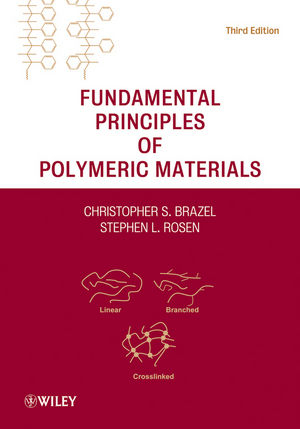
Fundamental Principles of Polymeric Materials (eBook)
John Wiley & Sons (Verlag)
9781118275313 (ISBN)
New edition brings classic text up to date with the latest science, techniques, and applications
With its balanced presentation of polymer chemistry, physics, and engineering applications, the Third Edition of this classic text continues to instill readers with a solid understanding of the core concepts underlying polymeric materials. Both students and instructors have praised the text for its clear explanations and logical organization. It begins with molecular-level considerations and then progressively builds the reader's knowledge with discussions of bulk properties, mechanical behavior, and processing methods.
Following a brief introduction, Fundamental Principles of Polymeric Materials is divided into four parts:
-
Part 1: Polymer Fundamentals
-
Part 2: Polymer Synthesis
-
Part 3: Polymer Properties
-
Part 4: Polymer Processing and Performance
Thoroughly Updated and Revised
Readers familiar with the previous edition of this text will find that the organization and style have been updated with new material to help them grasp key concepts and discover the latest science, techniques, and applications. For example, there are new introductory sections on organic functional groups focusing on the structures found in condensation polymerizations. The text also features new techniques for polymer analysis, processing, and microencapsulation as well as emerging techniques such as atom transfer radical polymerization.
At the end of each chapter are problems-including many that are new to this edition-to test the reader's grasp of core concepts as they advance through the text. There are also references leading to the primary literature for further investigation of individual topics.
A classic in its field, this text enables students in chemistry, chemical engineering, materials science, and mechanical engineering to fully grasp and apply the fundamentals of polymeric materials, preparing them for more advanced coursework.
Christopher S. Brazel, PHD, CHE, is Associate Professor of Chemical and Biological Engineering at The University of Alabama. His research interests include stimuli-responsive polymers, composite materials with magnetic nanoparticles, targeted block copolymer micelles, gels and networks for drug delivery, and microencapsulation. Previously, Dr. Brazel was a Fulbright Distinguished Scholar and Visiting Professor at the Institute for Science and Technology in Medicine, Keele University, UK.
Stephen L. Rosen, PHD, CHE, is a former Professor of Chemical Engineering at the University of Missouri-Rolla. Dr. Rosen authored the two previous editions of Fundamental Principles of Polymeric Materials.
New edition brings classic text up to date with the latest science, techniques, and applications With its balanced presentation of polymer chemistry, physics, and engineering applications, the Third Edition of this classic text continues to instill readers with a solid understanding of the core concepts underlying polymeric materials. Both students and instructors have praised the text for its clear explanations and logical organization. It begins with molecular-level considerations and then progressively builds the reader's knowledge with discussions of bulk properties, mechanical behavior, and processing methods. Following a brief introduction, Fundamental Principles of Polymeric Materials is divided into four parts: Part 1: Polymer Fundamentals Part 2: Polymer Synthesis Part 3: Polymer Properties Part 4: Polymer Processing and Performance Thoroughly Updated and Revised Readers familiar with the previous edition of this text will find that the organization and style have been updated with new material to help them grasp key concepts and discover the latest science, techniques, and applications. For example, there are new introductory sections on organic functional groups focusing on the structures found in condensation polymerizations. The text also features new techniques for polymer analysis, processing, and microencapsulation as well as emerging techniques such as atom transfer radical polymerization. At the end of each chapter are problems including many that are new to this edition to test the reader's grasp of core concepts as they advance through the text. There are also references leading to the primary literature for further investigation of individual topics. A classic in its field, this text enables students in chemistry, chemical engineering, materials science, and mechanical engineering to fully grasp and apply the fundamentals of polymeric materials, preparing them for more advanced coursework.
Christopher S. Brazel, PHD, CHE, is Associate Professor of Chemical and Biological Engineering at The University of Alabama. His research interests include stimuli-responsive polymers, composite materials with magnetic nanoparticles, targeted block copolymer micelles, gels and networks for drug delivery, and microencapsulation. Previously, Dr. Brazel was a Fulbright Distinguished Scholar and Visiting Professor at the Institute for Science and Technology in Medicine, Keele University, UK. Stephen L. Rosen, PHD, CHE, is a former Professor of Chemical Engineering at the University of Missouri-Rolla. Dr. Rosen authored the two previous editions of Fundamental Principles of Polymeric Materials.
"Thus, this is a felicitous compilation on polymer chemistry, physics and engineering, which I can recommend to any of my undergraduate students." (Materials Views, 31 January 2014)
"With its balanced presentation of polymer chemistry, physics, and engineering applications, the updated and revised third edition of Fundamental principles of polymeric materialsprovides a solid understanding of the main concepts underlying polymeric materials." (RFP Rubber Fibres Plastics International, 1 January 2014)
"This is certainly an excellent book from which to learn about various aspects of polymer chemistry." (IEEE Electrical Insulation Magazine, 1 January 2014)
"Recommended. Upper-division undergraduates and lower-level graduate students." (Choice, 1 December 2012)
Chapter 1
Introduction
Although relatively new to the scene of materials science, polymers have become ubiquitous over the past century. In fact, since the Second World War, polymeric materials represent the fastest growing segment of the U.S.' chemical industry. It has been estimated that more than a third of the chemical research dollar is spent on polymers, with a correspondingly large proportion of technical personnel working in the area. From the beginning, the study of polymers was an interdisciplinary science, with chemists, chemical engineers, mechanical engineers, and materials scientists working to understand the chemical structure and synthesis of polymers, develop methods to scale up and process polymers, and evaluate the wide range of mechanical properties existing within the realm of polymeric materials. The molecular structure of polymers is far more complex than the molecules you may have studied in a general chemistry course: just compare the molecular weights, H2O is 18, NaCl is about 58, but polymers have molecular weights from 10,000 to tens of millions (or possibly much higher for cross-linked polymers). Many of the structures you might have seen in a general cell biology course are made of polymers––proteins, polysaccharides, and DNA are all notable biological polymers. In a material science course, you may have studied crystal structures in metals to understand the mechanical behavior of different alloys (polymers can form crystals, too, but imagine the difficulty of trying to line up a huge polymer molecule into a crystal structure). Polymers are a unique class of materials having wide ranging applications.
A modern automobile contains over 300 lb (150 kg) of plastics, and this does not include paints, the rubber in tires, or the fibers in tires and upholstery. Newer aircraft incorporate increasing amounts of polymers and polymer-based composites. With the need to save fuel and therefore weight, polymers will continue to replace traditional materials in the automotive and aircraft industries. Similarly, the applications of polymers in the building construction industry (piping, resilient flooring, siding, thermal and electrical insulation, paints, decorative laminates) are already impressive and will become even more so in the future. A trip through your local supercenter will quickly convince anyone of the importance of polymers in the packaging (bottles, films, trays), clothing (even cotton is a polymer), and electronics industries. Many other examples from pharmaceutical coatings to playground equipment could be cited, but to make a long story short, the use of polymers now outstrips that of metals not just on a volume basis but also on a mass basis.
People have objected to synthetic polymers because they are not “natural.” Well, botulism is natural, but it is not particularly desirable. Seriously, if all the polyester and nylon fibers in use today were to be replaced by cotton and wool, their closest natural counterparts, calculations show that there would not be enough arable land left to feed the populace, and we would be overrun by sheep. The fact is that there simply are no practical natural substitutes for many of the synthetic polymers used in modern society.
Since most modern polymers have their origins in petroleum, it has been argued that this increased reliance on polymers constitutes an unnecessary drain on energy resources. However, the raw materials for polymers account for less than 2% of total petroleum and natural gas consumption, so even the total elimination of synthetic polymers would not contribute significantly to the conservation of hydrocarbon resources. Furthermore, when total energy costs (raw materials plus energy to manufacture and ship) are compared, the polymeric item often comes out well ahead of its traditional counterpart, for example, glass versus plastic beverage bottles. In addition, the manufacturing processes used to produce polymers often generate considerably less environmental pollution than the processes used to produce the traditional counterparts, for example, polyethylene film versus brown kraft paper for packaging.
Ironically, one of the most valuable properties of polymers, their chemical inertness, causes problems because polymers do not normally degrade in the environment. As a result, they increasingly contribute to litter and the consumption of scarce landfill space. One of the challenges in using polymers in materials is developing suitable methods for recycle or effective methods to improve the degradation of disposable items.
Environmentally degradable polymers are being developed, although this is basically a wasteful approach and we are not yet sure of the impact of the degradation products. Burning polymer waste for its fuel value makes more sense, because the polymers retain essentially the same heating value as the raw hydrocarbons from which they were made. Still, the polymers must be collected and this approach wastes the value added in manufacturing the polymers.
This ultimate solution is recycling. If waste polymers are to be recycled, they must first be collected. Unfortunately, there are literally dozens (maybe hundreds) of different polymers in the waste mix, and mixed polymers have mechanical properties similar to Cheddar cheese. Thus, for anything but the least- demanding applications (e.g., parking bumpers, flower pots), the waste mix must be separated prior to recycling. To this end, several automobile manufacturers have standardized plastics used in cars that can be easily removed, remolded, and reused in newer models. Another identifier helpful in recycling plastics is obvious if you have ever looked at the bottom of a plastic soda bottle; there are molded-in numbers on most of the large volume commodity plastics, allowing hand sorting of different materials.
Processes have been developed to separate the mixed plastics in the waste. The simplest of these is a sink–float scheme that takes advantage of density differences among various plastics. Unfortunately, many plastic items are foamed, plated, or filled (mixed with nonpolymer components), which complicates density-based separations. Other separation processes are based on solubility differences between various polymers. An intermediate approach chemically degrades the waste polymer to the starting materials from which new polymer can be made. Other efforts related to polymeric waste have focused on reducing the seemingly infinite lifetime of many plastics in the environment by developing biodegradable commodity polymers.
There are five major areas of application for polymers: (1) plastics, (2) rubbers or elastomers, (3) fibers, (4) surface finishes and protective coatings, and (5) adhesives. Despite the fact that all five applications are based on polymers, and in many cases the same polymer is used in two or more, the industries pretty much grew up separately. It was only after Dr. Harmann Staudinger [1,2] proposed the “macromolecular hypothesis” in the 1920s explaining the common molecular makeup of these materials (for which he won the 1953 Nobel Prize in chemistry in belated recognition of the importance of his work) that polymer science began to evolve from the independent technologies. Thus, a sound fundamental basis was established for continued technological advances. The history of polymer science is treated in detail elsewhere [3,4].
Economic considerations alone would be sufficient to justify the impressive scientific and technological efforts expended on polymers in the past several decades. In addition, however, this class of materials possesses many interesting and useful properties completely different from those of the more traditional engineering materials and that cannot be explained or handled in design situations by the traditional approaches. A description of three simple experiments should make this obvious.
Although such behavior is unusual in terms of the more familiar materials, it is a perfectly logical consequence of the molecular structure of polymers. This molecular structure is the key to an understanding of the science and technology of polymers and will underlie the chapters to follow.
Figure 1.1 illustrates the followings questions to be considered:
| Erscheint lt. Verlag | 8.5.2012 |
|---|---|
| Sprache | englisch |
| Themenwelt | Naturwissenschaften ► Chemie ► Organische Chemie |
| Technik ► Maschinenbau | |
| Schlagworte | chemical engineering • Chemische Verfahrenstechnik • Materialeigenschaften • Materials Science • Materialwissenschaften • Polymere • polymerization, intro to polymers, basics of polymers, intro text polymers, polymers intro text, intro course polymers text, chemical engineering, polymer science • Polymer Science & Technology • Polymerwissenschaft u. -technologie • properties of materials |
| ISBN-13 | 9781118275313 / 9781118275313 |
| Informationen gemäß Produktsicherheitsverordnung (GPSR) | |
| Haben Sie eine Frage zum Produkt? |
 EPUB (Adobe DRM)
Kopierschutz: Adobe-DRM
Adobe-DRM ist ein Kopierschutz, der das eBook vor Mißbrauch schützen soll. Dabei wird das eBook bereits beim Download auf Ihre persönliche Adobe-ID autorisiert. Lesen können Sie das eBook dann nur auf den Geräten, welche ebenfalls auf Ihre Adobe-ID registriert sind.
Details zum Adobe-DRM
Dateiformat: EPUB (Electronic Publication)
EPUB ist ein offener Standard für eBooks und eignet sich besonders zur Darstellung von Belletristik und Sachbüchern. Der Fließtext wird dynamisch an die Display- und Schriftgröße angepasst. Auch für mobile Lesegeräte ist EPUB daher gut geeignet.
Systemvoraussetzungen:
PC/Mac: Mit einem PC oder Mac können Sie dieses eBook lesen. Sie benötigen eine
eReader: Dieses eBook kann mit (fast) allen eBook-Readern gelesen werden. Mit dem amazon-Kindle ist es aber nicht kompatibel.
Smartphone/Tablet: Egal ob Apple oder Android, dieses eBook können Sie lesen. Sie benötigen eine
Geräteliste und zusätzliche Hinweise
Buying eBooks from abroad
For tax law reasons we can sell eBooks just within Germany and Switzerland. Regrettably we cannot fulfill eBook-orders from other countries.
aus dem Bereich