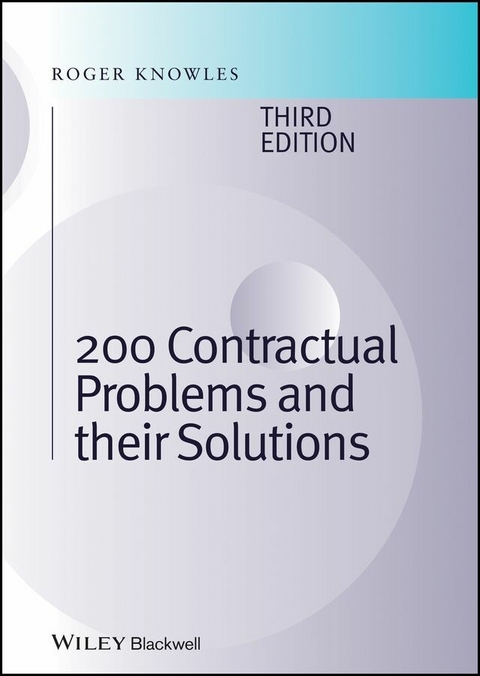
200 Contractual Problems and their Solutions (eBook)
John Wiley & Sons (Verlag)
978-1-118-25703-6 (ISBN)
It covers problems together with their solutions in respect of:
- Procurement matters
- Tenders and bidding
- Design issues
- Letters of intent
- Contractor's programme
- Contractor's float
- Delays
- Concurrent Delays
- Extensions of time
- Liquidated/delay damages
- Unliquidated damages
- Variations
- Loss and expense/additional cost claims
- Acceleration
- Global claims
- Payment
- Damage to the works
- Exclusion clauses
- Retention of title
- Practical completion
- Defect correction
- Adjudication
This book deals with a broad range of construction contracts including JCT Standard Form and Design and Build, New Engineering Contract NEC3, ICE and GC/Works/1.
This book was first published under the title of One Hundred Contractual Problems and Their Solutions, with a second edition entitled One Hundred and Fifty Contractual Problems and their Solutions. This third edition adds 50 new problems and replaces 15 of those in the last edition. Of the remainder half have been the subject of revision.
'Deserves a place on every site and in every office as the standard handbook on contractual problems'
-Construction Law Digest
Roger Knowles is a chartered surveyor, chartered arbitrator, barrister and CEDR accredited mediator. He left school as 16 years of age and commenced work as a trainee quantity surveyor, following which he secured his qualifications employing distance learning courses. His early career was that of a quantity surveyor, when he gained a great deal of experience of working on construction sites. He founded James R Knowles in 1973, a company of dispute resolution consultants, as a sole practitioner.
Roger built up James R Knowles until it was a world renowned brand and in 1998 became a quoted company on the AIM market. He sold his interests in James R Knowles in 2006, since which time he has acted as an independent disputes resolution consultant. His career has involved representing clients in many parts of the world including East Asia, the Middle East and throughout the United Kingdom. His work includes the preparation and resolution of construction claims, representing parties in arbitration and adjudication and acting as arbitrator, adjudicator and mediator.
Roger has been involved in training for many years. His specialist subjects include construction law, contract administration, arbitration, adjudication and ADR and he has lectured at well over 1,300 seminars at locations all over the world.
Since the mid 1970s, Roger has been a regular contributor to technical journals, with more than 400 published articles to his name. His career has also included representing trade associations and he is a former member of the Joints Contract Tribunal which publishes JCT contracts.
Roger was the founder of the Quantity Surveyors International and joint author of the Public Sector Partnering Contract.
200 Contractual Problems and their Solutions This book examines 200 contractual problems which regularly arise on building and engineering projects and provides a detailed explanation of their solutions, citing standard contract conditions and key parts of legal judgements as authority. A succinct summary is provided at the end of each detailed solution. It covers problems together with their solutions in respect of: Procurement matters Tenders and bidding Design issues Letters of intent Contractor s programme Contractor s float Delays Concurrent Delays Extensions of time Liquidated/delay damages Unliquidated damages Variations Loss and expense/additional cost claims Acceleration Global claims Payment Damage to the works Exclusion clauses Retention of title Practical completion Defect correction Adjudication This book deals with a broad range of construction contracts including JCT Standard Form and Design and Build, New Engineering Contract NEC3, ICE and GC/Works/1. This book was first published under the title of One Hundred Contractual Problems and Their Solutions, with a second edition entitled One Hundred and Fifty Contractual Problems and their Solutions. This third edition adds 50 new problems and replaces 15 of those in the last edition. Of the remainder half have been the subject of revision. Deserves a place on every site and in every office as the standard handbook on contractual problems Construction Law Digest
About the Author Roger Knowles is a chartered surveyor, chartered arbitrator, barrister and CEDR-accredited mediator. He left school at 16 years of age and commenced work as a trainee quantity surveyor, following which he secured his qualifications through distance learning courses. His early career was that of a quantity surveyor, when he gained a great deal of experience of working on construction sites. He founded James R Knowles in 1973, a company of dispute resolution consultants, as a sole practitioner. Roger built up James R Knowles until it was a world renowned brand and in 1998 became a quoted company on the AIM market. He sold his interests in James R Knowles in 2006, since which time he has acted as an independent disputes resolution consultant. His career has involved representing clients in many parts of the world, including East Asia, the Middle East and throughout the United Kingdom. His work includes the preparation and resolution of construction claims, representing parties in arbitration and adjudication and acting as arbitrator, adjudicator and mediator. Roger has been involved in training for many years. His specialist subjects include construction law, contract administration, arbitration, adjudication and ADR and he has lectured at over 1,300 seminars at locations all over the world. Since the mid-1970s, Roger has been a regular contributor to technical journals, with more than 400 published articles to his name. His career has also included representing trade associations and he is a former member of the Joints Contract Tribunal which publishes JCT contracts. Roger was the founder of Quantity Surveyors International and joint author of the Public Sector Partnering Contract.
200 Contractual Problems and their Solutions 3
Contents 5
Foreword 23
Preface 25
Chapter 1: Procurement 27
1.1. What are ‘entire contracts’ and how relevant are they in the construction industry? 27
1.2. Do projects where the parties enter into partnership arrangements require a formal contract to be agreed? 29
1.3. What is the effect of an agreement to undertake work which is expressed as being ‘Subject to Contract’? 31
1.4. What is Two-Stage Tendering and how does it operate? 33
1.5. Where tender enquiry documents indicate that an established... 35
1.6. What liability does a tendering contractor have who in its bid names key personnel... 37
1.7. Can a contract which is freely entered into by the parties not be enforced on the... 39
1.8. Can an architect or engineer be held to have acted negligently for advising a client to... 41
1.9. Where an unsuccessful tenderer is prevented from adjusting its tender after it has been... 44
1.10. What is the difference between Management Contracting and Construction Management? 46
1.11. A public sector project is advertised and tenders invited. Within the advertisement, it is... 48
Chapter 2: Tenders and Bidding 53
2.1. What is meant by the Battle of the Forms? 53
2.2. If a tender which contains an error is accepted in full knowledge of the error, has the tenderer any redress? 55
2.3. Where a contractor or subcontractor submits a tender with its own conditions of contract... 56
2.4. The submission of an unambiguous quotation which receives an unconditional acceptance can... 58
2.5. Where an employer includes with the tender enquiry documents a site survey which proves... 59
2.6. If, after tenders have been received, the employer decides not to proceed with the work... 65
2.7. What is a tender contract and will it assist a contractor/subcontractor who submits... 67
2.8. If an architect/engineer, acting as employer’s agent in a Design and Construct contract... 69
2.9. Does an employer have any liability for not sending a subsoil survey which is in his possession... 70
2.10. If a subcontractor submits a lump sum estimate to a contractor to carry out the subcontract work... 72
2.11. Where a tender enquiry requires tenders to remain open for acceptance for a specific period... 73
Chapter 3: Design 75
3.1. What is the difference between a f?itness for purpose responsibility and an obligation to exercise... 75
3.2. Where a contractor/subcontractor’s drawings are ‘approved’, ‘checked’, ‘inspected’, etc. by... 79
3.3. Who is responsible for co-ordinating design? Can a main contractor be legitimately given this... 82
3.4. Can a contractor be held responsible for a design error where the employer appoints an architect... 83
3.5 Can a main contractor be responsible if a nominated/named subcontractor’s design is defective? 84
3.6. Must a contractor notify an architect/engineer of defects in his design? 86
3.7. Where an architect/engineer includes a new product in his design following advice from a... 88
3.8. Where an architect/engineer is required by the conditions of the contract to approve, or accepts... 89
3.9. Where is the line to be drawn between an architect/engineer’s duty to design the works or a... 90
3.10. Where an item of work has been properly provided for in the Employer’s Requirements but is... 92
3.11. Is the contractor entitled to payment for design in full when the design work has been completed... 94
3.12. On a design and construct project, where the architect is novated from the employer to the contractor... 95
Chapter 4: Letters of Intent 97
4.1. Mr Justice Clarke, in the case of RTS Flexible Systems Ltd v. Molkerei Alios Muller (2010)... 97
4.2. What risk is a contractor taking if it receives a letter of intent which places a cap on expenditure... 99
4.3. When work is undertaken in accordance with a letter of intent without a contract being entered... 101
4.4. Under what circumstances, if any, could a letter of intent be regarded as a concluded contract? 103
4.5. What are the advantages and disadvantages to an employer and contractor in work being... 105
4.6. Could an architect, engineer or project manager be negligent for recommending to an employer... 106
Chapter 5: Programme 109
5.1. Where a contractor submits a programme which is approved or accepted by the architect/engineer... 109
5.2. Is a subcontractor obliged to follow a main contractor’s programme? 110
5.3. Who owns f?loat time in the contractor’s programme, the architect/engineer or the contractor? 112
5.4. What is the effect of making the programme a contract document? 114
Chapter 6: Delays and Delay Analysis 119
6.1. If work is delayed due to two or more competing causes of delay, often referred to as concurrent... 119
6.2. Will a claim for an extension of time and the recovery of loss and expense which does not... 126
6.3. What is meant by a contractor or subcontractor having to ‘use constantly his best endeavours... 133
6.4. What is meant by ‘Time is of the Essence’? 136
6.5. Where delays to completion of the works have occurred and disputes arise as to the appropriate... 138
Chapter 7: Extensions of Time 143
7.1. Does a contractor or subcontractor lose entitlements to extensions of time if he fails to... 143
7.2. What is the Prevention Principle – does it provide a contractor with assistance in avoiding... 148
7.3. Are minutes of site meetings considered by the courts to be adequate notices of delay... 151
7.4. Can an architect/engineer grant an extension of time after the date for completion has passed? 152
7.5. If the architect/engineer issues a variation after the extended completion date but before practical... 154
7.6. When an architect/engineer is considering a contractor’s application for an extension of time... 156
7.7. Where a contractor’s progress is behind programme, will he be entitled to an extension of... 157
7.8. Some standard forms of contract, such as the JCT contracts, provide for extensions of time... 158
Chapter 8: Liquidated/Delay Damages 163
8.1. What is the difference between liquidated damages and a penalty? 163
8.2. If the employer suffers no loss as a result of a contractor’s delay to completion, is he still... 165
8.3. If a delay is caused by the employer for which there is no specific entitlement to an extension... 167
8.4. Are liquidated damages which are calculated using a formula or based upon a percentage... 169
8.5. If the architect or engineer fails to grant an extension of time within a timescale laid down... 170
8.6. If the contractor delays completion but no effective noncompletion certificate is issued by... 172
8.7. Can a subcontractor who f?inishes late have passed down to him liquidated damages f?ixed... 174
8.8. What is meant by ‘time at large’? How does it affect the employer’s entitlement to levy... 176
8.9. Can a contractor challenge the liquidated damages f?igure included in a contract as being a... 178
8.10. If liquidated damages to be enforceable must be a reasonable pre-estimate of loss... 180
8.11. If liquidated damages become unenforceable and hence an entitlement... 182
8.12. Where a contract includes a single liquidated damages amount for failing to complete the... 183
8.13. Is it possible to include in a subcontract an all-embracing sum for liquidated and ascertained... 185
8.14. Are liquidated damages payable in respect of delays which occur after a contractor’s... 187
8.15. What are the problems associated with applying liquidated damages where provision... 188
8.16. Do liquidated damages provide a complete remedy for delays to a contract? 190
Chapter 9: Variations 193
9.1. Where a contractor/subcontractor submits a quotation for extra work which is accepted... 193
9.2. Can a contractor/subcontractor be forced to carry out a variation after practical completion? 195
9.3. Where work is omitted from the contract by way of a variation, can a contractor or subcontractor... 195
9.4. Where work is omitted from a contract and given to another contractor to carry out, is there a... 197
9.5. Where, due to a variation, a contractor has to cancel an order for the supply of material... 199
9.6. How are ‘fair’ rates defined? 201
9.7. When do quantum meruit claims arise and how should they be evaluated? 204
9.8. Can the issue of a variation to the work ever have the effect of creating a separate or replacement contract? 207
Chapter 10: Loss and Expense/Additional Cost 211
10.1. Where a contractor/subcontractor is granted an extension of time, is there an automatic... 211
10.2. Where a contractor/subcontractor successfully levies a claim against an employer for... 212
10.3. Will a contractor or subcontractor substantially prejudice its case for additional... 213
10.4. When a contractor/subcontractor, with regard to a claim for loss and expense or... 215
10.5. With a programme shorter than the contract period, can the... 221
10.6. Where a contractor submits a programme which is accepted or approved, showing... 225
10.7. Is a contractor/subcontractor entitled to recover the cost of preparing a claim? 227
10.8. Will the courts enforce claims for head office overheads based upon the Hudson... 231
10.9. Where a delay to completion for late issue of information has been recognised... 240
10.10. Once it is established that additional payment is due for prolongation... 241
10.11. When ascertaining contractors’ claims on behalf of employers, how should consultants... 243
10.12. Is a contractor/subcontractor entitled to be paid loss of profit as part of his monetary claim? 246
10.13. Is a contractor/subcontractor entitled to be paid acceleration costs as... 247
10.14. Where a written claims notice is required to be submitted within a reasonable time... 250
10.15. What methods of evaluating disruption have been accepted by... 251
10.16. Can a claims consultant be liable for incorrect advice? 255
10.17. If a delay in the early part of a contract caused by the architect/engineer pushes... 256
10.18. Who is responsible for the additional costs and delay resulting from unforeseen... 257
10.19. Where one party to a contract is in breach and the injured party incurs loss... 260
10.20. What is meant in legal terms by the words ‘consequential loss’? 261
10.21. Is it possible to include in a contract a daily or weekly rate which will be paid to... 262
Chapter 11: Payment 265
11.1. Where a contract requires the contractor to give a guaranteed maximum... 265
11.2. Where a subcontract provides for 2.5% cash discount, does this mean... 267
11.3. Under what circumstances are contractors/subcontractors entitled... 270
11.4. Can a contractor force an employer to set aside retention money in a separate bank account? 271
11.5. If an employer becomes insolvent, what liability does the contractor... 274
11.6. Can a contractor/subcontractor legitimately walk off site if payment is not made when due? 277
11.7. Where a contractor undertakes work which he considers should be paid for on... 279
11.8. Can an architect/engineer sign a daywork sheet and then refuse to certify... 280
11.9. Where a contractor/subcontractor includes an unrealistically low rate in the... 281
11.10. Can a debtor enforce acceptance of a lesser sum in full and f?inal settlement? 283
11.11. How can subcontractors avoid ‘pay when paid’ clauses? 286
11.12. Once the value of a contractor/subcontractor’s work has been certified and... 290
11.13. Can a contractor deduct claims for overpayments levied on one contract... 291
11.14. When a contractor completes significantly early, may the architect/engineer... 293
11.15. Where an architect/engineer undercertifies, is the contractor/subcontractor entitled to claim interest? 295
11.16. Can an architect/engineer refuse to include an amount of money in a certificate in... 299
11.17. Can an employer refuse to honour an architect/engineer’s certificate on the... 300
11.18. Where a cheque is issued in respect of construction work undertaken, can it... 303
11.19. Where agreement is reached whereby one party to a construction contract... 304
11.20. Are there any circumstances when a standard form of construction contract... 306
11.21. What is a project bank account and how do the advantages compare with the disadvantages? 310
11.22. What is the difference between set-off and abatement? 312
11.23. Where a contract requires the contractor to provide information for use... 314
11.24. Where a party to a construction contract is due to make a payment to the... 316
11.25. Where payment is made late, is there a legal entitlement to claim interest? 318
11.26. Where, under a JCT contract, an interim payment is due to be made to the... 320
11.27. Architects, engineers and quantity surveyors are often required to provide... 322
11.28. Where money remains unpaid, is the service of a statutory demand and a... 323
11.29. Where a claim is made by a subcontractor against a main contractor... 325
11.30. Can a contractor or subcontractor refuse to commence work until satisfactory... 327
Chapter 12: Practical Completion and Defects 329
12.1. How are practical completion and substantial completion under the JCT and ICE conditions defined? 329
12.2. Where an employer takes possession of a building or engineering facility before all the... 332
12.3. When does practical completion occur under a JCT Standard Form of Building Subcontract? 334
12.4. Where at the end of the defects liability/rectification period/maintenance period... 336
12.5. Is a contractor/subcontractor absolved from any liability if the employer... 338
12.6. Most subcontracts provide for the release of the f?inalbalance of retention only... 340
12.7. Can an employer recover from the contractor the costs involved... 341
12.8. Where a dispute arises between employer and contractor which... 342
12.9. What is the difference between patent defects and latent defects? 343
12.10. Are there any circumstances where a quantity surveyor could be... 347
12.10. Are there any circumstances where a quantity surveyor could be... 347
12.11. Work has been completed and defects in the contractor’s... 349
Chapter 13: Rights and Remedies 351
13.1. Where a contract requires the parties to act in good faith... 351
13.2. What obligation does a contractor, subcontractor or supplier have... 354
13.3. Is there an unfettered power to reject work given... 356
13.4. If an estimate prepared by an engineer or quantity surveyor proves... 358
13.5. When defects come to light after the architect/engineer has issued... 361
13.6. Who is responsible if damage is caused to a subcontractor’s... 365
13.7. How is the term ‘regularly and diligently’, as used in the standard... 367
13.8. Are there any circumstances under which a... 368
13.9. What is a contractor’s liability to the employer for failing... 370
13.10. Do retention of title clauses still protect a supplier or... 372
13.11. Can the signing of time sheets which make reference to standard... 377
13.12. Can suppliers rely upon exclusion clauses in their terms... 378
13.13. What level of supervision must an architect provide on site? 383
13.14. Where a specification includes a named supplier ‘or other... 386
13.15. If a subcontractor is falling behind programme and in danger... 387
13.16. Can parties to a dispute be forced to submit the matter to mediation? 388
13.17. Do contractors, subcontractors, architects or engineers who have... 390
13.18. Parties to a dispute often make offers to settle which are stated to... 392
13.19. Where a contractor takes over work which is part completed... 394
13.20. Where a contract requires a notification to be in writing, sent... 396
13.21. Where an engineer is employed by the employer, is he legally... 398
13.23. What are the legal responsibilities of a project manager? 402
13.24. Are project managers, when performing duties relating to the 404
13.25. Can a quantity surveyor who is employed by the employer be 406
13.26. Can an architect who recommends a contractor... 407
Chapter 14: Adjudication 409
14.1. Will an adjudicator’s decision be enforced by the courts? 409
14.2. Will a court enforce part only of an adjudicator’s award? 410
14.3. When can it be said that a dispute has arisen which gives rise to an... 411
14.4. To comply with the Construction Act 1996 and be subject to... 414
14.5. Can a dispute concerning oral amendments to a construction contract be referred to adjudication? 417
14.6. Where a mediator is appointed in relation to a dispute in... 418
14.7. Will a court enforce an adjudicator’s award which is clearly wrong? 419
14.8. If a dispute is the subject of ongoing litigation, can one... 421
14.9. Can an adjudicator withhold a decision from the parties until his fees are paid? 422
14.10. If an adjudicator issues a decision late, can it be enforced? 424
14.11. The Construction Act states that ‘a party to a construction... 426
14.12. Where a compromise agreement relating to a dispute... 427
14.13. A matter in dispute can only be referred to adjudication... 428
14.14. Will a clause in a construction contract which states that all... 431
14.15. Are the parties entitled to challenge an adjudicator’s fees on the grounds that they are unreasonably high? 431
14.16. Does a draft adjudicator’s decision constitute a f?inal decision? 432
14.17. Does an adjudicator who communicates with one party without... 433
14.18. Can an adjudicator employ the services of an expert to assist in making a decision? 434
14.19. Where an adjudicator seeks legal advice to assist him in reaching a... 436
14.20. Have the courts laid down any general guidelines as to how... 436
14.21. Where an adjudicator issues a decision involving the payment... 439
14.22. Where an adjudicator’s decision provides for a sum of money... 440
14.23. Can a party to a construction contract who is reluctant to have... 441
14.24. Can the party that is successful in adjudication recover its costs from the losing party? 442
14.25. Where a contractor includes in its subcontract terms a clause... 444
14.26. It has been argued that adjudication in accordance with the... 446
14.27. Where one party claims that the adjudicator has no jurisdiction... 449
14.28. What happens if the adjudication provisions as set out in the... 450
14.29. Is it possible for a Referring Party to restrict or exclude part of the... 452
14.30. Can a losing party refuse to comply with an adjudicator’s decision on the grounds that the Referral Notice was served late? 454
14.31. Section 105(1) of the Housing Grants, Construction and... 456
Table of Cases 459
Index 471
| Erscheint lt. Verlag | 17.1.2012 |
|---|---|
| Sprache | englisch |
| Themenwelt | Recht / Steuern ► EU / Internationales Recht |
| Recht / Steuern ► Öffentliches Recht | |
| Recht / Steuern ► Privatrecht / Bürgerliches Recht ► Baurecht (privat) | |
| Technik ► Bauwesen | |
| Schlagworte | Adjudication • Analysis • Bauingenieur- u. Bauwesen • Baurecht • Book • cases • Civil Engineering & Construction • completion • construction law • contractual • Cost • damages • defects • delay • Delays • Design • examines • Extensions • Foreword • Index • intent programme • Letters • Payment • Practical • procurement • rights • Table • Time • Variations |
| ISBN-10 | 1-118-25703-0 / 1118257030 |
| ISBN-13 | 978-1-118-25703-6 / 9781118257036 |
| Informationen gemäß Produktsicherheitsverordnung (GPSR) | |
| Haben Sie eine Frage zum Produkt? |
 EPUB (Adobe DRM)
Größe: 740 KB
Kopierschutz: Adobe-DRM
Adobe-DRM ist ein Kopierschutz, der das eBook vor Mißbrauch schützen soll. Dabei wird das eBook bereits beim Download auf Ihre persönliche Adobe-ID autorisiert. Lesen können Sie das eBook dann nur auf den Geräten, welche ebenfalls auf Ihre Adobe-ID registriert sind.
Details zum Adobe-DRM
Dateiformat: EPUB (Electronic Publication)
EPUB ist ein offener Standard für eBooks und eignet sich besonders zur Darstellung von Belletristik und Sachbüchern. Der Fließtext wird dynamisch an die Display- und Schriftgröße angepasst. Auch für mobile Lesegeräte ist EPUB daher gut geeignet.
Systemvoraussetzungen:
PC/Mac: Mit einem PC oder Mac können Sie dieses eBook lesen. Sie benötigen eine
eReader: Dieses eBook kann mit (fast) allen eBook-Readern gelesen werden. Mit dem amazon-Kindle ist es aber nicht kompatibel.
Smartphone/Tablet: Egal ob Apple oder Android, dieses eBook können Sie lesen. Sie benötigen eine
Geräteliste und zusätzliche Hinweise
Zusätzliches Feature: Online Lesen
Dieses eBook können Sie zusätzlich zum Download auch online im Webbrowser lesen.
Buying eBooks from abroad
For tax law reasons we can sell eBooks just within Germany and Switzerland. Regrettably we cannot fulfill eBook-orders from other countries.
 PDF (Adobe DRM)
Kopierschutz: Adobe-DRM
Adobe-DRM ist ein Kopierschutz, der das eBook vor Mißbrauch schützen soll. Dabei wird das eBook bereits beim Download auf Ihre persönliche Adobe-ID autorisiert. Lesen können Sie das eBook dann nur auf den Geräten, welche ebenfalls auf Ihre Adobe-ID registriert sind.
Details zum Adobe-DRM
Dateiformat: PDF (Portable Document Format)
Mit einem festen Seitenlayout eignet sich die PDF besonders für Fachbücher mit Spalten, Tabellen und Abbildungen. Eine PDF kann auf fast allen Geräten angezeigt werden, ist aber für kleine Displays (Smartphone, eReader) nur eingeschränkt geeignet.
Systemvoraussetzungen:
PC/Mac: Mit einem PC oder Mac können Sie dieses eBook lesen. Sie benötigen eine
eReader: Dieses eBook kann mit (fast) allen eBook-Readern gelesen werden. Mit dem amazon-Kindle ist es aber nicht kompatibel.
Smartphone/Tablet: Egal ob Apple oder Android, dieses eBook können Sie lesen. Sie benötigen eine
Geräteliste und zusätzliche Hinweise
Buying eBooks from abroad
For tax law reasons we can sell eBooks just within Germany and Switzerland. Regrettably we cannot fulfill eBook-orders from other countries.
aus dem Bereich