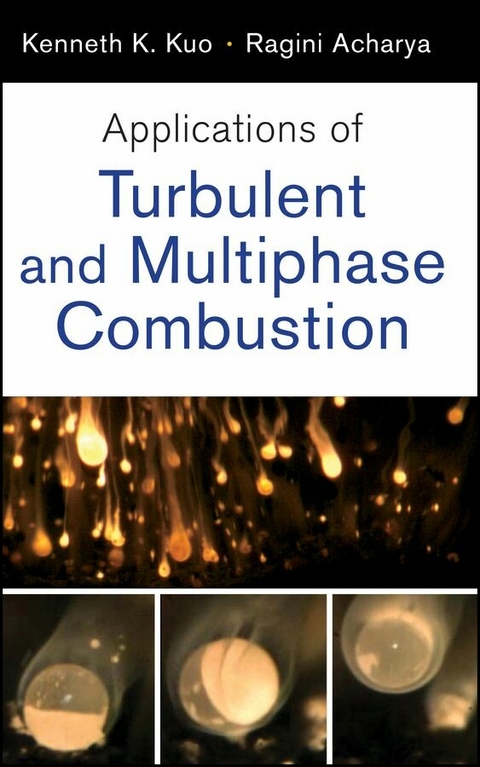
Applications of Turbulent and Multiphase Combustion (eBook)
600 Seiten
John Wiley & Sons (Verlag)
978-1-118-13068-1 (ISBN)
in diverse areas
An understanding of turbulence, combustion, and multiphase
reacting flows is essential for engineers and scientists in many
industries, including power genera-tion, jet and rocket propulsion,
pollution control, fire prevention and safety, and material
processing. This book offers a highly practical discussion of
burning behavior and chemical processes occurring in diverse
materials, arming readers with the tools they need to solve the
most complex combustion problems facing the scientific community
today. The second of a two-volume work, Applications of Turbulent
and Multiphase Combustion expands on topics involving laminar
flames from Professor Kuo's bestselling book Principles of
Combustion, Second Edition, then builds upon the theory discussed
in the companion volume Fundamentals of Turbulent and Multiphase
Combustion to address in detail cutting-edge experimental
techniques and applications not covered anywhere else.
Special features of this book include:
* Coverage of advanced applications such as solid propellants,
burning behavior, and chemical boundary layer flows
* A multiphase systems approach discussing basic concepts before
moving to higher-level applications
* A large number of practical examples gleaned from the authors'
experience along with problems and a solutions manual
Engineers and researchers in chemical and mechanical engineering
and materials science will find Applications of Turbulent and
Multiphase Combustion an indispensable guide for upgrading their
skills and keeping up with this rapidly evolving area. It is also
an excellent resource for students and professionals in mechanical,
chemical, and aerospace engineering.
Kenneth K. Kuo is Distinguished Professor of Mechanical Engineering and Director of the High Pressure Combustion Laboratory (HPCL) in the Department of Mechanical and Nuclear Engineering of the College of Engineering at The Pennsylvania State University.??Professor Kuo established the HPCL and is recognized as one of the leading researchers and experts in propulsion-related combustion. Ragini Acharya is Senior Research Scientist at United Technologies Research Center. She received her PhD from The Pennsylvania State University in 2008. Dr. Acharya's research expertise includes development of multiphysics, multiscale, multiphase models, fire dynamics, numerical methods, and scientific computing. She has authored or coauthored multiple technical articles in these areas.
Chapter 9. Solid Propellants and Their Combustion Characteristics
1. Background of Solid Propellant Combustion
2. Solid-propellant Rocket and Gun Performance Parameters
Chapter 10. Thermal Decomposition and Combustion of Nitramines
1. Thermophysical Properties of Selected Nitramines
2. Polymorphic Forms of Nitramines
Chapter 11. Burning Behavior of Homogeneous Solid Propellants
1. Common Ingredients in Homogeneous Propellant
2. Combustion Wave Structure of a Double-Base Propellant
3. Burning Rate Behavior of a Double-Base Propellant
4. Burning Rate Behavior of Catalyzed Nitrate-Ester Propellants
5. Thermal Wave Structure and Pyrolysis Law of Homogeneous Propellants
6. Modeling and Prediction of Homogeneous Propellant Combustion Behavior
7. Transient Burning Characterization of Homogeneous Solid Propellant
Chapter 12. Chemically Reacting Boundary-Layer Flows
1. Introduction
2. Governing Equations for Two-Dimensional Reacting Boundary-Layer Flows
3. Boundary Conditions
4. Chemical Kinetics
5. Laminar Boundary-Layer Flows With Surface Reactions
6. Laminar Boundary-Layer Flows With Gas-Phase Reactions
7. Turbulent Boundary-Layer Flows with Chemical Reactions
Chapter 13. Ignition And Combustion Of Single Energetic Solid Particles
1. Why energetic Particles Are Attractive for Combustion Enhancement in Propulsion
2. Metal Combustion Classification
3. Metal Particle Combustion Regimes
4. Ignition of Boron Particles
5. Experimental Studies
6. Theoretical Studies of Boron Ignition and Combustion
7. Theoretical of Diffusion Mechanism of Boron Particle Combustion
8. Ignition and Combustion of Boron Particles in Fluorine-Containing Environments
9. Combustion of a Single Aluminum Particle
10. Ignition of Aluminum Particle in a Controlled Post Flame Zone
11. Physical Concepts of Aluminum Agglomerate Formation
12. Combustion Behavior for Fine and Ultrafine Aluminum Particles
13. Potential Usage of Energetic Nano-sized Powders for Combustion and Rocket Propulsion
Chapter 14. Combustion of Solid Particles on Multiphase Flows
1. Void Fraction and Specific Particle Surface Area
2. Mathematical Formulation
3. Method of Characteristics Formulation
4. Ignition Cartridge Results
5. Governing Equations for the Mortar Tube
6. Predictions of Mortar Performance and Model Validation
Appendix A. Useful Vector and Tensor Operations
Appendix B. Constants and Conversion Factors Often Used in Combustion
Appendix C. Naming of Hydrocarbons
Appendix D. Particle Size--US Sieve Size and Tyler Screen Mesh Equivalents
References
| Erscheint lt. Verlag | 13.4.2012 |
|---|---|
| Sprache | englisch |
| Themenwelt | Naturwissenschaften ► Chemie ► Technische Chemie |
| Naturwissenschaften ► Physik / Astronomie ► Thermodynamik | |
| Technik ► Maschinenbau | |
| Schlagworte | Aeronautic & Aerospace Engineering • chemical engineering • Chemische Verfahrenstechnik • Luft- u. Raumfahrttechnik • Maschinenbau • mechanical engineering • thermodynamics • Thermodynamik |
| ISBN-10 | 1-118-13068-5 / 1118130685 |
| ISBN-13 | 978-1-118-13068-1 / 9781118130681 |
| Informationen gemäß Produktsicherheitsverordnung (GPSR) | |
| Haben Sie eine Frage zum Produkt? |
 PDF (Adobe DRM)
Kopierschutz: Adobe-DRM
Adobe-DRM ist ein Kopierschutz, der das eBook vor Mißbrauch schützen soll. Dabei wird das eBook bereits beim Download auf Ihre persönliche Adobe-ID autorisiert. Lesen können Sie das eBook dann nur auf den Geräten, welche ebenfalls auf Ihre Adobe-ID registriert sind.
Details zum Adobe-DRM
Dateiformat: PDF (Portable Document Format)
Mit einem festen Seitenlayout eignet sich die PDF besonders für Fachbücher mit Spalten, Tabellen und Abbildungen. Eine PDF kann auf fast allen Geräten angezeigt werden, ist aber für kleine Displays (Smartphone, eReader) nur eingeschränkt geeignet.
Systemvoraussetzungen:
PC/Mac: Mit einem PC oder Mac können Sie dieses eBook lesen. Sie benötigen eine
eReader: Dieses eBook kann mit (fast) allen eBook-Readern gelesen werden. Mit dem amazon-Kindle ist es aber nicht kompatibel.
Smartphone/Tablet: Egal ob Apple oder Android, dieses eBook können Sie lesen. Sie benötigen eine
Geräteliste und zusätzliche Hinweise
Buying eBooks from abroad
For tax law reasons we can sell eBooks just within Germany and Switzerland. Regrettably we cannot fulfill eBook-orders from other countries.
aus dem Bereich