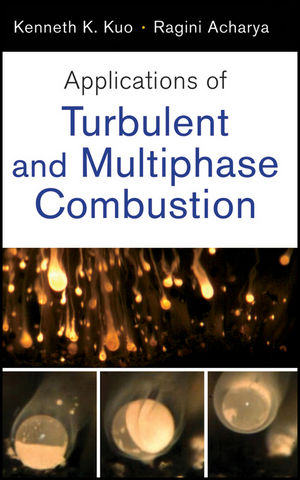
Applications of Turbulent and Multiphase Combustion
John Wiley & Sons Inc (Verlag)
978-1-118-12756-8 (ISBN)
A hands-on, integrated approach to solving combustion problems in diverse areas
An understanding of turbulence, combustion, and multiphase reacting flows is essential for engineers and scientists in many industries, including power genera-tion, jet and rocket propulsion, pollution control, fire prevention and safety, and material processing. This book offers a highly practical discussion of burning behavior and chemical processes occurring in diverse materials, arming readers with the tools they need to solve the most complex combustion problems facing the scientific community today. The second of a two-volume work, Applications of Turbulent and Multiphase Combustion expands on topics involving laminar flames from Professor Kuo's bestselling book Principles of Combustion, Second Edition, then builds upon the theory discussed in the companion volume Fundamentals of Turbulent and Multiphase Combustion to address in detail cutting-edge experimental techniques and applications not covered anywhere else.
Special features of this book include:
Coverage of advanced applications such as solid propellants, burning behavior, and chemical boundary layer flows
A multiphase systems approach discussing basic concepts before moving to higher-level applications
A large number of practical examples gleaned from the authors' experience along with problems and a solutions manual
Engineers and researchers in chemical and mechanical engineering and materials science will find Applications of Turbulent and Multiphase Combustion an indispensable guide for upgrading their skills and keeping up with this rapidly evolving area. It is also an excellent resource for students and professionals in mechanical, chemical, and aerospace engineering.
Kenneth K. Kuo is Distinguished Professor of Mechanical Engineering and Director of the High Pressure Combustion Laboratory (HPCL) in the Department of Mechanical and Nuclear Engineering of the College of Engineering at The Pennsylvania State University.??Professor Kuo established the HPCL and is recognized as one of the leading researchers and experts in propulsion-related combustion. Ragini Acharya is Senior Research Scientist at United Technologies Research Center. She received her PhD from The Pennsylvania State University in 2008. Dr. Acharya's research expertise includes development of multiphysics, multiscale, multiphase models, fire dynamics, numerical methods, and scientific computing. She has authored or coauthored multiple technical articles in these areas.
Preface xvii
1 Solid Propellants and Their Combustion Characteristics 1
1.1 Background of Solid Propellant Combustion 4
1.1.1 Definition of Solid Propellants 4
1.1.2 Desirable Characteristics of Solid Propellants 4
1.1.3 Calculation of Oxygen Balance 5
1.1.4 Homogeneous Propellants 6
1.1.4.1 Decomposition Characteristics of NC 6
1.1.5 Heterogeneous Propellants (or Composite Propellants) 7
1.1.6 Major Types of Ingredients in Solid Propellants 8
1.1.6.1 Description of Oxidizer Ingredients 10
1.1.6.2 Description of Fuel Binders 12
1.1.6.3 Curing and Cross-Linking Agents 14
1.1.6.4 Aging 15
1.1.7 Applications of Solid Propellants 16
1.1.7.1 Hazard Classifications of Solid Propellants 16
1.1.8 Material Characterization of Propellants 16
1.1.8.1 Propellant Density Calculation 16
1.1.8.2 Propellant Mass Fraction � 17
1.1.8.3 Viscoelastic Behavior of Solid Propellants 17
1.1.9 Thermal Profile in a Burning Solid Propellant 18
1.1.9.1 Surface and Subsurface Temperature Measurements of Solid Propellants 18
1.1.9.2 Interfacial Energy Flux Balance at the Solid Propellant Surface 20
1.1.9.3 Energy Equation for the Gas Phase 21
1.1.9.4 Burning Rate of Solid Propellants 23
1.1.9.5 Temperature Sensitivity of Burning Rate 25
1.1.9.6 Measurement of Propellant Burning Rate by Using a Strand Burner 26
1.1.9.7 Measurement of Propellant Burning Rate by Using a Small-Scale Motor 37
1.1.9.8 Burning Rate Temperature Sensitivity of Neat Ingredients 41
1.2 Solid-Propellant Rocket and Gun Performance Parameters 43
1.2.1 Performance Parameters of a Solid Rocket Motor 44
1.2.1.1 Thrust of a Solid Rocket Motor 44
1.2.1.2 Specific Impulse of a Solid Rocket Motor 48
1.2.1.3 Density-Specific Impulse 56
1.2.1.4 Effective Vacuum Exhaust Velocity 58
1.2.1.5 Characteristic Velocity C ∗ 58
1.2.1.6 Pressure Sensitivity of Burning Rate 59
1.2.1.7 Thrust Coefficient Efficiency 60
1.2.1.8 Effect of Pressure Exponent on Stable/Unstable Burning in Solid Rocket Motor 60
1.2.2 Performance Parameters of Solid-Propellant Gun Systems 61
1.2.2.1 Energy Balance Equation 64
1.2.2.2 Efficiencies of Gun Propulsion Systems 67
1.2.2.3 Heat of Explosion (�Hex o) 69
1.2.2.4 Relative Quickness, Relative Force, and Deviations in Muzzle Velocity 70
1.2.2.5 Dynamic Vivacity 71
2 Thermal Decomposition and Combustion of Nitramines 72
2.1 Thermophysical Properties of Selected Nitramines 76
2.2 Polymorphic Forms of Nitramines 78
2.2.1 Polymorphic Forms of HMX 80
2.2.2 Polymorphic Forms of RDX 82
2.3 Thermal Decomposition of RDX 88
2.3.1 Explanation of Opposite Trends on α- and β-RDX Decomposition with Increasing Pressure 90
2.3.2 Thermal Decomposition Mechanisms of RDX 92
2.3.2.1 Homolytic N–N Bond Cleavage 92
2.3.2.2 Concerted Ring Opening Mechanism of Rdx 94
2.3.2.3 Successive HONO Elimination Mechanism of RDX 96
2.3.2.4 Analysis of Three Decomposition Mechanisms 104
2.3.3 Formation of Foam Layer Near RDX Burning Surface 106
2.4 Gas-Phase Reactions of RDX 109
2.4.1 Development of Gas-Phase Reaction Mechanism for RDX Combustion 111
2.5 Modeling of RDX Monopropellant Combustion with Surface Reactions 125
2.5.1 Processes in Foam-Layer Region 126
2.5.2 Reactions Considered in the Foam Layer 128
2.5.3 Evaporation and Condensation Consideration for Rdx 128
2.5.4 Boundary Conditions 130
2.5.5 Numerical Methods Used for RDX Combustion Model with Foam Layer 131
2.5.6 Predicted Flame Structure 132
3 Burning Behavior of Homogeneous Solid Propellants 143
3.1 Common Ingredients in Homogeneous Propellants 147
3.2 Combustion Wave Structure of a Double-Base Propellant 148
3.3 Burning Rate Behavior of a Double-Base Propellant 149
3.4 Burning Rate Behavior of Catalyzed Nitrate-Ester Propellants 155
3.5 Thermal Wave Structure and Pyrolysis Law of Homogeneous Propellants 158
3.5.1 Dark Zone Residence Time Correlation 166
3.6 Modeling and Prediction of Homogeneous Propellant Combustion Behavior 167
3.6.1 Multi-Ingredient Model of Miller and Anderson 171
3.6.1.1 NC: A Special Case Ingredient 172
3.6.1.2 Comparison of Calculated Propellant Burning Rates with the Experimental Data 175
3.7 Transient Burning Characterization of Homogeneous Solid Propellant 187
3.7.1 What is Dynamic Burning? 188
3.7.2 Theoretical Models for Dynamic Burning 190
3.7.2.1 dp/dt Approach 193
3.7.2.2 Flame Description Approach 194
3.7.2.3 Zel’dovich Approach 194
3.7.2.4 Characterization of Dynamic Burning of JA2 Propellant Using the Zel’dovich Approach 196
3.7.2.5 Experimental Measurement of Dynamic Burning Rate of JA2 Propellant 201
3.7.2.6 Novozhilov Stability Parameters 202
3.7.2.7 Novozhilov Stability Parameters for JA 2 Propellant 203
3.7.2.8 Some Problems Associated with Dynamic Burning Characterization 205
3.7.2.9 Factors Influencing Dynamic Burning 207
Chapter Problems 208
4 Chemically Reacting Boundary-Layer Flows 209
4.1 Introduction 210
4.1.1 Applications of Reacting Boundary-Layer Flows 211
4.1.2 High-Temperature Experimental Facilities Used in Investigation 211
4.1.3 Theoretical Approaches and Boundary-Layer Flow Classifications 212
4.1.4 Historical Survey 212
4.2 Governing Equations for Two-Dimensional Reacting Boundary-Layer Flows 216
4.3 Boundary Conditions 221
4.4 Chemical Kinetics 224
4.4.1 Homogeneous Chemical Reactions 224
4.4.2 Heterogeneous Chemical Reactions 226
4.5 Laminar Boundary-Layer Flows with Surface Reactions 229
4.5.1 Governing Equations and Boundary Conditions 229
4.5.2 Transformation to (ξ,η) Coordinates 229
4.5.3 Conditions for Decoupling of Governing Equations and Self-Similar Solutions 232
4.5.4 Damköhler Number for Surface Reactions 233
4.5.5 Surface Combustion of Graphite Near the Stagnation Region 234
4.6 Laminar Boundary-Layer Flows With Gas-Phase Reactions 239
4.6.1 Governing Equations and Coordinate Transformation 239
4.6.2 Damköhler Number for Gas-Phase Reactions 240
4.6.3 Extension to Axisymmetric Cases 242
4.7 Turbulent Boundary-Layer Flows with Chemical Reactions 243
4.7.1 Introduction 243
4.7.2 Boundary-Layer Integral Matrix Procedure of Evans 243
4.7.2.1 General Conservation Equations 243
4.7.2.2 Molecular Transport Properties 247
4.7.2.3 Turbulent Transport Properties 251
4.7.2.4 Equation of State 256
4.7.2.5 Integral Matrix Solution Procedure 256
4.7.2.6 Limitations of the BLIMP Analysis 257
4.7.3 Marching-Integration Procedure of Patankar and Spalding 257
4.7.3.1 Description of the Physical Model 258
4.7.3.2 Conservation Equations for the Viscous Region 258
4.7.3.3 Modeling of the Gas-Phase Chemical Reactions 259
4.7.3.4 Governing Equations for the Inviscid Region 260
4.7.3.5 Boundary Conditions 261
4.7.3.6 Near-Wall Treatment of ˜k and ˜ε 262
4.7.3.7 Coordinate Transformation and Solution Procedure of Patankar and Spalding 263
4.7.3.8 Comparison of Theoretical Results with Experimental Data 266
4.7.4 Metal Erosion by Hot Reactive Gases 272
4.7.5 Thermochemical Erosion of Graphite Nozzles of Solid Rocket Motors 281
4.7.5.1 Graphite Nozzle Erosion Minimization Model and Code 283
4.7.5.2 Governing Equations 286
4.7.5.3 Heterogeneous Reaction Kinetics 290
4.7.5.4 Results from the GNEM Code 293
4.7.5.5 Nozzle Erosion Rate by Other Metallized Propellant Products 312
4.7.6 Turbulent Wall Fires 316
4.7.6.1 Development of the Ahmad-Faeth Correlation 321
5 Ignition and Combustion of Single Energetic Solid Particles 330
5.1 Why Energetic Particles Are Attractive for Combustion Enhancement in Propulsion 335
5.2 Metal Combustion Classification 336
5.3 Metal Particle Combustion Regimes 341
5.4 Ignition of Boron Particles 344
5.5 Experimental Studies 351
5.5.1 Gasification of Boron Oxides 352
5.5.2 Chemical Kinetics Measurement 353
5.5.3 Boron Ignition Combustion in a Controlled Hot Gas Environment 354
5.6 Theoretical Studies of Boron Ignition and Combustion 362
5.6.1 First-Stage Combustion Models 362
5.6.2 Second-Stage Combustion Models 365
5.6.3 Chemical Kinetic Mechanisms 365
5.6.4 Methods for Enhancement of Boron Ignition 367
5.6.5 Verification of Diffusion Mechanism of Boron Particle Combustion 369
5.6.6 Chemical Identification of the Boron Oxide Layer 371
5.7 Theoretical Model Development of Boron Particle Combustion 372
5.7.1 First-Stage Combustion Model 372
5.7.2 Second-Stage Combustion Model 377
5.7.3 Comparison of Predicted and Measured Combustion Times 381
5.8 Ignition and Combustion of Boron Particles in Fluorine-Containing Environments 384
5.8.1 Multidiffusion Flat-Flame Burner 385
5.8.2 Test Conditions 387
5.8.3 Experimental Results and Discussions 388
5.8.4 Surface Reaction of (BO) n with HF (g) 393
5.8.5 Surface Reaction of (BO) n with F (g) 394
5.8.6 Governing Equations During the First-Stage Combustion of Boron Particles 395
5.8.7 Model for the “Clean” Boron Consumption Process (Second-Stage Combustion) 396
5.8.7.1 Chemical Kinetics During Second-Stage Combustion 397
5.8.7.2 Consideration of Both Kinetics- and Diffusion-Controlled Second-Stage Combustion 402
5.8.7.3 Governing Equations During the Second-Stage Combustion of Boron Particles 403
5.8.8 Numerical Solution 403
5.8.8.1 Comparison with Experimental Data in Oxygen-Containing (Nonfluorine) Environments 404
5.8.8.2 Comparison with Experimental Data and Model Predictions in Fluorine-Containing Environments 405
5.9 Combustion of a Single Aluminum Particle 410
5.9.1 Background 413
5.9.2 Physical Model 414
5.9.3 Aluminum-Combustion Mechanism 417
5.9.4 Condensation Aspect of Model of Beckstead et al. (2005) 419
5.9.5 General Mathematical Model 422
5.9.6 Boundary Conditions 424
5.9.7 D n Law in Aluminum Combustion 429
5.10 Ignition of Aluminum Particle in a Controlled Postflame Zone 437
5.11 Physical Concepts of Aluminum Agglomerate Formation 439
5.11.1 Evolution Process of Condensed-Phase Combustion Products 440
5.12 Combustion Behavior for Fine and Ultrafine Aluminum Particles 443
5.12.1 10 μm Aluminum Particle—Early Transitional Structure 444
5.12.2 100 nm Aluminum Particle—Late Transitional Structure 446
5.13 Potential Use of Energetic Nanosize Powders for Combustion and Rocket Propulsion 447
Chapter Problems 452
Project No. 1 452
Project No. 2 454
6 Combustion of Solid Particles in Multiphase Flows 456
6.1 Void Fraction and Specific Particle Surface Area 462
6.2 Mathematical Formulation 463
6.2.1 Formulation of the Heat Equation for a Single Particle 469
6.3 Method of Characteristics Formulation 472
6.3.1 Linearization of the Characteristic Equations 476
6.4 Ignition Cartridge Results 477
6.5 Governing Equations for the Mortar Tube 484
6.5.1 Initial Conditions 488
6.5.1.1 Initial Condition for Velocity 488
6.5.1.2 Initial Condition for Porosity 488
6.5.1.3 Initial Condition for Temperature and Pressure 488
6.5.2 Boundary Conditions 488
6.5.2.1 On the Surface of Ignition Cartridge in Vent-Hole Region 489
6.5.2.2 In the Fin Region 489
6.5.2.3 The z-direction Boundary Conditions 489
6.5.3 Numerical Methods for Mortar Region Model 490
6.6 Predictions of Mortar Performance and Model Validation 491
6.7 Approximate Riemann Solver: Roe-Pike Method 496
6.8 Roe’s Method 499
6.9 Roe-Pike Method 501
6.10 Entropy Condition and Entropy Fix 502
6.11 Flux Limiter 503
6.12 Higher Order Correction 504
6.13 Three-Dimensional Wave Propagation 504
Appendix A: Useful Vector and Tensor Operations 507
Appendix B: Constants and Conversion Factors Often Used in Combustion 534
Appendix C: Naming of Hydrocarbons 538
Appendix D: Particle Size–U.S. Sieve Size and Tyler Screen Mesh Equivalents 541
Bibliography 544
Index 571
| Verlagsort | New York |
|---|---|
| Sprache | englisch |
| Maße | 163 x 243 mm |
| Gewicht | 948 g |
| Themenwelt | Naturwissenschaften ► Chemie ► Technische Chemie |
| Technik ► Maschinenbau | |
| ISBN-10 | 1-118-12756-0 / 1118127560 |
| ISBN-13 | 978-1-118-12756-8 / 9781118127568 |
| Zustand | Neuware |
| Informationen gemäß Produktsicherheitsverordnung (GPSR) | |
| Haben Sie eine Frage zum Produkt? |
aus dem Bereich